Torture! Or as some call it “enhanced interrogation”, where the only thing being “enhanced” is your chance of dying. And that was doubly true in the past. Throughout all of history, us humans have developed unique and creative methods of maiming and killing each other in ways that cause unimaginable amounts of pain.
And that’s what we’re covering today. We’re going to delve into the nasty parts of the past where others dare not go, to look at the different instances of torture that our species have used to butcher each other, showing as much regard for their fellow man as I have for bottles of shampoo.
Get ready to have your stomach well and truly churned.
Key Takeaways
- Historical torture methods were often designed to cause immense pain and suffering.
- Torture devices like the rack, the wheel, and thumbscrews were used extensively in medieval Europe.
- Some torture methods, such as rat torture and scaphism, involved prolonged agony and horrific deaths.
- Impalement was a particularly brutal and long-lasting method of execution used across different cultures and time periods.
- Many of these torture methods were used relatively recently, within the last few hundred years.
Number 10 – Rat Torture
One of the simplest methods of torture perhaps ever concocted, is also one of the cruellest.
First developed by the Chinese and Romans, but later perfected in Medieval Europe, “rat torture” as it’s known, involved having a person lay on their back, usually strapped to a table when one or several rats were placed inside half a cage upon the torso. The cage would then be heated either by a flame or hot coals and the rats, desperate to escape the heat, would attempt to burrow through the victim’s stomach to escape.
It was used effectively during the Dutch revolt as a form of torture to gain information, with those suffering from it being quick to give up what they knew or be eaten alive. If someone was not supposed to survive the ordeal, some sources state that the rats were made hungry first and cuts would be made on the person’s torso, which then combined with the heat would cause the rats to feast as they burrowed inside, slowly killing the person over hours or days of agony as they ate away at the victim’s intestines. Unless stopped quickly, infections like peritonitis would also see this method kill people after the fact.
Of all the torture methods humans have invented, few are as horrific as the ones left up to the whims of hungry, frightened animals.
Number 9 – The Rack
One of the most infamous torture methods ever devised was known as the rack. Utilised for over 2,000 years as a brutal instrument of pain, its iconic design struck fear into prisoners and criminals from antiquity to the Middle Ages.
The most common design features a square frame raised slightly off the ground, with rollers attached to both ends. Rope or chains would be attached to the rollers via a rachet mechanism and when the victim was placed upon it, torturers began the stretching process. As the rollers began tightening, it would force a person’s joints to extend.
Soon they would begin to pop and eventually would completely dislocate. Muscles in the arms and legs would be rendered completely ineffective and if stretched enough, it could even tear entire limbs off. That’s not all, the rack was horrendous because it could also be used as a simple restraint, meaning it could be combined with other forms of torture like having fingernails ripped out or being burned with torches.
One version even has a roller in the middle with metal spikes on it, in this variation the victim is laid face down and as they’re stretched, they’re slowly gored to death by the rotating mechanism.
It’s believed to have originated in ancient Greece where Herostratus, an arsonist who burned down the Temple of Artemis around 400 BC was stretched on the rack until he died. Almost two millennia later, Guy Fawkes was racked after his infamous gunpowder plot failed in the late 1500s. But incredibly, it would not be outlawed in Britain until 1708.
Number 8 – Breaking on the Wheel
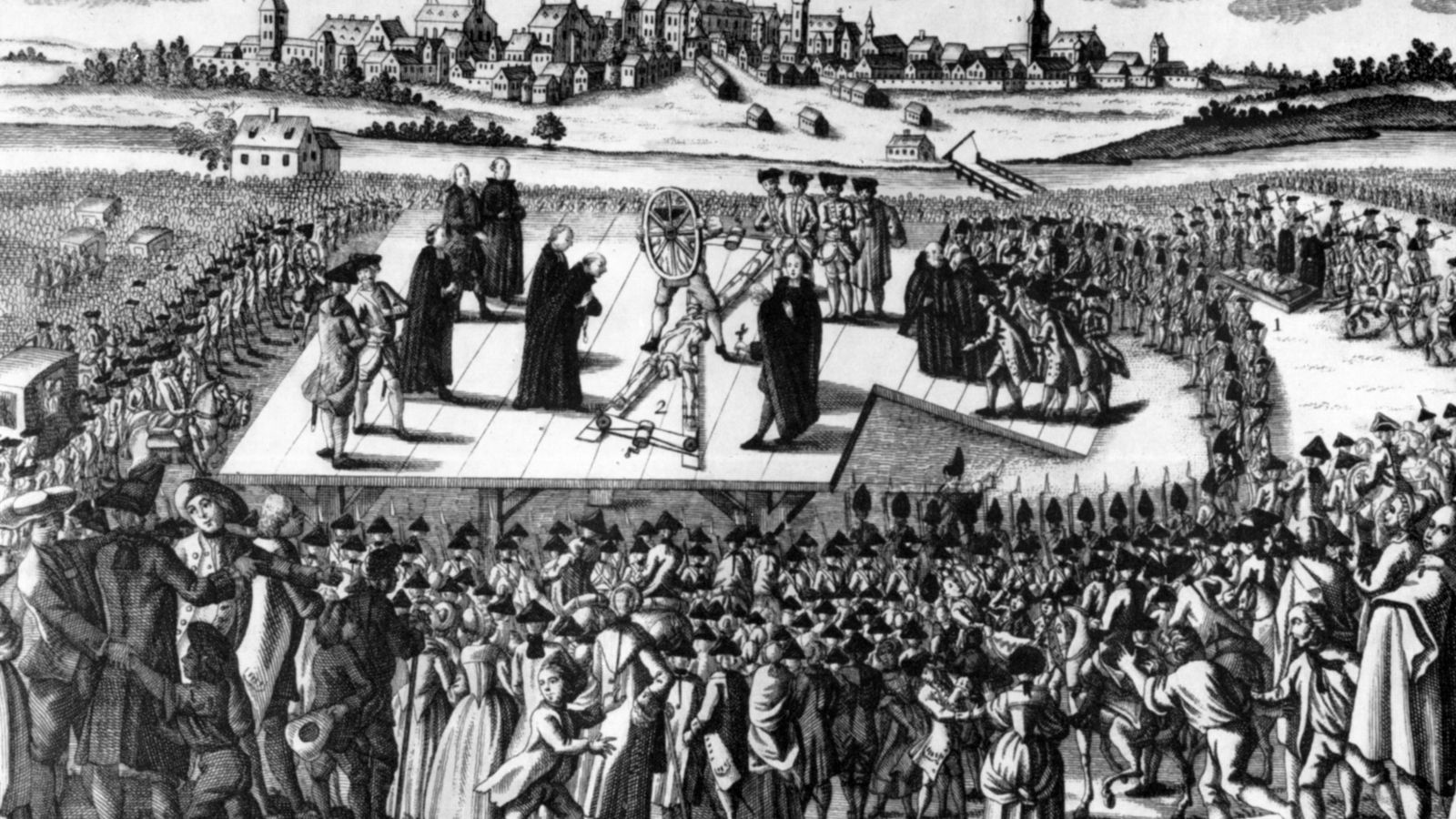
Of all the execution methods and torture methods that existed in medieval Europe, breaking on the wheel had to be among the worst of the worst. It was not just an execution, but by the time the torture was over, if you weren’t already dead you’d be practically begging someone to put you out of your misery.
Reserved for some of the worst crimes that people could commit, executioners would take a large wagon wheel, and tie their victim’s limbs to it, before bludgeoning them with cudgels, clubs or metal bars, whatever could be used to ensure that bones were shattered and joints were dislocated. Most executioners would start with the arms and legs before moving inwards to finish the culprit off with a blow to the head or spine.
After the victim was dead, they would leave the body on the wheel in a public place as a warning to others, sometimes placing it on a pole and hoisting it into the air for people to view as a gruesome display of the state’s power. But sometimes, the victims would survive the initial torture and simply be left to die in agony on the wheel afterwards.
It was popularised in Europe’s Middle Ages but even saw use as far back as ancient Rome. With the Roman historian Titus Flavius describing a similar execution, quoting here; “They fixed [the prisoner] about a great Wheel, whereof the noble-hearted youth had all his joints dislocated and all his limbs broken…the whole Wheel was stained with his blood.”
It has been a torture and execution mainstay then for over a millennium, the last use of the wheel in Europe was in the late 18th century but apparently it saw continuous use until the 19th in South America. Grizzly.
Number 7 – The Spanish Boot
For having such an amusing name, this method of torture was anything but. The boot, sometimes known as the Spanish Boot or the Malay Boot, was a kind of device in a range of designs all with the same goal in mind, to crush the leg and cause immense pain to the person wearing it.
The most basic kind of boot was first devised in Scotland, where rawhide was wettened and bound around the victim’s leg, before heating it over a fire, causing it to constrict, and placing immense pressure on the leg. But the design gradually progressed as it travelled. A common version involved wooden planks fastened around the leg going from the ankle to the knee. Then wooden stakes would be driven into the top of the boot using a mallet, as each stake was driven in, the pressure on the leg mounted, causing severe pain, trapped nerves, broken bones, and even loss of consciousness.
Metal versions were also eventually devised that could be tightened with screws, with spikes on the inside to shred the leg as the pressure grew. It was used as a means to get confessions out of criminals and sometimes was made to the exact specifications of the person in question’s leg. Not the kind of shoe fitting you’d like to attend. It was utilised well into the 18th century in parts of Europe.
In The Free Church of Scotland, Charles McCrie wrote in 1894 that; “So excruciating were the agonies of the victims and so piercing their shrieks that even hardened officials hastened out of the room when these engines of torture were brought in, and it was found necessary to pass an order of Council that members keep their seats while ‘the question’ was being thus ‘put.’”
Number 6 – The Scavenger’s Daughter
It must have been an interesting time in the Middle Ages to be a torture engineer, constantly having to come up with new and inventive ways to harm people. For example, what if someone said “you know the rack?” what if we built something that was just as cruel but did the exact opposite?”
Well, you’d end up with the “scavenger’s daughter.”
Sometimes going by “Skeffington’s Gyves”, named after it’s inventor, Sir William Skeffington, the device’s concept was simple. It was a metal hoop or an A-frame that was designed to keep the victim hunched over. The head, arms and feet would be placed into the device at the top, middle and bottom points before tightening it, bringing a person’s knees up and forcing their head down. This forced the body into a highly uncomfortable and compressed position, with almost no freedom to move whatsoever.
In the hooped designs, the body is also forced to kneel in a praying position by placing the main element over the spine rather than the neck, which emphasised the humiliation of the punishment, on top of making it hard to breath, and causing muscle cramps. Some designs even incorporated spikes that pushed into a person’s body, further dissuading movement. Those subjected to it were said to suffer lasting physical and psychological trauma.
It was mainly used in medieval England, particularly in the Tudor era. English Catholic priest Luke Kirby was subjected to the gyves in 1580, writing “I am bound and charged with gyves, yet am I loose and unbound towards God.”
Watch the Video
Open Video
Video Briefing
10 Absolutely Brutal Historical Torture Methods That Will Haunt You
Number 5 – Thumbscrews
Have you ever heard of those Chinese finger traps? The ones that you played with as a kid, and predictably got your fingers stuck in, causing you to panic? Well imagine that, but much, much worse.
Thumbscrews, sometimes called “thumbekins” or “pilliwincks” were a common design of torture device seen throughout medieval Europe designed to provide a small, but highly effective way of delivering pain. Designs varied but the common elements included a small bracket housing two pieces of metal with a screw running through the centre.
An unfortunate victim’s thumbs would be placed between the metal pieces before the screw was slowly tightened, squeezing them together, crushing the thumbs, and causing excruciating pain. They saw use throughout Europe with specific references and examples to them during the Scottish Middle Ages, but also in France, Spain and Russia throughout the 15th-18th centuries. Variations even included pointed spikes to pierce one’s flesh, as if having your digits flattened wasn’t painful enough.
They were mainly used as a method of extracting information or as punishment for minor offences, although the British Royal Armory Museum also reports that they were used in the asylum known as “Bedlam” when ordinary methods to cure violent patients wouldn’t work. A truly ghastly invention, which was able to dose out extreme anguish for a device so small. Perfect for the torturer on the go.
Number 4 – Molten Gold Cocktail
Yes, it’s not just something that happened in that one episode of game of thrones, being executed via molten gold was actually a thing that has happened in history. Except reality is always worse than whatever the entertainment industry can dream up. As molten gold was rarely poured over a person’s head such as in George R. R. Martin’s masterwork, but instead was poured down a person’s throat.
Now this is horribly painful and can kill you in about 100 different ways. Molten gold reaching the stomach, throat and lungs would blister them and send you into shock before killing you in short order, the steam itself from your own body’s moisture might cook you from the inside or make your organs burst, and if you manage to survive all of that somehow, the gold solidifying in your throat would cause you to suffocate. It is a brutal way to die, often withheld for the greediest condemned as a form of irony.
Several people have met their end this way. The most modern case was in 1599, when Spanish conquistadors tried to levy taxes against a group of Jivaro Indians who lived in Ecuador. The Spanish governor of Logrono found out first hand just how the natives wanted to deliver him his gold. It’s also reported that Manius Aquillius was executed by Mithradates in the same way all the way back in 89 BC.
Some are sceptical of how common this kind of execution really was, however. The story of the Jivaro Indians may have been concocted to justify later atrocities made against the natives by the Spanish, whilst accounts claiming that Marcus Licinius Crassus was executed just like Aquillius was, have been deemed unreliable.
Ultimately gold is valuable and there are many humiliating and ironic ways to end somebody’s life without wasting it in this manner or causing a right old mess trying to recover it. It’s not practical, but it is flashy and effective.
Number 3 – Keelhauling
Necessity is the mother of invention. It’s easy to torture and maim somebody when you have access to a castle, a dungeon and all the sadistic equipment you could ever want. But what about on the open water when all you have is a ship?
Well, unbelievably, it might be even worse.
Keelhauling is an old practice said mostly to be used by navies and pirates in the 17th and 18th centuries, usually to punish wayward sailors. The victim would first be suspended by a rope from the mast of the ship that was held taut by other sailors, with weights attached to the victim’s legs. When the sailors released the rope, the victim would be plunged into the water down one side of the ship and underneath the bottom, known as the keel, before being hoisted back up on the other side.
Now obviously, being dunked into freezing cold seawater isn’t pleasant, but that would be the least of one’s worries. The underside of a ship was often covered in hard barnacles whose edges would slash the victim’s body as they were dragged underneath it. Combine that with the saltwater and lack of oxygen, and you have a highly gruesome experience.
However, it’s clear that keelhauling was supposed to be just a punishment and not an execution, with the archived Universal Dictionary of the Marine from 1780 stating that the victims would get “sufficient intervals to recover from the sense of pain”. How kind of them.
Two Egyptian sailors were keelhauled in 1882 according to the UK’s parliamentary record for looting and murder, whilst one famous painting depicts an admiral’s surgeon hoisted just before the grizzly deed. This is one for time travellers to avoid at all costs.
Number 2 – Scaphism
To see one of the most disgusting torture and execution methods ever devised, you have to go all the way back to ancient Persia and scaphism, also referred to as “the boats”.
The first mention of scaphism comes from the Greek-Roman philosopher Plutarch, who stipulated that this particularly gruesome death went as follows.
The victim, usually who had been prosecuted for what was seen as a really bad crime, would be placed either within the hollowed-out trunk of a tree, or as per the name, between two boats fashioned together, with holes cut just large enough for their hands and head to poke out the top and sides. Then the contraption was placed on its back, and with the victim unable to move, the horror began. Copious amounts of milk and honey would be force-fed into the victim’s mouth. Such a concoction would cause significant distress in the stomach, causing diarrhoea and the sweet, disgusting mess would attract insects and vermin that would slowly eat the victim alive in a torture that could be prolonged for an awfully long time.
Plutarch stated that Mithridates, a Persian soldier, not the same one from the gold example, was sentenced to scaphism for murdering a man named Cyrus the younger. He endured this fate for 17 whole days before his death.
Unlike with thumbscrews for example, there is no evidence remaining of anyone who endured scaphism and so there are sceptics of its existence. It could be a story made up by the Greeks to make the Persians appear barbaric, and it certainly does, but considering the other horrendous ancient methods of torture and execution that existed for certain in this very video, scaphism would not have been out of place.
Number 1 – Impalement
This one’s just sadistic. It’s also one of the longest-running execution methods humanity has ever devised.
Impalement isn’t necessarily what you would expect. In the modern day, one may hear “impalement” and assume a stake thrust through the torso. A horrible and traumatic way to die, yes, but that would be a mercy compared to what impalement actually was.
You see impalement wasn’t a sideways affair… but an… “upwards” one. Culprits of various crimes would have a sharp, long wooden stake inserted into them from beneath, they would then be raised up, allowing gravity to push the stake into their body until they died, which caused untold agony for the hours or even days it would take to succumb. After the person died, the stake would then continue to penetrate the person’s body, sometimes reappearing through the neck, chest or even the mouth. To prolong the suffering, a blunter stake would be used, and various methods would be utilised to stop a person sinking onto it too quickly.
Nobody did impalement quite like Vlad, the Wallachian ruler who in the 13th century impaled 20,000 people. But impalement has quite a long history. One of the earliest records of it was in the 18th century BC in Babylon where King Hammurabi ordered a woman to be executed via impalement for killing her husband. It was a common execution method for women.
It’s also not that recently that it was last documented. During the Armenian genocide of the 19th century, Aurora Mardiganian, a survivor, saw women assaulted and impaled at the hands of the Ottoman Empire. In a biographical film of her life, these events were deemed so horrific that the impalement was replaced with crucifixion. It is truly one of the worst ways to die.
Conclusion
And that was 10 methods of historically horrible torture. One of the most mind-bending things about these methods is just how recently some were still being used, even up to only a couple of hundred years ago. We like to think that humanity has long since moved passed this kind of brutality, but the reality is very different. In the darkest recesses of the world, where nobody can see, things just as bad as what we’ve described today are likely happening to people all over the planet.
Let this video be a stark reminder to you all that regardless of time period, location or technology. People are cruel.
Thank you for watching.
Key Takeaways
- Historical torture methods were often designed to cause immense pain and suffering.
- Torture devices like the rack, the wheel, and thumbscrews were used extensively in medieval Europe.
- Some torture methods, such as rat torture and scaphism, involved prolonged agony and horrific deaths.
- Impalement was a particularly brutal and long-lasting method of execution used across different cultures and time periods.
- Many of these torture methods were used relatively recently, within the last few hundred years.
SideProjects Editors
The SideProjects editorial team researches, fact-checks, and structures explainers about the lesser-known tales, side narratives, and spin-offs behind major historical and contemporary subjects.
Frequently Asked Questions
What is rat torture?
Rat torture involved strapping a person to a table and placing one or several rats inside a half cage on their torso. The cage was then heated, causing the rats to burrow through the victim’s stomach to escape the heat.
How was the rack used as a torture device?
The rack featured a square frame with rollers and a ratchet mechanism. Victims were placed on the rack, and as the rollers tightened, their joints would extend, pop, and eventually dislocate, causing immense pain and potential limb dismemberment.
What was breaking on the wheel?
Breaking on the wheel involved tying a victim’s limbs to a large wagon wheel and bludgeoning them with cudgels or metal bars to shatter bones and dislocate joints. The victim was often left to die in agony on the wheel.
What was the Spanish Boot?
The Spanish Boot was a torture device that involved binding a victim’s leg with rawhide or wooden planks and then constricting it with heat or wooden stakes driven in with a mallet, causing severe pain, broken bones, and sometimes loss of consciousness.
How did thumbscrews work?
Thumbscrews were small devices with a screw running through two metal pieces. A victim’s thumbs were placed between the metal pieces, and the screw was tightened, crushing the thumbs and causing excruciating pain.
What was the Scavenger’s Daughter?
The Scavenger’s Daughter was a metal hoop or A-frame device that forced the victim into a hunched, compressed position with their head, arms, and feet secured. This caused muscle cramps, difficulty breathing, and psychological trauma.
What was keelhauling?
Keelhauling involved suspending a victim from a ship’s mast with weights attached to their legs and then releasing the rope, causing the victim to be dragged underwater along the ship’s keel, which was often covered in barnacles.
What was scaphism?
Scaphism involved placing a victim in a hollowed-out tree trunk or between two boats with holes for their head and hands. They were then force-fed milk and honey, attracting insects and vermin to slowly eat them alive.
What was impalement?
Impalement involved inserting a sharp, long wooden stake into a victim from beneath and raising them up, allowing gravity to push the stake into their body until they died, causing prolonged agony.
When was the rack outlawed in Britain?
The rack was not outlawed in Britain until 1708.