

If you’ve ever been intrigued by the mysteries of outer space, or if you’ve ever felt a sense of wonder looking up at the night sky, then you are in for a treat. Today we’re bringing you no less than one hundred facts about the cosmos, and they’ve been carefully selected to be quite different from the types of basic space facts you would normally find on the internet, ensuring that there is something new to be learned for even the most avid of space enjoyers. As we dive into the secrets of the Solar System, the mysteries of the Milky Way, and the strangest objects that might hypothetically exist, we guarantee that by the end of this article, your mind will be blown.
Early galaxies were banana shaped.
When we look at the universe around us, we see that most galaxies fall into a few categories. Spiral galaxies, like our Milky Way, are incredibly common, and often feature a bar structure across the center. Elliptical galaxies, shaped like large spheres or ovals, are less common, but still plentiful. There are also lenticular galaxies, which are sort of a mix between spiral and elliptical, and then there’s irregular galaxies, which don’t really have a defined shape.
Of course, there are a few other types and some subcategories, but these are the main ones that you’re going to see when you peer into a galaxy cluster.
Key Takeaways
- Early galaxies were banana-shaped, not spherical or disc-like.
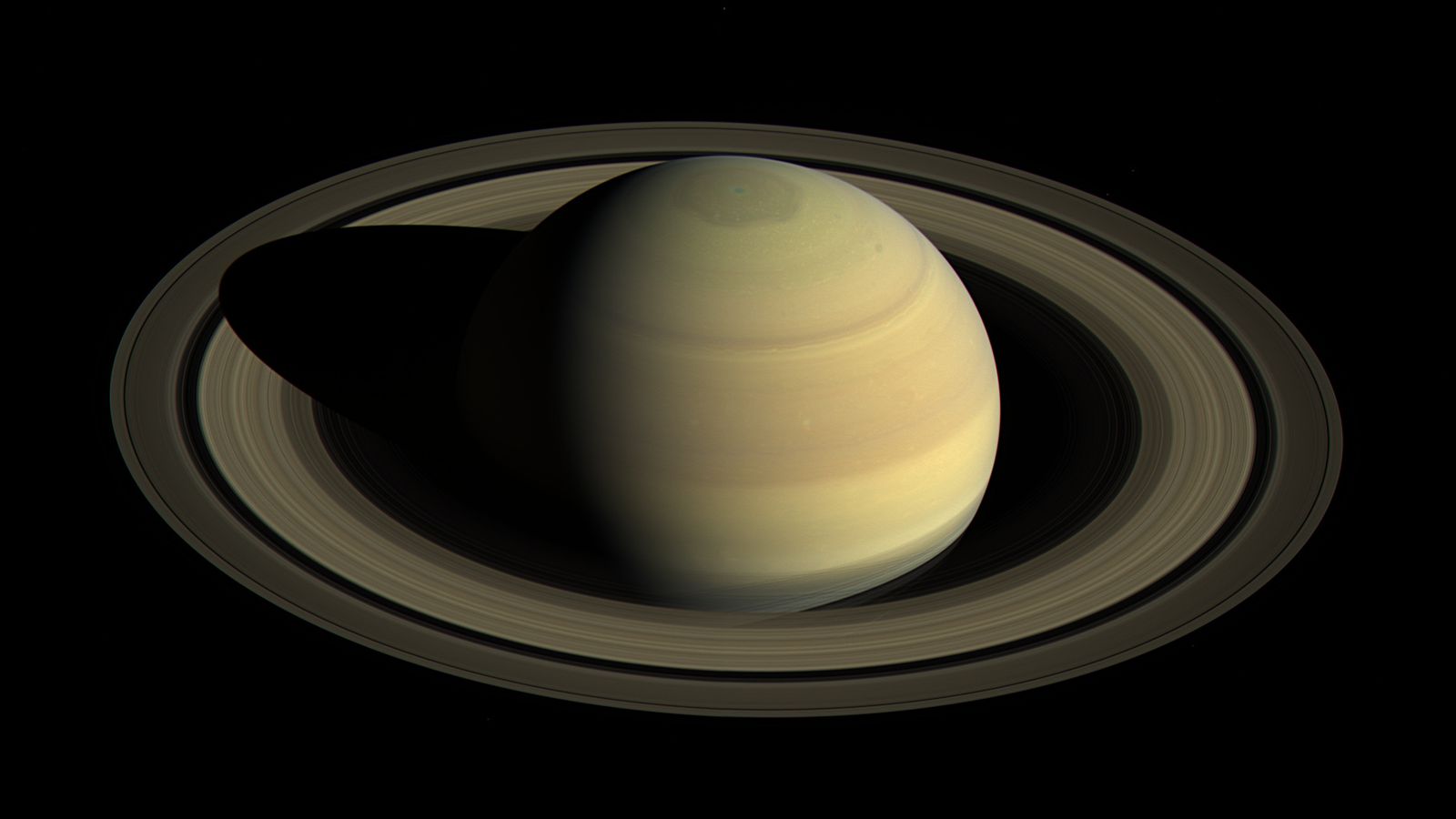
- Saturn has a hexagonal storm larger than Earth, with unknown origins.
- Earth has the best view of Hoag’s object, a rare ring galaxy.
- Moons can have their own moons, called moonmoons or moonitos.
- The Milky Way might be bigger than Andromeda, contrary to prior beliefs.
Which is why when astronomers think of the first galaxies to arise in the early universe, for a long time they figured that these shapes were just as common then as they are now, but a recent discovery from the James Webb Space Telescope has us questioning this assumption.
Analyzing new photos of nearly 4,000 newborn galaxies from around 500 million years after the Big Bang, researchers came to the shocking conclusion that they weren’t discs or spheres, but oddly banana shaped, confirming an earlier finding from Hubble which described them as pickle-shaped.
We don’t yet have an explanation for why they may have formed this way, but further research may give us insight into galaxy formation and some critical clues about the elusive nature of dark matter and how it shapes galaxy structure over time.
Saturn has a hexagonal storm larger than earth.
You may have heard of the storm visible on the surface of Jupiter, the Great Red Spot. Its distinct color and immense size make it an iconic part of our solar system, but what’s less well-known is that its neighbor Saturn also sports a massive storm, only Saturn’s is far more perplexing since its shaped like an almost perfect hexagon over the planet’s north pole. The hexagon is so large that each of its sides is longer than the diameter of the entire earth, giving it enough size that, depending on the planet’s location relative to us, the hexagon can even be seen by amateur astronomers with backyard-sized telescopes.
Aside from things like crystalline structures, neat polygons like this are not commonly seen in nature, especially on this scale, and so this discovery understandably left astronomers scratching their heads when it was first seen by the Voyager mission in 1981. Things got even stranger in the 2000s, when the Cassini mission watched as the hexagon’s color gradually shifted from mostly blue to a more golden-orange. We’ve also since confirmed that Saturn’s south pole does not have a hexagon.
There are a number of hypotheses attempting to explain this enigma, all of which involve highly complicated math relating to fluid dynamics, vortex formation, and anticyclonic shielding that we won’t pretend to understand, but the takeaway is that we’ve yet to come to a consensus. As for the color shift, the most likely explanation is a change in Saturn’s seasons creating a haze, but this is only one piece of the hexagonal puzzle.
Earth has the best view of Hoag’s object.
Hoag’s object is the name given to one of the most beautiful and intriguing things we’ve found in space. It’s what’s known as a ring galaxy, and Hoag’s is one of the most ideal ever found, with a near perfect circle of hot blue stars surrounding an orange nucleus. Its formation is largely a mystery, possibly a result of ancient galactic collisions or a near-miss that resulted in some gravitational meddling.
Ring galaxies like this are estimated to make up just 0.1% of all galaxies, and while a few others have been found, nothing comes close to Hoag’s in terms of symmetry and perfection. But this is not the strangest part of Hoag’s object. If you look into the dark space within the ring near the top middle, you’ll notice what appears to be a second ring galaxy, red in color and appearing much smaller because it is far off in the distance behind Hoag’s object. So not only is this the most perfect example of what might be the rarest galaxy type, but by some cosmic coincidence, earth is lined up in the perfect position to see a second super rare ring galaxy right through its center.
Moons can have their own moons.
Stars are orbited by planets. Planets are orbited by moons. But what do you call an even smaller object that is orbiting a moon? Well, there are actually few names for these, such as subsatellites, moonmoons, or moonitos, and once you start thinking about it, their existence isn’t all that odd.
After all, if a moon has enough mass, it’s entirely plausible that an even smaller chunk of rock could end up circling it in a stable orbit. It seems even more likely when you realize that some moons in our solar system are actually quite large, such as Jupiter’s Ganymede, which is larger than Mercury and almost the size of Mars. Mars has two moons of its own, so Ganymede certainly has the necessary mass to capture some of its own natural satellites, assuming that the gravitational pull of its parent planet doesn’t prevent this.
There have been a few candidates in our solar system, but none of these have panned out yet, and so, we’ve yet to officially confirm the existence of a moonmoon. However, based on the sheer number of planets and moons in our galaxy, if their stable existence is possible, there’s bound to be some moonitos hiding around somewhere.
The Milky Way might be bigger than Andromeda.
The nearest galaxy to our Milky Way is the spiral galaxy Andromeda. Andromeda is so large and so close to us that if our eyes were sensitive enough to see all of its stars and gases, we would see that it stretches across a third of our night sky.
Of course, Andromeda is also famous for the fact that we’re on an unstoppable collision course with it, after which the two galaxies will merge and form the Milkdromeda. If you’ve ever seen a documentary or simulation of this collision, you’ll see that nearly all of them have depicted Andromeda as much larger than the Milky Way, because this is exactly what we believed for a very long time, but newer research shows that this might not be the case.
Current estimates show that Andromeda contains the mass of around 1 trillion solar masses, and is about 220,000 light years in diameter, roughly double the mass and size that we believed the Milky Way possessed. But as it turns out, it’s actually very hard to make accurate measurements about the galaxy we live in, because our view is obstructed by it. To help put this in perspective, imagine you’re in a room filled with people, and you’re trying to gather information about everyone’s appearances.
Looking around, you can see the colors of other people’s hair and eyes, the shape of their eyebrows, nose, lips, and much more. But, if you’ve never looked in a mirror, you can’t know even half of this about yourself. Sure, you can look at your arms and see the color of your skin, but you can’t figure out the color of your eyes or the shape of any facial features without some form of outside help.
Likewise, without a cosmic mirror, it’s pretty difficult to estimate a lot of things about the Milky Way, however, as our techniques improve, we are getting better at it. The latest estimations using data from the Gaia mission and distant Hubble findings give the Milky Way a maximum mass of 1.54 trillion solar masses, and may be up to 170,000 light years in diameter, possibly making it considerably more massive than Andromeda.
But regardless of which of the galaxies is larger, one thing that hasn’t changed is that they are by far the biggest in our Local Group, with Andromeda and the Milky Way having more stars than the other 60 or so galaxies in it combined.
There is an Asteroid worth quintillions of dollars.
Cruising around the solar system between the orbits of Mars and Jupiter is an asteroid known as 16 Psyche. Psyche is quite a large asteroid, containing about 1% of all the mass of the asteroid belt, but what makes it of special interest is its composition. As far as we can tell, as much as 60% of the asteroid’s mass is metal, mostly iron and nickel.
It’s commonly cited across the internet that if you were to take this asteroid and sell its metal at current market prices, it would be worth somewhere in the ballpark of 10 quintillion US dollars. Of course, various estimates for its composition would change this value drastically, and obviously if we were to somehow bring it to earth and harvest it, the metals would instantly become so abundant that they’d be next to worthless.
But hypothetical price tag aside, 16 Psyche also has scientific potential. Specifically, because of its high metallicity, it’s believed that it may resemble the infant stages of the development of rocky planets. Thus, further investigation could give us insight into the interior of our very own planet, the primary reason behind NASA launching a spacecraft to go get a closer look at it. The Psyche discovery mission was launched in October 2023, and the spacecraft is expected to reach orbit around the asteroid of interest in the year 2029.
Europa has more water than the entire earth.
While the earth may be nicknamed the blue planet because much of its surface is covered in water, H20 really only makes up a tiny portion of our planet, which is mostly rock and metal. That’s because the vast majority of this water is in the crust, and the crust is but a small percentage of the earth’s mass. Jupiter’s moon Europa, on the other hand, has water as a significant percentage of its total mass, perhaps nearly all of it aside from its core, and since it’s about the size of our own moon, that means that even on lower-end estimates, Europa contains about twice as much water as all of the earth’s oceans combined.
But this is far from the only peculiar thing about Europa. Deep inside this water world, the pressure is immense, so immense, in fact, that it might be strong enough to compress water molecules into ice while they’re still above freezing temperature. There are currently 17 known types of ice, and the one that could potentially be created from highly compressed water on the ocean floor of Europa is known as ice 7.
Neutron stars can spin so fast that they tear themselves apart.
Neutron stars are one of the most extreme objects we’ve discovered so far in the universe. When a massive star runs out of fuel at the end of its life, its core collapses, squishing all that matter into a region roughly the size of a city containing an unbelievable amount of mass. It’s commonly shared across the internet that a teaspoon of neutron star material would weigh hundreds of millions of tons, or that a matchbox of the stuff would weigh over a billion tons, but even this ridiculous density is far from the only interesting thing about neutron stars. What’s more insane is just how fast they spin.
The reason neutron stars spin very quickly is due to the conservation of angular momentum. If you’ve ever seen a spinning figure skater pull in their arms, you’ll see that they start spinning much faster, slowing down again when they extend their arms. Similarly, as all the mass we just described in a neutron star goes from being spread out and spinning slowly into being condensed into a tiny region, the conservation of angular momentum results in a very high speed of rotation.
So fast, in fact, that the fastest rotating one we’ve confirmed so far spins 716 times per second. If you could somehow survive standing on its surface, you would have the ridiculous tangential speed of 24% the speed of light, which, for reference, is almost 5 times faster than the fastest man-made object in history, the NASA Parker Space Probe, which, as of 2024, is racing toward the sun at about 5% the speed of light.
But these dense monsters don’t begin their lives at such high rotational speeds. Newly formed neutron stars generally spin in the ballpark of 10 to 50 times per second, after which this speed can go up or down. In a phenomenon known as spin down, older neutron stars will slow over time, with elderly ones only making a full rotation every few seconds. But, on the flip side, there is also spin up, where neutron stars continue to absorb nearby mass, such as gas from a nearby star, reshaping themselves in the process and increasing their rotational speed.
Theoretically, a neutron star could continue to pull in mass and increase its rotational speed until it overcomes its own gravity and tears itself apart, a limit known as the Keplerian break-up frequency. There isn’t an exact breakup limit that is agreed upon by everyone, as it depends on various estimates for the structure and behavior of matter in the interior of the neutron star. For example, one paper from 2018 calculates this limit to be around 1100 rotations per second, but even this is challenged by a potential signal from the constellation Ophiuchus indicating that a neutron star there may be spinning at the shocking rate of 1122 times per second, so the real figure could be much higher.
Saturn now has the most moons in the Solar System.
For many years, it was believed that Jupiter was the planet with the most moons in our solar system, currently boasting 95. But as technology and our observation techniques have improved, Jupiter has actually fallen to second place. In May 2023, the International Astronomical Union officially added 62 newly discovered moons to Saturn’s family, bringing the gas giant’s total to 145.
But make no mistake, these moons are nothing like the giant we see in our own night sky. Most of the moons orbiting our Solar System’s gas giants are known as irregular satellites. Their orbits vary wildly and are often eccentric in shape or have high inclination, meaning they don’t match up with the flat plane that holds most regular satellites.
It’s believed that many of these irregular moons are a result of collisions and breakups of previously larger moons that existed many millions of years ago, or perhaps come from asteroids that were captured by Saturn’s gravity as they passed through the solar system.
However, it must be said that determining the exact number of moons orbiting Saturn is a bit of a controversial task, as there are millions and millions of rocks making up the planet’s iconic rings, some of which are hundreds of meters in diameter. There isn’t really an agreement on the boundary between what defines a smaller, nameless rock making up one of these rings and a rock large enough to be considered an irregular moon, which is why each new addition to the planet’s list must be approved by the International Astronomical Union.
And currently, there are still more than 80 of these moons that have yet to even be named.
There are 96 bags of poop on the moon.
Between 1969 and 1972, NASA landed 12 people on the surface of the moon through 6 successful missions. During these missions, it took three or four days to reach the moon, and once on the surface, the time spent there ranged from one to three days. All in all, we’re talking between 4 and 6 days for the approach and time spent on the lunar surface, which adds up to quite a few bowel movements.
Instead of keeping all of this on board the spacecraft, the astronauts took as much as possible down to the moon, and now, in total, there are 96 bags of human feces still sitting there. But as of late, this is actually of scientific interest. Human waste contains a ton of bacteria, and now some researchers are wondering if some of that bacteria may still be alive in the sealed plastic bags.
It’s unlikely, given the wild temperature swings and harmful radiation on the moon’s surface, but it is a possibility, and it could give us insight into the survival of microbes in extreme environments. If we find out that anything is still alive in those bags, we’re going to need to be extra careful in the future to not contaminate worlds that we visit.
The sun rotates faster at its equator.
We all know that it takes the earth 24 hours to complete one rotation, giving us our time unit of one day, but have you ever wondered how long a day would be on the surfaces of other places in our solar neighborhood?
A day on Mars is eerily similar to one on earth, clocking in at 24 hours and 37 minutes. Venus, despite being our sister planet, rotates incredibly slowly, and a day there is equivalent to 243 days on earth. Funny enough, it takes Venus just 225 earth days to complete one full revolution around the sun, meaning that on Venus, a year is shorter than a day.
As for our sun, if you were able to hypothetically vacation on its surface, calculating how many sun days you spent there would be a difficult task. The biggest problem here is that the sun is not rigid and solid, so it doesn’t rotate uniformly like rocky planets and moons. Instead, the rotational speed of the sun varies depending on latitude. Around the equator, it takes about 24 earth days to complete one rotation, while closer to the poles it can take up to 38 earth days.
As for the specific mechanisms behind why different parts of the sun’s surface spin at different speeds, we aren’t exactly sure, and it’s an area of ongoing astronomical research.
Suns are like onions, they have layers.
Much like how the earth is comprised of layers of different materials and densities, so is our sun. Current models predict that our home star is made of seven distinct layers, though there are three of them that we cannot see.
First is the Corona. This is the sun’s outer atmosphere, stretching far into space, but it usually isn’t visible because its light is drowned out by the sun’s surface. However, it can be easily viewed even with the naked eye during a solar eclipse when the moon obscures most of the sun’s other light, which is why there are even paintings of the corona from hundreds of years ago. Oddly enough, the sun’s corona is actually 200 times hotter than its surface.
Below the Corona is the chromosphere, a rather thin layer with a deep red color that only makes up about 1% of the sun’s total radius. Several interesting phenomena have been observed in this layer, such as spicules, which are hair-like plasma streams that shoot straight up before collapsing back down and fading away with a total lifespan of about 10 minutes. There are about three million active spicules on the sun at any given time.
Below the chromosphere is the photosphere. This is the visible surface of the sun that we’re all familiar with. It emits the majority of a star’s light, but it’s also very thin, only about 400 kilometers thick.
And now we begin the dive into the sun’s interior. Directly underneath the surface is the convection zone, a massive region nearly 200,000 kilometers thick filled with plasma. As this plasma heats up, it rises, and then as it cools, it descends back down, creating enormous, continuous plasma currents that often manifest as various phenomena on the surface.
Below this is the radiative zone. In this region, the plasma begins to reach very high densities and temperatures. In fact, it’s so dense, that when a photon is emitted from the core, such as a gamma ray, it cannot travel far before it is absorbed or scattered by the plasma in this region.
Each time this happens, it loses a little bit of its energy, its wavelength gradually increasing as it bounces and scatters its way up through the suns interior until it is finally released on the surface. This is why despite light only taking 8 minutes to reach the earth from the surface of the sun, depending on density it can take that same light more than 100,000 years just to go from the sun’s core to its surface. Just one gamma ray created in the core will eventually be released as several million photons of visible light.
Speaking of the core, we have finally reached the center of our star. Despite taking up only a small fraction of the sun’s total volume, the core contains a third of its total mass. Not surprisingly, it’s also the hottest part of the sun, reaching 15 million degrees Celsius or 27 million degrees Fahrenheit. The core is the sun’s engine, the location where it fuses hydrogen into helium, releasing unbelievable amounts of energy in the process, powering the sun and ultimately making life on earth possible.
Anything can become a black hole if you squeeze it hard enough.
Black holes are created when huge amounts of matter are forced into a region so small that it collapses under its weight and forms a singularity. As far as we know, the black holes we see around the universe were all created by the deaths of immensely large stars as they ran out of stellar fuel and their cores collapsed. It’s also been suggested that some of the oldest black holes may have formed before stars were even around, simply collapsing from massive, ultra-dense gas clouds not long after the big bang.
Black holes themselves are highly complex and full of mysteries and mathematical puzzles, but the basics of how one forms is actually quite simple. If you take any given amount of mass, there is a corresponding volume that you could compress it into that would be sufficient to form a black hole. This is called the Schwarzschild Radius, and it yields some surprising results.
For instance, the earth’s Schwarzschild radius is just under one centimeter, meaning to create a black hole out of our planet, you’d have to take all of its mass, including its gargantuan metallic core, its quintillions of kilograms of magma, and everything in the crust, including the ground, all of the world’s oceans, and everything on the surface, and crush it all down into a space so small that you could fit it in your belly button.
As you get to smaller objects though, you might find the task becoming impossible. If you were performing the same experiment with, say, the average mass of a human being, the required size would be much smaller than the nucleus of an atom.
This puts into perspective just how extreme the dense environment of black hole formation truly is, and explains why only the most massive of stars are able to transform into them.
Quasars are the brightest objects in the universe.
Quasars are a fascinating discovery of the distant cosmos that we’ve really only come to understand in the last 70 years or so. As astronomers began finding these mysterious, distant, and incredibly bright objects, many explanations were put forth to explain their existence, but they all seemed to fall short except for one. In 1964, two astrophysicists put forward the idea that quasars might be galaxies, and are luminous due to an accretion disk of gas lighting up as it falls into the supermassive black hole at the center.
It sounds strange to us in the 21st century, but back then, black holes were not widely accepted science and still largely theoretical, so this proposition was met with a lot of skepticism and several counterproposals. However, in the years since, the more we study quasars the more we find that this idea was spot on.
If a large enough amount of gas surrounds the supermassive black hole at the center of a galaxy in a thick disk, the gravitational stress and friction gets so extreme that the orbiting matter begins to give off light, transforming the matter into energy. This process is highly efficient, with the quasar able to transform between 5 and 10 percent of an object’s mass into energy, many times more efficient than the nuclear fusion going on inside of stars.
High efficiency and a huge amount of matter means a ton of light is released as all those stars and gases are burned up. These get so bright that not only does the accretion disk outshine the rest of its own galaxy and stars, it becomes significantly brighter than many other galaxies combined.
The brightest quasar that we’ve found so far is J0529-4351, which is so bright that it is also the most luminous known object in the entire universe. At the center of this quasar is a supermassive black hole with a mass 18 billion times larger than our sun, and powers its extreme light by consuming the equivalent of 370 solar masses every year.
This makes it so unbelievably luminous, that if you were to place it in the center of our solar system, it would be 500 TRILLION times brighter than our sun. If you were to detonate a hydrogen bomb in front of your face, it wouldn’t even reach a millionth of this brightness. The average quasar would easily outshine a thousand galaxies, and will continue to shine as long as its black hole is continually fueled.
The Milky Way might have been a quasar.
Now that we’ve covered a bit about quasars, it’s time to let you know that you might be living in one. Well, at least, maybe a retired one.
This theory is based on a couple of ideas. First, there is the logic that eventually, a quasar will burn through the majority of this fuel, and there will come a time when the accretion disk doesn’t have enough matter to continue shining so brightly. It’s very likely that after losing its active nucleus, the galaxy would appear rather normal.
The second part is that every quasar we’ve found so far is very, very far away from us. We’re talking tens of billions of lightyears away. The light that is reaching us from these quasars, as bright as it might be, began its journey at a time when the universe was much younger, around a billion years after the Big Bang.
Putting these two ideas together, some have suggested that quasars might simply be the infant stages of large modern galaxies, and the reason we don’t see any in our local neighborhood is because they burned off all this extra gas and dust billions of years ago and have since settled down into the calmer galaxies that we’re familiar with today. If this is true, it would likely include the Milky Way, as we also have a supermassive black hole at our center more than capable of shredding a disk of gas should the opportunity arise.
And it’s only logical that a quasar could then be ignited, or reignited, for a period of time if the center of the galaxy were to suddenly encounter enough matter again. A possible cause of this could be the collision of two large galaxies, so it’s very possible that our impending merge with the Andromeda galaxy could briefly ignite a new quasar after the black holes combine at the center.
The collision with Andromeda isn’t going to be as bad as you think.
The Milky Way-Andromeda collision is expected to happen in about 4.5 billion years, and on the surface, it sounds like the end of all life as we know it as the galaxies are ripped apart and reshaped and as the black holes at the center merge to reign over their new domain.
But assuming our distant descendants will still be around for this distant future, there isn’t actually all that much danger to life on earth in a galaxy merge. The chances of stars colliding with each other are actually negligible, and this is due to the vast distances between them, because while the galaxy may look densely populated with stars, there is a surprising amount of empty space. To put it in perspective, if the sun were a walnut in the center of Paris, the next nearest star to us, Proxima Centauri, would be a raisin in Berlin. There might be some gravitational effects on a solar system if the stars pass near each other, and some new binary pairs may join up, but actual collisions are not expected to be common.
The real foreseeable danger would be if the sun ended up too close to the center of the new galaxy and near to the merging black holes, or if we lost the cosmic lottery and our solar system was ejected. But hey, at least future humans won’t have to worry about stellar collisions.
The future of the sun is going to be just as bad as you think.
So, you’ve just crossed Andromeda off your list of existential cosmic fears, but there will be a bigger problem to face while that galactic collision is underway, and that’s the elderly years of our very own sun. As the sun nears the end of its lifespan, it’s going to heat up and begin swelling into a red giant, likely getting big enough to completely swallow the earth. Our problems would start long before this though, as the heating up sun would have long evaporated our oceans and deleted our atmosphere before we even came close to being eaten.
But all of these problems will be starting hundreds of millions of years from now. If humans are still kicking it, they’ll probably have some ways to avoid this fate, and indeed, some overthinkers in our day and age have already come up with some ideas for them.
First, we can pick a new place to call home. As the sun expands and heats up, humans can slowly move outward to match the goldilocks’ zone, or the habitable zone. First mars, then eventually some moons of the gas giants, and potentially even moons of Uranus, basically following the good weather and where our technology would permit us to live.
An even better option might be to just move the earth itself along this habitable zone, using large asteroids as a way to gradually raise the earth’s orbit over millions of years. This would be better because we could use a similar technique to approach the sun again after it shrinks into a white dwarf, the stage that the sun will likely stay at for hundreds of billions of years.
But on a good note, there is no indication that our sun is of the required mass to go supernova upon its death, otherwise we’d have to vacate the solar system entirely.
The solar system has some wild terrain.
Here on earth, we think we have some cool geography. Lots of huge mountains to conquer, deep oceans to explore, and well, let’s just say that pictures really don’t do justice to how big the Grand Canyon really is.
But the solar system really has us beat when it comes to this topic. We already covered that Jupiter’s moon Europa has a lot more water than the earth, and so, naturally, it also has the solar system’s deepest oceans. Some estimates have placed the maximum depth of the ocean on Europa at about 150 kilometers.
That’s about 15 times deeper than the deepest part of the Mariana Trench, making our ocean look like a shallow pool in comparison. This is a bit frustrating too, as many talks of potential life on Europa are centered on geothermal vents in the deep ocean, which means we’d have to conquer these depths to find out.
Cruising on over to Mars, we find two more solar system records. The first is for the largest mountain, which goes to the absolutely gargantuan Olympus Mons, a dormant shield volcano whose peak is nearly 3 times taller than earth’s heavyweight champion Mt. Everest.
It’s so big that it’s very visible from space, almost looking like a giant planet pimple. Near its equator, Mars also features the largest canyon around, Valles Marineris, which is around 4000 kilometers long, and up to 7 kilometers deep, several times deeper than the Grand Canyon. This thing is so large that it extends across nearly a quarter of the planet’s circumference, and if you were to transplant it onto the earth, it would stretch across almost the entire continental United States.
Lastly, we’ll take a look at the solar system’s tallest cliff. For this, we’re heading to Miranda, a small moon orbiting Uranus that appears to have been smacked around in its history, creating some wild terrain. Photographed by Voyager 2, the cliff known as Verona Rupes is 20 kilometers from top to bottom.
It’s kind of hard to imagine that height vertically, so for comparison take the tallest cliff on earth: Mount Thor in Canada. This tall, sheer cliff juts out from the surrounding landscape, and is intimidating on its own, but to reach the heigh of Verona Rupes, you’d have to stack 17 Mount Thors on top of each other.
Also, given Miranda’s lower gravity, if you jumped from the top, it would take you a whole 12 minutes to reach the ground, but don’t expect this to be a soft landing, as you’ll still reach a terminal velocity that would be undeniably lethal.
Supervoids are absolutely terrifying.
We often describe space as largely empty, and, compared to our environment on earth, it is pretty empty. But with that said, galaxies are still loosely gravitationally attracted to each other, forming huge groups known as superclusters, which stretch in large filaments across the visible universe, so even though some local regions might appear empty, overall, when you zoom out and take a look at the bigger picture, the majority of galaxies live in quite populated areas.
But the same can’t be said for those that reside in voids. In the late 20th century, astronomers began identifying regions of space that had an eerie lack of matter, and called them voids. The largest of these are called supervoids, and their scale is nothing short of horrifying.
The Boötes Void, for example, is a roughly spherical region of space with a diameter of more than 300 million light-years, that’s more than 100 times the distance from the Milky Way to Andromeda. An area of this size is expected to contain around 2,000 galaxies, but, instead, so far only 60 have been detected, loosely spread throughout the void. These galaxies are so small and isolated from each other and the rest of the visible universe, that astronomer Greg Aldering once said that if the Milky Way were in the center of such a void, we wouldn’t have even known about the existence of other galaxies until the 1960s.
Jupiter crossed the asteroid belt twice.
For billions of years, Jupiter has steadily remained the 5th planet from the sun, sitting at a distance of about 5.2 astronomical units, but this wasn’t always the case.
The early solar system was a hectic place to be, and much of that was thanks to Jupiter. According to the Grand Tack Hypothesis, Jupiter, and possibly Saturn as well, crossed the asteroid belt and entered the realm of the rocky inner planets not once, but twice before stabilizing its orbit where it currently lies.
This had a few lasting effects that are now explainable today, such as why Jupiter’s moons have such varying atmospheres, and also why Mars is so much smaller than earth and Venus, because Jupiter screwed up a lot of the rocky debris that would have otherwise helped to build the planet.
Uranus and Neptune switched places long ago.
It wasn’t just Jupiter who went on a bit of a ride though. Recent computer models show that, very likely, for the first 650 million years of the solar system, Neptune was actually closer to the sun than Uranus, before slowly moving outward to its current position. As far as we can tell, this wasn’t a violent move, more like a gentle ride that happened ever so slowly through subtle gravitational nudges over the eons as the solar system settled into place.
This planetary swap might help to explain a few oddities, such as why Uranus is the only planet to orbit on its side. It also may have featured the occasional interaction between the planets or their moons, which could be why Uranus’s Miranda looks like it’s been mashed around, and why one of Neptune’s moons is the only one in the solar system to orbit in the direction opposite its planet’s rotation.
Astronomers use supernovas to measure distance.
It might seem strange that astronomers are able to measure distances to celestial objects with such confidence. After all, there’s no frame of reference in space to compare yourself to like we’re used to on earth.
To get around this, astronomers have made their own frames of reference with a few creative ideas. One of these is a standard candle, an object that has a predictable luminosity, so then by judging how bright or dim it is compared to this standard, scientists can determine how far away it is. The most widely used standard candle is the type 1a supernova, the explosion that happens when a white dwarf is absorbing extra matter, reaches 1.4 solar masses, and explodes. Because this specific type of explosion always happens at this exact mass, its luminosity is similar each time, and thus becomes a good frame of reference for judging distances between star systems.
Ancient astronomers were much smarter than you realize.
While the majority of what we know about the universe has come about in the last couple centuries, it was curious minds hundreds and even thousands of years ago who set the foundations for modern astronomy.
For instance, the Maya were so knowledgeable that they constructed buildings that would light up certain illustrations during equinoxes, and could accurately predict solar eclipses. Even further back in history, Archimedes mentions that in the 4th century BC Aristarchus of Samos proposed what we now know as the first heliocentric model of the solar system. And several hundred years before this, the Babylonians were accurately tracking Venus, as they noted that its motion was peculiar compared the rest of the lights in the night sky.
The Soviets photographed the surface of Venus.
While talk of the space race is often centered around the Soviets being the first to put people in orbit and the United States first putting a man on the moon, there were many more accomplishments that have since been overshadowed.
One of these is the Venera missions, the Soviet’s attempts to land on Venus. There were 16 total Venera missions, many of which failed either in earth’s orbit or en route to the destination, but each was still a step forward in the scientific realm, and a couple stand out from the rest. In 1966, Venera 3 passed through the Venusian atmosphere, losing radio contact in the process, but becoming the first man-made object to crash land on another planet.
Nearly a decade later, Venera 9 would make a successful soft landing, and although the environment was so extreme that the spacecraft only remained operable for 53 minutes, it still had time to transmit a single photograph. In the black-and-white scene of rocks and boulders it sent back, it would present to humanity its first ever photograph taken from the surface of another planet.
Black holes have a theoretical opposite.
We’ve all heard of black holes, the regions of space where gravity is so strong that once you pass beyond the event horizon, not even light can escape. These were theorized long before they were actually observed, as their extreme nature arose from the mathematics of Einstein’s general theory of relativity. A few decades after these were first theorized, an opposite solution was found, aptly named a white hole.
A white hole is the opposite of a black hole in every sense. For instance, as you approach a black hole, you need more and more energy to escape its grasp, up until the amount of energy required becomes infinite and it is no longer possible to leave. With a white hole, all of this is reversed, as you approach it, you need more and more energy to get closer, until you reach a point where would need an infinite amount of energy to reach the center, rendering it out of reach. Instead of pulling matter in, they are constantly pushing matter out.
Outside of the mathematical solutions, however, there isn’t much evidence to support their existence. Some have speculated that the Big Bang was the result of a white hole eruption, or that paradoxes involving black holes would be solved if they were merely the entrance to a spacetime bridge which exits at a worm hole. We haven’t seen any though, and until we can come up with an astrophysical method for their creation, they’ll probably going to stay purely hypothetical. That said, though, this was the exact rhetoric around black holes for a long time, so you really never know.
White holes might not be real, but grey holes probably are.
So, while white holes will probably be left as numbers on the chalkboard, grey holes have a very good chance of being a real thing. Essentially, a grey hole is ALMOST a black hole, where some light can escape but not all. From our current observations, neutron stars cannot exceed roughly 2.4 solar masses before they collapse into a black hole, so if the conditions were just right for a neutron star to get really close to this limit without passing it, it could become so dense that it traps almost everything, but still lets out a teeny bit of light, becoming a grey hole until it overcomes the mass threshold to collapse into a true singularity.
Given the size of the universe, it’s pretty likely that this situation pops up here and there, and because we would need such highly sensitive instruments to detect the trace amounts of light that actually escape from them, even if we saw a grey hole we might just mistake it for a run-of-the-mill stellar mass black hole. The other issue is that even if they do exist, it might only be for such a brief period that we would never hope to catch one in the act.
Some planets don’t have a home star.
It’s easy to look at the earth and the rest of our planetary neighbors and think that our solar system is rather ordinary, but we actually have it pretty good, as there are some planets that don’t orbit a star at all.
These are called rogue planets, cruising around the vastness of interstellar space after being ejected from their own solar system. Estimates for how many of these lonely worlds exist vary wildly, with some researchers even suggesting that in the Milky Way, free floating planets outnumber stars 100,000 to 1, while others posit the far more conservative ratio of 2 to 1.
Some of these rogue planets travel with a buddy.
Recently, the James Webb Space Telescope spotted a huge number of these rogue planets, more than 500 of them, in fact, in the Orion Nebula. However, what shocked the researchers as they analyzed the data was the finding that nearly 10% of them had actually formed binary systems with other rogue planets. The name for these rogue pairs are Jupiter-mass binary objects, or Jumbos for short.
Planets can orbit more than one star.
To make rogue planets even more jealous, some planets orbit not just one, but two stars. These are called circumbinary planets, and at the center of their orbit is a binary star system, giving them a double sunrise and sunset. The first confirmed observation of a circumbinary planet came in 1993, when astronomers located a planet two and a half times the size of Jupiter circling around a binary pair comprised of a white dwarf and a rapidly spinning neutron star.
But two does not appear to be the limit. In 2021, the discovery was announced of what might be the first ever circumtriple planet, about the size of Jupiter and orbiting triplet suns.
Stars can go rogue too.
Just as a planet can get kicked out of its solar system, so too can a star get evicted from its home, only the home it’s leaving behind is the galaxy in which it was formed. These rogue stars, also called intergalactic stars, are often ejected into the unimaginably large voids between galaxies due to galactic level collisions. If you thought rogue planets were lonely, at least they are still roaming around in their galaxy, these stars don’t even have that luxury.
Imagine being literally billions of light years from the nearest object. It’s also technically possible for these stars to retain some of their planets as they’re being ejected. If earth would have been born around one of these lonesome stars far away from any galaxies, our night sky would be very, very dark.
The hunt for exomoons is underway.
Exoplanets are a big deal in modern astronomy, and as technology advances, we’re not only finding more and more of them, but also getting better at narrowing down which ones are earthlike and possibly habitable. The main way we locate these alien worlds is by measuring the ever-so-slight, yet predictable dimming, of their star as the exoplanet passes between it and the earth.
But one growing area of interest as of late is the search for moons around these exoplanets, and as you probably could’ve guessed, these are called exomoons. Locating them is an incredibly complex task due to their tiny mass and large distances, but it’s been suggested recently by astrophysicist Dr. Kipping that we may be able to detect the presence of exomoons by analyzing repeated transits of exoplanets and “folding them” on top of each other, in a sense, to flesh out the ever-more-precise data betraying the presence of a moon. Published in a 2021 paper, he’s named this novel method transit origami.
As a fun sidenote, if you remember moonmoons from earlier, it’s probably only a matter of time until someone decides to start a search for exomoonmoons.
Kilonovas aren’t quite as bright as supernovas.
When a very large star reaches the end of its life, it can explode in a supernova, a violent but spectacular cosmic scene. However, supernovas are not the only types of stellar explosions. Another type are kilonovas, which are the result of two neutron stars merging.
Given how extreme neutron stars are in every other sense, you’d expect this to be an extraordinarily powerful event, but they really aren’t all that impressive. Generally, they’re about 10 times dimmer than your average supernova, and they’re usually so dim we don’t even see them in the visible light spectrum, only detecting the collision from the gamma rays emitted during the merge.
Micronovas are even smaller.
But it gets even smaller. In 2022 the discovery of a new type of nova was confirmed, this one even dimmer than a kilonova, and thus earning the name micronova. A micronova occurs on the surface of a white dwarf star, as its strong magnetic fields pull material toward the star’s poles, it causes sudden bursts of fusion to occur, and as the hydrogen is fused into helium, a large thermonuclear explosion can be seen. Essentially, micronova are the equivalent of big groups of nuclear bombs going off, and while they are quite difficult to spot, the team behind the announcement has so far confirmed three sightings.
Asteroids are no match for our technology.
If you’ve ever had the existential fear that an asteroid could come along and annihilate life as we know it, you’re not alone. NASA shares those same fears, and hoping to not share the same fate as the dinosaurs, they’ve come up with some pretty good technology for defending our planet.
The currently preferred method to neutralize an asteroid is to push it off course by slamming a spacecraft into it. NASA tested this in 2022 when the DART Impactor crashed into the asteroid Dimorphos. The idea here is that even a small change in the asteroid’s trajectory will add up to a significant difference over the vast distance it has to cover before it reaches earth, and will therefore miss our planet. If we determine that the impact alone isn’t enough to create the change, there are also ideas of a soft landing, after which a spacecraft can anchor itself into the asteroid’s surface and activate thrusters to further push it off course.
There are a couple flashier ideas though. One of these is, of course, a delivery filled with mankind’s best hydrogen bombs to eliminate the asteroid in a historically gargantuan explosion. But while this atomic option is taken seriously by many, it’s currently seen more as a last resort as there seems to be a decent chance of simply breaking the asteroid up into lots of smaller pieces that remain on a collision course with earth. Then, instead of dealing with one larger impact, we’d have potentially hundreds of city-killers raining down from the sky.
But our technology is no match for solar storms.
Watch the Video
Open Video
Video Briefing
100 Science Facts that Will Shock You
While the sun is quite docile most of the time, there are occasions when its surface erupts in an event known as a coronal mass ejection, sending huge amounts of highly magnetized plasma into space. If a large enough piece of this ejection hits the earth, its interaction with our atmosphere and magnetic field can result in geomagnetic storms, giving off bright auroras in the atmosphere.
For millions of years, this was the only real consequence of such events, and was really nothing more than a very peculiar weather phenomenon. But that’s only because we didn’t have any electronic technology, which can be seriously affected by these storms. Today, our reliance on electronics has given us a serious vulnerability, and if a strong enough storm comes by, we could see some widespread damage.
In 1859, such a storm hit the earth, called the Carrington Event, and it was so intense that telegraph systems all over Europe and North America sparked and failed. In some instances, the machines delivered an electric shock to their operators, and in other very bizarre instances, the storm allowing the telegraph to continue working even it had been disconnected from its power source, as was the case seen in a conversation between a station in Massachusetts and one in Maine featuring this line,
“Mine is disconnected, and we are working with the auroral current. How do you receive my writing?”
To which the other responded:
“Better than with our batteries on.”
The two carried on the conversation for two full hours without connecting their power source. It was a peculiar week for telegraph operators to be sure, but this was the only real damage as there weren’t very many electronics back then. In the modern era, these could pose a serious threat to power grids, but more so a lethal threat to satellites, which are outside of the earth’s protective shield.
And this isn’t just speculation, in 1989, two coronal mass ejections struck the earth a couple days apart, damaging several satellites and causing a 9-hour blackout in Quebec. If a much larger one were to occur today, we’d have to be prepared for global damage.
There is no such thing as a green star.
Depending on a star’s temperature, size, and what fuel they’re fusing, they appear to us in varying colors. There’s yellow and white dwarfs, red giants, and even blue giants. However, nowhere in the universe are you going to encounter a star that is green.
The reason is that stars don’t just emit one color, but many simultaneously, and if it’s the right temperature to emit green light, the star is also emitting lots of blue and red. If you putting the three of these colors together, our eyes see only white, hiding the green. A great way to understand this is to imagine a star’s light like a seesaw.
When one end goes up, you see red, and when the other goes up, you see blue, but green is in the middle, so no matter what you do, you can’t get the center to be above both ends and stand out on its own. The closest you can get is to have the seesaw sitting flatly, leaving all colors equal, and thus, creating white as a result.
We have found a few objects that appear to be green, but this is not because a star itself is emitting purely green light, but because they are surrounded by something else that affects these light waves before they reach us. For example, the planetary nebula NGC 6826 looks as green as can be, but that’s because it’s surrounded by a large cloud of ionized oxygen.
What this means is that if we do find a green star, we are either missing something very important in the physics and light department, or its colors have been intentionally altered.
The Milky Way blocks our view of the Great Attractor.
In the 1980s, astronomical surveys revealed that our galaxy, every galaxy near us, and as many as 100,000 others are all being gently pulled in the same direction, gravitationally tugged by a mysterious source. This source was given the name the Great Attractor, and must be of immense mass to have such a strong gravitational influence on so many galaxies. It’s probably a dense cluster of galaxies but, to be honest, it’s very hard to get much information on this.
That’s because of all the places in the universe for such a structure to exist, it just happens to be in the Zone of Avoidance, the area of our sky that is blocked by the Milky Way. This mean that unfortunately we can’t observe the Great Attractor directly, and instead have to settle for analyzing a few wavelengths, such as X-rays, that allow us a glimpse through the Zone of Avoidance.
Galaxies also have a habitable zone.
The habitable zone, also known as the goldilocks’ zone, is the distance from a star that is deemed to be within the right temperature range for life to form. For hotter stars this is further out, and for cooler stars it is closer. Generally, this is the distance at which liquid water can remain stable on the surface.
But on a larger scale, galaxies themselves also have habitable zones. For starters, you need to be in a part of the galaxy that’s has enough materials for life to form. This includes needing enough metallicity to form rocky planets. Generally, these elements are more common the closer you get to a galaxy’s center, but you can’t get too close, or your solar system will be in constant danger.
Centers of galaxies have many more stars on average, which would subject your planet to regular nearby supernovae. Not to mention, if the galactic nucleus is active, such as in a quasar, you’ll want to be nowhere near it. But go too far out into the spiral arms, and the high concentrations of gas clouds and dust could also be harmful.
This leaves a habitable distance from the center of the galaxy that is more ideal for life. In the case of the Milky Way, the best distance for a solar system seems to begin at around 10,000 light years from the center and stretch to about 33,000 light years. For reference, our solar system is about 27,000 light years from the center, putting us near the outer edge of this zone.
Some of the first stars had black holes in their cores.
The first stars to ignite in the early universe were massive, formed from dense clouds of hydrogen. These stars burned through their fuel much quicker than stars today, but, in some cases, because the star was so huge, when its core inevitably collapsed, its surface could have remained intact, withstanding the collapse and blast within.
The result would have been an active star with a black hole at its core, an object known as a quasi-star. After the core has collapsed into a black hole, it wouldn’t immediately pull in the rest of the star. That’s because as matter continued to group up and fall into the event horizon, the black hole would release large amounts of radiation, which would push outward and counteract the force of gravity that would otherwise pull the star in, creating equilibrium and allowing the surface of the star to remain stable. This delicate balance would only hold up for around 7 million years, but until its final crumbling, a Quasi-star would have potentially been as luminous as a small galaxy.
Some stars today may have neutron stars at their cores.
While the conditions of the universe today no longer allow for stars large enough to hide black holes in their belly, we still have stars big enough to eat and hide the next best thing. This so-called Thorne-Zytkow object is the result of a red giant or red supergiant colliding with a neutron star. Due to the immense size difference though, the neutron star is simply engulfed by the red supergiant and disappears beneath the surface. For the next few hundred years, the neutron star slowly spirals in toward the core, and when it collides, the resulting combination of mass would likely create a black hole.
This leaves us with a period of just a few hundred years at best to spot one of these, the equivalent of the blink of an eye on the cosmic timescale, so while we have a few candidates for current or even future Thorne Zytkov objects, they’re likely to be quite a rare find across the universe.
The moon’s crust is thicker on its dark side.
Analysis of our moon’s surface shows that long ago, liquid rock flowed on its surface. This comes as no surprise, as our current models show that the moon was born from a violent collision between the earth and a second, smaller planet, and it likely took millions or even billions of years for the resulting natural satellite to completely cool down into the gray rock we see today.
But this cooling process wasn’t uniform across the whole surface. Because the moon is tidally locked, one of its sides is always facing the earth. Heat from the also hot and lava-covered earth reached this side of the moon, making it take longer slightly to cool down than the dark side, which only faced cold, empty space.
The result is an ever-so slightly thinner crust on the side facing the earth, as well as significantly more signs of volcanism. It doesn’t actually have more volcanic activity than the far side, but because the crust was warmer and taking longer to cool, these volcanoes had much more of an impact on the landscape than they did on the far side. Likewise, impact craters are much more prominent on the far side, because that side didn’t have soft, flowing rock to cover up many of the craters over the eons.
There is more gold in the sun than water in the earth’s oceans.
The Sun is 98% hydrogen and helium, and this remaining 2% is split up between many other trace elements. One of them is gold, whose abundance in the sun is about 3 parts per trillion. In everyday sense, 3 parts per trillion might as well be rounded down to zero, but because the sun’s mass is so large, this actually works out to be quite a bit of gold. In fact, doing out the math, it turns out to be nearly 2 sextillion kilograms of gold, or a 2 followed by 21 zeros.
In comparison, if you took all of the water out of the world’s oceans, it would weigh just over 1 sextillion kilograms, somewhere in the ballpark of half of the weight of all the gold in the sun.
Chinese astronomers were the first to notice sunspots.
A sunspot is a dark and slightly cooler region on the surface of the sun that arises from fluctuations of the magnetic field of plasma below.
Please do not try this at home, but it’s actually possible to see sunspots with the naked eye if some of the sun’s light is obscured by fog or haze, dimming the overall scene and allowing you to see the small black shape moving across the sun’s surface.
It’s thanks to this method that the first sunspots were observed and recorded, dating all the way back to 364 BC, by ancient Chinese astronomer Gan De, with the Greeks following not long after.
Jupiter’s storm is at least hundreds of years old.
It isn’t quite on the same scale as a sunspot, but Jupiter’s great red spot is a huge blemish on the surface of the gas giant. Slightly larger than the entire earth, this immense storm has been raging for hundreds of years.
We know it’s been around for hundreds of years because paintings and sketches of the planet from the 17th century show the distinct red spot, and astronomers wrote about a permanent stain that could be visible at all times of the year.
But for all we know, it could be much older than this, we only started recording its existence after inventing the telescope, and there’s still much we don’t know about it. Perhaps it’s on its way to fizzling out, or maybe these types of cyclones on gas giants last for thousands of years.
Venus may be the best place to look for life.
While Mars gets all the fanfare about searching for extraterrestrial life in the solar system, it’s starting to look like Venus has the better prospects. Not the surface, mind you, that place is about as toxic as it gets to life. Where we’re looking is the clouds of the planet’s thick atmosphere.
The clue here is the 2020 detection of phosphine in the atmosphere, a compound made from phosphorous and hydrogen that, as far as we know, is only created by biological processes. This has sparked imaginations of microbes that may have adapted to live in the temperate layers of Venus’ clouds, producing phosphine as a byproduct. However, the debate rages on, as multiple independent studies came out a year later showing there was no evidence for phosphine on Venus.
Then, in 2023, more studies came out shutting down the critics by confirming its presence. The most tantalizing part of this is that the microbes on earth that produce phosphine live in oxygen-free environments, making them sound like the ideal organism to live on Venus.
But on the flip side, there are several critics who point out that believing phosphine can only be made from living organisms is quite short-sighted, after all, it may just be that conditions on earth aren’t quite right for its natural occurrence, and it may actually be quite common in other places.
Guess we’ll just have to book a trip to find out for sure.
Dyson spheres aren’t really feasible, but a Dyson swarm is.
A Dyson sphere is a megastructure that an advanced civilization could build around its host star in order to fully control its power output, allowing them the energy necessary for futuristic projects like interstellar travel. This sounds cool in science fiction, but there’s just no way it’s remotely possible. The amount of material you would need to create something that fully encloses a star would be so colossal that you’d have to entirely dismantle more than a hundred earth sized planets.
Instead, a more realistic proposal for a future megaproject is the downgraded version, a Dyson swarm. A Dyson swarm would instead be thousands or even millions of small satellites orbiting the sun, little drone like spacecraft that redirect its light toward power stations from which it can then be distributed. Swarms like this could easily be scaled over time, providing more than enough energy for all of humanity for as long as the sun lives. Perhaps the easiest way to acquire the materials for a Dyson swarm would be from Mercury, whose surface we could transform into one big production site.
Time machines also need to be space machines
As far as we can tell, time travel to the past isn’t possible. Even if it were, however, there’s one big thing that many science-fiction shows miss when discussing their time machine, and that’s the fact that you also need to account for the spatial difference between your current time and your destination. Travel back 1 month without accounting for this difference, and instead of exiting the time machine in your garage where you built it, you’ll be floating in space, because the earth hasn’t reached your location yet in its yearly trip around the sun.
But it’s even more complicated than this. Not only would you need to account for the earth’s motion around the sun, but also its rotation. Even this wouldn’t be enough though, as the sun is also moving, slowly circling the center of our galaxy, which itself also hurtling through space at breakneck speed, oh, and space is also expanding.
At this point, you start to run out of frames of reference to even judge your location at all.
We might never find alien life, not because of space, but because of time.
The essence of the Fermi Paradox is that the ingredients and conditions for life are seemingly in high abundance both in our galaxy and in the universe, yet we continually come up empty handed in our search for extraterrestrial intelligence.
One solution to this paradox is that we are simply too early. We may indeed be correct in the notion that alien life is abundant in the galaxy, it’s just still in its infant stages and we just happen to be among the first instances of it. If this is true, it isn’t thousands of lightyears of interstellar space that we’d have to conquer to find intelligent life, instead its millions of years. In fact, this solution to the paradox could mean that if intelligence don’t survive long enough for another one to arise, the history and future of our galaxy could be filled with hundreds or even thousands of civilizations that just never happened to be around at the same time, and therefore all assumed that they were alone in the universe.
There are approximately 2 trillion galaxies in the observable universe.
It’s difficult to estimate figures like this about the observable universe as a whole, and new discoveries always mix things up, but at our current knowledge of superclusters and the size of the universe, 2 trillion is the number mostly agreed upon. It might not sound impressive when you realize that this doesn’t even come close to the number of atoms in a single red blood cell, but it’s still astronomically large. If you went on a warp-drive road trip and spent just one hour in every galaxy, it would take you 228 million years to visit them all. And remember, each of these galaxies has upwards of 100 billion stars, a scale truly mind-boggling.
Kelt 9b is a planet hotter than some stars.
Orbiting a hot blue star almost 700 light years from earth, the planet Kelt 9b is a hellish world. It’s what’s known as a hot Jupiter, a type of gas giant exoplanet that orbits very close to its host star. But Kelt 9b stands out even amongst these already extreme planets. It’s more than twice the size of Jupiter, yet it orbits its star at a distance of just .03 astronomical units, that’s 10 times closer than mercury is to our sun.
Zipping around its star, a year on this planet is equivalent to just 36 hours. It’s also tidally locked, so one side of it is constantly cooking, and reaches temperatures of 4327 °C, or 7,820 °F, making it a planet hotter than several types of small stars.
Another peculiar note about Kelt 9b is that it orbits its star perpendicular to the spin axis of its sun, meaning as it completes a full revolution, it passes over the star’s north and south poles. All of this combined means that each year, it experiences its equivalent of two winters and two summers, with a seasonal change every 9 or so hours.
Oumuamua might have been a new type of astronomical object.
In 2017, astronomers in Hawaii made history when they became the first people to ever detect an interstellar visitor to our solar system. This was Oumuamua, roughly translating to “first distant messenger” in Hawaiian.
Oumuamua was odd. Cigar shaped, rapidly spinning, and somewhat red in color, but the strangest part came when it passed the sun, and as it departed, began to accelerate. This acceleration stumped everybody, as there seemed to be no apparent mechanism to explain it, such as a comet’s trail. Of course, this immediately led to speculation that it was an alien space probe with solar panels on the back, but later, a more grounded solution was proposed, that Oumuamua was a hydrogen iceberg, born eons ago in the frozen core of a star that failed to ignite.
Frozen hydrogen will turn into a gas when it reaches -267 degrees Celsius, just 3 degrees above the general ambient temperature of space. As Oumuamua passed the sun, its heat helped the hydrogen reach this temperature, turning some of it into a gas and giving it that slight acceleration.
We live in just the right time to view a total solar eclipse.
A total solar eclipse is the result of an extraordinary cosmic coincidence. The diameter of the moon is about 400 times smaller than the sun, and the moon is also about 400 times closer to us than the sun. The result is that they are the exact same size in the sky, allowing for total solar eclipses, but it won’t always be this way. The moon is slowly receding away from the earth, and the sun will eventually begin to grow, meaning in about 600 million years or so, the moon’s silhouette will be too small to entirely cover the sun in the sky, and total eclipses will become a thing of the past.
Pluto can be considered a binary planet.
When one object orbits another, it doesn’t just spin around it in a perfect circle. This is an oversimplification, because no matter how small the orbiting object is, it still has mass, and therefore also exerts a gravitational pull on whatever larger object it is orbiting. This means that technically, there is a point between the two around which both of them share an orbit.
This point is called a barycenter, and it’s easy to understand when looking at binary star systems with similar masses, as you can see that instead of one orbiting the other, they do a sort of spinning dance in space around a shared middle point. However, for most planets and their moons, the barycenter falls well within the radius of the planet itself, which is why there isn’t much of an observable effect and it’s easy enough to simplify as the moon simply circling around the center of earth.
This isn’t the case for Pluto though. One of its moons, Charon, is relatively large, with a diameter just over half of Pluto’s. Because the difference in mass is so much narrower, their barycenter lies outside of Pluto, in the space between the two. This led to the International Astronomical Union proposing in 2006 that Pluto and Charon be considered a binary planet system, but, sadly, not only was this idea rejected, it was also the same year that Pluto got demoted to dwarf planet.
As a side note, the barycenter between our Sun and Jupiter is also just outside the radius of the sun, that’s how big Jupiter really is.
The man who discovered Pluto flew right past it.
While it may not be considered a binary planet, or even a planet at all, Pluto is still of great interest due to its unique, eccentric orbit and mysterious origins. Pluto was discovered in 1930 by self-taught American astronomer Clyde Tombaugh, who was offered a job at the Lowell Observatory after spending years building his own telescopes on his family farm.
It was at Lowell Observatory that Tombaugh discovered Pluto, cementing his name in astronomy’s history. In 2005, the New Horizons spacecraft was launched to get a closer look at this distant world. On board New Horizons were Tombaugh’s ashes, which flew right past Pluto in 2015. His remains will be the first to escape the solar system.
The solar system is much larger than you think.
Though it’s normally depicted this way, the solar system doesn’t end at the orbit of Pluto. What we generally consider to be the outermost region of the solar system is the Oort cloud, a ring of trillions of icy objects that is thought to be the source of most comets. It’s believed that the inner edge of this cloud begins at about 2,000 astronomical units, but then stretches as far out as 100,000, which, if true, would more than 3,000 times further from the sun than the orbit of Neptune. This is so incredibly far, that despite Voyager 1 traveling about a million miles per hour, it will still take about 300 years to reach the inner edge of the Oort Cloud, and then another 30,000 years to exit from the other side.
There is a category of black hole larger than supermassive.
In the middle of the Phoenix Cluster is a huge elliptical galaxy called Phoenix A. With an estimated diameter of almost 700,000 light years, Phoenix A is nearly 7 times larger than the Milky Way, making it one of the largest galaxies ever found. It also has one of the highest rates of star birth ever witnessed, currently producing around 740 solar masses worth of new stars every year.
But forget all of that, we’re here for the galactic monster at its core. According to a paper from 2016, the black hole at the center of Phoenix A is of such unbelievable size that you really can’t wrap your brain around it. If the estimates are correct, this black hole has a mass of more than 100 billion solar masses. That would make it 24,000 times heavier than the black hole at the center of our galaxy.
Its event horizon would be a ridiculous 3,900 astronomical units, more than 100 times the distance from the sun to Pluto’s average orbit.
This is so large that another paper in 2020 proposed that it, and a few other candidates such as TON 618, which has a confirmed mass of over 60 billion solar masses, are too heavy to be grouped in with the other supermassive black holes, and should instead form a new class of objects called Stupendously Large Black Holes, or SLABs for short.
Given enough time, black holes will evaporate.
But even stupendously large black holes are not immune to the sands of time. Hawking Radiation is far too complicated to explain in detail in a quick fact list like this, but suffice to say that as a result of quantum fluctuations, a black hole loses energy over time if it is not consuming more matter. The popular explanation involves a virtual pair of particle and antiparticle forming in the vacuum, with the antiparticle falling past the event horizon and the regular particle escaping, thus eliminating a small amount of matter inside, but this is a gross oversimplification and reallynot that accurate, because it isn’t a particle that is radiated away from the black hole, it is a highly redshifted photon.
But technical details aside, if a black hole has no more matter to consume, it will begin to radiate away its energy, photon by photon. This is what is meant when we say evaporate, because eventually all energy within the black hole will be exhausted, and nothing will remain. This is a process so slow there aren’t even metaphors remotely close.
For the largest black holes, it’s estimated that it would take up to 2 googol years, that’s a 2 followed by 100 zeros. Above and below the Milky Way are strange bubbles. In 2010, a new analysis of gamma rays revealed structures in our galaxy that we were previously unaware of.
Nicknamed Fermi bubbles, they are located above and below the center of our galaxy, and span about 50,000 light years in diameter. These areas emit higher-energy gamma rays than the rest of the galaxy, despite there being no object in the vicinity that can emit such energy. Because of this, it’s currently believed that it’s due to some interaction with the supermassive black hole at the Milky Way’s center, either odd collections of gas and dust, or perhaps a relic from a time when our galactic nucleus was more active.
Jupiter is not a failed star. It’s commonly repeated that Jupiter is a failed star due to the fact that it made of many of the same elements as stars yet lacks the mass required to begin nuclear fusion and light up. But this makes it sound like Jupiter was just on the verge of becoming a star when its career stagnated and it stayed a planet forever, when in reality, it is very, very far from the threshold.
To achieve nuclear fusion in its core, Jupiter would need to have more than 80 times its current mass, and that would barely put it on the very small end of stars, a red dwarf. So yes, you could call it a failed star, but it’s so far from ever becoming one that it would probably be more accurate to call our moon a failed planet. Mars shows evidence of a gigantic tsunami It’s been known for quite some time now that Mars used to have liquid oceans on its surface.
Water was probably deposited there from comets during the same period that brought it to earth, and likely Venus, and though it’s now only confined to the frozen ice caps of the red planet, we can still see the story that water left behind on the Martian surface. By analyzing deposits and shapes of landforms, scientists have found clear evidence of large tsunamis, one of which was traced to have originated from the Lomonosov crater, a huge asteroid impact site. Back when this impact happened, around 3 billion years ago, this was right smack in the middle of a Martian ocean, meaning the blast from the asteroid would have resulted in a megatsunami of epic proportions that radiated out in every direction.
Enceladus is the most reflective body in the solar system. Saturn’s moon Enceladus is entirely covered in smooth ice. This ice reflects nearly all the light that reaches it, making it the most reflective body in our solar system.
Reflecting all this light comes with the side effect of reflecting most of the heat as well, and as a result the surface of Enceladus is incredibly cold, reaching negative 330 degrees Fahrenheit or negative 201 degrees Celsius. Despite this, the interior is warm enough to hold an ocean of liquid water. And this isn’t just speculation like it is with many other icy worlds.
During a flyby, NASA’s Cassini spacecraft watched as icy geysers erupted from its surface, spewing water and ice into space from deep reservoirs below. Some of this falls down toward Saturn and joins its rings, while the rest rains back down onto the moon’s surface as snow. Io is the most volcanic body in the solar system.
Only slightly larger than earth’s moon, Jupiter’s Io has around 400 active volcanoes covering its surface, with some of them spewing clouds of rock and gas dozens of miles into the atmosphere. If it contains enough molten lava, these fountains can be so tall and bright that sometimes they can even be seen from telescopes on earth. But Io is a world of extreme contrast.
With one step, you can touch molten iron, that’s recently been brought up from the scorching depths, but with the next, you can touch its otherwise frozen surface. Having essentially no atmosphere and being so far from the sun, anything that isn’t getting blasted by a volcanic eruption is as cold as it can get. Haumea is the fastest spinning object in the solar system.
Located in the far reaches of the solar system, Haumea is a rocky dwarf planet about one-third the mass of Pluto. Its discovery was fraught with controversy as two separate teams both claimed credit, with one group allegedly accessing the data logs of the other without permission, but drama aside, Haumea is a fascinating discovery. First of all, despite its small size, it not only has two moons, but its own thin ring system made of ice and dust.
It’s also not spherical like most other planets and dwarf planets, but rather a stretched out ellipsoid, which also happens to be the fastest rotating major body in the solar system, making a complete spin around its axis every 4 hours. The universe is missing nearly all of its antimatter. The universe loves balance.
Every action has an equal and opposite reaction, momentum and charge are always conserved, energy can’t be created or destroyed, and much more. But the one place where the universe seems to break this rule is with the observed lack of antimatter. All accepted models and intricacies of the big bang seem to indicate that it should have created an equal amount of matter and antimatter.
But we don’t see equal parts across the universe today, so either the big bang did not create as much antimatter as expected, or something happened just after that changed the matter to antimatter ratio. There is no consensus on what could have caused this, and it is considered one of the great mysteries of modern physics. One rotation of the Milky Way takes more than 200 million years.
Since we’re inside of it, it’s no simple task to measure how quickly our galaxy is spinning, but astronomers are able to deduce this using something called the Tangent Point Method, which compares the doppler shift of objects at varying distances and some good old math. The most accurate figure we’ve settled on is that it takes the sun about 225 million years to complete one full circle around the Milky Way. This means that in just one galactic year, earth went from early dinosaurs roaming the supercontinent of Pangaea to you in the 21st century watching this video.
Most stars exist thanks to quantum tunneling Earlier, we brought up how some consider Jupiter to be a failed star, but if it weren’t for quantum tunneling, even our own sun would be a failure. That’s because stars run on nuclear fusion, the combining of hydrogen into helium in their centers. The idea is that when the star has enough mass, all this matter creates enough temperature and pressure in its core to force the hydrogen nuclei to overcome their mutual electromagnetic repulsion and fuse into each other.
However, it turns out that according to classical physics, our sun, and, in fact, almost every other star out there, don’t actually possess enough mass to create the necessary pressure. Thankfully, quantum tunneling makes it possible. The basic run-down of quantum tunneling is that matter can act like both a particle and a wave.
Due to the wave characteristics, a particle’s location is not exact, and is better described as sort of fuzzy ball. The particle can be anywhere in this fuzz, it’s just a matter of probability. If you push this fuzzball up against a net, it won’t go through as a whole, but part of the fuzz pokes through the little holes in the barrier.
Given enough time, due to probability, there is a chance that the particle’s location will be in the tiny fuzzy region that is poking through net, and it would suddenly appear to our eyes as if the whole thing has just teleported through a solid object. Another way to understand it would be to imagine if you had the ability to teleport as far as your arms could reach. If you were outside or in a big room, this wouldn’t get you anywhere that you wouldn’t have been able to just walk to, but it would allow you to reach through a partially opened car window and teleport inside.
Now imagine two hydrogen nuclei. Electromagnetic repulsion pushes them apart when they get close, you can think of this repulsion as the wall or barrier that needs to be crossed. If the two are far from this barrier, there’s essentially zero chance that one of them will tunnel across it because the probability is far too low.
However, get them close enough to each other for long enough, push them up against that wall, and the chances of one suddenly appearing on the other side become much higher. Once the barrier has been crossed, the strong nuclear force overpowers electromagnetism, and the nuclei essentially fall into each other. This is exactly what is happening in our sun and most other stars.
Unfathomable numbers of nuclei are shoved and squeezed into each other deep in the core. In this environment, there is enough pressure to get them close to that barrier, close enough that quantum tunneling becomes a possibility, and boom, the star lights up. If it weren’t for this bizarre phenomenon, only the most massive of stars would be able to achieve fusion, and the universe would be a much darker place.
It takes only a day for a star’s core to turn to iron Iron is the final element that can be created via this fusion process in the core of a star. Anything heavier than this requires far more energy, and is made during events like supernovas or neutron star collisions. And many of the elements leading up to iron can only be created in larger stars.
Our sun, for example, is only massive enough to fuse up to about Oxygen. But in larger stars with many times more mass than our sun, they will inevitably reach a stage where they have fused their entire core into iron. At this point, they no longer have sustainable fuel for nuclear fusion, and will explode in a violent supernova.
This timeline involves a few distinct stages that get shorter as they go, and is as follows: Stage 1: hydrogen burning, which lasts for up to 10 million years Stage 2: helium burning, which lasts about a million years Stage 3: carbon burning, 600 years Stage 4: neon burning, 1 year Stage 5: oxygen burning, just 6 months And finally, Stage 6: silicon burning, which converts the entire star’s core into iron in just one single day. In trillions of years, stars will be frozen In the early universe, stars were almost pure hydrogen, allowing them to burn hotter and brighter than stars today, which have higher levels of heavier elements. You can think of these heavier elements as impurities that over time lower the overall maximum temperature of stars.
Follow this trend forward, and trillions upon trillions of years from now, the metallicity and impurities of stars will theoretically be much, much higher, and the average temperature of stars will be far lower, as their cores struggle to fuse, slowly churning along over the eons. It’s believed that some of these stars could be burning at such a low temperature that their surfaces could reach temperatures of around 273 degrees Kelvin. In regular units, that’s 0 degrees Celsius, or 32 Fahrenheit.
Since these stars would remain in this condition for a very, very long time, it’s very likely that their surface will be slowly met with debris from outer space containing ice, which will be able to remain frozen on its surface, or even liquid in some slightly warmer spots. So, while stars today are so hot that even getting within millions of miles of them would cook anything resembling life, their surfaces very well might be temperate and even habitable in the far future. Long after this, they will become pure iron.
As we said earlier, iron is the final element to be created via fusion in the core of a star, however, given enough time, it’s possible that the entirety of the star will eventually become solid iron. This is once again due to quantum tunneling, which, given an agonizingly long time, will allow for cold fusion as the remnants of lighter elements tunnel into each other and fuse into iron, atom by atom, until there is nothing left to fuse. Suffice to say, this takes a long time, in the ballpark of 10 to the power of 1500 years.
This number is so stupidly large that it’s hard to even understand. Don’t even bother coming up with any analogy, you could individually examine every grain of sand on earth for a decade each, you could spend a millennium with every single subatomic particle in the universe one by one, none of this comes even remotely close to such a high number, that’s how ridiculously far into the future it would be. Scientists used to think the universe had no beginning.
Nowadays, it’s common knowledge that the universe is expanding, and the Big Bang theory is pretty well accepted. Of course, there are alternative theories and unanswered questions, but this is usually down to things like what caused the big bang or what potentially came before it. But a hundred years ago this was not the case, and the prevailing belief about the age of the universe was the Steady-State Theory.
At the core of this theory is that the universe as we know it does not have a defined beginning, but is essentially eternal, and despite expanding, maintains the same energy density by constantly creating new matter. According to this theory, the Milky Way Galaxy has been around for untold eons, which, funny enough, would mean that even iron stars might be found within it, which is why one of them is visited by a spaceship in the Soviet science fiction novel Andromeda Nebula. It was only during the 40s and 50s that this view began to be challenged, creating a rift in the world of cosmology between the supporters of Steady State and the supporters of the Big Bang, until continued advances eventually pushed Steady State out the contest.
We have direct photos of exoplanets. When we talk about finding exoplanets and how it’s almost always done by observing their effect on their host star, it can come off as a bit disappointing that you don’t get to see them directly. But this reality is changing with the work of the Spectro-Polarimetric High-Contrast Exoplanet Research, or SPHERE, located at the Very Large Telescope in Chile.
In 2020, they achieved the first ever direct photograph of planets orbiting another sun-like star, TYC 8998-760-1. In the photo, you can clearly see two bright lights near the star, these are both gas giants, one with a mass 20 times that of Jupiter and the other with 7 times its mass. It truly is spectacular to be able to see exoplanets on a real photograph, especially considering that this system is 310 light years away.
Gravity lets you see behind things. Predicted by Einstein long before it was observed, gravitational lensing is an odd by-product of the laws governing our universe. Take for instance, a star.
This is a region of space with a lot of mass, and thus, warps spacetime to a high degree. A smaller star far off in the distance behind this one would normally be invisible to us, since our view is blocked, but because spacetime is curved, some of the light from this second star can end up travelling in a trajectory AROUND the star in the middle, and can still reach us on the other side. This can manifest in a few ways.
The first is what appears to be a smear of light in a sort of circle. This is often called an Einstein ring, and is commonly seen when the source of light, the object acting as a lens, and the observer are all in perfect alignment. If the three aren’t in perfect alignment, you don’t end up with a clear ring, but rather distorted and stretched objects, or, in very weird cases, duplicate images of the same object.
The first double image was discovered in 1979, when what was initially thought to be a pair of quasars turned out to be the same quasar presenting to us in two locations. Since then, we’ve found even crazier ones, such as Einstein’s Cross, a single quasar presenting to us as four duplicate images. Because of the way the light gets bent in different directions, there’s actually a chance that one of the duplicate images of an object takes a shorter path through space than the other, so even though we would be looking at, for instance, the same star, one of the images may show it 10 million years ago, while the other shows it just 5 million years ago.
Gravitational lensing could allow us to make a really, really big telescope. Aside from being a cool tidbit about the universe, gravitational lensing may actually have some real practicality. In 1936, Albert Einstein predicted that light being gravitationally lensed around the sun would converge on a specific focal point, which he calculated to be about 542 astronomical units from the sun.
Building on this finding, it’s been suggested over the years that a probe orbiting at this exact distance could use the sun as a giant lens to peer at distant objects behind it, essentially turning our star into one huge telescope. Hypothetically, this would be able to provide us with incredibly detailed, up-close photos of exoplanets, with a 2020 study suggesting that we would even be able to see surface features such as mountains or canyons. And while most people agree that the idea is, in theory, promising, it simply isn’t a feasible mission at the moment. 542 astronomical units is really far away, in fact, it’s about 18 times the distance that Neptune orbits the sun.
This is so far that according to NASA’s live mission status, Voyager 1 has not even covered a third of this distance, and it was launched in 1977. Phobos is going to crash into Mars. Both of the moons of Mars are a bit odd, and that’s probably because they were once asteroids that were captured by the planet’s gravity.
But the larger of the two, Phobos, is especially weird. It has a strange, irregular shape, and orbits very close to Mars, so close, that it’s actually hard to see sometimes. However, the most interesting thing about Phobos is that it is on a predictable collision course, spiraling inward with a crash date of about 50 million years from now.
When the time comes, it will either smash into the surface of the red planet, or be ripped apart by tidal forces, with a high likelihood that it forms a ring. Gravitational waves let us watch black holes collide. As with an amusing number of topics in modern cosmology, the existence of gravitational waves was predicted in Einstein’s theory of relativity, which described them as ripples in spacetime.
However, they were predicted to be so small that even Einstein was skeptical they could ever be observed. However, in 2015, a team announced the first direct observation of them, only able to do so because of an event that was immensely powerful, and thus released higher energy gravitational waves than your everyday occurrences. The event in question was a stellar black hole merger, one with 29 solar masses and the other with 36, which used to be in a binary pair until they began spiraling in toward each other, eventually colliding.
As you can imagine, this is a cataclysmic event, and the resulting gravitational waves briefly changed the length of one of the team’s measurement tools, allowing them to directly see the ripple of spacetime flowing through it. Still, the effects were so small that calling them microscopic or subatomic doesn’t do it justice. The measuring arm in question was 4 kilometers long, and uses a pair of lasers to check if their travel time has been altered before they meet at the end of the tunnel.
Following the black hole merge, the paths of these lasers were changed, confirming the discovery. What’s insane here though is that the change was on a scale a thousandth the diameter of a proton. To put that in perspective, it’s equivalent to having this same tunnel reach all the way to Proxima Centauri, and measuring that the ripple changed the laser’s length by the width of a piece of paper.
Earth is not the best place to live. As astronomers search for earth-like planets around the galaxy, the exoplanets they encounter are given a habitability score based on metrics such as temperature, presence of water, and distance to the star. This is called the planetary habitability index, and, surprisingly, earth may not be at the top of the list, as the parameters earned our home planet a score of 0.829, while the planet Kepler 442b scored a tad better at 0.836.
This planet is rocky, about twice as large as earth, is believed to have liquid water, and is just beyond the distance that would tidally lock it with its star, likely allowing it to develop a strong magnetic field, which is considered crucial to life as it blocks harmful radiation from space. Its star is much smaller than the sun, and so Kepler 442b orbits much closer, which is considered an advantage because it means that the star is potentially calmer than our sun, meaning fewer solar flares or coronal mass ejections that would threaten the planet. Of course, there’s still tons of factors to examine and a lot more research to be done before you start packing your bags, but it is fascinating to see that there are very likely pleasant, earthlike planets in our galactic neighborhood.
It snows metal on Venus. So, earth may not be at the top of that habitability index, but we can certainly be grateful for how nice our planet is compared to its twin sister. Venus may have once been similar to earth in the distant past, but today its surface is one of the most hostile environments to life in the solar system, as its surface temperature is hot enough to melt lead.
Photos from the Pioneer Venus orbiter showed a shiny, reflective surface occasionally developing on the mountains of Venus. On any other planet, this would be assumed to be snow and ice, but obviously it’s far too hot for this to exist here. Instead, these thin layers are likely made of metal, currently believed to be a cocktail of lead and bismuth, but may also contain pyrite, essentially equating to metallic snow.
Jupiter is bigger than every other planet combined If you take all the mass in the solar system, all the planets, asteroids, dust, gas, and ice, you’ll find that the sun makes up 99.86% of all of it. But of that remaining 0.14%, Jupiter takes up the vast majority. In fact, Jupiter is so big that it’s two and a half times more massive than the rest of the planets put together, and that’s including Saturn, who often appears to be about the same size in common representations of the planets, but has far less mass in reality.
And not only in terms of mass does it dominate, but also in size. With a diameter 11 times larger than earth, you could 1,300 copies of our planet inside. You can fit all of the planets between the earth and the moon, sometimes.
One of the more common space facts floating around is that the distance between the earth and the moon is large enough to fit every single other planet between the two, Jupiter included. But this is only true with careful planning. The average distance between the earth and the moon is 382,500 kilometers, and adding up the diameter of every planet, you arrive at 380,010 kilometers.
That’s a tight fit, just over 2,000 kilometers to spare. But this tiny margin of error means that this fun fact isn’t always true. First off, notice how we said the AVERAGE distance between the earth and the moon, because sometimes the moon is quite a bit closer, around 360,000 kilometers, meaning if the moon were in this position, the planet chain would be about 20,000 kilometers too long.
Likewise, the diameter measurements that allow the planets to fit are taken by measuring the planet from pole to pole. If we take the measurement across their equator, the planets are a bit wider, especially Saturn, and we end up overshooting the average moon distance by about 10,000 kilometers. So, yes, you can fit all the planets between the earth and the moon, but only if the moon is at a certain place in its orbit and if you orient all the planets correctly.
ORCs are a new mystery in astronomy One of the more mysterious space discoveries in recent years are Odd Radio Circles, or ORCs for short. These objects, when viewed at radio wavelength, are seen to be circular, bright, and very, very large. They’re so big that they’re actually several times larger than the Milky Way galaxy, but their origin is a complete mystery.
And the more we look for them, the more we are starting to find. As of January 2024, 11 have been detected, including some near infant galaxies captured by the James Webb Space Telescope. A potential clue came when a team found that one of the ORCs was seen around a galaxy with a large amount of gas near its center that seemed to be moving outward as if from a powerful blast.
Their idea is that some galaxies, called starburst galaxies, produce stars at a rate much higher than normal, and sometime producing a lot at once. Since this batch of stars were all born around the same time, they all die together, creating a supernova symphony that leaves a massive, long-lasting blast of radio waves. The magnetic field on Uranus opens up once a day The magnetic field of earth is one of the reasons life has been allowed to thrive.
But on Uranus, it seems that the magnetic field is less of a steady shield, and more like a strobe light. About once per rotation, the magnetic field lines up with the solar wind, briefly allowing the planet to be blasted with charged particles from the sun. Earth’s magnetosphere is generated by spinning and flowing metal deep underneath our feet, but given the volatility and odd nature of the magnetic field on Uranus, there must be some other explanation.
One theory suggests that its magnetic field is generated by the flows of a mantle made of water and ammonia, and another suggests that an ocean of liquid diamond is to blame. Eris is the reason Pluto is no longer a planet. Discovered in 2005, Eris is a dwarf planet orbiting the sun far beyond the realm of Neptune.
When it was announced, its size was determined to be larger than that of Pluto, and thus, was initially classified as the solar system’s tenth planet. But this didn’t last long. The existence of Eris was further evidence that beyond Neptune, objects the size and composition of Pluto were actually quite common, and so, in 2006, the International Astronomical Union officially defined what constituted a planet, and everything else was demoted to dwarf planet.
Among those demoted were Pluto, Eris, and a large spherical asteroid named Ceres. Today, there are 5 official dwarf planets, and the number is only expected to grow as we peer deeper. Pluto is sometimes closer to the sun than Neptune.
One of the other reasons that Pluto from the rest of the main planets is its abnormal orbit. Not only is offset from the flat plane where the rest of the planets reside, it also orbits in an elliptical shape. As a result, there are short periods when its orbit is closer to the sun than that of Neptune.
This happens for a period of 20 years every 248 years. Most recently, this happened between 1979 and 1999. Space junk is getting dangerous.
Since the first man-made objects began leaving the atmosphere in the 20th century, we’ve launched a lot of stuff into space. Actually, the exact number of objects we blasted up is 15,946, and as you can assume, many of these are now outdated, broken, and non-functioning. This results in a lot of space junk floating around the earth, with NASA estimating that there are more than 25,000 objects the size of a grapefruit and 100 million objects even smaller than this.
Each of these are cruising around at up to 10 times the speed of an average bullet, making each and every one of them a potential danger to our property in space. But it can even start to pose a problem to people on earth. In March 2024, Alejandro Otero was sitting in his home in Florida when he heard what he described as a tremendous noise.
What he found was a chunk of metal about the size of a can of soda that had torn through this roof and slammed into the floor of his house. Mr. Otero claimed that he was in total shock as the object had nearly hit his son.
Turns out, this hardware was from the International Space Staton. It was an old battery that had been jettisoned after getting replaced in 2021, and was completely expected to burn up upon reentering the atmosphere. But as we can see, it survived reentry, and very nearly hurt someone.
The more object we leave floating around our planet, the more likely events like this will become. But the real threat of space junk is the problems it will start posing to satellites. If the amount of trash up there continues to grow unchecked, it might become an issue for rockets heading up into orbit.
The Soviets almost got to the moon first. When John F. Kennedy announced in 1962 that the United States intended to put a man on the moon within the decade, there didn’t seem to be a very strong response from the Soviet Union.
On the surface, The USSR seemed far more interested in projects like space stations and discovery probes, and not the risky plans of putting an astronaut on the moon. This led many to talk about how the space race wasn’t much of a race at all, as it seemed the two now had different goals in mind. But as the Soviet Union began to relax in 1980s, and just before it collapsed, a tour was given to a group of U.S. scientists to show some old relics of the space race.
Among them was a lunar landing craft, and, apparently, it was quite advanced. As it turns out, the Soviets actually had a very serious lunar program, and judging by how much effort and funding had been put into the equipment, they very well may have beaten the United States to it given a little more time. The reason they didn’t allegedly came down to rockets.
Soviet engineers struggled to design the propulsion systems for the rocket to leave the earth, land on the moon, and make a full return trip while having enough power to carry a human crew. Given more time, they certainly would have figured it out, but following the American success on the front, the Soviets scrapped the program in the early 70s. Zambia also tried to get to the moon first.
In 1960, Edward Makuka Nkoloso founded the Zambia National Academy of Science, Space Research, and Philosophy. This seems like a great institution to found to educate the next generation of citizens in a country that had just gained its independence, but Nkoloso had much, much higher ambitions than just education. His stated goals were to build a rocket to carry a 17-year-old girl named Matha to the moon, accompanied by two cats.
He also spoke of trips to mars, anticipating that he could beat both the USA and the USSR to these achievements. He also wanted to preach Christianity to the Martians he expected to encounter there. He had high hopes that Zambia could rise to fame and power if it took a quick hold of the frontier of space that was rapidly growing in importance.
To train his astronauts, who he had, no joke, nicknamed afronauts, Nkoloso rolled trainees down a hill inside of an oil drum and had them spin around on a tire swing. He asked UNESCO and foreign sources for around 2 billion dollars, but never received anything. Turns out, the minister of finance had thrown out the requests without even sending them, because the Zambian government was doing all they could to distance themselves from the alleged space program.
Eventually, though, they took a more active stance, and shut down his launch site a few days before their first rocket was ignited. Nkoloso reported that the program had been shut down due to three things: a lack of funds, the unexpected pregnancy of Matha the astronaut, and the sabotage of the rocket by meddling foreign powers. The first man-made object in space wasn’t a rocket or satellite.
Sputnik 1 was the first man-made object to reach escape velocity and completely exit the earth’s atmosphere, after which it orbited the earth for three months. But the United States may have actually launched an object up there first, albeit not so intentionally. Operation Plumbbob was a series of nuclear tests during the summer of 1957, and one of the detonations took place underground, in a borehole that was covered with a steel cap weighing 2,000 pounds, or 900 kilograms.
Well, the blast yield turned out to be thousands of times more powerful than anticipated, creating a jet of fire that shot high up into the sky, and, in the process, blew the steel cap off its place and sent it soaring into the air, never to be found again. Some believed it had been vaporized, but upon examining a high-speed camera, which captured one frame per millisecond, the cap was able to be spotted in a single frame, allowing its speed to be estimated as reaching more than six times the escape velocity of the earth. So, if it wasn’t torn apart by the blast or by friction as it tried to leave the atmosphere, this metal cover very likely was the first man made object to be exiled from our planet, accidentally beating Sputnik 1 by just 38 days.
The asteroid belt is not as dense as you think. Looking at movies and TV shows about space, the asteroid belt appears to be a thick band of rocks that requires a skilled pilot to navigate safely. And indeed, there are there are tons of rocks here, ones considered to be large number in at over a million, while there are hundreds of millions of smaller ones.
But it would be very inaccurate to depict this as a dense sea of rocks that must be carefully steered through. That’s because while the numbers of asteroids may be large, the space they inhabit is even larger, to the point where the average distance between asteroids is about 600,000 miles, or 960,000 kilometers. Plenty of space for even the worst of spacecraft pilots to peacefully pass through without any worry of collision.
UY Scuti puts our sun to shame. Our sun is considered a yellow dwarf star in the middle of its lifespan. This makes it quite a bit larger than many other stars out there, but compared to the largest stars out there, our sun is nothing but a speck of dust.
UY Scuti is considered by many to be the largest star ever discovered, a red supergiant that is so bright it was first catalogued all the way back in 1860. It’s estimated diameter is more than 1,700 times that of our sun, meaning that if you hollowed it out, you could fill it with 5 billion suns, or 7 trillion jupiters, or, if you’re feeling ambitious, around 7 quadrillion earths. If you replaced our sun with UY Scuti, the surface of the star would completely envelop all four of the rocky planets and extend out into the asteroid belt.
It’s simply enormous. However, despite its intimidating size, its huge size means that the surface of UY Scuti is actually cooler than the surface of our sun. Space takes its toll on the human body.
One of the biggest challenges facing the future of space travel is how to maintain astronaut health during long trips. Our bodies have adapted to living on earth, and, crucially, are accustomed to earth’s gravity. Living in microgravity has serious detrimental effects on the human body, one of which is the loss of bone density, leading to a higher risk of fractures.
Muscles also suffer, as without the need to provide constant tension to stabilize and keep the body upright against gravity, they begin to atrophy, especially in the legs and back. Another problem arises with the eyes, which can suffer minor structural changes known as spaceflight-associated neuro-ocular syndrome, or SANS. Some of these problems can be remedied with regular intense exercise, such as the stationary bikes used on the international space station, but there are likely many more issues that we will run into in the future.
For instance, we don’t know the effects of space travel on pregnancy, or on a growing child. We also don’t have great data on very long-term effects, such as what could happen during the years-long trips to and from Mars, or after spending a decade on a future moon base. All of this will need to be addressed if humanity wants to venture deeper into the final frontier.
Pizza has been delivered to space. Forget Neil Armstrong’s famous words as he stepped onto the lunar surface, forget Yuri Gagarin’s ‘until we meet again, dear friends’ before departing on his historic mission to become the first human being to leave the earth. Forget these, because the greatest space speech of all time comes from Randy Gier, the chief marketing officer of Pizza Hut.
In 2001, he announced, “Having recorded numerous ‘firsts’ on Earth, we also wanted to make history by becoming the first company in the world to deliver pizza to space. From this day forward, Pizza Hut pizza will go down in history as the world’s first pizza to be delivered to and eaten in space.” Pizza Hut paid the Russian space agency a million dollars to make the delivery happen, and because extended stays in space have the effect of dulling the tastebuds, extra salt and spices were added.
Also, pepperoni didn’t seem to survive the preliminary tests, growing moldy, so it was swapped out for salami. After it had been prepared, the pizza was placed in a vacuum sealed bag and stored among the scheduled cargo. A few weeks later, it was eaten by Russian cosmonaut Yuri Usachov, who can be seen flashing a thumbs-up in the promotional video.
After the success, Pizza Hut released a statement saying “…we’re determined to give customers what they want, when they want it and where they want it, even if they are in space. Wherever there is life, there will be Pizza Hut pizza”. It rains methane once every thousand years on Titan.
Titan is Saturn’s largest moon, and one of the largest in the solar system. Just like earth, it has lakes, rivers, and rain, only instead of water, on Titan this is all happening with methane. This makes it the only object in space other than earth on which stable surface liquid has been found.
It’s believed that the rain happens when volcanoes or geysers spew methane out from deep stores below the surface, an event which seems to happen every thousand years or so. Despite the thick atmosphere, Titan is too far from the sun to receive much warmth, and thus, the surface is in a perpetual deep freeze. It’s accepted that no form of life can exist at this level, but conditions might be different beneath the surface, and the environment could be perfect for hypothetical methane-based life.
Of course, finding extraterrestrial life would be one of the most important discoveries of all time, but finding it on Titan would be even more significant than on, say, Venus or Mars. That’s because these two planets are not only quite close to earth, but they also have far more similar compositions and histories. If we were to find microbes on Mars, there is no ruling out that its ancestors originated from earth, and made the trip to Mars long ago on a rock that was ejected into space during an impact event.
This isn’t even all that far-fetched, as we’ve recovered pieces of Mars that have landed on earth, so it’s only logical to assume the reverse could happen. If life was found on Titan, it would be so chemically different from life on earth that no common ancestor explanation would be possible, and we would certainly be looking at a completely separate instance of life in the universe. Only Iapetus can see Saturn’s rings.
Saturn’s rings are a sight to behold, and are so visible that they were first spotted by Galileo himself in the year 1610. But we only have this great view because of our distance and angle relative to Saturn. If you were on one of Saturn’s moons, it would be very difficult to spot the rings, as they would be edge-on and so thin that they’d all but disappear.
However, if you lived on Iapetus, you would get to see the rings in all their glory. That’s because Iapetus orbits Saturn at a high incline, closer to its poles, and thus has a clear view of its parent planet’s many rings. The Milky way has a supernova once every 50 years.
Based on how many stars are in our galaxy, and the percentage of these that are heavy enough to explode upon death, it’s estimated that there is a supernova about once every 50 years in the Milky Way. Most of these will be obscured from our view as they’ll be deep within the galaxy, but one close enough to be seen is not unheard of. The first recorded supernova is credited to ancient Chinese astronomers, who recorded in the year 185 AD the sudden appearance of a new, bright star in the sky, which lasted for 8 months before fading from view.
They called it a guest star, and wrote of another one in the 393. Over the following 1500 years or so, they recorded around 20 more such events, many of which were corroborated by astronomers in India, Europe, or the Middle East. Some of these were so well documented that we’ve actually narrowed down which supernova they witnessed.
For example, in 1054 AD nearly every civilization on earth wrote about the sudden appearance a new star. It was so noteworthy that it has even been found in the petroglyphs of the ancestral Puebloans, who carved a large, four-pointed star near to a crescent moon, which is precisely where it would have been located in the night sky at the time. Astronomers have traced this event to the Taurus constellation, where the supernova has left behind the mesmerizing and iconic Crab Nebula.
Judging from the size of the nebula, the supernova’s peak brightness was likely 4 times brighter than Venus in the night sky, and would have even been visible during the day for nearly a month. The US Space Command confirmed the first interstellar visitor to earth. In January 2014, a meteor just a foot in length smacked into the coast of Papua New Guinea.
Based on its angle and speed, a 2022 paper claims that the only plausible origin of the meteor is a separate star system. If this is true, it would not only be our first known interstellar object to reach earth, but it would technically predate Oumuamua as the first known interstellar object in the solar system, we just didn’t know it at the time. Many astronomers doubted the findings, as the data regarding the asteroid’s speed had been recorded by the United States Space Command and thus was not public information.
Once the debate had sprung, the office released a statement and some data on the meteor’s velocity, concluding that it was “sufficiently accurate to indicate an interstellar trajectory”. The final piece of the puzzle was to go out and find some of it. The topic was fascinating and very pubic, so funding wasn’t hard to secure, but there was a daunting reality that many of the fragments may be at the bottom of the Pacific Ocean.
However, in 2023, the two lead researchers reported finding metallic fragments that they believed to be a part of the meteor, and after analyzing their isotope ratios, concluded that they were older than the solar system itself. The axis of evil eludes explanation. One of the core philosophies of astronomy is the Copernican principle, or the assumption that our place in the universe is not special.
When something appears to violate the Copernican principle, it is a call for further investigation, as there should be nothing statistically extraordinary about our galaxy or even solar system. Which is why astronomers were shocked to find that many aspects of the cosmic microwave background, or CMB, are suspiciously aligned with the earth’s plane of orbit in our solar system, also called the ecliptic plane. One such example is that above the ecliptic plane, or the top half of the CMB from our perspective, appears to be slightly cooler than the bottom half.
There is no reason for our insignificant solar system in one of trillions of galaxies to be so perfectly aligned with the central divide of the universe’s background radiation. In an article on the subject, theoretical physicist Larence Krauss wrote, “The new results are either telling us that all of science is wrong and we’re the center of the universe, or maybe the data is simply incorrect, or maybe it’s telling us there’s something weird about the microwave background results and that maybe, maybe there’s something wrong with our theories on the larger scales.” And the problem only seems to be getting worse, as data published from the Planck Telescope in 2013 found even stronger evidence for the anomalies.
As for potential explanations, there are many. Some believe the anomaly to be purely psychological with humans finding patterns where there are none to be found. Others believe the cause could be local, that perhaps our motion around the galaxy causes our view of the CMB to be warped from our perspective.
The US considered using nuclear bombs for space propulsion. In the 1950s and 60s, Project Orion investigated the feasibility of using nuclear weapons to propel spacecraft at high speeds. And no, we don’t mean some highly advanced capsule that captures the energy like a reactor and releases it out the exhaust behind the craft, we mean literal atom bombs being detonated behind the rocket to push it forward.
This was taken very seriously at the time, with one of the most prominent supporters being Wernher von Braun. It was believed that with a sufficiently strong shock absorbing blast pad, the power from the nukes could be safely used to quickly gain speed in the vacuum of space. Visions of the project scaled up to extreme heights, with a proposed ‘super Orion’ ship weighing 8 million tons and using bombs that weighed 3,000 tons each, with a total price tag equal to the yearly GDP of the United States.
As ridiculous as it sounds though, it actually is quite an efficient way to gain lots of speed in space, and it was believed that a one-way trip to Alpha Centauri could be achieved in just 133 years, reaching tops speeds above 30 trillion kilometers per hour. But there are some really big issues with this as you can imagine. One of them is slowing down, which would require equally powerful blasts in the opposite direction.
The next is danger to earth, because, funny enough, it was even thought for a while that the atomic blasts could begin right on the launchpad to give it a head start, and just continue booming one after another as the rocket left the atmosphere. Project Orion was scrapped upon the signing of the non-nuclear proliferation treaty, which banned atmospheric nuclear tests. And while it is a fun thought experiment, with the knowledge we’ve gained since, a much more practical spacecraft would instead utilize matter-antimatter annihilation as its propulsion instead of nuclear bombs, as the fuel would weigh far less than the nuclear devices while releasing far more energy in the process.
Neutron stars can be used as cosmic clocks. In our discussions of many aspects of neutron stars today, we neglected to include one thing, that many of them, if not all, emit beams of electromagnetic radiation from their magnetic poles. Much like a laser pointer though, we can only really see this if it’s pointed right at us.
The ones firing these beams right at us are called pulsars. Because neutron stars spin at very predictable rates, you can observe and measure the timing of these electromagnetic waves with incredible accuracy. In fact, 30 years ago, they were reportedly more accurate than the world’s best atomic clocks, though the atomic clocks have since come out on top.
Part of the reason pulsars cannot compete with the best of timepieces is that they randomly experience glitches. Pulsar glitches are an event in which the spin speed seems to randomly wander, increasing by a small amount, followed by a gradual recovery period to the pre-glitch speed. There are also anti-glitches, where the speed randomly decreases for a bit.
The reason for these is unknown, but it may have something to do with a sudden restructuring of the interior of the star. More energy hits the earth than we could ever hope to use. The amount of energy that the sun radiates into space is extreme.
At any given moment, the earth is being bombarded with 173,000 terawatts of energy, and if you’re wondering, a terawatt is a trillion watts. According to MIT, this is more than 10,000 times all of humanity’s energy usage, all essentially for free, just constantly hitting our planet. Figures like this make you wonder why we haven’t yet covered the world’s deserts with solar panels to power the whole world for cheap, but it’s a lot more complicated than that.
You’d still have to store and transport the energy, maintain, repair, and clean the solar panels, and worry about the potential environmental effects of building megastructures of that level. But whenever we get around to it, these hundreds of thousands of trillions of watts are just waiting to be used. But as crazy as that amount of energy sounds, it is but a mere fraction of the sun’s output, since it radiates its photons in every direction and we are a relatively small target.
As an analogy, you could take the whole population of earth and have each person represent an equal fraction of the sun’s energy output. If they all left the sun at the same time, only four of them would reach the earth. The voyager crafts carry our first greeting to aliens Since they will likely be the first of our spacecraft to exit the solar system and enter interstellar space, the voyager spacecraft have both been equipped with what is called the golden record, intended to make a good first impression in case anyone else happens to stumble upon it.
It includes unique greetings from native speakers of 55 languages, including 5 extinct languages, as well as various sounds from earth, such as music, the sounds of crickets, frogs, a train’s horn, a jet, and human laughter. Accompanying the audio are a collection of 116 images. These detail life on earth, the spacecraft, and much more, such as diagrams of the human body and a map of which pulsars are pointed toward earth to help an intelligent civilization deduce our location.
There are photos of DNA, the pyramids, autumn leaves, gymnasts, and the Golden Gate bridge. They were selected to represent a wide variety of human activity and accomplishments, and to do so in a way that describes all of us as one human family, regardless of national origin, including a Somali woman holding a microscope, and an Indonesian woman performing a traditional dance. In fact, despite the spacecraft being launched at the height of the Cold War, photos were included of Soviet sprinters taking the lead in a race.
It’s both awe-inspiring and humbling to see so much of human history and culture wrapped up in such a small package, with a note from the then president of the US ending with the sentence, “This record represents our hope and our determination and our goodwill in a vast and awesome universe.” Key Takeaways Early galaxies were banana-shaped, not spherical or disc-like. Saturn has a hexagonal storm larger than Earth, with unknown origins.
Earth has the best view of Hoag’s object, a rare ring galaxy. Moons can have their own moons, called moonmoons or moonitos. The Milky Way might be bigger than Andromeda, contrary to prior beliefs.
Frequently Asked Questions What shape were the first galaxies? Early galaxies were banana shaped. What is the largest storm in our solar system?
Saturn has a hexagonal storm larger than earth. What is the best view of Hoag’s object? Earth has the best view of Hoag’s object.
Can moons have their own moons? Moons can have their own moons. Is the Milky Way bigger than Andromeda?
The Milky Way might be bigger than Andromeda. Is there an asteroid worth quintillions of dollars? There is an Asteroid worth quintillions of dollars.
Does Europa have more water than Earth? Europa has more water than the entire earth. Can neutron stars spin so fast that they tear themselves apart?
Neutron stars can spin so fast that they tear themselves apart. Which planet has the most moons in the Solar System? Saturn now has the most moons in the Solar System.
How many bags of poop are on the moon? There are 96 bags of poop on the moon.
Key Takeaways
- Early galaxies were banana-shaped, not spherical or disc-like.
- Saturn has a hexagonal storm larger than Earth, with unknown origins.
- Earth has the best view of Hoag’s object, a rare ring galaxy.
- Moons can have their own moons, called moonmoons or moonitos.
- The Milky Way might be bigger than Andromeda, contrary to prior beliefs.
SideProjects Editors
The SideProjects editorial team researches, fact-checks, and structures explainers about the lesser-known tales, side narratives, and spin-offs behind major historical and contemporary subjects.
Frequently Asked Questions
What shape were the first galaxies?
Early galaxies were banana shaped.
What is the largest storm in our solar system?
Saturn has a hexagonal storm larger than earth.
What is the best view of Hoag’s object?
Earth has the best view of Hoag’s object.
Can moons have their own moons?
Moons can have their own moons.
Is the Milky Way bigger than Andromeda?
The Milky Way might be bigger than Andromeda.
Is there an asteroid worth quintillions of dollars?
There is an Asteroid worth quintillions of dollars.
Does Europa have more water than Earth?
Europa has more water than the entire earth.
Can neutron stars spin so fast that they tear themselves apart?
Neutron stars can spin so fast that they tear themselves apart.
Which planet has the most moons in the Solar System?
Saturn now has the most moons in the Solar System.
How many bags of poop are on the moon?
There are 96 bags of poop on the moon.