

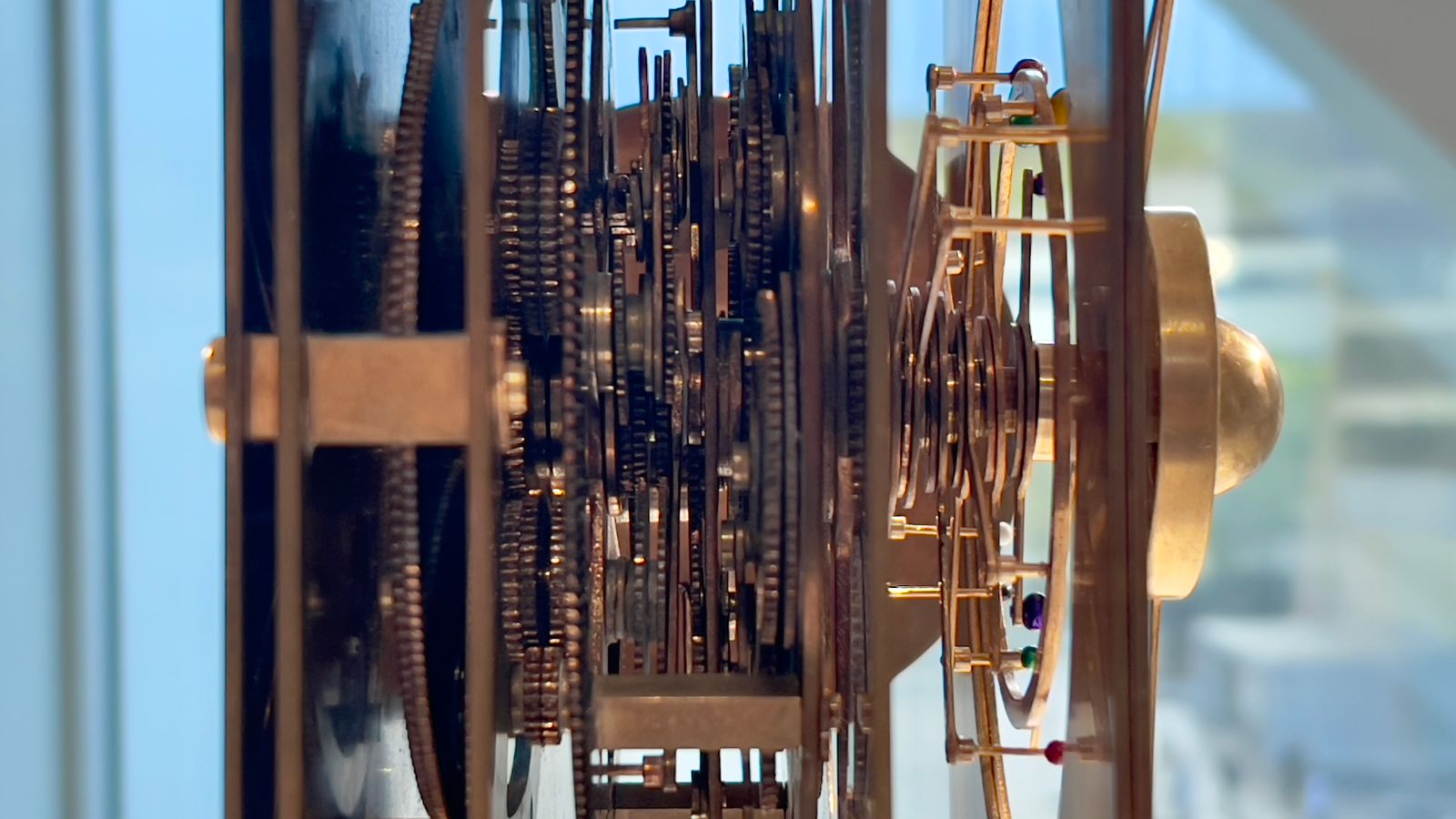
Everyone today is familiar with the digital computer—a machine that deals in 1s and 0s a few million at a time. But what have you ever heard about analog computers? Well, perhaps not as much as you probably should have. An analog computer is a computational device that uses mechanical principles, rather than digital math, to make calculations. You may have seen one or two in your life: a wind-up clock for example.
Quite how long these devices have been around was something of a debate, but most agreed that the first “analog computers,” mostly astronomical clocks, were first invented in around the 14th century. That was until one discovery in 1901 near Antikythera, Greece, changed our understanding of the history of computers, forever. It was a discovery so shocking, that for nearly 70 years, mainstream historians of technology dismissed it as either a fluke, or a fake. That is until a small group of dedicated researchers unraveled its mysteries, and proved that the ancient Greeks did indeed possess astonishingly complex analog computers of their own, and nearly a millennium and a half earlier than we thought.
Discovery
One day in the year 1900, Captain Dimitrios Kontos was in command of a crew of sponge divers, from the island of Symi, as they plumbed the depths of Point Glyphadia, off the island of Antikythera.
Key Takeaways
- The Antikythera mechanism, discovered in 1901, is an ancient analog computer.
- This device, dating back to the 1st century BC, could predict astronomical events.
- The mechanism’s complexity challenges assumptions about ancient Greek technology.
- It was used for both practical and educational purposes, such as planning events.
- The device’s precision suggests advanced manufacturing techniques in ancient Greece.
All was going well, when one of his crew surfaced in a panic, babbling about a group of ghost women, or mummies, at the bottom of the sea. Divers often report strange sightings, but Kontos nevertheless documented the incident, and informed the Greek government. Within a year, the Hellenic Royal Navy was back at the same spot to investigate. What they found would soon shock the whole world.
There on the sea floor, the Greek navy discovered an ancient shipwreck at a depth of about 45 meters, and brought up a treasure trove of bronze and marble statues (the women the diver had seen), pottery, glassware, jewels, coins, and a mysterious box. This was a cargo ship full of many of the finest items of high Greco-Roman art ever discovered; we now believe that it may have been destined for the court of Julius Caesar himself, a gift from the island of Rhodes.
The items were cataloged by the National Museum of Archaeology in Athens, where the box, which appeared to be little more than a corroded lump of bronze and wood, went largely unnoticed as the curators of the museum fussed over the far more arresting finds, like the coins and statues. And yet, of all the treasures this mysterious ghost ship had given to the world, none were greater than that little lump of bronze and wood.
Decoding
By May of 1902, Valerios Stais, a staff archaeologist of the Athens museum had noted, barely in passing, what appeared to be a gear wheel embedded in a piece of rock. He theorized that the device might be some form of ancient astronomical clock. Unbelievably, museum officials dismissed the find, reasoning that the Greeks and Romans had never possessed that kind of technology, meaning that the object must have been coincidentally dropped by a passing ship, perhaps a thousand years after the initial shipwreck had occurred.
Perhaps scholars’ lack of interest in the object was a blessing in disguise. There it sat in the museum for nearly half a century, a curiosity neglected, as human beings went from the industrial revolution, to the computer revolution.
There it languished until 1951, when Yale University’s Derek J. de Solla Price took an interest in the device. A physicist and clock aficionado, Price would become the grandfather of our modern understanding of the mechanism, pouring out the device’s impressive secrets over decades to come.
He first recognized markings of the calendar month, “Libra” on one of the visible gears as corresponding to the ancient Greek dialect of the period and place in which the shipwreck occurred. Beginning with the assumption that the device was some kind of calendar clock, he set about reconstructing its possible original design. In order to convince the curators of the Greek museum, Price needed to offer compelling evidence of what the mechanism might be.
It took a long time, until 1971, for Price and the Greek nuclear physicist Charalampos Karakalos to be given permission to examine the mechanism. Together, they devised a method of scanning the device using x-rays, which enabled them to image the mechanism, layer by layer, revealing its internal workings without destroying the machine as a whole.
The series of x-ray images the pair produced of the 82 fragments of the mechanism were revealed to the world in a 70 page paper, published in 1974. The result was shocking. A device so complex in its design, as well as in the knowledge that it implied about the workings of the solar system, that many mainstream scientists at first derided it as a fake.
Verification and Construction
Throughout a subsequent half century of study, scientists have painstakingly catalogued and examined every millimeter of the mechanism, and today its origin is without question in the academic community.
The device is an extremely complex analog computer, once consisting of at least 40 gears, which would have been capable of calculating anything from the exact position and size of the moon in the sky at any point during an 18 year period, to the position of every then-known planet in its orbit. It could have predicted eclipses, full moons, and even the speed of the moon across the sky, and it would have told its owner the future dates of Olympic games, and much more.
The mechanism, which some believe to have been even larger and more complex than what is now visible to us, reveals that the ancient Greeks and Romans understood astrophysical concepts which were only rediscovered in Europe in the 16th century or later, including “lunar standstill,” or “lunistice” which occurs when the moon reaches its furthest north or south point in a lunar month, and its apparent motion ceases. What’s more: they devised ways of building a machine to precisely mimic this behavior.
It also reveals a far greater mastery of complex miniaturized mechanical devices than anyone had dared think existed in ancient Greece and Rome, around the 1st century BC.
The mechanism is constructed mostly of bronze, in an ingenious array of interlocking gears which use complex mathematical procedures to rectify the solar year (the amount of time it takes for the Earth to rotate around the Sun), with the lunar month (the amount of time it takes for the Moon to transit between “nodes” in the northern and southern hemispheres), in a 19 year cycle that was only rediscovered in the west during the enlightenment. This means that the Greeks had a deeper understanding of astronomy than had once been thought; a knowledge which rivaled 16th century science.
There are yet more secrets hidden within. The mechanism contains a compound central shaft (a series of shafts within shafts, with rod and pin gearing), again, a piece of technology that was not thought to exist in ancient Greece, which helps it to display the position of sun, moon and the first five planets with the turn of just one hand crank.
The mechanism’s calculations occur when gears with different numbers of “teeth” work together to recreate the appropriate relative motion of different celestial objects. A side crank meant to be operated by a person turns a main gear, which represents the solar year. The power from this gear is variously reduced or enlarged by subsequent connected gears to produce the motion of different objects, including the sun, the moon, the planets, and the constellations. In order to achieve this, a dazzling display of mechanical workmanship was required: each gear must be utterly precise and fitted ever-so perfectly in place for the device to have worked.
Watch the Video
Open Video
Video Briefing
The Antikythera Mechanism: The Incredible Ancient Greek Computer #shorts
The mechanism also appears to contain a number of novel “complications,” a name given by horologists for a device within a device which subtly changes its operation. It is these complications which truly make the Antikythera mechanism unique.
These complications seem to be inserted in the mechanism in order to make very fine corrections of the observed motion of the planets that are not accounted for in the Greeks’ understanding of astronomy—and yet do actually exist because of cycles in planetary motion which the Greeks saw, but did not understand. This includes the way the Earth’s orbit “migrates” around the sun in a cycle, and the movement of the sun itself around its own center of gravity.
Because the Greeks believed all objects in the sky orbited the Earth, their mathematics… didn’t really work. That’s why the complications in the mechanism are there, to reconcile what the Greeks observed with what they believed was happening.
In order for the mechanism to demonstrate the apparently irregular motion of the moon around the Earth (how the moon appears to speed up and slow down in its orbit from our perspective), the mechanism uses an ingenious series of compound canted gears, offset from each other and spinning at different speeds, and with teeth at irregular intervals, which are driven by the central drive shaft, but which come into contact with the moon’s controlling gear only when the moon is meant to be in motion, and not when the moon is meant to “stop” in the model.
The Greeks believed that the planets and sun had “epicycles,” meaning that while they circled the Earth, they also circled around their own orbital center of mass. Without accounting for this motion, any model of the solar system would become inaccurate very quickly, but with the complications the maker included, the Antikythera mechanism would have remained accurate for many years into the future.
It is not far fetched to imagine that if such devices had become really widespread in the Greek and Roman worlds, some astronomer like Copernicus or Galileo might eventually have been inspired to solve the problem that kept such models from functioning in periods longer than a few decades. Indeed, it was the invention of precise time-keeping and exact observations of the heavens that did later inspire astronomers to move past the model of the Earth as the center of the universe. It’s amazing to think how close the Greeks came to that discovery 2000 years ago.
Abilities
Not all of the Antikythera mechanism’s abilities are known, as it is now believed that there were probably additional gears and dials which did not survive the device’s underwater burial. However, modern reconstructions show that the mechanism would have been capable of reconciling the solar and lunar calendars, representing the precise positions of each planet and the sun and moon over a 19 year period. The mechanism would have been capable of predicting solar and lunar eclipses, and appears to also have been able to show the timing of the ancient Olympic Games, based on inscriptions found on the back face of the mechanism.
5 dials on the back of the mechanism demonstrate the 235 “synodic months,” showing that the Greeks understood 235 lunar months to be extremely close to 19 solar years. This allows the user to set the current solar day on the front of the dial, and have that day translated to the lunar “day” (within the 235 month cycle) on the back of the mechanism.
It’s believed that these calculations could have been important for planning important events, such as military campaigns, as well as religious ceremonies, particularly when the ancient Greeks needed to know the length of a day in the future, and the brightness of the moon on that day, as well as its position. Using this mechanism, a Greek or Roman general could predict that the moon would be full and located in one particular place in the sky, and that the day would end at a specific time—possibly conferring an advantage in a nighttime attack. Religious leaders also could have used the mechanism to plan ceremonies centered around one of the planets, or to advise their leaders about their horoscopes.
Fragments of texts that were inscribed on the front, back and inside cover of the mechanism show that it was also a teaching device: it would have been used to explain the apparent motion of the stars and planets, possibly to a young pupil or even a group of students. This also shows that it was almost certainly a gift, and not a piece of equipment being used on the ship.
There’s no doubt that among the many treasures on this particular shipwreck, the Antikythera mechanism was likely a central attraction, probably representing many thousands of hours of very skilled work.
Many questions remain about the device’s origins, and the maker, leading some to theorize that it came from the hand of Archimedes, or Hipparchus themselves. While there is no proof of this, it’s absolutely clear that the maker had a first rate understanding of all that the Greeks once understood about the heavens, and it is seen as extremely unlikely that this device is a one-off. Its workings are too clever, its craftsmanship far too precise to be the result of a lone experimenter. It was manufactured by someone, and was probably of great monetary value.
Legacy
Study of the Antikythera mechanism is ongoing, as scientists continue to apply new methods, such as microfocus x-ray computed tomography (CT scans), and polynomial texture mapping (PTM) to try to understand both the mechanism’s purpose, and the means by which it was initially constructed.
One of the most important findings of this research is the revelation that whoever made it, knew exactly what they were doing, and had done it before. Master clockmakers who have studied the mechanism (and some who have even re-created it using ancient methods), note how the workmanship reveals no obvious “corrections,” or the addition of materials to a gear after it has been cut, indicating that the maker was extremely masterful, or that the workshop that created it was specialized in gear making to an extremely high standard.
This may in fact be new evidence that the Greeks at one time were able to produce “assembly line” products, and may have owned very complex tool-making machines of which modern historians know little.
These findings present a great mystery: what happened to all the other evidence of these profound technical and intellectual gifts of the ancient Greeks?
It may be that devices like the Antikythera mechanism, constructed of expensive and soft bronze, and subject to inevitable tarnishing and mechanical fouling, were never intended to last for centuries to begin with. The thing that keeps other examples like the mechanism from reaching us today may be the same reason it’s hard to find an original iPod. If it no longer works, it’s often better to recycle it.
And so, for now, the Antikythera remains our only glimpse of an ancient culture, far closer to our own than once thought.
Key Takeaways
- The Antikythera mechanism, discovered in 1901, is an ancient analog computer.
- This device, dating back to the 1st century BC, could predict astronomical events.
- The mechanism’s complexity challenges assumptions about ancient Greek technology.
- It was used for both practical and educational purposes, such as planning events.
- The device’s precision suggests advanced manufacturing techniques in ancient Greece.
SideProjects Editors
The SideProjects editorial team researches, fact-checks, and structures explainers about the lesser-known tales, side narratives, and spin-offs behind major historical and contemporary subjects.
Frequently Asked Questions
What is an analog computer?
An analog computer is a computational device that uses mechanical principles, rather than digital math, to make calculations.
When and where was the Antikythera Mechanism discovered?
The Antikythera Mechanism was discovered in 1901 near Antikythera, Greece.
What was the initial reaction to the discovery of the Antikythera Mechanism?
For nearly 70 years, mainstream historians of technology dismissed it as either a fluke or a fake.
Who first recognized the significance of the Antikythera Mechanism?
Derek J. de Solla Price, a physicist and clock aficionado from Yale University, first recognized the significance of the Antikythera Mechanism in 1951.
What is the Antikythera Mechanism capable of calculating?
The Antikythera Mechanism is capable of calculating the exact position and size of the moon in the sky at any point during an 18-year period, the position of every then-known planet in its orbit, predicting eclipses, full moons, and the speed of the moon across the sky.
What is the significance of the Antikythera Mechanism’s construction?
The Antikythera Mechanism reveals a far greater mastery of complex miniaturized mechanical devices than anyone had dared think existed in ancient Greece and Rome, around the 1st century BC.
What is the purpose of the complications in the Antikythera Mechanism?
The complications in the Antikythera Mechanism are inserted to make very fine corrections of the observed motion of the planets that are not accounted for in the Greeks’ understanding of astronomy.
What are some of the abilities of the Antikythera Mechanism?
The Antikythera Mechanism is capable of reconciling the solar and lunar calendars, representing the precise positions of each planet and the sun and moon over a 19-year period, predicting solar and lunar eclipses, and showing the timing of the ancient Olympic Games.
What is the current status of the study of the Antikythera Mechanism?
Study of the Antikythera Mechanism is ongoing, with scientists applying new methods such as microfocus x-ray computed tomography (CT scans) and polynomial texture mapping (PTM) to understand both the mechanism’s purpose and the means by which it was initially constructed.
Sources
- Original Side Projects video: The Antikythera Mechanism: The Incredible Ancient Greek Computer #shorts
- https://egusphere.copernicus.org/preprints/2022/egusphere-2022-151/egusphere-2022-151.pdf
- http://mega-what.com/glossary/LunarCal.html
- https://www.nature.com/articles/s41598-021-84310-w
- https://soundcloud.com/user-80982638/the-natural-curiosity-project-45-a-lesson-in-humility-the-antikythera-mechanism
- https://curiositystream.com/video/1947
- https://www.jstor.org/stable/1006146
- Hero image source by Kgbo / openverse, by-sa.