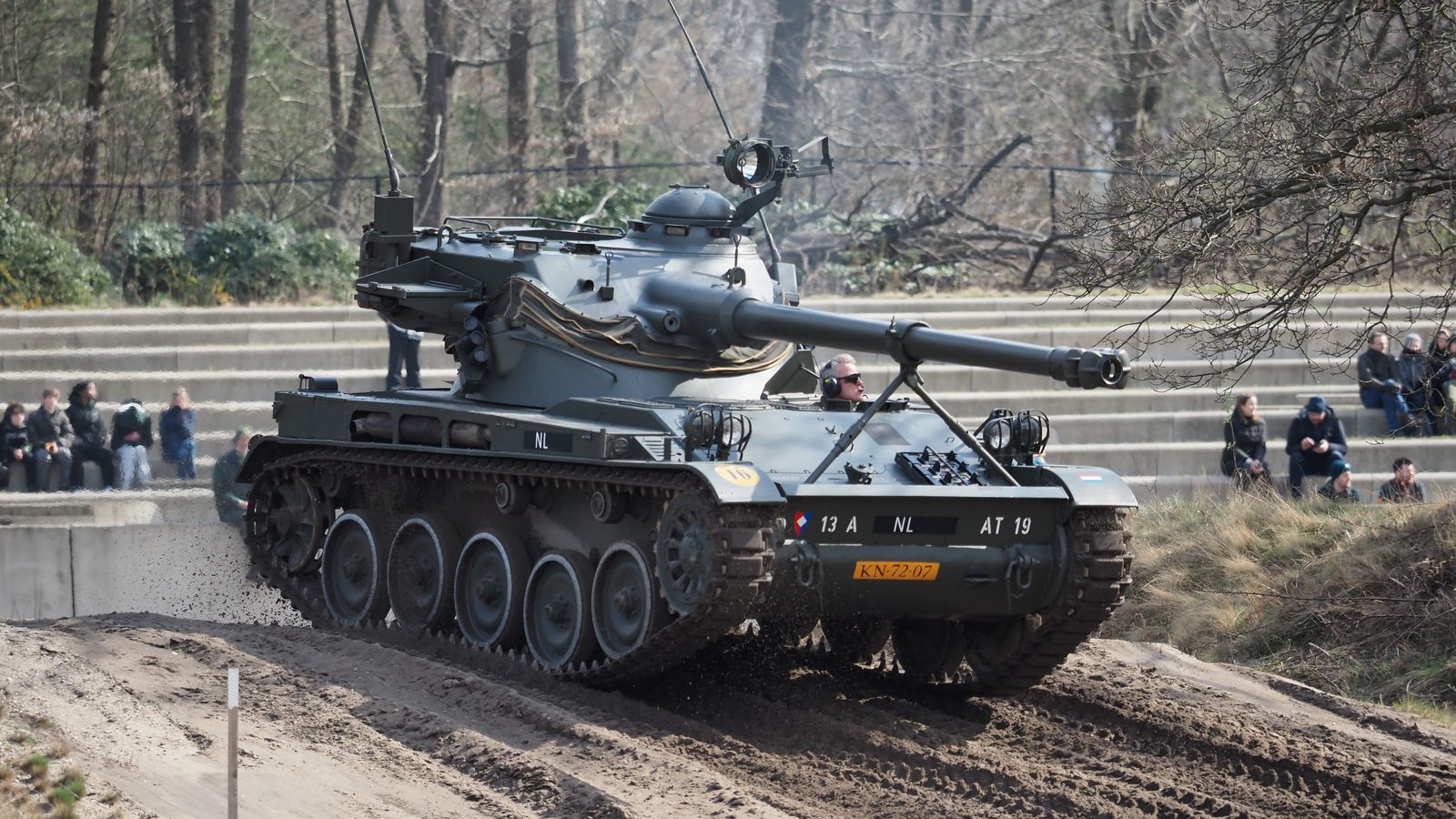
When you think of the great tank producing nations, France isn’t likely the first one that springs to mind. And this is a dire shame, because the nation actually has an exceptionally rich history of tank and armoured vehicle production; with them being among the initial pioneers back in WWI, when they produced revolutionary vehicles such as the Renault FT Light Tank, and continuing to produce top of the line stuff to this very day, such as the Leclerc Main Battle Tank.
Hidden within that history, however, is a whole other, and frankly far more interesting story; one in which France produces and uses not just great tanks, but also, well… weird ones – and today, we’re going to be having a look at five of them… so let’s begin!
Char 2C Bis
We’re willing to bet that many of you have already heard of the Char 2C, since, as both the largest tank, period, and indeed, the only super heavy tank ever put into full production, it is just a bit famous. For those of you who haven’t, however, it was developed at the tail end of WWI, being conceived as the ultimate breakthrough tank that would be able to push through muddy terrain and German fortifications as if they weren’t even there.
Key Takeaways
- France has a rich history of tank production, from WWI’s Renault FT to modern Leclerc tanks.
- The Char 2C Bis was a modified super-heavy tank with a 155mm howitzer, but it proved impractical.
- The M4A4 FL10 Sherman used an oscillating turret from the AMX-13, sold to Egypt but later fought in Suez.
- The AMX-13-105 light tank had a 105mm gun, capable of threatening main battle tanks.
- The ARL-44 was hastily built post-WWII using old components, resulting in a unreliable and short-lived tank.
A brief such as that was naturally quite a demanding one, and so it ended up being a simply vast machine when all was said and done; with it coming in at a whopping 76 tons, being over 10 metres long, having a VERY decent maximum armour thickness – by WWI standards anyway – of 45mm, and a dizzying array of weaponry that included a 75mm Model 1897 cannon in its main turret, and four Hotchkiss Model 1914 machine guns spread all over the tank.
That, in and of itself, would be more than enough for the 2C to earn itself a place on this list, but alas, no, it isn’t actually the tank we are interested in; at least in its standard form – for you see, it actually had a far more bizarre, and all the more obscure variant, and that would be the Char 2C Bis. This variant, in a nutshell, took the 75mm gun that adorned the ‘normal’ 2C, chucked it, and replaced it with a stubby barrelled howitzer that was more than DOUBLE its calibre – 155mm to be precise.
To make it weirder still, we don’t actually even know which 155mm gun was used, although most tank historians speculate that it was likely a highly modified Model 1917 Schneider Howitzer.
But while what gun it carried may be a mystery, we do at least know why the 2C Bis came about; and that was because the French Military wanted to experiment with a ‘bunker deleter’ of sorts, one that could trundle out onto the battlefield, and not just put enemy fortifications out of action, but totally wipe them from the battlefield.
As for when and how it came about, that would be in December 1922, when one the 2Cs, specifically Champagne – there being so few of them that they were all individually named – was selected as the tank that was to be retrofitted, and so got shipped off to the French Army’s proving ground at La Seyne to see the work done. This ended up taking until 1926, and saw Champagne get retrofitted with its posh new gun, obviously, as well as an all-new rounded cast steel turret to house it.
All of that added a fair bit of weight to the already rather beefy tank, so it was given some juiced up engines, and also had three of its four machine guns removed; saving the weight of both the gun, and the bloke who had to shoot it. This proved to be a good idea too, as the deletions actually made Champagne lighter than a ‘normal’ 2C by a whole two tons, which, coupled with the new engines, meant that it could now push 10mph rather than 9mph on flat ground… a modest increase to be sure, but in just the same way that a newly passed teenage driver is chuffed to bits when a new air filter squeezes an extra horsepower out of his three pot econo-box, so too was the French Army happy as a pig in muck with the increased speed.
They were less pleased when they came to actually test out their new 2C Bis, however, as it turned out to be an absolute heap of junk; with the new cannon, whatever it was, barely being able to produce a muzzle velocity greater than 200 metres per second thanks to its absolutely tiny barrel; for reference, the Model 1897 that it had replaced had over double that. This meant that its range was absolutely atrocious.
Further still, while the 2C Bis might have been lighter overall, the turret itself was still WAY heavier, and all of that weight bore down on the front suspension, which REALLY was not happy about it, and often broke as a result. They fettled with it for a few years to try and get it working right, but they eventually gave it up as a bad job, with Champagne being returned to its original configuration no later than 1934, and the experimental turret eventually just being stuck on one of the Mareth Line bunkers in Tunisia so that it could be of ‘some’ use.
M4A4 FL10
For those of you who already know about the Sherman, America’s go-to medium tank of WWII, you are likely aware that MANY attempts were made over the years to replace the 75mm M3 gun that it usually sported, which many believed lacked top end punch, with something a bit heavier hitting; with notable examples coming from the Americans themselves, who started fitting the 76mm M1 gun into some of their Shermans from January 1944, the British, who started producing their own 76mm 17-Pounder armed ‘Sherman Fireflies’ in the same month, and the Israelis, who crammed a monstrous 105mm CN105F1 into the M-51 ‘Super Shermans’ from 1961.
The French, having seen just how much more effective the Sherman became when given a bigger shooty bit, naturally wanted in on the action themselves, but their attempt would be all the more peculiar, as they produced THIS, the oh so snappily named M4A4 FL-10.
And if you are wondering what made it so weird, have a closer look at its turret; looks a bit off, doesn’t it? And that is because it is what you call an ‘oscillating turret,’ which is where the gun and upper turret are mounted on a pivoting section, separate from the lower turret, allowing the upper portion to tilt for elevation while the entire unit rotates for aiming.
While being VERY different to a conventional turret, which really just is a rotating armoured box with a hole for the gun, nothing complicated at all, there is actually some method to the madness when it comes to oscillating turrets, with them offering several advantages such as: simplified gun elevation mechanisms, reduced weight, a lower overall profile for better concealment, improved compatibility with autoloaders for faster reloading, and cost-effectiveness due to their simpler design and maintenance requirements – although they would eventually fall out of vogue since they couldn’t be sealed and thus made CBRN safe.
As for how such a turret came to be incorporated, it actually wasn’t done for France’s own benefit, but rather, as a cheap and cheerful way of upgrading some of the upwards of 2,000 units that they had received from the Americans both during and after WWII, with a view to then flogging them to developing nations for a tidy profit.
The ‘cheap and cheerful’ bit came from the fact that the turret was actually just from the AMX-13; with it turning out that just producing more of those, with their usual 75mm SA50 guns, and plonking them onto Shermans, was a WAY cheaper way of upgrading them than trying to mess about with the turrets they already had.
Only one country ended up buying them however, and that, ironically, would be Egypt, who purchased 50 of them in 1955; and if you’re wondering why that’s ironic, that would be due to the fact that France would actually invade Egypt in 1956 following its seizure and nationalisation of the Suez Canal – meaning that not even a year after their delivery, France was blowing up the very tanks they had sold.
It also turns out that France may have slightly ripped Egypt off, as while the FL10 did indeed have a meatier gun than a ‘normal’ Sherman, the AMX-13 was actually a light tank, meaning that its turret, when stuck on a Sherman, ended up having WAY thinner armour than the rest of the tank, potentially exposing it to great risk in combat situations. Additionally, the autoloader system, while innovative, didn’t exactly seem to take to the Egyptian heat, with it reportedly breaking VERY regularly; and what are we meant to say about that - other than ‘c’est la vie?’
AMX-13
For our next weird French tank, let’s stick with the AMX-13 that we met in the last chapter, as there is WAY more that we can say about it. In doing so, however, let us cast the ‘standard’ AMX-13-75 variant from our minds, as, with its 75mm SA50 cannon, it was but a peashooter by French standards; mere diet coke, when we are interested in the BIG full sugar stuff, like the AMX-13-105 variant.
No prizes for guessing what sized gun it had, because, sure enough, as the name gives away, it came packing a 105mm cannon, specifically a CN-105-57. Given that its contemporaries, like the Soviet PT-76 and American M41, both only came with 76mm guns, it was a simply monstrous thing; a weapon that could, in the right circumstances, genuinely threaten main battle tanks, and the light tank it was fitted to didn’t even weigh 14 tons.
Watch the Video
Open Video
Video Briefing
5 French Tanks That Prove They Just Do Things Differently
As for the specifics of just how threatening it could be, put it this way; its go-to High Explosive Anti-Tank, or ‘HEAT’ round, the OCC-105-F1, could penetrate up to 350-400mm of steel plate, and the Soviet T-55, for reference, had a little over 200mm at its thickest point. Further still, because it was a HEAT round, which gets its oomph from a shaped explosive charge creating a high-velocity jet of metal that penetrates armour by focusing energy on a small area, rather than kinetic energy, it could do that at ANY distance. Then there was its ‘Armour-Piercing Fin-Stabilized Discarding Sabot’ round, the OFL-105-G1, which, while less impressive, could still penetrate just shy of 200mm of steel plate in optimum circumstances.
Despite that, however, it should be noted that that AMX-13-105 was NOT a tank hunter by trade, and rather, France used it as a ‘normal’ light tank, just one that also had the capability to tangle with the bigger stuff as and when the tactical situation forced it to have to do so, with its regular bread and butter being things like providing air-transportable fire support, where it would deploy from the air alongside paratroopers, assisting them in their initial assault, and subsequent holding the fort down till the big stuff could arrive, as well as reconnaissance missions, and infantry support against fortified positions and light armoured targets.
Bizarrely, while we know that the AMX-13 generally was first introduced in 1952, we have no idea when the AMX-13-105 specifically was. We really did look hard for that information too, and it just doesn’t seem to be out there. We tried Janes, a BIG name in open-source military intelligence, for example, and they just had it down as the “late 1950s” so we’ll just gesture vaguely at that time period and say, “yeah, about then probably.”
But at least we do know when France pulled it from service, and that’d be in 1987. By that point, its gun, despite its vast size relative to the tank it was bolted to, simply wasn’t top of the line anymore, being unable to take on the latest and greatest generation of Soviet main battle tanks such as the T-72 and T-80, both of which came festooned with composite armour that the CN-105-57 just had not been designed to deal with.
For what it’s worth though, while France has now basically abandoned the idea of light tanks occasionally taking on main battle tanks in its doctrine, the spirit of the AMX-13-105 does live on in a whole new generation of differently tasked vehicles with WEIRDLY large guns, with examples being the Panhard ERC, an armoured car that packs a 90 mm CN90 cannon, and the AMX-10 RC, an armoured reconnaissance vehicle that packs a 105mm L/47 cannon.
ARL-44
A question, folks. What would you do if you had to rebuild a tank force following an absolute spanking at the hands of a certain Austrian Armband Enthusiast? Would you, A), accept the situation for what it was, take your time, and come out with an absolute banger of a tank down the line, or would you, B), cobble any old sh*t together because, “I’m totally still a great power, trust me bro!”
Well, if you were France’s military leadership contending with that question after WWII, you would have ended up picking option B), with the any old sh*t in question being THIS, the ARL-44.
So enthusiastic were the French to get their tank force rebuilt in fact, that initial design work on it began before the German occupation had even ended, with the work being carried out hidden in plain sight disguised as other things; a supposed trolley bus, a purported tracked snow blower, things like that. Although, it should be noted that we really stress the word INITIAL there, as at that early stage, they were entertaining a VERY different tank to the one that would eventually be built, with the brief then being for a 30-ton medium tank armed with a 75mm gun of some kind.
By comparison, the ARL-44 ended up weighing 53 tons, and carrying 90mm gun, specifically a SA45.
Following the liberation of Paris in August 1944, however, progress sped up exponentially, what with the threat of death no longer looming over them if they were caught, and the Provisional French Government throwing actual tons of cash at them in order to see a tank, literally any tank, completed ASAP.
And with speed being the name of the game, there was no time at all for innovation or optimisation; they simply took what they had lying around, designed an armoured box to encase it all, and called it a day. The result was a tank that, despite being seemingly quite high tech by mid-1940s standards, was weirdly antiquated and awkward looking when seen in the flesh. The tracks and suspension, for example, they were taken straight from the Char B1, an interwar tank that had first left the factory back in 1934, and had been in design since 1921, and the engine was a Maybach HL-230, a German design that used to power things like the Panther and Tiger II during the war.
Even that SA45 gun, which sounds like it could be a bit of beast on paper thanks to its size, was a bodge, as it could trace its lineage back to the 90mm Model 1939 anti-aircraft gun; with it basically just being one of those, but with a hastily modified mounting system, a muzzle brake tacked on the end, and a lengthened barrel.
Oh, and the turret that housed that gun, it was made from steel salvaged from the scuttled battlecruiser Dunkerque… it really was bodge, after bodge, after bodge with the ARL-44.
But wait, it gets worse, because would you believe it, it turns out that tanks which are hastily thrown together tend to be absolute heaps of junk, and the ARL-44 is no exception, with notable problems being gearboxes that often decided to spit out their innards, brakes that liked to cook themselves and stop working, and a suspension that was prone to falling apart.
As a result of all this, the ARL-44’s time in service was… lacklustre, and that’s putting it mildly. A mere 60 of them were built, and they didn’t even get to enter service until 1949, because while they had hulls ready to go from 1946, it took them a whole three years to find that scrap steel for the turrets. From there, they did… well, pretty much nothing, making a single public appearance in 1951’s Bastille Day Parade, and that’s about it.
They were eventually phased out in 1953, with France just having to swallow its pride and turn to the American M47 Patton, of which they bought 856 units, to keep things ticking along until its domestic industry was capable of producing a truly modern medium or heavy tank.
Panther
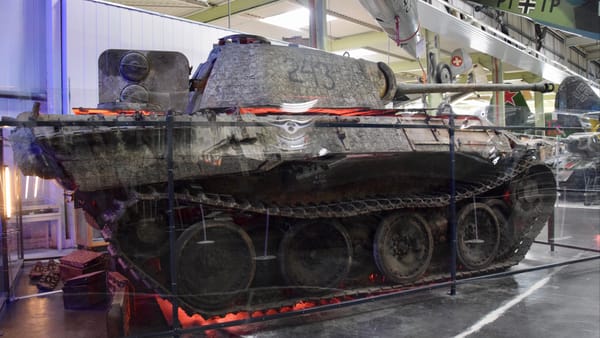
The most peculiar French tank of all however would have to be the Panther, and no, that isn’t a tank that co-incidentally just so happens to have the same name as the iconic German WWII medium tank, it’s the EXACT same tank, as France just cracked on and used it for themselves after Hitler ever so kindly redecorated the Führerbunker with his grey matter in 1945.
It all began following the destruction and encirclement of the Falaise Pocket in August 1944, because there, a LOT of German vehicles just so happened to have been left behind; either abandoned in fully working nick, or put out of action with only minimal damage.
For the French, who needed every tank they could get their hands on as they continued to push the Nazis out of their country, this presented quite the tantalising opportunity, and so, from January 1945, they started hauling them out, patching them up, and using them to equip the French forces that were then encircling Saint-Nazaire; a small coastal town on the West Coast of France where a not insignificant number of German troops were holding out – largely thanks to a VERY heavily fortified U-Boat base.
17 vehicles were sent in total, among which was a single panther which was dubbed Dauphiné by its crew, and given the WEIRDLY large amount of photos we have of this tank as compared to the others, which included otherwise much more shiny and impressive things like Tiger Is, and more exotic things like a Panzerwerfer 42 rocket-launching half-track, it is clear that this Panther made a VERY good impression indeed on the French.
Further to just this, as the rest of the French Forces pressed East as part of the Allied Army, more and more Panthers kept getting captured, meaning that come the war’s end, France actually had quite the reasonable stock of them on hand, 59 of them to be precise, and with them needing every half decent tank they could get their hands on, those that were still in at least half decent condition were dragged into the workshop, juiced up, and pushed into service.
49 in total emerged from said juicing, and they were given to the 6th Cuirassiers Regiment and the Combat Tanks Regiment, and then, for several years, with those regiments, they acted as THE heavy hitters of the French Tank Force, producing, in the process, utterly bizarre photos such as this one, where Panther tanks can be seen in convoy with American M3 halftracks.
This arrangement had been intended to be a VERY short one, with the ARL-44 being slated as the Panther’s replacement when it was finished, but yeaaaaaaaaaah… we know how that turned out. As a result, the Panthers remained in service till 1950, at which point, because they were then held together mostly by duct tape and a can-do attitude, they were pulled from service and replaced with American M47s.
And sure, we know that the Panther isn’t exactly a tank that France ‘made,’ per say, but hey, it’s an interesting story, so we thought we’d include it anyway.
Key Takeaways
- France has a rich history of tank production, from WWI’s Renault FT to modern Leclerc tanks.
- The Char 2C Bis was a modified super-heavy tank with a 155mm howitzer, but it proved impractical.
- The M4A4 FL10 Sherman used an oscillating turret from the AMX-13, sold to Egypt but later fought in Suez.
- The AMX-13-105 light tank had a 105mm gun, capable of threatening main battle tanks.
- The ARL-44 was hastily built post-WWII using old components, resulting in a unreliable and short-lived tank.
SideProjects Editors
The SideProjects editorial team researches, fact-checks, and structures explainers about the lesser-known tales, side narratives, and spin-offs behind major historical and contemporary subjects.
Frequently Asked Questions
What is the Char 2C Bis and why was it created?
The Char 2C Bis was a variant of the Char 2C, the largest and only super heavy tank ever put into full production. It was created by replacing the 75mm gun with a 155mm howitzer to experiment with a ‘bunker deleter’ that could destroy enemy fortifications.
What were the issues with the Char 2C Bis?
The Char 2C Bis had several issues, including a very low muzzle velocity for its 155mm gun, which resulted in poor range. The heavy turret also caused frequent suspensions failures. Despite attempts to fix these problems, it was eventually returned to its original configuration.
What is the M4A4 FL10 and what made it unique?
The M4A4 FL10 was a modified M4 Sherman tank with an oscillating turret from the AMX-13 light tank. This turret design allowed for simplified gun elevation mechanisms, reduced weight, and a lower profile, but it was not sealed for CBRN safety.
What was the AMX-13-105 and how was it used?
The AMX-13-105 was a variant of the AMX-13 light tank equipped with a 105mm cannon. Despite its light weight, it could threaten main battle tanks with its HEAT rounds. France used it for air-transportable fire support, reconnaissance, and infantry support against fortified positions.
What was the ARL-44 and why was it created?
The ARL-44 was a hastily constructed French tank created post-WWII to quickly rebuild the French tank force. It used components from older tanks and vehicles, including tracks from the Char B1 and an engine from the German Panther and Tiger II. It was designed to be a stopgap until more modern tanks could be developed.
What problems did the ARL-44 face in service?
The ARL-44 had numerous issues, including unreliable gearboxes, brakes that often failed, and a suspension prone to breaking down. Its service life was short and uneventful, with only 60 units built and phased out by 1953.
Why did France use the German Panther tank?
France used the German Panther tank after capturing them from the Germans following the Battle of the Falaise Pocket in 1944. They repaired and used these tanks to equip their forces, particularly around Saint-Nazaire, and later in other regiments until 1950.
How many Panther tanks did France have in service?
France had 59 Panther tanks after the war, of which 49 were repaired and put into service. These tanks were used by the 6th Cuirassiers Regiment and the Combat Tanks Regiment until they were replaced by American M47s in 1950.