Introduction
History is full of shocking facts and stories, as we saw in the two earlier iterations of this new format… and now, it’s time to do it all over again, but with weird, wacky, and wondrous military facts.
So, let’s not faff about, and get straight into it!
1. Unsinkable Sam
Did you know that there was a sailor who served both with the German Kriegsmarine AND the British Royal Navy during WWII? And as if that wasn’t unlikely enough, they also survived the sinking of three separate ships in 1941, specifically the German battleship Bismarck in May, as well the British destroyer HMS Cossack and aircraft carrier HMS Ark Royal in October and November respectively.
Key Takeaways
- A cat named Unsinkable Sam served in both the German and British navies during WWII, surviving the sinking of three ships.,The USS Enterprise crew created a toilet bomb to commemorate dropping six million pounds of ordnance in Vietnam.,Some Japanese soldiers continued fighting after WWII ended, with the last surrendering in 1974.,British tankers prioritize a device for boiling water over other equipment, highlighting their tea-drinking culture.,A bear named Wojtek was enlisted in the Polish Army during WWII, helping to load artillery shells and becoming a corporal.
Now, when we say that, what kind of sailor do you have in mind? Perhaps a young fellow who found himself serving his führer blindly, until a chance encounter with a Mark 12 torpedo gave him pause to reconsider where his loyalties lie? An understandable assumption for sure, but ultimately an incorrect one, for you see, Sam was actually a cat.
His service began on the 18th of May 1941 when Bismarck set sail for Operation Rheinübung. Unfortunately for him however, this wasn’t an operation that went terribly well for Bismarck, as the entire British home fleet descended upon her to deliver a firm shoeing, one that promptly sent her bow first into the drink and onto the seabed.
As a result of this, Sam found himself drifting on a section of wood panelling Jack and Rose style, before he was scooped out of the water by the crew of Cossack and made the ship’s Mouse Catcher in Chief.
He was then saved again five months later when Cossack was torpedoed by U-563, being scooped up by a fleeing sailor’s hand before he leapt into a lifeboat. Sam then found himself on Ark Royal when his saviour received a new posting, only to end up clinging to ANOTHER piece of wood when Ark Royal was torpedoed by U-81.
He then spent a few years as Chief Mouser to the Governor of Gibraltar, before retiring to Belfast and passing away peacefully of old age in 1955.
2. Germ Warfare
One thing movies don’t tell you about soldiering, is that all the adrenaline pumping PTSD inducing stuff is actually a TINY part of the gig, and that actually, day to day, being a soldier is damned boring – lots and lots of marching up and down the square, moving a ton of sand bags 6 feet to the left, or just being sat around in a forward operating base, staring at a clock, and waiting for SOMETHING to happen. This, naturally, leads to soldiers finding… ‘creative’ ways to kill the time; they are but human after all.
That brings us to the American aircraft carrier USS Enterprise in 1965, where the crew’s boredom had hit such crushing depths, that they opted to relieve it by creating a special one-off bomb to ‘commemorate’ the sixth million pound of ordnance dropped on Vietnam, specifically a toilet bomb.
And we don’t mean a normal bomb that someone curled one out in to give the Vietcong an extra little treat, no, we mean a LITERAL toilet bomb. The toilet itself was pinched from one of the lower deck ablutions, stuffed full of explosives, and outfitted with all the bits needed to be dropped from the pylons of a Douglas A-1H Skyraider.
The Skyraider in question was 572 ‘Paper Tiger’ piloted by Commander Clarence W. Stoddard, and as he was catapulted from Enterprise’s deck a rather perplexed Air Traffic Controller could be heard calling out “what the hell was on 572’s right wing?!” over the radio, the answer to which could be found in Stoddard’s flight log: “seven Mark 82 500lb bombs and one sani-flush.”
3. Japanese Holdouts
Japan’s surrender in WWII came on the 2nd of September 1945, but a few of its soldiers didn’t quite get the message and kept on fighting, either because they believed the announcement of surrender to be an allied ruse, felt bound by honour to never surrender, or were simply cut off from communications so never got the message.
Most surrendered within a year or two, but some of them held out for WAY longer than you may first imagine, with some, such as Masashi Itō, Kinshichi Kozuka, and Teruo Nakamura holding out until 1960, 1972, and 1974 respectively.
4. The Most Important Piece of Equipment in a Tank
If we were to ask you to name the most important piece of equipment in a tank, what would spring to mind? Maybe the cannon, vital as it is for ruining the enemy’s day and making sure you get home in one piece? Or maybe the radio, because after all, you can’t underestimate the importance of communications in this day and age?
Ask that question to an American or Russian tanker, and they may well be the answers you get. But ask it to a Brit, and there is only one answer you will receive – the ‘Vessel Boiling Electric,’ or ‘BV’ for short, an item that in unbelievably stereotypically British fashion, boils water on demand to keep the tea flowing.
The device was an ingenious solution to a problem that had plagued the British Army throughout WWII - tankers constantly stopping for a cheeky brew - anywhere and anytime.
So prolific was this, that it started to cause real problems on the tactical level, as no one, not even the fiercest Regimental Sergeant Major could stop a tankie from pulling up to exercise his God given right to a lovely cuppa.
So, come the end of WWII and the introduction of the Centurion, the British Army just started fitting all their tanks with the aforementioned BVs, so that brews could be enjoyed on the move. They remain standard to this day, and are taken so seriously, that any vehicle with a defective BV is declared unfit for purpose and torn off the front lines.
5. The Soldier Bear
Wojtek was a Syrian brown bear bought as a cub by the soldiers of Polish II Corps, while serving in Iran in 1942. Initially he was naught but a cute unit mascot, but was soon formally enlisted into the unit – primarily so that the men of II Corps could blag extra food for him and prevent him being taken away by any fun sponge of a senior officer that may insist that a bear was too ‘dangerous’ or ‘unpredictable’ to have a bear running about a warzone.
But while he may have just enlisted for the benefits, Wojtek was every bit the competent and professional soldier; quickly learning to salute his superior officers, march on his hind legs besides the men, and load 100 lb crates of artillery shells onto the back of trucks. For this diligence, and ABSOLUTELY not just because the men of II Corps thought it was cute, he was promoted to the rank of Corporal in 1943.
But Wojtek didn’t let his new position go to his head, and despite the lofty expectations of rank, he remained one of the boys, and could often be found of a night wrestling with the men, drinking beer, and enjoying his favourite treat, cigarettes – which despite MANY witnesses insisting he smoked like a people, he likely just ate.
Wojtek survived the war and was demobilised in 1945, he then settled into a well-earned retirement at Edinburgh Zoo and lived to the ripe old age 21… and right to the very end he would remember and salute his old comrades… particularly when they threw cigarettes into his enclosure.
6. The Army That Came Back with More Men Than It Sent
When the Austro-Prussian War broke out in 1866, Liechtenstein threw its hat in the ring and entered the war on the side of Austria. To this end they sent a modest detachment of 80 men into the fray, specifically to guard the Brenner Pass between Austria and Italy. This proved to be quite the mundane affair, as the war never came that way.
And so, with no shooting or stabbing of the King’s enemies to be done, the soldiers did what soldiers always do when they find themselves bored – get drunk and liaise with the locals. They had a grand old time of it, and the lads thoroughly enjoyed their little alpine holiday at the expense of the King’s treasury. They enjoyed it so much in fact, that they made a friend who came back home with them, and thus Liechtenstein became one of the few nations to bring more men back from war than it sent.
The man’s specifics are hard to verify. Some say he was an Italian defector, and others insist that he was simply a local who had Liechtenstein sold highly to him by the soldiers and so fancied seeing what it was all about for himself – whatever his motivation, it’s an incredible story.
7. A Defector to North Korea
When we picture soldiers jumping the wire during the Cold War, we typically imagine them jumping from Communism rather than to it, but while that was the way it usually went, it wasn’t ALWAYS the way it went, as exemplified by James Joseph Dresnok, an American soldier who defected to North Korea in 1962.
He did it because he had nothing left to lose - he came from an abusive home in the US and thus had no contact with his family, his wife of two years had left him on an earlier deployment, and above all else, he REALLY didn’t take well to military life; hating the harsh punishments that often came his way for the many minor infractions he committed while serving – and so, he took the plunge.
For what it was worth, it appears to have been the right move for him. He found stable work in North Korea as an English teacher, and from 1978 also became something of a North Korean celebrity, as his complexion had him perfectly suited to be cast as the archetypal American ‘baddy’ in movies. He eventually passed in 2016, without expressing a single morsel of regret for his decision.
And what’s more, his story, while rare, is far from unique, as he was just one of seven American soldiers who defected to North Korea after the end of the Korean War.
8. Stealing a Helicopter
What do you do when your enemy has a tarty helicopter that you quite fancy having a look at? Well, you pinch one of course – or at least that’s what the Americans did in 1987 when they wanted to get their hands on a Mi-25, the export version of the fearsome Mi-24 attack helicopter, in a mission dubbed ‘Operation Mount Hope III.’
The operation took place following the eight-month-long Toyota War between Chad and Libya, which concluded in 1987 with a Chadian victory. Post-war, the Libyans left behind significant military hardware, including the Mi-25 helicopter at the Ouadi Doum airbase – and thus the Americans saw their opportunity. The mission was led by the 160th Special Operations Aviation Regiment, and they utilized MH-47 Chinook helicopters.
As for the plan, that was simple: get in double quick, hook it up, and get out even quicker.
It was executed under the cover of darkness, to maintain secrecy and minimise the risk of engagement with any remaining Libyan forces. All went well, and after dumping the Mi-25 at an airbase in N’Djamena, the capital of Chad, everything was loaded up into a couple of C-5 Galaxy’s and the Americans disappeared with their prize.
9. The Second Largest Air Force
Given that the US Air Force is the world’s largest Air Force, with 5,213 aircraft on the books, which do you suppose is the second largest?
China perhaps, as they had been pumping cash into their military of late? Or Maybe Russia? They surely must have a fair sized fleet on the go even with their current… ‘difficulties’ in Ukraine?
Certainly, they would be sensible guesses, but with China having 1,992 aircraft in inventory, and Russia having 3,864, neither of them take that second spot.
Bizarrely, it is in fact the US, again, that takes the title - specifically the US Navy, which currently has 4,012 aircraft in inventory – such is the insane size of the US Military.
There’s a cracking fact to put in the pub quiz bank, you’re welcome!
10. The First Machine Gun?
When asked to name the first machine gun, people will typically point to the Maxim Gun – a recoil operated machine gun invented all the way back in the black and white days of 1884. But what if there was something else that beat it to the post?
Enter the Puckle Gun from all the way back in 1718 – a bad boy of a shooter capable of putting nine chunky 1.25 inch diameter rounds down range in a minute, a rate that admittedly, was ‘just a smidge’ under the 600 rounds per minute the Maxim could manage, but sufficient enough for some to say it was the first machine gun, given how it emerged in the muzzle-loading musket days, when a REALLY well trained soldier could let off three rounds a minute.
Those who say it doesn’t count point to how it operated, specifically the fact that the operator had to manually rotate the cylinder and reset the hammer after each shot, when a ‘true’ machine gun, to simplify, should just keep firing when you hold down the trigger.
So, does it count then? Well, we will leave that up to you to decide.
11. Defenceless Nations
Last year the world spent 2.2 TRILLION USD on defence, and with such a crazy amount of cash being thrown about for the sole purposes of acquiring killing machines and training a body of handy sorts to operate them, you would be forgiven for assuming there would not be a single nation on earth that would willingly leave itself defenceless by failing to spend even a single cent on an army.
And yet, there are 16 countries that do exactly that, and instead depend upon lucky geography or powerful friends to ensure their protection.
The nations in question are Costa Rica, Andorra, Dominica, Grenada, Vatican City, Liechtenstein, Samoa, Tuvalu, Kiribati, Nauru, St Lucia, St Vincent and the Grenadines, the Solomon Islands, the Marshall Islands, Micronesia, and Palau.
12. WWII Tanks in Ukraine
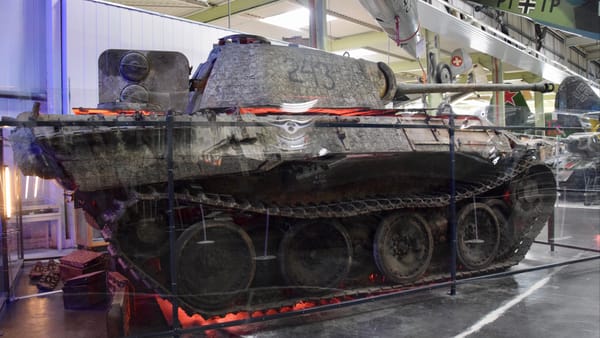
We’ve all heard about old tanks being dragged out of retirement and returned to service on the battlefields of Ukraine, but such stories usually concern T-55s or T-62s… not WWII vintage German Panzer IVs, and yet, that is exactly what happened in 2023.
Now, the armour aficionados in the audience will have noticed straight away that some things aren’t right here – it has tracks from a BMP1, and it is missing its muzzle break… and yet, despite this, we shouldn’t write it off as a replica that ‘somehow’ found its way to the frontlines, as its dimensions, armour thickness, suspension, and return rollers are PERFECT, as they rarely are on replicas.
So then, just how did this weird miss-mash of a survivor end up fighting in Ukraine?
Well, sadly, we don’t have a clue, as nothing more has come to light about it since – it could be one an enthusiast owned that was either restored on a budget, or just had some ‘whatever’ tracks thrown on it to get it going, or it could have been pulled from a museum and quickly bodged together… we just don’t know.
And yet, despite the uncertainty, there it is, a Panzer IV in Ukraine, clear as day.
13. The Bazooka Scooter
The Vespa 150 TAP was a wacky little thing developed for France’s paratroopers back in the 1950s – a bazooka scooter; literally, a Vespa scooter with a whopping great 75mm M20 recoilless rifle strapped to it.
Built between 1956 and 1959, and remaining in service until at least the early 1970s, this weird little thing saw action in both the Algerian and Indochina wars.
But alas, we are saddened to report that it wasn’t fired on the move, and so, rather than zipping about the colonial countryside and dropping tanks in a weird Quadrophenia / Full Metal Jacket crossover, the TAP was instead used just to ferry the M20 around all nippy and speedy like, and when the rider found something he wished to blow up, he’d dismount, and set it up on the ground conventionally.
Ultimately, the Bazooka Scooter concept never really caught on, and remains a weird little footnote in French military history. Primarily, this was because scooters are REALLY terrible at crossing rough terrain – imagine Jeremy Clarkson on the Top Gear Vietnam special, then up the ante with people shooting at him, and you suddenly get why it was such a terrible idea.
14. He’s More Meth Than Man Now…
In 1944, Finnish soldier Aimo Koivunen survived a harrowing, and frankly quite hilarious ordeal when he overdosed on methamphetamine – popping a total of 30 pills, the supply for his ENTIRE unit.
What followed was an… ‘interesting’ series of events, with highlights including:
- Being so buzzed off his nut that he began to rocket ahead of his unit, and so focused had the meth made him, that by the time he came to his senses and realised he had overtaken his men, he was now miles over the horizon and totally on his own.
- Skiing 62 miles through the forest while completely black out unconscious and having no memory of his journey or what he did on it when he came back to.
- Stepping on a landmine and coming off with nothing but a slightly roughed up uniform to show for it, and then stepping on ANOTHER landmine that did actually mess him up severely, but thanks to the magic of meth, he pressed on as if he was fine.
- Hallucinating that a mighty tree was in fact a terrifying wild animal, and then proceeding to fight said tree as if his very life was at stake.
Surprisingly, he survived all of that, and eventually stumbled upon a Finnish patrol that immediately raced him to a hospital, from which he was eventually discharged when his heart rate dropped to normal THREE WEEKS later.
Even more surprisingly, he then walked away from the mother of all come downs totally unscathed, and retired in peace after the war, eventually passing away in 1989 at the ripe old age of 71.
15. They Couldn’t Hit an Elephant at This Dis…
John Sedgwick was a Union Army general during the American Civil War. He was born in 1813, and served in many conflicts before the Civil War, including the Seminole Wars and the Mexican-American War.
He took to war like a duck to water, and after honing his craft in those bitter conflicts, he was one of the Union’s most valuable and respected Generals come the onset of hostilities with the Confederacy.
On the 9th of May 1864 during the Battle of Spotsylvania Court House, he was commanding the Sixth Corps. He was at the front lines, directing artillery placements and troop positions under Confederate sniper fire. His troops were ducking for cover, but Sedgwick, wanting to calm them, stood tall and reportedly said, “They couldn’t hit an elephant at this dis…” his final word being cut short by a Confederate bullet, which passed straight through his skull and exited through his left eye socket. He immediately collapsed to the floor; dead before he even hit the ground – becoming the highest rank Union casualty of the whole war.
His death was a cataclysmic loss for the Unionists. He was a key figure in their command structure, a tactical genius that helped formulate some of the army’s greatest plans, and deeply loved by his men for his caring and paternal leadership. For his legacy however, none of that matters, and today he is defined by one thing and one thing alone – irony.
16. The Most Expensive Plane
This is the most expensive plane ever to take to the skies, the Northrop Grumman B-2 Spirit. It is an advanced strategic bomber designed to be all but invisible to enemy radar thanks to its low, flat profile, and wealth of other highly classified stealth technologies incorporated into its design.
It has all of this tech for one purpose, and one purpose alone – to be the single most deadly thing in the sky, specifically by brazenly flying its payload of 16 B83 nuclear bombs right over enemy radar and air defence installations and dropping them wherever it pleases all but guaranteed that it will not be intercepted while doing so.
To put into perspective just how insane this capability is, a B83 has a yield of 1.2 megatons, making a cumulative yield of 19.2 megatons per sortie… which is 914 greater than the yield of the Fat Man bomb dropped on Nagasaki in 1945… it’s legitimately terrifying stuff.
So then, with capabilities like that, it is small wonder that the B-2 is the most expensive airplane ever made… but just how much does it cost exactly? Well, adjusted for inflation, the flyaway cost in 2024 dollars works out at just over four BILLION… per unit. Or, to put it in other terms, about the same as the WHOLE cost of a British Queen Elizabeth class supercarrier, or twice Argentina’s ENTIRE military budget.
17. The Admiral Crapnetsov
Much has been made of the dire state of the Russian Military since its invasion of Ukraine, between a total failure in logistics that saw its advance on Kyiv stall to a complete halt in the city’s suburbs, having to depend upon Aliexpress walkie-talkies after corruption ate up its radio budget, and the near COMPLETE absence of its supposedly most advanced machines, the SU-57 fighter and T-14 tank from the frontlines, we really are spoilt for choice when picking examples.
But catastrophic as they are, one thing serves as a monument to Russian military failures and delusions better than any other, and that would be their sole aircraft carrier, the Admiral Kuznetsov.
The vessel, originally commissioned for the Soviet navy back in 1991, has been moored up for overhaul since 2018… and it hasn’t exactly gone well. In 2018 the floating dock holding the carrier, PD-50, sank, causing a crane to crash onto its deck which led to substantial damage. This was then followed by another incident in 2019, in which a significant fire broke out on the ship, resulting in the death of at least one sailor and injuries to 12 others. Further to this, the budget allocated for her overhaul is believed to have been largely swallowed up by corruption.
As a result of this, not only has no progress been made on the Kuznetsov, but her condition has only degraded further, to the point that today it is believed that her engines are totally nonfunctional and in need of total replacement.
And if that wasn’t bad enough, just to REALLY rub salt in the wound, both China and India have Soviet made carriers of their own, the Liaoning and INS Vikramaditya respectively… and they both work a treat… Russia really has no one to blame but itself for this one.
18. China and the USSR Went to War
When speaking of the Cold War, two blocs are typically discussed, those being the Capitalist West, headed by the US and containing the various capitalist nations of the world under their leadership, and the Communist East, which contained all of the Communist nations under the leadership of the Soviet Union.
But such a lens is actually incorrect, as there were really three blocs in the Cold War, with the third being led by China; this is where we get the term ‘third world’ from today - it was originally nothing to do with wealth, or a lack thereof, and was actually a Maoist term coined to refer to the nations that fell into China’s sphere of influence.
The Soviet Union and China did used to be friends early on mind you, but they fell out BIG time in 1960, when ideological differences culminated in the Sino-Soviet Split. From then on, in practical terms, they HATED each other, and the Soviet Union and China had the same relationship as the Soviet Union and America did.
Things escalated so much, that come 1969 the two nations were at war. Granted, it wasn’t exactly a ‘run to the shelters the nukes are coming’ type of war, was never formally declared, saw no changes in the borders, and ended seven months later with no more than 150 people killed and a dozen tanks destroyed – but still, the armies of both nations were shooting at each other, and so it counts.
19. The Last Nation to March Under the Swastika
Because of the actions of a certain moustached Austrian fella, it is fair to say that the swastika has ‘rather’ negative connotations in the modern day, and because of this, the ancient symbol of peace and well-being, that you once couldn’t move for the world over, has been all but purged from public view.
But one nation’s military still marches under it, quite literally, and that would be Finland… allow us to explain.
Despite Finland being wartime allies of the Nazis, their use of it is actually completely coincidental, and predates its adoption by the Nazis, dating back to 1918, when Count Eric von Rosen, a Swedish explorer and friend of Finland gifted the newly independent country its first aircraft – which was emblazed with his personal good luck charm, a big blue swastika. Finland just so happened to like the symbol, and so continued to apply it to their later aircraft, as well as roll it out more widely.
After the war, many branches of the Finnish armed forces began to phase it out, for obvious reasons. But the Air Force stood its ground – it was THEIR symbol long before it was Hitler’s, and they would be damned if they were going to let him ruin a tradition that they were perfectly fond of.
Despite this steadfastness, their use of it has weaned over the years. The roundel adorning aircraft was dropped immediately in 1945, and it was then slowly dropped from the banners and insignias of various units as the years rolled on, culminating with it being removed from the air force’s official logo in 2017. But one unit persists in its use, the Finnish Air Force Academy, and they still march under it to this day.
20. The First Aircraft to Shoot Itself Down
A peculiar incident occurred on the 21st of September 1956 when a Grumman F11F piloted by US Navy test pilot Tom Attridge managed to shoot itself down.
It happened while Attridge was conducting high-speed tests of the then new fighter’s cannons, specifically while letting the cannons rip during a sharp dive.
The rounds, which left the muzzle at supersonic speed, quickly slowed down due to the resistance of the air and followed a curved trajectory downwards, a trajectory that Attridge, with his throttle still binned and full afterburners blazing, soon entered himself, causing the rounds to impact his canopy, right engine intake, and nose cone, which lead to a total loss of power.
Watch the Video
Open Video
Video Briefing
50 Military Facts That Will Blow You Away
Fortunately, the rounds didn’t penetrate the canopy, and all of the aircraft’s control surfaces were still intact, so Attridge, the skilled pilot that he was, was happily able to bring his battered F11F back down to the ground on a glide, and make a rather bumpy emergency landing in a farmer’s field. He walked away from it alive, but the impact left him severely injured and out of the cockpit for six months while he recovered.
21. The Biggest Cannon
The Tsar Cannon from 1586, which currently sits outside of the Kremlin Armoury in Moscow, is typically cited as the biggest ever cannon, and by calibre, the width of the barrel, this is indeed correct, with it coming in at a mighty 35 inches. But with it weighing in at a MERE 40 tons, and never having particularly been used… many say it doesn’t REALLY count.
With that in mind, may we present to you the Schwerer Gustav from Nazi Germany.
This beast weighed an astonishing 1,350 tons, making it just ‘a tad’ heavier than the Tsar Cannon, and despite having a smaller calibre of ‘only’ 31.5 inches, it was 155 feet long compared to the 17.5 feet length of its Russian forerunner. Its rounds were also MUCH heavier, weighing in a whopping 7 tons compared to the one-ton balls that came out of the business end of the Tsar Cannon – for these reasons, many argue that the Schwerer Gustav is ACTUALLY the biggest cannon.
But which one is correct? Well, that’s subjective and for you to decide; pure calibre or ‘everything’ else… the choice is yours.
22. The Biggest Military
And while we are on the subject of ‘the biggest,’ which country do you suppose has the biggest military today? The US perhaps? A sensible guess for sure given their population and the INSANE amount of money they spend every year. Or maybe China?
Again, a good guess for both of the same reasons – but while they would be sensible guesses, they would also be incorrect ones, as the real answer is North Korea, a country which has 7,769,000 people, give or take a third of its entire population serving in the military, as compared to ‘only’ 4,015,000 in China, and 2,072,950 in the US.
A few things to note however to qualify that figure, in terms of active military, i.e., people who do soldiering full time, North Korea ‘only’ has 1,280,000, a figure which is roughly equivalent to that of the US and places it 5th in that category, with the remainder of its figure being made up of 600,000 reservists, people who do soldiering on their days off, and 5,889,000 paramilitary forces.
This is because North Korea, whose military strategy is guided by so called ‘Songun,’ or ‘Military First Politics,’ makes its military the centre point of its whole society. So not only do they keep LOTS of soldiers on the books directly, but their military also permeates into other aspects of society, leading infrastructure projects, education, cultural works, and other such things, and the workers that do those tasks are also trained up as soldiers on the side and do their jobs under the military banner.
You have to admit, it’s quite a smart strategy for a nation that isn’t exactly the most popular on the world stage… would you want to invade a country where basically EVERYONE living there can be handed a rifle and sent straight to the frontlines?
23. The Last British Monarch to Lead Troops into Battle
King George II, who reigned from 1727 to 1760, holds the distinction of being the last British monarch to personally lead troops into battle. It occurred during the Battle of Dettingen back in 1743, amid the War of the Austrian Succession. At this battle, he led an allied force comprising British, Hanoverian, Austrian, and other troops against the French.
Despite being taken by surprise and facing a formidable French army, George II displayed remarkable leadership. Clad in the most lavish garb of the day, he rode amongst his troops, rallying and inspiring them with his presence. But his direct involvement was not merely ceremonial or morale raising; he actively participated in the strategic planning and execution of the battle tactics, and even got a few swings in on the French himself.
Since then, military service has remained an important aspect of the monarchy, and it is all but unwritten rule that senior royals are expected to serve at some point, with King Charles III doing his time between 1971 and 1976, and the future king, Prince William, doing so between 2005 and 2013. But in terms of ACTUALLY getting stuck in while wearing the big shiny hat… it hasn’t happened since George II.
24. The Last Head of State to Serve in WWII
And while we are on the topic of heads of state at war, let us discuss Queen Elizabeth II. While she wasn’t exactly storming about Normandy lopping off Nazi heads, she did in fact serve in WWII before she took the throne, and so long lived was her reign, that she was THE last head of state in the world to have done so.
It all began at the age of 18 in 1945, when then Princess Elizabeth, who found the whole Nazi malarkey rather irksome, joined the Auxiliary Territorial Service, a women’s voluntary branch of the British Army.
There she trained as a driver and mechanic. Her service was hands-on and saw her get involved in the maintaining of military vehicles… and by all accounts she was a belting mechanic.
Her service continued until the war’s end, and she ended the war as a Junior Commander. The skills she acquired and her experiences during the war left a lasting impact, and instilling in her a love for driving – something which is best encapsulated by a little story from 1998, when Crown Prince Abdullah of Saudi Arabia made a disparaging remark about female drivers as he climbed into Liz’s Land Rover… in response to which she decided to show off her Army honed skills, and proceeded to drift and slide her Land Rover around Balmoral, much to the chagrin of the Prince’s now brown-stained underpants.
25. The Deadliest Battle in Human History
The Siege of Leningrad, which occurred during WWII and lasted from September the 8th 1941 to the 27th of January 1944 is by a country mile, the single deadliest battle in human history. The Siege itself was fought by an Axis coalition of German, Finnish and Italian forces in the offense, and Soviet forces in defence.
The Axis strategy was simple enough, they hoped to encircle the city, completely cut it off from all supply lines, and pound it into oblivion with long ranged artillery. The idea was that this would yield a swift, glorious, and above all else safe victory for the attackers – who rather than getting bogged down in slow and brutal street fighting, would just sit back, hold their line, and wait for the duopoly of starvation and bombardment to cause a complete collapse of morale, and thus bring about the city’s surrender.
That simple plan didn’t work out, however. Despite coming very close, the Axis attackers failed to fully encircle the city, meaning that just enough supplies and reinforcing soldiers could trickle into Leningrad to keep both hope, and resistance alive and well – and a brutal slog ensued, from which neither side would quickly surrender.
When the Siege finally broke, a scene of total devastation was left in its wake. Leningrad itself was little but rubble, and within that rubble, millions of bodies lay, with the figures for the total number of casualties both dead and wounded being anywhere from five and a half million, to one and a half million across both sides – making it easily the single deadliest battle in human history.
26. The Last Battle of the Roman Empire
Few societies have a martial record as glorious as that of the Roman Empire. For centuries its mighty legions trod the armies of Europe and Near Asia underfoot and bent the civilians hiding behind them to their whims, all to expand the power and influence of Rome.
But the Roman Empire has been gone for a fair old while now, long having been confined to the history books after fate’s fortunes turned against it – so what was the last battle those once glorious and triumphant legions fought?
Well, there’s actually two answers to that one – the last battle the Western Roman Empire fought, and the last battle the Eastern Roman Empire fought, as the Empire itself was split up in 395AD.
For the Western Roman Empire, it wouldn’t have to wait long. Its fortunes were already long in the pan even before the split, and come 476AD, barely a century later, its forces were engaged in the Battle of Ravenna against the Germanic Tribes of Odoacer. It would be their last defeat, as two days later, Romulus Augustulus, the last Western Emperor was kicked off his throne and the Empire formally came to an end.
For the Eastern Roman Empire, its fortunes fared significantly better, and it would cling on for another millennia or so. But come the 15th century, as the medieval period drew to a close, its time was up also – its coup de grace being delivered by Ottoman Sultan Mehmed II at the Siege of Constantinople in 1453.
27. The German Army Still Uses Nazi Camouflage… Kind Of
Way back in the black and white days, the German Army was a pioneer in the use of camouflage uniforms, as exemplified by it being the first ever nation to give a standard issue piece of camouflage equipment to ALL of its soldiers, specifically the M31 ‘Zeltbahn,’ a rather handy half poncho half tent section that came in this rather fetching pattern; so called ‘Splittermuster’ or ‘Splinter Pattern.’
The bad moustache man who rose to power two years later was all about this whizz-bang new camouflage idea, so when the time came to outfit the SS for war, he naturally wanted them to have some too. But seeing as how they were supposedly the best of the best, his own legion of ideologically indoctrinated nutters, he didn’t want them to have MERE splinter pattern – they needed something that’d mark them out as being better than everyone else.
This led to the development of several unique to the SS patterns of camouflage, such as ‘erbsenmuster,’ or pea-dot pattern, and ‘platanenmuster,’ or plane tree pattern.
Now have a look at this modern Bundeswehr soldier in his ‘Flecktarnmuster,’ or Flecktarn pattern of camouflage. The colours are a bit different, but otherwise, yeaaaaaaaaah… if it isn’t broke don’t fix it we guess.
28. Saddam’s WWII Tanks
During the 2003 US-led coalition invasion of Iraq, some interesting things were discovered among the plethora of modern and Cold War era vehicles that made up Saddam’s tank force – namely a surprising amount of OLD WWII era tanks that would have been confined to museums in any other country, but in Saddam’s Iraq were rolled out to play their part as everything came crashing down.
The Iraqi army, originally established in the 1920s, had received various tanks over the decades, including models from Fascist Italy, the United Kingdom, and later the United States, with examples being things such as Italian CV35 tankettes, British Vickers Mk VI light tanks, and Crusader tanks, and they all re-emerged following the invasion. A particularly intriguing find was this German Sturmpanzer II Bison, a self-propelled gun that plonked a heavy infantry gun on an old (even at the time) Panzer II chassis.
The extent to which they were used in fighting varied massively. The aforementioned Bison for example, from the fact it was pictured in the middle of a desert having been blown up, was presumably used to some degree, whereas on the other extreme, this Crusader, still in perfect nick on a plinth, was presumably never used at all.
But the fact that such old vehicles were pushed back into combat at all, even if just to a limited degree here and there, is still rather interesting.
29. Russia and NATO Nearly Went to War in 1999
In 1999, during the Kosovo conflict, a flashpoint of tension nearly escalated into a direct military confrontation between NATO forces, particularly led by the US and UK, and Russian troops.
This tense situation arose when Russian forces unexpectedly took control of Pristina Airport in Kosovo, which was strategically important for the NATO-led KFOR peacekeeping mission planning to enter Kosovo after an agreement was reached to end hostilities.
British General Mike Jackson, in charge of the NATO forces, faced a direct order from US General Wesley Clark to block the runways and prevent Russian reinforcements. However, Jackson, concerned about the potential for a significant escalation that could lead to a direct conflict between NATO and Russian forces, refused to obey Clark’s orders. He argued that such an action might trigger a larger, possibly catastrophic, conflict, and stated that he would not “start the third world war” for Clark.
Fortunately, the standoff was later resolved diplomatically, with Russian forces eventually participating in the peacekeeping mission but not under NATO command.
Oh, and fun bonus fact, famed English singer songwriter James Blunt was also there – he was then a Captain with the Life Guards Regiment at the time, and it was the squadron he was commanding that was initially racing to secure the airport when the Russians unexpectedly took control.
30. The Last WWI Rifles in Service
The Sirius Dog Sled Patrol, a unit within the Royal Danish Army’s Joint Arctic Command, operates in the harsh, remote terrains of Northeast Greenland. Established in 1941, the unit is tasked with long-range reconnaissance missions and enforcing Danish sovereignty over the vast Arctic expanse. The unit’s personnel, handpicked members of the Danish forces, navigate the icy wilderness in pairs, each duo conducting patrols that can last up to four months, accompanied by their sled dogs… and they also have the distinction of being the last unit on Earth to still be equipped with weaponry from WWI.
Specifically, they use the American M1917 Enfield bolt-action rifle, and it is their primary means of defence against both any potential villains they stumble across, and polar bears alike. The reason for this choice is simple – in Denmark’s opinion, nothing modern has come along that can do the job better.
The conditions in the arctic are BRUTAL, and any rifle that isn’t made to the best of standards, or has even a single blemish in its design simply won’t cut the mustard, and will inevitably become a useless lump of ice in such conditions – something that is far from ideal when one ton of polar bear has its heart set on making you lunch… and thus the Enfield soldiers on still, waiting for some young upstart to come along that can finally bear the weight of its heavy burden.
31. The British SS
Famously, and also ironically, the Nazi SS was one of the most racially diverse organisations to ever exist, with it having units whose members were drawn from all four corners of the globe – including those countries that Germany was actively at war with, the most interesting of which is the British Free Corps.
It recruited from British and Imperial POWs and was started by John Amery, a rabid British fascist and Nazi sympathiser. Unlike other ‘enemy’ units of the SS however, like those representing the Soviet Union, which had upwards of a million men throw their hat in the ring with their former enemy, recruitment was always a major struggle for the British Free Corps, and it never managed to reach more than 27 active members at its peak, with only 54 joining up in total come the war’s end.
It was founded in 1943, and never took part in meaningful combat duties, even when it found itself attached to the 11th SS Panzergrenadier Division – instead being used far more for propaganda work and infrastructure odd jobs back on the home front. This is itself an interesting deviation from other ‘enemy’ units, as both the 33rd ‘French’ and 15th ‘Latvian’ divisions were HEAVILY involved in fighting on the Eastern Front.
Post-war, the Free Corps members were apprehended, and some were tried and convicted, with its founder, John Amery, being executed for treason in 1945.
32. The Biggest Battleship
Now let’s take a look at history’s biggest battleship, which would be the Japanese Yamato. Commissioned in 1941, she was a remarkable feat of naval engineering, one designed to counter the numerically superior US Pacific Fleet by taking on multiple battleships at once.
Fully laden, she boasted a displacement of nearly 72,000 tonnes and was 263 meters in length – which, to put it in context, is near as damn it the exact same dimensions as a modern British Queen Elizabeth class super carrier.
Her teeth came from nine 18.1 inch Type 94 main guns, which were split into three turrets of three, and were also the largest calibre of naval artillery EVER fitted on a warship even to this day. These guns were capable of firing shells over a distance of 26 miles.
Despite her impressive capabilities however, Yamato’s operational history was limited. She popped up all over the Pacific here and there during the war but was denied the big showdown with the US Navy for which she was designed and was eventually sent into the drink in April 1945, when she was pounced upon by so many bombers that even she couldn’t fend them off.
33. Ice Aircraft Carrier
During World War II, Britain embarked on a highly ambitious and unconventional project known as Project Habakkuk. The idea was to construct a massive aircraft carrier out of pykrete, a mixture of ice and wood pulp, which promised to be both durable and slow melting. The concept was born from desperation – the UK was losing far too many carriers in the Atlantic, and you know what they say, desperate times call for desperate measures and all that.
The visionary behind this project was Geoffrey Pyke, who, with the support of Lord Mountbatten and Winston Churchill, proposed this innovative solution to create unsinkable, iceberg-like carriers. Pykrete’s properties, being stronger than plain ice and slow to melt, made it an ideal material for such a massive structure, potentially revolutionizing naval warfare in the Atlantic.
A prototype was built on Patricia Lake in Canada, which demonstrated the material’s feasibility, but the project was eventually deemed impractical. The challenges, such as the immense scale of construction, the need for continuous refrigeration to prevent melting, and the advent of longer-range aircraft and new technologies, were simply too great to overcome – even in the wacky ‘Wallace and Gromit’ days of WWII British engineering.
34. The Oldest Military Unit
The oldest military unit in the world is currently the Spanish Infantry Regiment “Inmemorial del Rey” No. 1 – which has existed, uninterrupted, since 1248. It came into being when King Ferdinand III of Castille began maintaining a group of full-time soldiers post his conquest of Seville - one of Europe’s first standing armies since the Roman Empire.
Needless to say, the regiment has changed quite a bit over the years. It started off as a ‘normal’ infantry regiment, before going through stints as both grenadiers and light infantry, and then settled into its modern role as an Honour Battalion for the Spanish Crown – think like the more famous boys and girls you see outside of Buckingham Palace in London; still proper soldiers who get called up like anyone else… just ones who do lots of marching about in posh uniforms when they aren’t deployed.
Currently, the regiment is based in Madrid and comprises several battalions and specialized units, including a dedicated honour guard battalion, a support unit, an automobile unit, and a well-regarded regimental band known for its performances both in Spain and internationally.
35. The Last Cavalry Charge
We like to think of cavalry charges as an antiquated relic of the early black and white days; one that had its rude awakening to reality in the face of WWI machine gun fire and was then promptly confined to the history books.
This is KIND OF true, but what such a summarisation misses out is that the idea took ‘way’ longer to die out than many would first imagine – with the final cavalry charge taking place in the closing days of WWII, specifically at the Battle of Schoenfeld in March 1945.
It unfolded as the Polish People’s Army was progressing into Pomerania, with the strategic objective of reaching the Baltic Sea.
Initially, the Polish offensive, which was using tanks and infantry, struggled against strong German defences, and that’s when a bright spark among the Poles said, “sod this for a game of soldiers,” and broke out the horses - utilising a ravine for concealment, before launching two cavalry squadrons, backed by artillery, against dug in German anti-tank emplacements.
Surprisingly, it actually worked a treat, and the Germans turned and fled with their tail between their legs in face of the four-legged onslaught. They didn’t make it a habit however, and the event went down as a lucky one-off fluke, rather than a sign that maybe horses were back in martial vogue.
36. An Absolute Mad Lad
We like to think of war as quite the unpleasant affair, and in fairness, on account of all the wanton slaughter, pestilence, and general misery that typically accompanies it, this is usually an agreeable enough perspective… but it isn’t a wholly correct one, because rather shockingly, there exists a special sort of fellow for whom war and its unpleasantness comes to them as naturally as water comes to a duck.
Take Lieutenant-General Adrian Carton de Wiart as an example, he served in the Boer War, First World War, and the Second World War, in the course of which he was shot in the face, head, stomach, ankle, leg, hip, and ear, was blinded in his left eye, survived two plane crashes, tunnelled out of a prisoner-of-war camp, AND tore off his own fingers when some know it all doctor with a head full of ‘dEgReES’ and ‘mEDicAL eXpEiREncE’ insisted that the amputation was unnecessary.
Having gone through all of that, you’d imagine that he’d be a man haunted by his experiences wouldn’t you, and that his personal memoirs would read like a reprint of All Quiet on the Western Front?
But no, while thinking back on his experiences, he said: “Frankly, I enjoyed the war.”
What an absolute unit.
37. Nazis Dressed as Nuns
Fans of the classic wartime comedy Dad’s Army will be well aware of the recurring joke about Nazi paratroopers infiltrating while disguised as Nuns, but did you know, it ACTUALLY happened.
To evidence that lofty claim, consider the following quote from The Sands of Dunkirk by Richard Collier:
“Gunner William Brewer and four mates, retreating to Dunkirk, were drinking tea near a farmhouse when Bombardier ‘Geordie’ Allen came doubling white-faced. ‘Did you ever see a bloody nun shaving?’ Stealing across the pasture, all five men saw what they’d always taken to be the tallest of tales: two German paratroopers, white coifs discarded, crucifixes dangling, shaving behind a haystack. Seconds later, the ‘nuns’ fell dying, riddled with .303 fire, the blood a dark spreading stain on the black habits.”
And just to prove it wasn’t a one off, how about this little extract from A Soldier’s Tale, by M.K. Joseph:
“In Heugot’s, a bistro just behind the Place du Palais Bourbon, a startling transformation took place when a nun who for months had made regular collections among the political clients patronising the bistro appeared as a man – and a German. As Cocteau pointed out, there were ‘nuns’ everywhere, since penetrating the disguise was a delicate matter.”
So yeah, Nazi soldiers really were running about dressed as nuns.
38. The World’s First Super Soldiers?
You can’t move for depictions of super soldiers in contemporary science fiction, but did you know, the idea has also been tried in real life, with the earliest example coming from the standing in a straight line and politely shooting at each other days of the 17th century?
More specifically, it comes from Friedrich Wilhelm I of Prussia, who wanted his favourite regiment, Regiment Number 6, the so called ‘Potsdam Giants,’ to be comprised of nothing but absolute units, and thus instituted the absurd rule that every single member of the regiment MUST be at least 6 foot 2 inches tall.
That would be all but impossible to achieve today, so how on God’s earth did he manage it all the way back then, when, you know, no one had any food, and thus lofty fellows were in rather short supply.
Well, you could poach them from other militaries with a big bag full of gold, or you could forcibly conscript them – and when that invariably didn’t work, you could take the ones you did have, and pair them up with equally tall women… and thus the world’s first super soldier program was born!
Oh, and if you’re reading this and wondering if Friedrich may have had… ‘other motivations’ behind his obsession with big strapping blokes, you’d be correct, as evidenced by the following which he told to the French Ambassador:
“The most beautiful girl or woman in the world would be a matter of indifference to me, but tall soldiers—they are my weakness.”
And you know what? Good on you for living your best life Friedrich.
39. A Rare Glimpse of Humanity
On the 20th of December 1943, right in the dark depths of WWII, an incredible act of human kindness played out in the skies over Germany. Lieutenant Charles Brown was behind the stick of his trusty B-17 bomber, which unfortunately for him, was heavily damaged, having taken an insane amount of flak fire and swarmed by over 12 German fighters while over Bremen.
His plane was JUST about holding together, but things weren’t looking good. His tail gunner, Sergeant Hugh Eckenrode was dead, many more of his crew were well on their way to joining him, and the plane seemed like it was going to fall apart at any moment, with vast expanses of sky now visible through what once was a solid fuselage.
One more attack run would finish him off, he was sure of it. But luckily for him, the man sent to do exactly that was one First Lieutenant Franz Stigler – a man who, when he dived in for the kill in his Messerschmitt 109, couldn’t bring himself to do it.
The plight of the stricken bomber’s crew was plainly visible even to him through the damaged fuselage, and so, he chose not only to spare them, but escort them out of German controlled skies and back to safety – a rare glimpse of war time humanity in the skies over Nazi Germany.
40. The Lusitania WAS Carrying Ammunition
You likely learned about the 1915 sinking of the RMS Lusitania in school – one of the many German slights that worked to drag the US into WWI. If so, you were likely told that it was an illegitimate target, as it was serving a purely civilian purpose, and thus its sinking was a war crime.
But did you know, since those age-old textbooks were penned, it has come out that it WAS actually carrying ammunition, and thus was a completely legitimate target by the standards of the day?
Speculation on this matter had been rife for years, pretty much ever since the Lusitania sank in fact, but it was finally confirmed in 2014, when a bundle of documents penned by the British Government back in 1982 were declassified and released to the public, one of which was a communication between Noel Marshall, then the head of the Foreign Office’s North America department, and a salvage company that wanted to access the wreck, which said the following:
“The facts are that there is a large amount of ammunition in the wreck, some of which is highly dangerous … (it could) literally blow up on us.”
This was further confirmed by the releasing of the Lusitania’s shipping manifest, which admitted it clear as day – she had 4,200 cases of Remington rifle cartridges, containing about four million rounds, and 1,250 cases of shrapnel shells and fuses in her hold.
41. Illegal Weapons of War
It’s a mad thing given the pointless, wholesale, and industrial scale slaughter that was WWI, but did you know that there was an American weapon that the Germans found so wanton and barbaric, that they actually petitioned their enemy to discontinue its use on humanitarian grounds?
But just which one could it be, because we’re really spoilt for choice in WWI…
Poison gas perhaps, what with the whole slowly dying a burning and agonising death over the course of many hours as your insides melt from the inside out business? Nope, not that.
Or maybe flamethrowers, as being melted alive certainly isn’t a great way to go. Nope, not that either.
It was actually this which was the cause of all the commotion, the Winchester Model 1897, better known as the ‘Trench Gun.’
It sounds absurd given what else was on offer, but just listen to it from the horse’s mouth, specifically from a telegram sent by the Germans on the 15th of September 1918:
“The German Government protests against the use of shotguns by the American Army and calls attention to the fact that according to the laws of war, every prisoner found to have in his possession such guns or ammunition belonging thereto forfeits his life.
This protest is based upon article 23e of the Hague conventions respecting the laws and customs of war on land.”
42. General Butt Naked
Fought between 1989 and 1997, the First Liberian Civil War was a truly horrific business. The conflict resulted in the deaths of over 200,000 people, the displacement of countless others, and left the nation in ruins. Crimes against humanity were also prolific, child soldiers were the norm on both sides, as were mass killings and rampant sexual violence.
Amidst this chaos rose Joshua Milton Blahyi, better known by his moniker of ‘General Butt Naked,’ and he is a… ‘interesting’ sort to say the least.
He led the Naked Base Commandos, a paramilitary insurgency group fighting on the side of President Samuel Doe. And from what you’ve heard thus far, would you like to guess the standout feature of their… ‘method’ of warfare?
Yep, you guessed right. They did it stark b*llock naked. Well, we say naked, sometimes they would spice things up by cross-dressing, or wearing brightly coloured wigs – but for an average day’s crimes-against-humanity-ing, a birthday suit was the battle dress of choice.
Why naked you ask? Well, let’s hear that from Joshua himself:
“I was naked, and they are shooting me, and nothing was happening. It was not just psychological, it was the means of displaying my power. When I’m naked I disappear faster, when I’m naked I activate my spiritual powers faster than when I had on clothes.”
As for the crimes against humanity, the Naked Base Commandos had a particular… ‘ritual’ they liked to partake in before taking to battle… and there’s no way to take the sting off of this, so we’ll just come out and say it: they’d kidnap a random child, kill them, cut out their heart, and eat it. This, supposedly, would further unlock their spiritual powers.
And JUST in case the nudity and the murder didn’t grant them enough protection, they would also use a long pointy medical implement to put a tar like substance into their body in a most unpleasant manner.
But it gets weirder still, because would you believe it, just as General Butt Naked’s side started to lose the war, he had an epiphany – while he was elbow deep in a child sacrifice, literally we might add, the Good Lord Jesus Christ decided to appear and encourage him to repent for his wicked ways.
And sure enough, he did exactly that. He’s now a Christian pastor… and spends his spare time visiting his victims, who would you believe it, aren’t exactly chuffed to see him, and basically breaking into their homes and not leaving until they forgive him.
You couldn’t make this up.
43. Douglas Bader
During WWII, there was a British fighter ace named Douglas Bader. He was both a great pilot, and a fantastic strategist, having both 22 kills to his name, and being a huge advocate for the aerial tactics that eventually won the Battle of Britain.
That isn’t what makes him REALLY interesting however, what does that is the fact he accomplished this… WHILE HAVING NO LEGS.
44. The Second Highest Ranked Norwegian Soldier
At present, the highest ranked Norwegian soldier is General Eirik Kristoffersen. He is currently head of the entire army and has had a simply glowing career since he first enlisted all the way back in 1988.
But commendable though his service has been, we are much more interested in the second highest ranked soldier in that particular army, Major General Sir Nils Olav III, Baron of the Bouvet Islands.
Why? Because he is a King Penguin.
Sadly, Sir Nils’ rank is only ceremonial, meaning we are unable to tell you all about a penguin who ran around Afghanistan with an M16.
He is the product of a Norwegian Army tradition dating all the way back to 1961, when the Norwegian King’s Guard, while in Edinburgh for the annual Military Tattoo, popped into the local zoo. While there, one soldier, Nils Egelien, took a particular liking to the penguins, and arranged for his regiment to adopt one, which was then named after him.
Finding the whole thing rather cute, the regiment decided to treat Nils Olav as if he was people… which including promoting him every time they were in Edinburgh. This led to the martial penguin’s rank getting a bit out of hand over the years, especially when ranks and awards are retained by ‘new’ Nils Olavs.
Oh, and the civilian establishment also found the whole thing rather cute, hence the knighthood, and the whole ‘Baron of the Bouvet Islands’ business…
And that’s how a penguin became Norway’s second highest ranked soldier.
45. The First Battle (That We Know About)
Battles have been a facet of human civilisation ever since the first cavemen realised they could impose their will on other cavemen by ganging up and smashing their skulls in, but unfortunately, due to writing not really being a thing for the first 300,000 or so years of human history, we know NOTHING about the majority of battles that have occurred.
So, knowing that, which IS the first battle we know about?
That would be the Battle of Megiddo, which occurred on the 16th of April 1457BC. It saw the Egyptian Empire, commanded by Pharaoh Thutmose III, square off against the Canaanites in the Levant, and delivered a thumping victory for the Egyptians that led to them dominating the region for MANY years to come.
But we don’t just know a basic overview of the battle, we also know how it played out in some detail. It saw Thutmose strategically camp his forces near the enemy and launch a surprise attack in the early hours of the following morning. The Canaanites had a high-ground advantage, which the Egyptians countered with a clever concave formation and totally overwhelmed them – leading to a glorious and decisive Egyptian victory.
We also know the casualty figures: around 4,000 killed and 1,000 wounded on the Egyptian side, and around 8,300 killed and 3,400 captured on the Canaanite side.
46. Nazi Crackheads
Close your eyes and picture a crackhead… what comes to mind? Perhaps a stereotypical image of a dishevelled fellow on a park bench, engaging in all sorts of bizarre behaviour as he eagerly searches for his next fix? Or maybe an exhausted white-collar financier type who can only get through his gruelling 14-hour shifts with a generous serving of vitamin C?
Whatever you pictured, we are willing to bet it wasn’t the Nazi Army – and yet, sure enough, they were huge sniff monsters, as narcotics of all sorts were RIFE in the ranks.
The chief one was Pervitin, a methamphetamine derivative issued by the Army as an ‘alertness aid.’
We don’t know exactly how much of the stuff was dished out, as such documentation doesn’t survive, but we do know that they had 35 MILLION tablets on hand before the Battle of France, and that its issuing continued throughout the war.
But it didn’t just exist down in the ranks either, Hitler himself was also partial to a bit of rocket fuel. Don’t believe us? Have a look at footage of him tweaking off his nut at the 1936 Olympics.
47. The Nazi Aircraft Carrier
Most of us know that aircraft carriers were ‘a bit’ of a big deal in WWII, and that Japan, the US, and the UK had a mad amount of them. But what is less well known is that the Germans, typically written off as a middling naval power at best during the war, also had one, kind of.
The ship in question was the Graf Zeppelin, and she was part of Germany’s ambitious ‘Plan Z’ – a mass naval building program that was intended to see Germany threaten the supremacy of the Royal Navy, and if finished would have seen them rocking four top-of-the-line carriers.
So then, if Germany had her, why do we say they only ‘kind of’ had a carrier? Well, that would be because she was never actually finished.
She was launched in December 1938, and was intended to carry a formidable air wing of 42 aircraft, including the Messerschmitt Bf 109 ‘t’ variant, and Junkers Ju 87 ‘c’ variant – both of which were specialised naval variants with tail hooks, reinforced landing gears, and all that other good stuff that naval aircraft need.
This would have made her a fearsome prospect if completed, but with war ratcheting ever nearer, and eventually breaking out, there was always something better to spend the money on than actually completing and commissioning her, and so she sat in port, half finished, for the entire war – eventually being scuttled by her own crew in March 1945.
48. The Time That POWs Stole a Plane
We all love a good escape story, hence the Great Escape, the 1963 classic depicting the legendary 1944 mass escape from Stalag Luft III.
But our personal favourite concerns two Luftwaffe pilots, 2nd Lieutenant Heinz Schnabel and 1st Lieutenant Harry Wappler, who REALLY raised the bar for daring when they bust out of Shap Wells Prison Camp in 1941.
Their plan saw them secretly make perfect copies of Dutch Air Force uniforms in the camp and 1:1 forgeries of paper IDs, then they cut the wire with homemade tools, and legged it.
But that isn’t even the audacious part of their plan, because how would they get across the channel?
Simple, they’d steal a plane, specifically a Miles Magister trainer from just down the road at RAF Kingstown. Thanks to their uniforms, and buckets full of confidence, no one thought anything of it when they marched through the front gate, hopped in the plane, and took off into the sky.
Unfortunately for them, they messed up their fuel calculations, and so ended up making an unplanned hard landing in a field in Norfolk. They attempted to ride it out and play it cool by keeping up the Dutch schtick but were soon rumbled and shipped off to a POW camp in Canada.
49. The First Steam Warship
Most of you will know that steam propulsion completely revolutionised warships in the 19th century… but do you know what the VERY first steam powered warship ever was? Hopefully not many of you, or else this fact will be a bit redundant!
The ship in question was the Demologos, and being the first of her kind, her design was a far cry from later established norms. She was a paddle steamer, so far so normal, right?
Where it gets weird is when you discover that her paddle wheel was buried deep within a catamaran hull, that being a style with two parallel hulls of equal size, and a gap of some kind between them.
As for her role on the battlefield, she wasn’t a ship-of-the-line intended to integrate with the ‘normal’ navy at sea, but rather was a so called ‘floating battery;’ literally just a floating gun platform meant for operation in harbours and shallow waters. This also made her tiny, with a displacement of barely 1,500 tons, although she did carry quite a mean set of teeth in the form of 30 32-pounder guns and 2 100-pounder guns. As for her speed… that was a WHOPPING 6mph.
Despite being revolutionary, her impact was actually quite limited. The whole world turned around and went: “Ooooh, that’s a bit of alright init, we got to get us some of those,” but that was about all that happened, and steam warship development proper wouldn’t begin until almost 20 years later.
And given the fact she was first put to sea in 1814, perhaps this isn’t surprising, as she was WAY before her time.
50. British Military Slang
To finish us off, let’s have a quick review of some fun British military slang from over the years.
- “The Civil Servant”: the SA80 rifle, dubbed as such because it doesn’t work and can’t be fired.
- “Fart Sack”: sleeping bag, dubbed as such on account of what tends to accumulate in it while a soldier is sleeping inside.
- “Crap Hat”: someone from a supposedly boring and/or unglamorous service, often said by the SAS, Paratroopers, and Marines – on account of their posh coloured berets that advertise their ‘actiony’ roles.
- “Gat”: a gun, derived from ‘Gatling Gun.’ Note that “bang-stick, shooter, piece,” and “bullet-chucker” are also applicable.
- “Bastard Wire”: barbed wire, used to imply that the individual that laid it is one.
- “STAB”: short for “stupid TA bastard,” this term describes an incompetent member of His Majesty’s Army Reserve, formerly known as the Territorial Army.
- “Death STAG”: A nighttime shift of ‘Standing Tall at Gate’ guard duty, otherwise known as STAG, dubbed as such on account of what it makes you wish for while doing it.
- “Exercise Blockage”: the inability to go to the toilet while out soldiering… and a problem that is often solved by a Thai Green Curry ration pack.
- “Regimental Bath”: a group activity that involves buckets of freezing water, Brillo pads, and a liberal squirting of shower gel, all applied forcefully and without consent. Performed on gungey blokes who haven’t changed their underpants since the Invasion of Iraq.
Key Takeaways
- A cat named Unsinkable Sam served in both the German and British navies during WWII, surviving the sinking of three ships.,The USS Enterprise crew created a toilet bomb to commemorate dropping six million pounds of ordnance in Vietnam.,Some Japanese soldiers continued fighting after WWII ended, with the last surrendering in 1974.,British tankers prioritize a device for boiling water over other equipment, highlighting their tea-drinking culture.,A bear named Wojtek was enlisted in the Polish Army during WWII, helping to load artillery shells and becoming a corporal.
SideProjects Editors
The SideProjects editorial team researches, fact-checks, and structures explainers about the lesser-known tales, side narratives, and spin-offs behind major historical and contemporary subjects.
Frequently Asked Questions
What is the name of the cat that survived the sinking of three ships during WWII?
Unsinkable Sam
What did the crew of the USS Enterprise create to commemorate the sixth million pound of ordnance dropped on Vietnam?
A toilet bomb
Which Japanese soldiers held out the longest after Japan’s surrender in WWII?
Masashi Itō, Kinshichi Kozuka, and Teruo Nakamura
What is the most important piece of equipment in a British tank?
The ‘Vessel Boiling Electric,’ or ‘BV’ for short, which boils water on demand to keep the tea flowing.
What is the name of the Polish bear that was enlisted in the military during WWII?
Wojtek
Which country sent 80 men to guard the Brenner Pass during the Austro-Prussian War and returned with more men than it sent?
Liechtenstein
What is the name of the American soldier who defected to North Korea in 1962?
James Joseph Dresnok
What was the name of the mission in which the Americans stole a Mi-25 helicopter from the Libyans in 1987?
Operation Mount Hope III
Which military branch has the second largest airforce in the world?
The US Navy
What was the name of the first machine gun, invented in 1718?
The Puckle Gun
Sources
- Original Side Projects video: 50 Military Facts That Will Blow You Away
- Hero image source by Wolfmann / openverse, by-sa.