
Welcome to yet another mega compilation of facts scoured from the deepest corners of the internet. Today we’re diving into the whole of human history, covering one hundred facts from the 20th century all the way back to beginning of civilization, from all corners of the earth. So sit back, relax, and hopefully you’ll learn something new today.
The Russian Baltic Fleet had a disastrous voyage in 1905
During the Russo-Japanese War of 1904-1905, the Russian Empire faced a dire situation in the Far East, with its Pacific fleet having been badly damaged by the Japanese. In a desperate bid to regain control, Russia decided to send its Baltic Fleet on an epic 18,000-mile journey around the world to confront the Japanese navy—a mission that would go down as one of the most comically disastrous voyages in naval history.
The fleet set sail from St. Petersburg in October 1904, and almost immediately, things went wrong. Off the coast of Britain, the Russian fleet mistakenly opened fire on a group of British fishing vessel, thinking they were Japanese torpedo boats, killing three civilians. This incident, known as the Dogger Bank Incident, nearly triggered a war with Britain.
Key Takeaways
- The Russian Baltic Fleet’s 18,000-mile voyage in 1905 was plagued by mishaps, including mistakenly firing on British fishing vessels.
- Spain once threw platinum into the ocean, believing it to be an inferior form of silver.
- Alexander the Great held a drinking contest in 324 BC where 42 contestants died from alcohol poisoning.
- The 1927 Liberian election had a voter turnout of nearly 1600%, with Charles King receiving 230,000 votes.
- The lunar module’s autopilot was overridden by Neil Armstrong to avoid a dangerous landing zone on the moon.
Thankfully that was avoided, but the troubles didn’t end there. To make matters worse, the fleet’s journey around Africa and through the Indian Ocean was plagued by logistical nightmares, breakdowns, and accidents.
The fleet was so poorly managed that at one point, it ran out of coal and had to buy supplies from a passing German merchant ship. At one point the fleet also mistook a Swedish merchant vessel for an enemy ship, and then later fired at one of their own ships after also mistaking it for a Japanese one.
And after all that, after mistaking every possible ship for a Japanese vessel, they finally reached Japan and encountered their first enemy ship… and immediately mistook it for a friendly Russian boat.
By the time the Japanese mustered their forces, the Russian Baltic Fleet was exhausted, and they were defeated in a devastating naval battle, forcing Russia to sue for peace shortly after.
Spain used to throw platinum into the ocean
As the Spanish Empire built up their presence across Latin America after the discovery of the New World, extracting the region’s precious metals and shipping them back to Europe was a top priority. However, when the Spanish first encountered platinum, they didn’t yet understand its true value or rarity.
Initially, they believed it to just be an inferior version of silver, which is actually how the metal got its name, platino, or little silver. This led to platinum being an extremely cheap metal at the time, and counterfeiters began alloying it with other metals to create fake silver coins. Eventually this became such a problem that the Spanish Crown issued a decree in 1735 ordering all confiscated platinum to be thrown into the sea.
But because records weren’t kept on how much was actually dumped, we have no way to know exactly how much platinum Spain threw into the ocean, however, it was likely quite a bit, as their colonial mining and shipping industries were extensive, transporting an estimated 150,000 tons of silver out of South America between the 16th and 18th centuries.
Knowing that today a single kilogram of platinum is worth around 30,000 USD, if the total quantity of confiscated and dumped platinum was even a small fraction of their silver, they may have tossed tens of millions of dollars’ worth overboard.
Alexander the Great held a drinking contest that killed several contestants
Alexander the Great is famous for his military power and tactical genius, having commanded an army that conquered much of the known world before he even turned 30. But as with many armies throughout history, the intensity of their celebrations often rivaled those of the battles themselves.
One such example took place in 324 BC, in the city of Susa. It was here that Alexander’s army held a drinking contest of sorts as part of the funeral procession for Calanus, an Indian philosopher. The winner of this drinking contest was a man named Promachus, a common soldier, who claimed first place after drinking an estimated 13 liters of unmixed wine.
His prize for first place was a golden crown, but, unfortunately, he didn’t have much of an opportunity to enjoy his newfound riches, because within three days, Promachus, and forty-one other contestants, died of alcohol poisoning.
Liberia once held the most rigged election in history
History has no shortage of corrupt governments or leaders undermining elections to stay in power, but none of them can compare to Libera’s general election in 1927, which has been referred to as the most fraudulent in history, even earning it a Guinness World Record.
The two candidates were Charles King, running for reelection, and Thomas Faulkner, representing the People’s Party. In total, only around 15,000 people registered to vote, which is why it was surprising when the votes were counted and it was announced that Charles King received 230,000, while Faulkner only got around 9,000. In total, this was equal to a voter turnout in the realm of nearly 1600%, and of course a landslide victory for King, who cheerfully entered his third term.
There is, perhaps, a fitting ending though, as this fraudulent term was filled with never-ending controversies, including accusations of slave labor, and King would eventually resign before finishing his presidency.
The moon landing had to be altered at the last second
Niel Armstrong and Buzz Aldrin taking mankind’s first steps on the moon is one of the most iconic moments not just of the 20th century, but of all of history, but just before they landed on the lunar surface, things almost went very, very wrong.
You see, the lunar module utilized an autopilot system for landing, but as they approached the moon’s surface, Armstrong realized that this autopilot was taking them into an area with lots of boulders and jagged, sharp rocks. This was the flank of a spot called the West Crater, and it would have been potentially catastrophic for the lunar module, as any damage to the vehicle could have made it impossible to take off again and meet back up with the orbiting space craft.
Fortunately, Armstrong wasn’t just any random guy they’d picked for the first ever manned moon mission. He’d spent seven years as a test pilot, pushing the limits of technology by taking experimental aircraft to higher speeds and even the edge of space. He’d been chosen for the moon mission because of this experience, and from his well-known calm demeanor in the face of the many dangers he’d encountered in his career.
That training and unmatched coolness showed during the lunar descent, as Armstrong immediately identified the dangerous landing zone, and without hesitating, switched off autopilot to control the module himself. Carefully managing their remaining fuel, he steered the craft over the fields of boulders, until he could find a safer landing zone.
Finding a flat spot with softer lunar soil, Armstrong carefully landed the lunar module, touching down successfully, and the rest is history.
Chicago once lifted the whole city
During the mid-19th century, Chicago’s importance and population was starting to boom, which meant that some of the city’s infrastructure issues needed to be addressed. Chief among these was the fact that city’s elevation, especially at its center, was barely higher than that of Lake Michigan, which meant that the sidewalks and streets were constantly being flooded and left with huge pools of stagnant, often pathogenic, water. This was a public health nightmare, and it led to numerous infectious outbreaks, such as dysentery, typhoid fever, and even a six-year epidemic of cholera that killed thousands of people.
By the 1850s, the city council agreed that something needed to change, and so they gathered the city’s engineers and drafted a plan. Their solution? To simply raise the entire city center, in a massive engineering project that would become known as the Raising of Chicago.
The first building to be raised was a four-story brick building that weighed over 750 tons, and it was lifted up using two hundred jackscrews being turned simultaneously. In the end, the building’s ground floor was 6 feet higher than it had been previously. Perhaps the most impressive moment was the lifting of Lake Street, which was a solid row of interconnected brick offices, shops, and businesses.
Lifting any of these individually would have caused serious damage to the rest, and so it was decided that the entire complex, amounting to about half of a city block, needed to be lifted up at the same time. Six engineers representing several firms worked as a team to get this done, requiring the manpower of 600 workers using more than 6,000 jackscrews, creating such an unbelievable spectacle that thousands of people came to watch, and were even allowed to walk around underneath the buildings after they’d been lifted.
Another insane moment was the lifting of the Tremont House, a hotel that at the time was housing numerous VIP clients, including a US Senator. Many of the guests were completely oblivious to the engineering masterpiece taking place underneath their feet, and as the building was raised over the course of a few days, some patrons complained that the stairs seemed to be getting steeper.
Any buildings that couldn’t be raised, usually older wooden frames that couldn’t survive the process, were instead relocated. This was done by placing them on rollers and scooting them to safer parts of town. One man wrote:
“Never a day passed during my stay in the city that I did not meet one or more houses shifting their quarters. One day… in the horse cars we had to stop twice to let houses get across”
When everything was all said and done, central Chicago was around 6 feet higher up, the buildings, streets, sidewalks, all of it, and the city’s public health had been forever improved. Well, except for the poorer neighborhoods. In many of these areas, the street was raised, but if the residents couldn’t afford to have their houses lifted with it, they just stayed a bit lower, creating some sunken houses that are still there to this day.
The oldest grape wine ever found is 8,000 years old
As archaeologists continue to look for it, they keep finding older and older evidence of alcohol consumption by our ancestors, and recent findings in Georgia are right up this alley.
Researchers excavating south of the country’s capital, Tbilisi, unearthed pottery, 8 jars to be precise, from two neolithic villages that were estimated to be around 8,000 years old. This on is own is already an incredible archaeological discovery, but the real shocker was yet to come. Analysis of chemical residue on the inside of the jars revealed that they once held wine. Coupled with many of the jars bearing images of grape vines, it’s clear that this is our earliest known instance of organized grape wine production, and perhaps even types of grapes bred specifically for it.
Cortes had a unique way to communicate with the Aztecs
The Spanish conquest of the Aztec Empire was a brutal turning point in the history of the Americas, which saw the mighty Aztecs fall and the Spanish gain a foothold in Mexico. However, this vast campaign and successful assault on the Aztec capital would have never been possible without the hundreds of thousands of indigenous allies that sided with Cortes, eager to get revenge on the empire that had occupied and harassed them for years.
The most important native ally was the Tlaxcala, but in order to establish an alliance with them, Cortes first needed to somehow speak to them, after all, he spoke Spanish, and they spoke Nahuatl, a language that likely no European knew at the time. Fortunately, he did have a unique way to communicate with them.
Years earlier, a Spanish ship had crashed off the Yucatan Peninsula, and the 11 survivors were captured by the local Maya and scheduled to be sacrificed to the gods. 5 of the men met this sacrificial end, and a few died from disease, but two managed to escape, Aguilar and Guerrero. These two were ultimately captured by a different Maya tribe, but after working as slaves for several years, they earned their freedom, and became respected members of the society, with Guererro becoming a war chief, marrying a wealthy woman, and fathering the first children of European descent in the Americas.
Crucially, throughout all these adventures, they both had learned the Maya language.
Meanwhile, a Maya girl, known to the Spanish as La Malinche, was born in Aztec land but was kidnapped and sold into slavery at a young age, exposing her to both Nahuatl and Yucatec Maya. Malinche eventually ended up with the Spaniards after her tribe was defeated by them on the coast, and once Aguilar was recovered by Cortes, all the pieces fell into place. Cortes would speak Spanish to Aguilar, Aguilar would interpret into Maya to Malinche, and Malinche would interpret this into Nahuatl to other native tribes.
If all these unusual events hadn’t occurred just before his arrival, Cortes may have found himself unable to communicate and form alliances with the locals, and the history of central America could have gone very differently.
The US tricked the USSR into selling them titanium
At the height of the Cold War, the US needed a newer, faster, and higher-operating aircraft to spy on the Soviet Union, and began development on the iconic SR-71 Blackbird. However, due to the long timeframes that it would be maintaining ultra-high speeds, conventional airframes would melt under the heat generated by atmospheric friction. The engineers determined that the best possible solution was to make the plane from a titanium alloy, and eventually, the aircraft would be around 90% titanium to withstand these conditions.
However, the United States didn’t have enough stores of the metal to accommodate their needs for this new invention. To purchase the titanium, they were going to have to look international, and it just so happened that the USSR was the largest producer of it in the world at the time.
According to Ben Rich, an engineer that worked on the aircraft at the time, the United States began working through fake shell corporations in multiple third world countries to purchase the ore from their rivals, securing enough to produce the legendary aircraft. Rich later wrote in his memoirs,
“The Russians never had an inkling of how they were actually contributing to the creation of the airplane being rushed into construction to spy on their homeland.”
There was once a car race from New York to Paris
In 1908, an automobile race of epic proportions commenced in Times Square. Six cars from four nations were lined up, eager to be the first to drive from New York all the way to Paris.
Those of you who have ever looked at a map may be wondering how that’s possible, given the presence of the Atlantic Ocean between the destinations, but the plan was actually to drive westward. The route began in New York City, headed west across the entire United States, up the western coast of Canada, and across the frozen Bering Strait to the eastern edge of Russia, after which the whole of Russia and Europe would be crossed to end up in France and complete the race.
The contestants faced brutal conditions, with little to no paved roads, or even roads at all, and this would be the first ever winter crossing of the United States in a car. At times they would even have to push themselves along railroads for hundreds of miles. The American team was the first to arrive in San Fransisco, where the route had already been slightly modified, with the teams taking a ship to Alaska instead of driving through Canada. However, once in Alaska, they determined that the conditions were impossible for a Bering Strait crossing, and the route was once again changed, this time taking the cars across to Japan and then Russia by ship.
Only 3 teams ever made it to Vladivostok, Russia, and crossing the muddy plains of Siberia during the spring thaw was perhaps the greatest challenge of the entire race, with one team even earning a penalty of thirty days by crossing some of this portion inside of a railcar, as well as for skipping Japan. The winner was ultimately an American team led by George Schuster, who won the event by 26 days, the largest winning margin in any motorsport in history.
Ancient India performed the first ever rhinoplasties
While the phenomenon has become far safer and more widespread in recent decades, humans have a long history with cosmetic surgery. The first texts describing how to repair and reshape a broken nose are found in the Edwin Smith Papyrus, dating to Egypt’s Old Kingdom around 5000 years ago.
But fast forward a few thousand years, and techniques improved greatly. The ancient Indian text Sushruta Samhita describes what we can consider the earliest detailed rhinoplasties, with Sushruta laying out the steps for reconstructing a nose by taking a flap of skin from the cheek. The reconstruction of the nose was often vital to the patient’s well-being as its removal was a severe but common punishment in India at the time for several crimes, including adultery.
Rome loved a fruit so much they ate it to extinction
Silphium, also called laserwort, was a plant in the Roman Empire that appears to have been incredibly popular. It’s depicted on coins from the time and it seems that the city of Cyrene depended on its export for much of their economy, but the thing is, we aren’t exactly sure what it was, because it seems to have gone extinct during Roman times.
The Romans believed Silphium to be many things, an aphrodisiac, a contraceptive, a perfume, you name it. The plant was described as having thick roots, a hollow stock, and a black bark, with a scent similar to fennel and leaves similar to celery.
There are a few theories for why it went extinct, the most widely supported is that it was overfarmed for sale in Rome, depleting the soil quality in the relatively small area it could grow, leading it its inevitable extinction. However, there are other theories, such as the fact that it may have been a hybrid whose offspring didn’t produce fruit.
Regardless, it’s no longer around, and while a few modern plants bear some similarities, we will likely never know its exact properties.
Teddy Roosevelt finished a speech after getting shot
In October, 1912, U.S. President Teddy Roosevelt was giving a speech outside the Gilpatrick Hotel in Milwaukee, Wisconsin, when suddenly he was struck in the chest by a .38 caliber bullet. The wannabe assassin, John Schrank, was immediately tackled and disarmed by the crowd, and likely would have been seriously harmed or killed by the angry spectators, but Roosevelt quickly shouted for everyone to leave him unharmed.
The police rushed onto the scene, taking Schrank into custody and hurrying to check on Roosevelt, insisting that he leave for the hospital at once. However, Roosevelt declined, deducing from his many years hunting and combat experience that because he hadn’t coughed up any blood, the bullet certainly hadn’t gotten deep enough to pierce his lung. And in fact, he was right. The bullet had been slowed considerably before piercing his skin, first having to penetrate his jacket, then his steel eyeglass case, and then a folded 50-page-thick copy of the speech he was giving.
After standing back up and calming the crowd, he resumed his speech, announcing,
“Friends, I shall ask you to be as quiet as possible. I don’t know whether you fully understand that I have just been shot—but it takes more than that to kill a Bull Moose.”
Examinations later showed that the bullet was stuck in his pectoral muscle, and, just as Roosevelt had figured, had not struck anything vital. It was determined that it would be more dangerous to remove it than to leave it in, so they decided not to operate, and he carried it inside his chest for the remaining seven years of his life.
46 BC was the longest calendar year in history
It’s been known for quite some time that one earth year isn’t exactly 365 days, it’s actually more like 365.2422, which is why we need to insert a leap day every few years to keep the calendar synchronized with the earth’s movement around the sun.
But we didn’t always have such a good grasp on the calendar, and before Julius Caesar took power, the Roman calendar was actually based on an older, outdated model, which itself was probably based on the moon, which had the year marked as only 355 days long. This meant that every year it drifted 10 days off of the solar year, and to make up for the difference, every couple year priests would insert an extra month of 20 or so days, basically leap month.
However, this was not a long-term solution, as sometimes the priests forgot, and sometimes wars and other conflicts stopped them from carrying out their work, which was especially the case in the 1st century BC, leading to the active calendar being so far off the solar year that the months were not at all lined up with the proper seasons.
Once Caesar took power, he took the advice of the top priests and reformed the entire calendar, creating a new one that would bring it in line with the sun, with the 12 months we are all familiar with having 30 or 31 days, and of course, the one month with 28. The Romans were well aware at this point that the solar year wasn’t precisely 365 days though, and so they also prepared to add a leap day every 4 years to make up for this.
This was a great plan, and the Julian calendar became the standard for more than a thousand years, only needing to be updated in the 16th century to more accurately place the leap years. However, you can’t just change the calendar in an instant, and Caesar wanted it to begin fresh at the beginning of the following year, which would end up being January, 45 BC. The priests calculated that in order to catch up to the solar year at this desired time, the 355-day current year needed to have 90 extra days added to it, and so Caesar implemented three temporary months to extend the year, one that was 23 days, one that was 33, and one that was 34.
Once the new year finally arrived, the Julian calendar was in place, and such measures would never be needed again, but it does leave 46 BC as the longest calendar year in history with a total of 445 days, and, understandably, was even nicknamed annus confusionis, or the year of confusion.
Native Americans had clam gardens before the pyramids were built
On the coast of British Columbia, several First Nation tribes, such as the Wei Wai Kum, maintain a highly unique food source, clam gardens. These are undersea walls that are built out of stones off the coast of shallow beaches, creating these sort of artificial tide pools that attract large numbers of shellfish, especially clams, which are then collected and eaten.
But recently, archaeologists confirmed that this practice is far older than previously thought, with the findings of clam gardens that were constructed around the year 3500 BC, potentially making them older than even the Great Pyramids of Giza.
And the more researchers looked for these stone walls, the more they found, noting that the entire coast of Vancouver Island and even down into Washington state seemed to be covered in ancient clam gardens. What’s also interesting is that for, potentially hundreds or even thousands of years, clam gardens were often individually owned, and even children were allowed to construct small ones for themselves for practice, making clam gardening a vital part of the community.
The first chess engine was a hoax
In the late 1700s, a machine was unveiled that shocked the world. A mechanical human figure seated at a table, made of metal and gears and wires, and it was a fantastic chess player. It became known as the Mechanical Turk, and went on tour across Europe defeating strong chess players as it went. If its king was placed in check, it would nod three times, and if its queen attacked, it could nod twice.
And don’t even think about cheating, because if you played an illegal move, it would shake its head in disappointment.
One traveler, Louis Dutens, tried to trick the Turk by taking his queen and moving it like a knight, but the automaton picked it back up and placed it in its original square. It was reported to play aggressive, attacking chess, and to generally defeat its opponents within 30 minutes, including some renowned players at the time. It even defeated Napoleon in 1809, and also played against a man regarded as one of the greatest of his era, Philidor, who did manage to beat the Turk, but called it “his most fatiguing game of chess ever”. The machine traveled around the world, generating loads of profit for its creator everywhere it went.
But of course, there was no artificial intelligence in the 18th century, and the mechanical Turk was nothing but a hoax. After the machine was lost in a fire in 1834, the owner’s son published the explanation of how they’d kept up the charade. Inside the box was a small compartment for a real chess master to sit, of which the owner hired six or seven throughout his career.
This secret operator was hidden from the outside world, and placed behind clockwork walls of gears and wood so that spectators could dramatically open the doors to the interior of the machine before each match and still not see the real human inside. Each chess piece on the board was connected to a magnet, which held another magnet on the bottom side of the machine, allowing the operator to see the moves being played and respond by gently guiding the magnets and machine’s arms in return.
Overall, the device was incredibly complex and thorough, and, having been designed with the intent to trick the average observer, it’s no wonder that it fooled so many people during its time.
Ancient China designed the first ever earthquake detector
Credit for the first ever modern seismograph is usually given to the Italian physicist Filippo Cecchi, with his clever use of pendulums to allow one to record the exact timing of an earthquake and how long it lasted. However, mankind’s efforts to detect seismic activity go back much, much further than this, and as far as we can tell, the earliest mention of such a device is in the year 132 AD, in ancient China. It was here that philosopher Chang Heng unveiled a device with a large urn and eight dragon heads facing in different directions.
Each dragon held a ball in its mouth, and because they were so precariously balanced, if an earthquake occurred, the ball would fall out of the dragon’s mouth, rolling down into the mouth of a carved toad sitting below. Allegedly, the orientation of the dragons could even determine the direction from which the earthquake originated, and supposedly detected one that occurred hundreds of miles away and that wasn’t noticed by anyone other than the clever device.
A mystery nuke detonated in 1979
Vela was the name given to a group of satellites launched by the United States to monitor Soviet nuclear tests, as both parties, and the majority of the world, had agreed to stop atmospheric nuclear testing in 1963.
However, it wasn’t the USSR that was responsible for what Vela saw in 1979. On the 22nd of September, the Vela Hotel satellite suddenly spotted a bright double flash of light, located near the Prince Edward Islands, roughly halfway between Antarctica and South Africa.
Some speculated that the cause had been a meteor of some sort, but Vela had previously identified several nuclear explosions from the same, iconic double flash, and most experts concluded that it must have been a nuclear detonation. The only problem was, it was unclear who did it, because none of the major players at the time, the Soviet Union, the United States, Great Britain, etc., had any reason to perform such a test, let alone in such an odd location.
Independent researchers in the years since have come to the conclusion that the most likely cause was a joint test between Israel and South Africa, and according to Seymour Hersh, a well-renowned American journalist, this was actually the third of such joint tests.
It’s believed that South Africa provided much of the uranium required for the atom bomb creation, and Israel provided much of the technical expertise, creating a secretive joint atom-bomb program. Today, both countries are officially nuclear-free, but if the vela incident truly was related to their program, this may not be the full truth.
Cannons were used as sun clocks
In the late 1600s, several European countries had a peculiar way to announce that it was noon, the firing of a cannon. These were called sundial cannons, and they required little to no human interaction to function, save from reloading. The way they operated was with a large lens placed above, such that when the sun was directly overhead, its light would focus through the lens and ignite the cannon’s fuse.
However, it isn’t quite that simple, as the position of the sun changes throughout the year, meaning that the lens needed to be on a rotating platform that could be adjusted depending on the season.
Most sundial cannons have been put out of commission over the years, but there is still one operating today, in a tower in Atvidaberg, Sweden, which was installed all the way back in 1853 and still fires once a day between May and August.
Ancient Egyptians used honey to treat wounds
The ancient Egyptians had some very peculiar beliefs about biology and the human body, such as believing that the circulatory system transported urine, tears, mucus, semen, and even feces around the body, but for all the stuff that they were completely lost on, they actually discovered quite a few useful things.
One of these useful findings is their use of honey. In several ancient texts, honey is prescribed as a medicine for wounds, often used to cover them to allow them to heal. It might sound peculiar, and a bit sticky, but its actually very beneficial, as honey is a natural antibiotic that, if properly applied, would prevent bacteria from infecting the wound while it healed.
In fact, if it stays in a sealed container and away from moisture, honey doesn’t really go bad, and jars of it found in King Tut’s tomb are likely still edible if you fancy an ancient snack.
The Soviet Union had an all-women air force regiment in WW2
During the Second World War, women were generally kept far from the frontlines, and those who wished to support the war effort were often relegated to transport tasks, hospital staff, and other supporting roles. However, in the Soviet Union, Stalin warmed up to the idea of integrating women into combat roles after being persuaded by Major Marina Raskova, who convinced him that letting women into the fight was not only a necessity due to the conditions of the war, but also a great piece of propaganda for the nation.
And so, Stalin permitted the creation of a few female volunteer regiments, the most famous of which was the 588th, better known as the Night Witches. Made entirely of female volunteers in their late teens and early 20s, the Night Witches were only allowed to use outdated interwar aircraft that had been designed for training, such as the wooden Polikarpov U-2 biplane. They made the most of these slow and older planes though, cutting their engines once they were approaching their targets and quietly gliding to them, breaking the silence only when they were on top of their targets and dropping their bombs.
And it turned out that there were some advantages to being in such slow aircraft, as their speed was lower than the stalling speed of the Messerschmitt Bf 109, which made it very hard for German fighter pilots to shoot them down even if they managed to detect their arrival in time.
They earned the name Night Witches thanks to their German targets, who likened the sound of their wooden aircraft to that of broomsticks. And, to make them even braver, the regiment didn’t even carry parachutes until 1944, despite the fact that they would often have to reach out onto their wings to perform minor repairs midflight. Throughout the war, they flew over 23,000 sorties, and dropped 3,000 tons of bombs. In the end, 23 of the women would earn the legendary medal Hero of the Soviet Union.
Shakespeare may have the first recorded “your mom” joke
William Shakespeare, often regarded as one of the greatest writers in the English language, wasn’t just a master of tragedy and romance, he also had a sharp wit to him, and his humor may have been well ahead of his time with the dropping of the earliest recorded “your mom” joke.
In his play Titus Andronicus, written sometime in the early 1590s, Shakespeare includes a scene where the character Chiron says to Aaron “Thou hast undone our mother”. Without missing a beat, Arron replies, “Villain, I have done thy mother.”
The main cause of death in the Dublin Whisky Fire wasn’t fire
On June 18, 1875, Dublin experienced one of the most bizarre and tragic disasters in its history—the Great Whiskey Fire. A blaze broke out in a malt house on the city’s southwest side, and as the flames spread, they reached a large warehouse storing thousands of barrels of whiskey. The heat caused the barrels to burst, and a river of burning whiskey began flowing through the streets.
The flaming river flowed down the hill toward the poorer parts of Dublin, turning the streets into a fiery hazard. Despite the terrifying sight, it wasn’t the flames that claimed the most lives. As people fled the area, some had a different idea: they attempted to save the whiskey. Many locals began scooping up the flowing whiskey and drinking it straight from the streets.
In the aftermath of the fire, it was revealed that while no one had died from the flames or smoke inhalation, there were 13 fatalities due to alcohol poisoning.
The pirate capital of the world sank into the ocean
Port Royal, located on the coast of Jamaica, was once known as the “wickedest city on earth.” In the late 17th century, it served as the bustling capital of piracy in the Caribbean, attracting infamous pirates like Blackbeard and Henry Morgan. The city was notorious for its debauchery, wealth, and lawlessness, with taverns, brothels, and gambling dens lining its streets. But it had one fatal flaw, it had been built on a soft sand bar.
Port Royal’s hedonistic days came to an abrupt and catastrophic end on June 7, 1692, when a massive earthquake struck. The quake, estimated to be around 7.5 on the Richter scale, was followed by a tsunami, and the combined force of these natural disasters caused the sandy ground beneath Port Royal to liquefy—a phenomenon known as liquefaction.
In just minutes, two-thirds of the city sank into the sea, dragging buildings, streets, and people down with it. It’s said that 2,000 people died in the initial disaster, with another 3,000 succumbing to injuries and disease in the aftermath. Entire sections of the city were swallowed by the ocean, leaving behind a ghostly underwater ruin that still lies beneath the waves today.
Some believed it to be divine retribution for the city’s sins, others a classic tale of poor architecture, but whatever the case, it’s one of the most intriguing instances of a bustling city being wiped completely off the map in an instant.
Iceland is home to the world’s oldest parliament
Iceland, a land of stunning landscapes and rich history, boasts the world’s oldest still-functioning parliament, known as the Althing. Established in 930 AD, the Althing was initially a national assembly where chieftains and representatives from across Iceland would gather annually at Thingvellir, a dramatic rift valley, to discuss laws, settle disputes, and make decisions.
The assembly took place outdoors, with laws being recited from memory by the lawspeaker, a respected figure chosen to oversee proceedings. Any disputes or legal matters were handled by a system of courts, with punishments ranging from fines to outlawry, where a person could be legally hunted down by others.
While the Althing has undergone many changes over the centuries—including a period of complete inactivity while the island was under Danish rule—it was reinstated as the national parliament of an independent Iceland in 1844, and moved to its current location in Reykjavík. Today, it operates as a modern legislative body, but its roots stretch back over a millennium.
However, if you consider its periods of inactivity a disqualifier for the oldest parliament, there are a few other candidates, such as Tynwald Court, the legislature of the Isle of Man, which has been in continuous operation for perhaps a thousand years.
Greece and Bulgaria went to war over a dog
In 1925, tensions in Balkans reached a bizarre boiling point, leading to what is now known as the War of the Stray Dog. The incident occurred along the border between the two countries, near the town of Petrich, which was a hotspot for occasional skirmishes and heightened military presence.
According to the story, a Greek soldier was chasing his runaway dog, which had crossed the border into Bulgaria. The soldier, ignoring the border in his pursuit, was shot by Bulgarian sentries, and this seemingly minor incident quickly escalated into a full-blown military conflict. Enraged by the death of their soldier, Greece demanded an apology and reparations, and when Bulgaria refused, Greek forces invaded the town of Petrich.
What followed was a brief but intense conflict that saw several casualties on both sides. However, the League of Nations, a precursor to the United Nations, quickly intervened and called for a ceasefire. After an investigation, the League ordered Greece to withdraw its troops and pay compensation to Bulgaria.
There is a second version of the events, one which involves Bulgarian soldiers crossing the border and killing a Greek captain, but the dog version caught on in history for obvious reasons.
Wall street used to have an actual wall
Long before the skyscrapers and centers of global finance, Wall Street had a very literal meaning – it was named after a physical wall.
In the mid-17th century, when New York City was still the Dutch settlement of New Amsterdam, the area was constantly under threat from neighboring Native American tribes. To protect the growing colony, the Dutch constructed a sturdy wooden wall along the northern boundary of the settlement, running roughly along what is now known as Wall Street.
The wall was completed in 1653, but it didn’t last too long, as it was dismantled by the English after they seized control of the area in 1664. They renamed the city New York, and though the wall along the street is long gone, the name of the street stuck around.
George H. W. Bush was almost cannibalized
In late 1944, 9 American airmen crash landed on the island of Chichi Jima after their planes were shot down, and 8 of them were subsequently captured by the Japanese. This incident would become famous, because not only did the Japanese soldiers, at the orders of Lt. General Yoshio Tachiabana, beat and torture the American airmen, they then executed them and ate parts of their bodies. The only American pilot to evade capture and escape the horror was George H. W. Bush, who would later become the 41st president of the United States.
In a 1947 war crimes trial, the four officers who partook in the cannibalism were hanged, and the other 30 soldiers who assisted them were sentenced to eight years in prison.
Chocolate was a form of currency in ancient America
Long before chocolate became the sweet treat we know today, it played a crucial role in the economies of ancient Mesoamerican civilizations, particularly the Aztecs and Maya. For these cultures, cacao beans were considered so valuable that they were often used as a form of currency.
The beans were traded for everyday goods and services, from food and clothes to taxes and tributes. For example, a single cacao bean might buy you a small piece of fruit, while a hundred beans could get you a turkey. Cacao was so valuable that it was often counterfeited by nefarious criminals who would create fake beans from painted clay.
But chocolate wasn’t just about economics; it also had deep cultural significance. The Maya and Aztecs believed that cacao was a divine gift from the gods, and they used it in religious ceremonies and rituals. The beans were ground into a paste and mixed with water, spices, and sometimes honey to create a bitter, frothy drink that was believed to have powerful energizing and aphrodisiac properties.
China exported grain throughout the Great Famine
One of the most tragic episodes in modern history was the Great Chinese Famine, which occurred between 1959 and 1961 during Mao Zedong’s Great Leap Forward. The famine resulted in the deaths of an estimated 15 to 45 million people due to widespread starvation that resulted from forced collectivistic farming techniques and government mismanagement, making it one of the deadliest famines in human history.
However, despite the desperate situation within China and the widespread starvation, Mao Zedong’s government continued to export large quantities of grain abroad. At the time, Mao was determined to maintain China’s image as a powerful and self-sufficient nation, and he believed that fulfilling export commitments was essential to securing political alliances and repaying debts to countries like the Soviet Union.
This decision to prioritize exports over domestic needs exacerbated the famine, as grain that could have fed millions was instead shipped overseas. Even as reports of mass starvation and suffering finally reached the leadership, the government persisted with most of the exports, further deepening the crisis.
Typhoons defended Japan from the Mongols…twice
In the late 13th century, Japan faced the terrifying prospect of invasion by one of the most powerful military forces the world had ever seen—the Mongol Empire. Led by Kublai Khan, the Mongols launched two massive invasions against Japan in 1274 and 1281. But in both instances, Japan was saved by what they called the kamikaze, or “divine wind.”
During the first invasion in 1274, the Mongols assembled a formidable fleet and army, which successfully landed on Japanese shores and began to push inland. However, as they prepared for a major assault, a sudden and powerful typhoon struck, destroying much of the Mongol fleet and forcing the invaders to retreat.
Undeterred, Kublai Khan launched an even larger invasion in 1281, this time with a fleet reportedly comprising over 4,000 ships and 140,000 men, with many gathered from China and Korea. The Mongols again landed on Japanese soil, and the situation looked dire for Japan. But, as fate would have it, another massive typhoon swept through, decimating the Mongol fleet and drowning tens of thousands of soldiers. The Japanese wrote about killing those that washed ashore clinging to drifting wood, except for those who were southern Chinese, as they successfully communicated that they’d been forced to join the Mongol armies.
In WW1, French prostitutes charged more if they had syphilis
During World War I, soldiers in France often sought the services of prostitutes, but there was a strange and dangerous twist in the market. Prostitutes who were known to have syphilis—an infection that was rampant at the time—actually charged a premium for their services.
This might sound counterintuitive, but the reasoning behind it was tied to a bizarre and reckless mindset among some soldiers. These men believed that contracting syphilis and showing some concerning symptoms could earn them a temporary reprieve from the horrors of the front lines. They thought that by becoming infected, they could be sent to a hospital for treatment, which would keep them away from the battlefield for a while. As a result, some prostitutes capitalized on this by charging higher prices, knowing that certain soldiers were willing to pay extra for the “privilege” of contracting the disease.
And another fun fact, the treatment for Syphilis at the time was an incredibly painful urethral irrigation, which really puts into perspective just how horrific trench warfare must have been for soldiers to prefer contracting the disease to fighting on the front lines.
The Plain of Jars is a complete historical mystery
Scattered across the central highlands of Laos lies one of the most enigmatic archaeological sites in the world: the Plain of Jars. This vast landscape is dotted with thousands of large, ancient stone jars, some of which are as tall as three meters and weigh several tons. The jars are spread across more than 90 different sites, with the largest concentration found near the town of Phonsavan.
The origin and purpose of these stone jars, which date back to 1200 BC, remain a mystery. Some theories suggest that they were used as funerary urns, where the dead were left to decompose and be eaten by birds before their bones were later buried. Others speculate that the jars were used to collect rainwater, store food, or even ferment alcohol. Some stone lids have also been found that seem to fit the jars, indicating that perhaps many of them once had coverings, though this isn’t known for certain.
Adding to the mystery is that none of the jars seem to have been decorated, except for a single jar in Site 1. No written records from the culture that created the jars have been found, leaving archaeologists and historians to rely on local legends and scant archaeological evidence. One popular legend among the local Lao people is that the jars were used by a race of giants to brew and store large quantities of rice wine.
A man burned the Temple of Artemis just to become famous
In 356 BC, one of the Seven Wonders of the Ancient World, the magnificent Temple of Artemis in Ephesus, was deliberately set on fire by a man named Herostratus. His motive? He wanted to achieve eternal fame, even if it meant committing an act of unimaginable destruction.
The Temple of Artemis was a grand structure, known for its incredible size and ornate beauty, dedicated to the Greek goddess of the hunt, Artemis. Herostratus, a relatively unknown figure, decided that the best way to ensure his name would be remembered throughout history was to destroy something of immense value, and figured that the temple was as valuable as anything could get at the time. Under the cover of night, he set fire to the temple, and the flames quickly engulfed the intricate wooden structure that covered the roof and ceiling, reducing it to ruins.
The Ephesians were outraged by this senseless act of arson and, in an attempt to deny Herostratus the fame he sought, they sentenced him to death and declared it a law that his name should never be spoken or recorded. This decree, however, backfired spectacularly, as historians, intrigued by the story, recorded his name anyway. Thus, Herostratus technically achieved his goal of being remembered, albeit as a symbol of destruction, and, well, we aren’t exactly helping the case by including him in this video.
The US considered dying Mt. Fuji black in WW2
As the Pacific War neared the Japanese homeland, the US military began exploring ways they could engage in psychological warfare to speed up Japan’s surrender. One of their more unusual ideas was to dye Mt. Fuji, Japan’s most sacred and iconic mountain an unnatural and unsettling color, such as all black or blood red.
The idea was that a fleet of bombers could be used to drop many tons of dye or paint onto Fuji’s snow-capped peak, transforming its white summit into a stark, permanent reminder of the approaching war for anyone living in its shadow.
But as interesting as it may have been, the plan was never put into action, likely due to logistical concerns and the worries of endangering many pilots’ lives for something that might ultimately have no effect on the war.
One of history’s deadliest wars may have ended due to a mistranslation
The Taiping Rebellion, which raged in the 1850s in China, was one of the deadliest conflicts not just in Chinese history, but in the history of the whole world, with an estimated death toll of 20 to 30 million, far outclassing the likes of the US Civil War and perhaps even WW1. Surprisingly though, this war wasn’t the result of many large nations clashing, it was actually just a civil war inside of China, one that started because of a religious cult. A cult which started because the founder believed he was the younger brother of Jesus Christ.
Hong Xiuquan, a failed scholar from southern China, experienced a series of visions in the 1830s after coming into contact with Christian missionaries and their teachings. In these visions, he claimed to have been visited by God and instructed that he was Christ’s brother, and had been sent to rid the world of demons and establish a heavenly kingdom on Earth.
Hong began preaching his beliefs, along with his own rewritten bible, attracting a large following among the disaffected and impoverished in southern China. His movement, known as the Taiping Heavenly Kingdom, grew rapidly, advocating for radical social and religious reforms, including the communal sharing of wealth, gender equality, the abolition of traditional Chinese practices, and, on a more extreme note, the death penalty for drugs, alcohol, or prostitution. Perhaps the strangest rule was a complete and utter ban on any sexual relations, even between married individuals, though of course this rule didn’t apply to Hong himself.
In 1850, Hong’s followers, now numbering in the hundreds of thousands, launched a rebellion against the ruling Qing Dynasty, aiming to overthrow the emperor and establish their own kingdom. The Taiping forces captured vast territories and even established their capital in Nanjing. However, the rebellion was marked by extreme brutality on both sides, with massive civilian casualties, especially as an inevitable famine swept over the land as farms were razed.
The Qing Dynasty was finally able to crush the Taiping rebellion when Hong died in 1864, but his death may have been completely avoidable. You see, nearing the end of the conflict, Hong and his followers were besieged, and, running low on food, he ordered everyone to eat manna, which, if you’re not familiar, is mentioned in the bible as the food God provided to the Israelites, generally interpreted as some sort of bread. However, the translation into Chinese at the time was a sweetened dew and medicinal herb, and so he began plucking weeds from the ground and eating them. He soon fell dangerously ill and died a couple weeks later.
Following his death, the Qing Dynasty retook control of the city, and they took Hong’s body, cremated it, and blasted the ashes out of a cannon to ensure his remains had no final resting place.
The largest ever chariot battle might have been a draw
The Battle of Kadesh was fought around 1274 BC, between the Egyptians and the Hittites. The battle is widely regarded as the first pitched battle in history, where both sides assembled their armies and clashed on the battlefield. It is also probably the largest chariot battle in history, with both sides employing thousands of them.
But perhaps what the battle is more famous for is that both sides claimed a victory in it. Ramses II, known often for his grandiosity, depicts the battle as a glorious triumph for Egypt, with his own personal heroics included, of course. Massive reliefs of the battle are carved into temple walls across Egypt, honoring the day.
However, the Hittite records tell a completely different story. While they acknowledge the ferocity of the battle, they also claim success, as from their perspective, they successfully prevented the Egyptians from capturing Kadesh and their army had not been decisively defeated. Ultimately, a peace treaty was signed between the two kingdoms, leaving them to peacefully spread their victory propaganda among their own people.
Andrew Jackson tried to beat up his would-be assassin
While Teddy Roosevelt called for his attempted assassin to be apprehended unharmed, Andrew Jackson had other ideas. On January 30, 1835, Jackson became the first sitting U.S. president to face an assassination attempt, and the way he responded forever solidified his reputation as a tough guy.
As Jackson was leaving a funeral at the U.S. Capitol, a man named Lawrence stepped forward, drew a pistol, and fired at the president. Lawrence had previously been having dreams about former presidents telling him to kill Jackson, and he also had some unstable beliefs about the US government owing him money.
Watch the Video
Open Video
Video Briefing
100 History Facts that Will Shock You
Miraculously though, Lawrence’s gun misfired. Undeterred, he pulled out a second pistol and fired again, but incredibly, this gun also misfired, probably due to the humid and damp weather that day. At that point, Jackson, who was 67 years old at the time, didn’t hesitate. Instead of waiting for help, he charged at Lawrence himself, knocking the man over and beating him ferociously with his cane.
The attack was so furious that bystanders, including Congressman Davy Crockett, had to pull Jackson off the would-be assassin to prevent him from killing the man on the spot.
Lawrence was quickly subdued and later found to be insane, spending the rest of his life in an asylum.
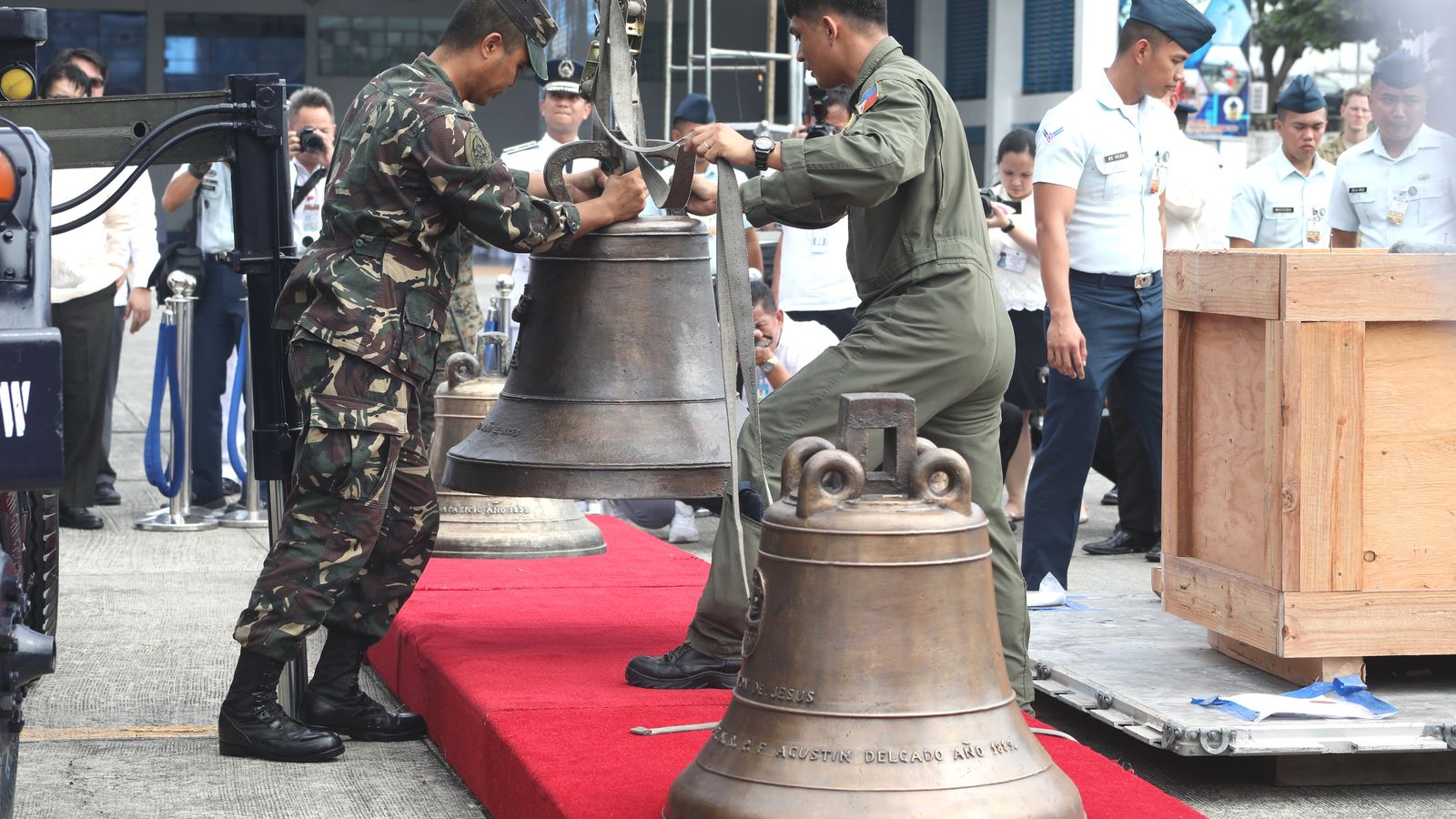
The United States stole bells from the Philippines for an entire century
In 1901, during the Philippine-American War, U.S. forces committed an infamous act of cultural theft. After a brutal battle in the town of Balangiga on the island of Samar, where Filipino resistance fighters ambushed and killed dozens of American soldiers, U.S. troops retaliated with devastating force. As part of this response, and a bit out of spite, they seized some church bells as war trophies.
These bells, known as the Balangiga Bells, were taken back to the United States and became a symbol of American victory, with two of them displayed at F.E. Warren Air Force Base in Wyoming and the third at a U.S. Army Museum in South Korea.
For over a century, the Philippines repeatedly requested the return of the bells, but these pleas were largely ignored or met with resistance from various U.S. officials and veterans’ groups who saw the bells as sacred military relics. It wasn’t until 2018, after years of diplomatic efforts and growing pressure, that the United States finally agreed to return the Balangiga Bells to the Philippines, bringing them back home more than a century after they were taken.
Medieval Christians were jealous of Viking hygiene
Examining the skeletons and cultural records of Viking cultures, historians have found that they had surprisingly good hygiene, with everything from regular baths to a decent dental routine. Some old Norse poetry, such as the Havamal, even refers to the importance of starting each day your hair washed and combed, as you never know which day could be your last and you don’t want to appear before the gods unkempt.
Interestingly though, one confirmation of their cleanliness comes from the writings of their rivals, the Christians, who believed that such clean bodies were seductive to their women. In the year 1002, after the massacre of the Danes, one letter read,
“The Danes made themselves too acceptable to English women by their elegant manners and their care of their person. They combed their hair every day, bathed every Saturday, and even changed their garments often. They set off their persons by many such frivolous devices. In this manner, they laid siege to the virtue of the married women and persuaded the daughters, even of the nobles, to be their concubines.”
You think they would have taken this as a hint that bathing more often might be a good thing, but they reacted quite oppositely. In fact, Christian scholar Alcuin even wrote to a few kings that the English people were being raided by Vikings because God was punishing them for being too prideful in their appearance.
In hindsight though, it does just sound like the priests were a bit jealous.
The Great Fire of London helped save the city from the Blitz
After the Great Fire of London devastated the city for four days in 1666, the center of the city was in ruins. However, with its destruction came the chance to rebuild it, and instead of constructing it once again from tightly packed wood structures, it was decided that stone would be put to use to help prevent the spread of a future fire.
The 1667 Rebuilding Act aimed to do just this, instructing that every new building be made from brick or stone, and any buildings in violation of this code would be demolished. It also helped push the city to change the way their water pipes work, with plugs periodically placed, essentially the inklings of a fire hydrant system.
But what these people couldn’t have foreseen was that these changes would save lives hundreds of years in the future. Fast forward to World War 2, with Germany bombing London night after night. The Blitz was absolutely devastating to London, reducing much of it to rubble, but if it hadn’t been rebuilt from less flammable materials, things could have been much worse.
To see what might have been, we can look to Tokyo. Unfortunately for the Japanese, Tokyo had never been subject to something akin to the Rebuilding Act of 1667, and so by the time World War 2 rolled around, the densely populated city was still almost entirely made of wood.
And the United States took full advantage of this with the Firebombing of Tokyo. In a single night, a squadron of bombers set fire to central Tokyo, leaving 100,000 dead and over a million homeless. One can only imagine how differently World War 2 would have gone if Germany had been able to pull something similar in London.
Einstein’s biggest blunder wasn’t a blunder
Not even a genius on the level of Einstein was immune to doubting his own work. When Einstein was working on his equations for general relativity, he introduced a term known as the cosmological constant, a variable intended to counteract the effects of gravity to maintain a static universe, which was the common model of the universe at the time.
However, not long after, astronomer Edwin Hubble discovered that the universe was not static, but rather, expanding. This revelation made Einstein’s cosmological constant seem unnecessary, and he regretfully referred to it as his greatest blunder.
But the story later took an interesting turn. A few decades later, scientists discovered that the universe’s expansion is not steady, but accelerating. This mysterious acceleration couldn’t be explained by any current theories, leading to the revival of a force very much like Einstein’s cosmological constant that counteracts the force of gravity, dark energy.
So, in the end, Einstein was so smart that perhaps his biggest blunder was thinking he’d made his biggest blunder.
The Polynesians probably got to the Americas before Columbus
It was long taught that Columbus discovered the Americas, until it was determined that the Vikings had reached the coast of modern-day Canada a few hundred years earlier. And now, recent research indicates that another group might have also beaten Columbus, the Polynesians.
The Polynesians were masters of the Pacific, spreading their culture far and wide as they moved between islands with their masterfully crafted boats and navigational skills, and it seems they may have made it much further than Hawaii and Easter Island. For starters, recent genetic research strongly indicates pre-Columbian contact, with a study from the journal Nature finding that populations in the Marquesas and Easter Island had genetic admixture with indigenous populations of South America, suggesting contact long before the arrival of Europeans. The authors narrowed this contact down to between 1150 and 1230 AD, with the mixture into Easter Island happening a few decades later.
Then there are lots of other clues. Take for instance, the many words for the humble sweet potato, a plant which originates in the Americas and, mysteriously could also be found in eastern Polynesia before the discovery of the Americas. In Quechua, a language in the Andes, it is kumal, in the Marquesas, it is called kuma’a, in Samoa its umala, Rapa Nui it is Kumara, because many Ls were transformed into Rs in their language, a common linguistic occurrence, and so on. Looking at a map of the pacific, you can clearly see how the word for sweet potato transformed between languages as it was traded and introduced across the ocean. And this isn’t just a random addition or subtraction of letters, the evolution of words as Polynesian languages morphed across the Pacific is a well-documented linguistic phenomenon, sometimes referred to as “dropping consonants out of their boats as they rowed”.
Though sweet potatoes aren’t the only plants that are brought up as evidence. There is also the coconut. Coconuts were introduced to South America and the Caribbean by European settlers, as they are native to the areas around the Indian Ocean, but there are actually a couple types of coconut that were already present in South America before the plant was introduced by settlers, and they are found on the western coast. A study in the journal Genetic Resources and Crop Evolution investigated the origin of this plant, and suggests that a seafaring Austronesian society brought the coconut to South America around 2,250 years ago.
And then there are parasitic worms. Yes, you head that right. Certain types of hookworms have been found in the remains of native Americans and in Asian populations, which wasn’t able to be previously explained by the Bering Strait crossing theory. This is because these hookworms spread and lay their eggs in the soil, but they require a temperate of 22 degrees Celsius to stay alive.
It would have been far too cold for this along the frozen Bering strait, which has led many to speculate that their arrival in the Americas came from a crossing of the Pacific, where it could have stayed warm throughout the trip.
And these are far from the only pieces of evidence, with seemingly more uncovered the deeper we look. Of course, in any realm of science, we need to remain skeptical, but given the mounting evidence and general plausibility of earlier contact, it seems very possible that the Polynesians did indeed make contact with Native Americans before Columbus ever did.
Paper clips were a sign of resistance in Norway
The nation of Norway was largely caught by surprise when they were invaded by Nazi Germany in April, 1940, who quickly took control over the weaker country and fully occupied it. The main reasoning for the invasion was to gain access to Norway’s vast natural resources, as well as their heavy water plant that would be vital for Germany’s atom bomb program.
But Norway wasn’t content to just sit around and let the Nazis boss them around, and they organized one of the most successful resistances of the entire war, assassinating officials, sabotaging equipment, and even organizing larger-scale armed assaults.
Before the resistance could catch on though, the movement needed to begin, and one of its earliest highlights was at Oslo University. It was here that students organized the first outbreak of civil disobedience, wearing paper clips on their lapels to signal their resistance to German occupiers and their allegiance to their nation. It seems like your average, everyday item, but the paper clip was symbolic, a sign of unity and solidarity, binding the people together.
Eventually though, the Nazis caught on, and wearing a paper clip was made strictly illegal. Being arrested for wearing one could lead to severe punishment as it was associated with the resistance movement, but it still maintained its popularity until Norway was liberated.
There were three US presidents in 1881
It began with Rutherford B. Hayes, who was the outgoing president in early 1881. He did not seek re-election, and his term ended on March 4, 1881. He was succeeded by James A. Garfield, who took office the same day as the 20th President of the United States. However, Garfield’s presidency was tragically cut short.
On July 2, 1881, just four months into his term, Garfield was shot by Charles J. Guiteau, a disgruntled office-seeker. Garfield survived the initial shooting but succumbed to his wounds on September 19, 1881, after months of suffering and medical complications. This made him the second U.S. president to be assassinated.
Upon Garfield’s death, Vice President Chester A. Arthur was sworn in as the 21st President of the United States on September 20, 1881. Arthur served the remainder of Garfield’s term, making him the third president to hold office that year, something that has not happened since.
People whipped themselves trying to cure the black death
During the 14th century, the Black Death ravaged Europe, killing an estimated 25 to 30 million people—about a third of the continent’s population. In the face of such a devastating and mysterious plague, people turned to desperate measures to seek divine intervention and redemption. One of the most extreme responses was the rise of the flagellants.
The flagellants were groups of devout Christians who believed that the Black Death was God’s punishment for humanity’s sins. To atone and seek mercy, they practiced public self-flagellation—whipping themselves with leather straps, often embedded with metal spikes, as they marched from town to town. These processions could last for days, drawing large crowds as the flagellants chanted prayers, sang hymns, and whipped themselves into bloody submission as they marched from town to town.
While they believed this extreme penance would ward off the plague, their gatherings likely inadvertently made the situation worse. The mass processions only helped spread the disease even faster, as large groups of people moved between towns and villages to watch them, spreading the disease amongst themselves more easily.
Neanderthals created art, perhaps even before homo sapiens
For a long time, Neanderthals were viewed as simple, brutish, distant relatives of modern humans, lacking the capacity for complex thought or culture. However, recent archaeological discoveries have turned that stereotype on its head, revealing that Neanderthals were, in fact, capable of creating art.
In several caves across Europe, researchers have found evidence of Neanderthal artwork that dates back as far as 65,000 years—well before modern humans arrived in Europe. One of the most striking examples comes from a cave in Spain, where red ochre pigments were used to create abstract symbols and handprints on cave walls. These paintings are the oldest known examples of cave art, and they suggest that Neanderthals had a sense of symbolism and possibly even spirituality.
Other findings, like engraved bones, shell ornaments, and tools decorated with geometric patterns, often buried with their owners, further demonstrate their artistic understanding. These discoveries suggest that Neanderthals had cognitive abilities and a cultural life that was far more sophisticated than previously thought, and also puts into perspective how humans ended up interbreeding with them, as they were a lot more similar to us than we previously gave them credit for.
The Korean alphabet was invented to be easy to learn
The Korean alphabet, known as Hangul, is one of the few writing systems in the world that can be attributed to a specific creator and date. It was invented in 1443 by King Sejong the Great of the Joseon Dynasty, with a clear purpose in mind: to be easy to learn and accessible to everyone, regardless of their social status or education level.
Before Hangul was created, Koreans primarily used Classical Chinese characters, which were, and still are, very complex and difficult to learn, making literacy a privilege only available to the elite. To address this, King Sejong commissioned a group of scholars to develop a new script that would be simple, logical, and easy to understand. The result was Hangul, a phonetic alphabet that today consists of 14 consonants and 10 vowels, designed to represent the sounds of spoken Korean clearly and systematically.
What makes Hangul particularly unique is that its letters are shaped to mimic the position of the tongue, mouth, and throat when producing each sound, making it intuitive and quick to grasp. The system was so effective that King Sejong famously described it as so easy “a wise man can acquaint himself with them before the morning is over, and even a stupid man can learn them in the space of ten days.”
Napoleon was once attacked by an army of rabbits
Napoleon Bonaparte, the famed military leader who conquered much of Europe, once faced an unexpected adversary: a swarm of rabbits. This bizarre incident occurred in 1807, after the signing of the Treaties of Tilsit, when Napoleon decided to celebrate with a grand rabbit hunt.
Napoleon’s chief of staff, Alexandre Berthier, was tasked with organizing the hunt and went all out, gathering thousands of rabbits—some accounts say as many as 3,000. The rabbits were caged around the hunting grounds and released as soon as Napoleon and his party were ready.
However, things didn’t go as planned. Instead of fleeing in fear, the rabbits turned and charged directly at Napoleon and his hunting party. The rabbits, likely accustomed to humans from being kept in captivity, saw the men not as threats but as sources of food, and they swarmed toward Napoleon en masse.
Napoleon tried to fend off the fluffy onslaught with his riding crop, but the rabbits overwhelmed him and his men. His marshals and aides joined in, trying to shoo the rabbits away, but the relentless wave of bunnies continued. In the end, Napoleon had to retreat to his carriage to escape the onslaught.
The Pyramids used to have shiny, polished tops
When we think of the Great Pyramids of Giza, we often picture their rough, weathered surfaces, but in ancient times, these iconic structures looked quite different. The pyramids were originally covered with a smooth, polished layer of white Tura limestone, which gave them a smooth, almost reflective surface. At the top sat a special capstone made of precious metal, which, while traditionally referred to as solid gold, most likely wasn’t. It was more likely shell on a capstone and made of an alloy such as electrum, a natural alloy of gold and silver with traces of a few other metals.
However, over time, this original shine was lost. Pieces of the metal were stolen or broke off, and the limestone eroded, leaving the rough, sandstone-colored pyramids we’re familiar with today.
The Sphinx once had a nose, and maybe a beard
Standing at 66 feet tall and 240 feet long, the Sphinx is believed to have been carved around 2500 BC during the reign of Pharaoh Khafre, or perhaps much earlier. However, what we see today is not quite the Sphinx that ancient Egyptians would have known. At some point in its long history, the Sphinx lost its nose, leading to much speculation and legend.
Contrary to popular myth, it wasn’t Napoleon’s soldiers who shot off the nose with cannon fire, as sketches from before Napoleon’s time show the nose was already missing. The most widely accepted view among historians is that it may have been deliberately chiseled off by a Sufi Muslim leader in the 14th century, who viewed the Sphinx as a pagan idol after catching the locals worshipping it.
Interestingly, there is also evidence that the Sphinx once sported a stylized pharaonic beard. Fragments of a stone beard, found at the base of the Sphinx, are now housed in the British Museum and the Egyptian Museum in Cairo. The beard may have been a later addition, perhaps added during a restoration in the New Kingdom era, around 1400 BC, to align the Sphinx more closely with the depictions of Egyptian kings.
So, while we’re used to seeing the weathered, mysterious face of the Sphinx gazing across the Giza Plateau today, in its original form, just like the pyramids, it must have looked quite different.
Gutenberg did not invent the first printing press
While his invention certainly revolutionized literacy in Europe, Johannes Gutenberg is often mistakenly credited with being the original inventor the printing press around the year 1440, but the truth is, the concept of printing had already been around for centuries. Long before Gutenberg, movable type printing was being developed and used in East Asia. The world’s first known movable type printing press was invented in China around 1040 by Bi Sheng, a Chinese commoner during the Song Dynasty.
Bi Sheng created movable type by carving individual characters onto small blocks made of clay and setting them into an iron frame. This allowed for the arrangement of characters in any order, making the printing of multiple copies much faster and more efficient than previous woodblock printing methods. A few centuries later, Korean printers took the technology even further by developing movable metal type, producing a complete printed book, a Buddhist text called the Jikji, in 1377—nearly 80 years before Gutenberg’s Bible.
Columbus used a lunar eclipse to scare natives
During his fourth and final voyage to the New World, Christopher Columbus found himself stranded on the island of Jamaica in 1503, with his ships in disrepair and his crew desperate for supplies. At first, thelocal Taíno people provided Columbus and his men with food and resources, but as time went on, tensions rose, and the islanders grew weary of supporting the stranded Europeans. Columbus, however, had a trick up his sleeve—the European knowledge of astronomy. More specifically, he was aware that a lunar eclipse was predicted for the night of February 29, 1504. Using this information, he devised a plan to intimidate the Taíno into continuing to provide for his crew. Three days before the eclipse, Columbus met with the local Taíno chiefs and warned them that his Christian god was angry with them for withholding food and supplies. He claimed that in three days, God would make the moon disappear as a sign of his displeasure. When the night of the eclipse arrived, the moon slowly began to vanish from the sky, turning a deep red, just as Columbus had predicted. The frightened Taíno, seeing this celestial event as a divine sign, quickly agreed to resume supplying Columbus and his men with provisions. As the eclipse continued, Columbus pretended to pray and promised that he would ask his god to forgive the islanders. When the eclipse began to recede, the Taíno believed Columbus had restored the moon through his connection to the divine, and they continued to aid his crew until a rescue ship arrived months later. Hitler’s health was a total disaster While Hitler was generally healthy throughout most of his early life, his health took a steep downward turn in his last decade or so, brought on by the stress of a losing war, being a severe hypochondriac, and a concoction of strong medications administered by his personal physician. Beginning in the mid-1930s, he complained of stomach cramps, digestive issues, colon complications, and heart palpitations, but doctors couldn’t find any clear source of the issues. A non-cancerous mass was removed from his throat, and he started getting eczema on his legs. To manage his worsening anxieties, Hitler surrounded himself with doctors, but none would end up being more influential than Dr. Theodor Morell, his personal physician. Morell prescribed an astonishing array of treatments, including regular injections of vitamins, hormones, amphetamines, barbiturates, and other dubious “medications.” Hitler’s medicine cabinet was filled with dozens of different types of pills, powders, and liquids, which he took obsessively. By 1944, his already declining health was made exponentially worse when he was the victim of an attempted assassination, surviving a bomb blast at his Wolf’s Lair headquarters. The explosion burst both of his eardrums, badly burned and swelled his left arm, and covered him in splinters and superficial cuts. By this point, one of his most striking symptoms, a trembling of the left hand and leg, was getting significantly worse, and he began holding them behind his back to hide them when speaking in public. He also suffered from severe insomnia, exacerbating all other symptoms he was experiencing. When he spoke to Hitler Youth soldiers in March 1945, he was bent over, walked slowly, was shaking, and could barely be heard. There has been a lot of speculation over the years as to what caused all of these issues, aside from the aforementioned extreme wartime stress. It’s believed by some that he contracted syphilis during WW1, and though he received treatment, the symptoms may have returned in the late 1930s. Others have suggested Parkinson’s, Huntington’s disease, and even the possibility that he only had one testicle. India had the first hot tubs Long before the luxurious spas of today, the people of the ancient Indus Valley Civilization—one of the world’s earliest urban cultures—were enjoying their own version of a hot tub. Around 2500 BCE, in what is now modern-day Pakistan, the city of Mohenjo-Daro was a well-designed urban center, with complete with streets, residential zones, and even early sewage canal systems. But one interesting finding was the common use of baths, and even bath houses, many of which, including the famed “Great Bath”, have been found with many nearby furnaces. This had led to the speculation that the furnaces were used to heat water that would be poured into the bath, amounting to what might be history’s earliest hot tubs. Alexander the Great wasted water to inspire his troops During his relentless campaign to conquer the Persian Empire, Alexander the Great led his army through some of the most challenging terrains on Earth, including the scorching deserts of Gedrosia (modern-day southeastern Iran and Pakistan). In 325 BC, as he and his men crossed this barren wasteland, they were tormented by extreme heat, thirst, and exhaustion. Many of his soldiers began to lose hope, fearing they would perish in the unforgiving desert, and many did, with the army losing an estimated 30,000 soldiers to the conditions during the 60-day march. One day, some scouts returned to Alexander with a precious gift: a helmet filled with water. Knowing that the water could be a small but vital relief for their desperately thirsty king, they presented it to him with great care. However, instead of drinking it, Alexander did something remarkable. He took the helmet, thanked the scouts, and, in full view of his parched and weary soldiers, poured the water onto the sand, refusing to drink even a drop unless all his men could share the same luxury. The last German surrender of WW2 was months after the war’s end Most people think of the Nazi surrender on May 7th, 1945, as the official end of World War II in Europe. However, not all German forces got the message immediately—or were in a position to surrender right away. The last official German surrender actually took place months later, in a far-flung and unexpected location. The German weather station crew on the remote northern island of Svalbard, remained unaware of the war’s end. Stationed there to provide crucial weather reports for the German military, the crew of Operation Haudegen continued their work, completely cut off from news of the outside world. It wasn’t until September 4, 1945—nearly four months after Germany’s official surrender—that a Norwegian seal-hunting ship arrived to inform them that the war was over. The ten-man crew was stunned by the news, and their surrender on September 4, 1945, marked the very last act of German capitulation in World War II. Early Vikings may have used a sun compass The Vikings were known for their incredible seafaring skills, venturing across the North Atlantic in longships to explore, trade, and raid distant lands. But how did they manage to navigate the open ocean with such precision, long before the invention of the magnetic compass? Recent discoveries suggest that the Vikings might have used an ingenious tool known as a “sun compass.” The “sun compass” theory stems from a wooden fragment found in a Viking settlement in Greenland, which had a circular disk with a central pin. The disk was marked with concentric circles and may have been used to measure the position of the sun. By aligning the pin’s shadow with specific markings, Vikings could determine their latitude, even when the sun was low on the horizon. What made this tool even more remarkable was that it could be used in conjunction with “sunstones,” translucent crystals that polarize light. The most popular of these was probably Iceland Spar, or Calcium Calcite, an extremely clear crystal that can be found in the region. These stones could help the Vikings determine the sun’s position even on cloudy or foggy days, which were common in the North Atlantic. By using the sun compass and sunstones together, Viking navigators could maintain their course across vast, open seas without any landmarks in sight. The oldest cheese in the world was found in Egypt While investigating a collection of jars found in the tomb of Ptahmes, a high-ranking Egyptian official from around 3 thousand years ago, scientists found an unidentified substance left in some of the jars. Imagine their surprise when chemical analysis revealed that the substance was none other than cheese. The lead researcher said, “The material analyzed is probably the most ancient archaeological solid residue of cheese ever found to date.” They’ve since determined that it was made mostly from sheep’s milk, and, while they deny actually tasting it, assert that chemical analysis shows that it was likely quite acidic with a strong, sour flavor. Dated to the 13th century BC, it’s currently the oldest cheese ever found. Winston Churchill had a doctor’s note to drink alcohol in the US Winston Churchill, the British Prime Minister known for his love of cigars and champagne, faced a potential problem when he visited the United States in 1931. During this period, the U.S. was still in the midst of Prohibition, a nationwide ban on the production, import, transport, and sale of alcoholic beverages. Churchill, however, was not one to let such a law interfere with his lifestyle. Shortly before his visit, Churchill had been in a car accident, which left him with some injuries, including some pain in his chest. Seizing this opportunity, his doctor wrote a note prescribing alcohol as part of his recovery. The note specifically stated, “the use of alcoholic spirits, especially at mealtimes, is an absolute necessity” due to the nature of his injuries. Armed with this official prescription, Churchill was able to legally obtain alcohol throughout his stay in the United States, and he continued to enjoy his favorite drinks while engaging in diplomacy and discussions with American officials. China built an entire fleet just to show off their money During the early 15th century, China embarked on one of the most impressive and ambitious naval projects in history under the leadership of Admiral Zheng He. The Ming Dynasty commissioned a fleet of gigantic treasure ships, known as baochuan, to sail the seas and showcase China’s immense wealth, technological prowess, and political might. These treasure ships were unlike anything the world had seen before. Some were said to be nearly 400 feet long, though other scholars think this is quite the exaggeration and have scaled the numbers down a bit since. Regardless of their exact size, they each featured multiple decks, nine masts, and could carry several hundred passengers, along with massive amounts of cargo, including gold, silk, porcelain, and other luxury goods, which they were packed with. The fleet overall was made up of hundreds of ships, including supply vessels, troop carriers, and warships, all serving to support the mighty treasure ships and, in total, carrying more than 25,000 men. From 1405 to 1433, Zheng He led seven grand voyages across the Indian Ocean, visiting Southeast Asia, India, the Persian Gulf, and even the eastern coast of Africa. Several kingdoms wrote about the visits, and even many famous explorers got a glimpse of the grand fleet, including Marco Polo. What’s unique about these expeditions is that they weren’t aimed at colonization or military prowess, but rather to foster trade and to show off China’s wealth, hoping to establish themselves as the cultural and financial center of the world. The USSR basically deleted the Aral Sea Once the fourth-largest lake in the world, the Aral Sea, located between Kazakhstan and Uzbekistan, was nearly “deleted” from the map due to a massive Soviet agricultural project. In the 1960s, the Soviet Union began an ambitious plan to turn Central Asia into a major cotton-producing region, dubbing cotton “white gold” and expecting the region to become a major source of wealth for the nation. To achieve this goal, Soviet planners began diverting the two rivers that fed the Aral Sea—the Amu Darya and the Syr Darya—into a complex network of irrigation canals. This allowed the previously arid plains to be transformed into farmland, but at a massive ecological cost: the water supply to the Aral Sea was drastically reduced. By the 1980s, the sea had begun to shrink rapidly. The consequences were disastrous—what was once a vast inland sea teeming with fish became a series of increasingly smaller and saltier lakes. The fishing industry, which had supported thousands of local jobs along its coast, collapsed entirely. Toxic dust storms, caused by the exposed seabed contaminated with agricultural chemicals, began spreading diseases and causing environmental havoc in the region. By the early 21st century, the Aral Sea had lost nearly 90% of its water volume, becoming one of the most dramatic examples of environmental mismanagement in history. Ancient cultures used meteors to make iron tools Long before humans learned to smelt iron from ore, ancient civilizations were already working with iron—iron that literally fell from the sky in the form of meteors. Ancient Egyptians, for example, crafted meteoric iron beads around 3200 BCE, nearly two millennia before the Iron Age, and ancient Inuit living in Greenland sharpened chunks of meteorite into harpoon tips and knives. But the most famous example is the dagger found in the tomb of the Egyptian pharaoh Tutankhamun. The blade, which dates back to the 14th century BC, was crafted from meteoric iron and has been polished to a fine finish. Yugoslavia had a special luxury train for foreign diplomacy Built in the 1950s, and nicknamed the “Blue Train”, Yugoslavia’s diplomacy train was fitted with opulent accommodations, including lavish salons, a presidential suite, meeting rooms, a dining car that could seat dozens of guests, and even a room for the personal barber of Josip Tito. Tito used the Blue Train for domestic travel across the diverse regions of Yugoslavia and for international visits, receiving foreign dignitaries, heads of state, and political allies wherever possible. And of course, the train was heavily armored and guarded to ensure the highest levels of security, granting Tito the perfect place to negotiate his nation’s precarious position in the Cold War. Throughout its years in operation, it hosted many high-profile guests, including Queen Elizabeth II, Haile Selassie of Ethiopia, and many more. Teddy Roosevelt had a rebellious daughter The eldest daughter of President Roosevelt, Alice, was one of the most rebellious and charismatic figures of early 20th century American society. Dubbed “Princess Alice” by the press, she was famous for her sharp wit and bold personality, defying social norms expected of women at the time. Growing up in the spotlight due to her dad’s fame, her unconventional behavior quickly became a media sensation. She smoked cigarettes in public, drove around with boys late at night, stayed out partying into the early hours of the morning, and even carried around a pet snake in her purse, which she named Emily Spinach. She once famously buried a voodoo doll of Nellie Taft, the wife of President William Howard Taft, in the White House Garden just to make a point, and wasn’t afraid to publicly criticize any political figure, including her family members. When asked about her behavior, her father told the press, “I can either run the country or I can attend to Alice, but I cannot possibly do both.” Alice would live to age 96, and according to those that knew her best, she kept her rebellious nature and sharp wit throughout even her latest years. The first recorded joke is a fart joke Inscribed on a cuneiform tablet dating back to 1900 BC in ancient Sumer is what appears to be the world’s earliest recorded joke, and it just so happens to be a fart joke. It reads, “Something which has never occurred since time immemorial; a young woman did not fart in her husband’s lap.” Obviously, the joke and its context have lost some of their humorous punch over the millennia, but it is absolutely fascinating to see that flatulence has been the source of jokes for about as long as humans have been writing them down. It also highlights that despite the thousands of years between us, we might not be as different from our ancestors as we think. Paraguay allowed Polygamy after the War of the Triple Alliance The war of the Triple Alliance was fought in the mid-19th century by Paraguay against an alliance made up of Argentina, Brazil, and Uruguay, in a misguided effort to bolster the nation’s power that quickly transformed into one of the bloodiest conflicts in Latin American history. And Paraguay got the worst of it, being dealt several decisive defeats and having their army essentially annihilated. Part of the problem was that Brazil had a “take no prisoners” approach, leading to thousands of captured men being slaughtered. In the aftermath of the war, Paraguay had lost so many men that they only made up 13% of the nation’s population, and the country was now faced with the prospect of rebuilding their society with a drastic lack of male citizens. The result, against all traditional and especially Catholic norms, was to temporarily overrule the laws against polygamy, and encourage women to share their husbands with other women to help boost the population. Suffice to say, if you were a veteran of the war, you had no problem finding a wife. This unofficial policy was left in place for a couple decades and gradually shifted out of the norm as the nation’s demographics began to recover. The Mongols used psychological warfare to take cities without a fight While the Mongols were known for their ruthless military tactics and devastating cavalry charges, they also employed psychological warfare to great effect, often causing entire cities to surrender without a single arrow being fired. Chief among these tactics was the use of fear and intimidation, as the Mongols were masters of creating an aura of terror around their forces. Before attacking a city, they would send messengers demanding immediate surrender, promising mercy to those who complied and utter destruction to those who resisted. These messengers would often be accompanied by stories of previous cities that had resisted Mongol attacks, only to be completely annihilated, with their populations massacred or enslaved. To further amplify the fear, the Mongols would sometimes employ tricks like lighting multiple campfires at night or using dummies and mannequins to make the attacking force appear much larger than they actually were. They also spread rumors and used spies to spread exaggerated tales of their cruelty and invincibility. On several occasions, this led to entire cities surrendering without a fight. However, it’s no secret that the Mongols were ruthless, and even if a large city willingly let themselves be conquered, the town was often still razed and looted all the same. The term Aspergers was coined by the Nazis The term “Asperger’s Syndrome” is named after Hans Asperger, an Austrian pediatrician who first described the condition in 1944. He identified a group of children who exhibited distinct behavioral patterns, including difficulties with social interactions, narrow interests, and strong verbal skills. He called these children “little professors” due to their ability to talk extensively about their specific interests. His research laid the foundation for what would later be known as Asperger’s Syndrome, considered a form of autism for many years until the diagnosis was recently retired. However, the story is much darker than this. Asperger’s work wasn’t performed with the intent of learning more about these children or teaching them how to function in society, it was done to see if they would be of any practical use to the Nazi regime, and if they weren’t, to simply use them for scientific experimentation or just have them outright euthanized. For many years, it had been believed that he was actually one of the good guys, who used his position to save children from such a fate, but historians began finding evidence that he supported their elimination, only protecting the kids he deemed highly intelligent. This is because recently discovered medical records show that he referred dozens of children to the Am Spiegelgrund clinic, which was widely known for its child euthanasia. While nearly 800 children would ultimately die in this clinic, Asperger himself went on to enjoy a long and fruitful academic career after the war until his death in 1980. Knowing this, it’s quite unsettling that the diagnosis was named after him, and probably for the best that it’s now no longer in use, with the symptoms now simply falling under the broader autism spectrum disorder. Surgeons used to wear bloody aprons to show their experience The Renaissance, often celebrated as a time of great artistic and scientific advancements, had its quirks, especially in the world of medicine. In the 16th and 17th centuries, surgery was a rough and ready practice. Surgeons were often seen as less prestigious than physicians, who primarily dealt with internal medicine and did not perform gruesome and often risky operations. To set themselves apart and attract clients, many surgeons took to wearing robes stained with the blood of their past procedures. The more blood, the better—it was a badge of honor that suggested they had performed many surgeries and had years of hands-on experience. Fortunately, this incredibly unhygienic trend eventually went out of style, and by the 1800s, cleanliness became the new norm, meaning you no longer had to worry about being contaminated with whatever diseases were present in the previous patient’s blood. The Buddhas of Bamiyan had a tough life Carved into the cliffs of the Bamiyan Valley in central Afghanistan, the Buddhas of Bamiyan were once two of the world’s most remarkable examples of ancient sculpture. These massive statues were carved directly into the sandstone cliffs around the 6th century AD by Buddhist monks. For centuries, they stood as the tallest standing Buddhas in the world, symbolizing the rich cultural heritage of the region. The statues were originally covered in vibrant paint and adorned with intricate details, which made them not only religious icons but also masterpieces of ancient art. They were part of a thriving Buddhist monastic complex that included hundreds of caves filled with frescoes and small carvings, making the Bamiyan Valley a major center for Buddhist pilgrimage and culture along the Silk Road. However, this also made them a target for those who opposed Buddhism and viewed it as a threat. The Mongols attempted to destroy the statues in 1221, followed by the Mughal emperor Babur in 1528. Later, another Mughal emperor, Aurangzeb, ordered heavy artillery to be fired at them, destroying their legs, and cannons were shot at them again in the 18th century by Persian king Nader Afshar. But they managed to survive all of this, and though they were a bit battered, they made it all the way until the 21st century, until they were finally destroyed by the Taliban. The Taliban declared that the statues were idols contrary to their interpretation of Islamic law, and needed to be removed. There were widespread international attempts to save the statues, with some countries like Pakistan offering to pay for their maintenance and preservation, and Japan even offering to literally design a new method to pick them up and move them, but all to no avail. The Taliban planted explosives along them and inside drilled holes, and in 2001, destroyed the 1500-year-old monument. The wheel was independently invented in the ancient Andes The invention and use of the wheel is often associated with the great civilizations of the Old World, like Mesopotamia, Egypt, and China, but it was also independently invented in ancient America. The fascinating twist, though, is that it was mainly used for toys rather than transportation or practical tools. Archaeologists have discovered small clay or wooden figurines with wheels attached, dating back to around 1500 BC, in several Mesoamerican cultures, including the Olmecs and the Maya. These wheeled toys, shaped like animals or carts, featured small axles and wheels, demonstrating that the concept of the wheel was well-known to these ancient civilizations. However, despite understanding the basic principles of the wheel, these cultures didn’t ever use it for larger-scale applications like carts or chariots. There are several theories as to why this is the case, but the simplest explanation is that Mesoamerica’s rugged and mountainous terrain made wheel-based transportation less practical, as opposed to the flat plains and deserts of the old world, as well as the fact that ancient American societies lacked large, domesticated draft animals like horses to pull wheeled vehicles. Bird poop used to be highly valuable During the 19th century, bird poop became a highly prized commodity, specifically in the realm of agriculture. Guano, the accumulated excrement of seabirds, bats, and other flying creatures, is incredibly rich in essential nutrients like nitrogen, phosphate, and potassium, making it an exceptionally effective natural fertilizer. The value of guano was discovered by European farmers in the early 1800s, who noticed its incredible ability to revitalize depleted soils and dramatically increase crop yields. This discovery sparked what became known as the “Guano Boom,” with countries like Britain and the United States scrambling to secure vast quantities of guano to fuel their agricultural industries. The best guano deposits were found on remote islands off the coast of Peru and in the Pacific, where massive colonies of seabirds had been nesting and excreting for centuries. By the mid-19th century, these islands had become sites of intense international competition. To secure access, the United States even passed the hilarious Guano Islands Act in 1856, which allowed American citizens to claim any uninhabited island with the smelly deposits on behalf of the country. Peru became especially wealthy from guano exports, earning vast sums from this natural resource and temporarily transforming its economy. However, the guano boom eventually ended as deposits were depleted, and just as fears began rising that the world’s farms wouldn’t be able to sustain the growing global population, synthetic fertilizers were invented. The SS Baikal was a pretty big waste of money The SS Baikal was an ambitious project by the Russian Empire to create a massive icebreaking ferry for Lake Baikal, the world’s deepest freshwater lake, located in Siberia. The reason they needed such a big boat was for the construction of the Trans-Siberian Railway, a massive rail line intended to connect Moscow with the Russian Far East. However, Lake Baikal interrupted the rail line, and the terrain around the lake was deemed too rugged for train tracks, and so they decided to build a massive icebreaking ship to carry train cars and connect the two halves of the railway. Constructed in 1896, the SS Baikal was honestly a marvel of its time, weighing more than 4,000 tons. It was fitted with reinforced steel and powered by three steam engines, giving it the strength to break through Lake Baikal’s thick ice. The vessel was shipped in parts and assembled on-site at the lake—a monumental effort in itself. However, the SS Baikal quickly proved to be a bit of a waste of money. Despite its powerful design, the ferry often struggled to break through the lake’s thick winter ice, which could reach several feet in depth. It frequently became stuck and required significant repairs and maintenance, draining the program’s funds. Additionally, the ferry could only operate during specific times of the year, and delays were common due to severe weather conditions. This was all such a hassle that within a few years the government went ahead and authorized the construction of Trans-Siberian Railway around Lake Baikal, making the ferry largely obsolete, and the ship ended up being used only sparingly until it was severely damaged during the Russian Civil War in 1918 and eventually scrapped. An 1857 shipwreck sparked a 1990s insurance battle The SS Central America was a US vessel that sank in a hurricane off the coast of South Carolina in 1857, carrying 578 passengers and crew, along with many tons of gold that had been mined in the California Gold Rush. The shipwreck was one of the greatest maritime disasters in American history, causing the loss of hundreds of lives and contributing to the financial panic of 1857. Along with the human tragedy, an estimated $2 million worth of gold—equivalent to well over a hundred million today—went down with the ship. For well over a hundred years, the shipwreck’s location was a tantalizing mystery, with millions of dollars’ worth of gold just waiting to be found. And found it was, by a treasure hunting team in the 1980s, who located the ship and retrieved the precious cargo using new remote-controlled submersibles. However, they didn’t get to immediately ride off into the sunset with their newfound riches, and were instead immediately sucked into a fierce legal battle. You see, back when the ship had originally sunk, insurance companies across the US were forced to pay their clients hefty claims for the lost assets, and many of those companies were still around in the 1990s. They now wanted a cut of the treasure they’d been forced to pay for more than a century earlier, claiming that they had a right to significant compensation. The battle went on for years, but eventually a court ruling gave more than 90% of the findings to the treasure hunting team. Toronto once had a clown vs firefighter riot In the summer of 1855, Toronto experienced one of its most unusual public disturbances: a full-blown riot that began with a brawl between circus clowns and local firefighters. The trouble began when a group of clowns from the circus went to a local tavern called the Fireman’s Hall after a performance. The tavern was a popular hangout spot for the city’s Hook & Ladder Firefighting Company, whose members were known for their rough demeanor. At some point during the night, an argument broke out between the clowns and the firefighters over a local woman, escalating into a fistfight. The firefighting crew, angry but outnumbered, were initially beaten back and defeated by the clowns, but they soon regrouped and stormed the circus grounds, tearing through tents and causing chaos, destroying property, and fighting with various circus performers. At some point, a wagon was set on fire, causing the city’s fire bell to be rung. However, when more firefighters arrived on the scene, they didn’t bother putting out the flames, they instead ran to join their brothers in combat against the clowns. The riot turned so chaotic that the city’s police were unable to contain it, and the militia had to be called in to bring back peace. In the aftermath, dozens of police and firefighters were fired. The invention of the elevator safety brake made skyscrapers possible In 1852, an American inventor named Elisha Otis revolutionized the world with the invention of the elevator safety brake. Before Otis’s innovation, elevators were considered dangerous and unreliable, primarily used for transporting goods in factories or mines, rather than people. The biggest fear was that a hoisting rope might snap or a pulley could shatter, sending the elevator plummeting down its shaft. This happened on occasion, and wasn’t a problem when the only cargo was bags of coal, but posed a serious hurdle for the safety of using elevators to transport human beings. Otis’s solution was brilliantly simple yet highly effective. He developed a spring-loaded safety mechanism that would automatically engage if the elevator’s cable broke. The device featured a system of wagon springs attached to a ratchet, which would instantly clamp onto the elevator shaft’s guide rails if tension on the rope was lost. This safety brake essentially stopped the elevator car from falling, preventing potentially deadly accidents. To prove the effectiveness of his invention, Otis staged a dramatic demonstration at the 1854 New York World’s Fair. Standing on a platform suspended high above the crowds, Otis ordered the rope to be cut. As the audience gasped in horror, the platform dropped only a few inches before the safety brake engaged, halting the fall. Otis turned to the crowd and confidently declared, “All safe, gentlemen, all safe!” The Ottomans had their own tulip craze You may have heard of tulip mania, a period in Dutch history when tulip bulbs suddenly became immensely valuable for a few years, a strange and unique piece of economic history. But what’s less well-known is that the Ottoman Empire also had their own version, called the Tulip Era. The period, which roughly spanned from 1718 to 1730, was marked by a fascination with the flower that became a symbol of wealth, prestige, and refined taste. Tulips were brought to the Ottoman Empire centuries earlier, and had become a beloved flower in the gardens of Istanbul. But by the early 1700s, tulips reached the height of their popularity among the Ottoman elite. The ruling Sultan Ahmed III and his court were obsessed with cultivating rare and beautiful varieties, with some tulips fetching enormous prices due to their unique colors, shapes, and patterns. During this period, tulips permeated all aspects of Ottoman culture. Lavish tulip-themed parties and festivals were held, and the flower featured prominently in poetry, art, textiles, and even palace architecture. The tulip became a status symbol, with wealthy Ottomans competing to display the most exotic and valuable blooms in their gardens and homes. General MacArthur was fired for wanting to nuke China During the Korean War, General Douglas MacArthur clashed with President Harry S. Truman over how to conduct the conflict. MacArthur, who was a highly decorated and influential military leader, and a well-regarded war hero of the Second World War, had been initially successful in pushing back the North Korean forces, but was now faced with a tougher situation when China entered the conflict in late 1950. MacArthur, frustrated by the setbacks and convinced that a decisive victory required a stronger response, began publicly advocating for a much more aggressive strategy, including the possibility of expanding the war into China. He proposed bombing Chinese supply lines, blockading China’s coast, and even using nuclear weapons to halt the Chinese advance and destroy key military targets across North Korea and China. However, President Truman and his advisors were deeply concerned about the potential consequences of such an escalation. They feared that expanding the war into China could lead to a broader conflict with the Soviet Union, potentially sparking World War III, a greater concern now that the Soviets were developing their own atom bombs. These ideas put a lot of tension between the general and the president, culminating in him writing a letter to a congressman attacking Truman’s policies. Ultimately, MacArthur was fired for insubordination, a controversial move which was seen by some as ungrateful to the man’s legacy, but by others as necessary to stave off an even bigger war. One of the Aztec’s greatest warriors fell off a roof As the conquistadors and their native allies broke into the center of the Aztec capital of Tenochtitlan, the Aztec forces began to retreat, eventually being cornered in a market, where they prepared to make their last stand. They had now been constantly sacrificing and praying to their gods for weeks, hoping for some sort of relief, and their hopes were lifted when an owl warrior appeared on a rooftop, in full view of the Aztec army. The warrior, part of an elite class of soldiers called the Eagle and Jaguar knights, was dressed head to toe in a ceremonial owl costume, complete with an elaborate feathered headdress. In Aztec culture, owls were associated with darkness, death, and the underworld, and this warrior, considered to be among the best in the empire, wearing such a costume atop a temple was seen as a great omen of victory. However, the omen quickly changed when this grand warrior suddenly slipped and fell off the roof to his death. The accident was taken as the worst possible omen by the priests, who began foretelling of their impending defeat, which was delivered the next day. A newspaper once convinced Americans that there were bat-people on the moon In August 1835, the New York Sun, a popular American newspaper, published a series of articles that would become known as the “Great Moon Hoax.” The articles claimed that a renowned astronomer, Sir John Herschel, had made incredible discoveries on the moon using a powerful new telescope. The reports, supposedly reprinted from a scientific journal, captivated readers with detailed descriptions of a fantastical lunar landscape filled with various forms of life. According to the Sun, Herschel had observed lush forests, oceans, and herds of strange animals like unicorns, two-legged beavers, and even bat-like humanoids he called “Vespertilio-homo.” These “moon people” were said to be winged creatures with human-like features, who built temples and lived in a peaceful society. The stories included vivid illustrations and descriptions that enthralled the public, spreading quickly throughout the United States and even reaching Europe. For weeks, readers were spellbound by these sensational “discoveries,” and the New York Sun enjoyed a massive surge in circulation and advertisement revenue. However, of course, it was all a fabrication. The articles were written by Richard Adams Locke, a reporter for the Sun, who later admitted that the stories were intended as satire to poke fun at some of the wilder astronomical theories of the time, as well as to mock the gullibility of the public. The funniest part is that the astronomer himself, Herschel, didn’t even bother dispelling the myths, apparently finding it all rather amusing and noting that he wished his findings were so interesting, though he later became annoyed when people repeatedly asked him questions about it after the hoax had already been revealed. The world’s oldest amputation was in southeast Asia. In 2022, archaeologists discovered the oldest known example of a successful surgical amputation, dating back more than 31,000 years. The evidence comes from a prehistoric skeleton found in a cave in Borneo, Indonesia. The skeleton belonged to a young individual who, for whatever reason, had undergone the removal of their lower left leg. By the clues remaining, it does appear that this removal was intentional and surgical in nature, making it the earliest known amputation. What’s even more amazing though, is that the person survived the procedure, and, as indicated by how much the bone healed, it appears that the person lived for another six to nine years following the operation. Pythagoras believed beans were evil Pythagoras, the ancient Greek philosopher and mathematician best known for the Pythagorean theorem, founded a religious movement known as Pythagoreanism, which combined philosophy, mathematics, and mysticism. As part of his teachings, he imposed strict dietary rules on his followers, including an amusing ban on eating beans. The reasons for Pythagoras’s aversion to beans are still debated among historians, but several theories exist. Some suggest he believed that beans contained the souls of the dead, given the belief in transmigration or reincarnation that was central to his philosophy. Another theory is that he had correctly associated beans with flatulence, and may have thought that passing gas interfered with spiritual purity and mental clarity. Plato was a champion wrestler before becoming a philosopher Before Plato became one of the most well-known philosophers of all time, he had quite an athletic youth, and was actually an accomplished wrestler. In fact, his real name was Aristocles; “Plato” was a nickname given to him by his wrestling coach, derived from the Greek word “platos,” meaning “broad.” This name likely referred to Plato’s broad shoulders or strong physique, a trait that served him well in the wrestling ring. Plato came from a wealthy and influential Athenian family and received an education befitting his status, which included training in athletics. He was known to have competed in several wrestling competitions during his youth and was reportedly skilled enough to participate in the Isthmian Games, an event similar to the Olympic Games. Galileo’s middle finger was preserved After Galileo died in 1642, the astronomer was buried in a modest grave. About a century later, his remains were moved to a more prominent tomb in the Basilica of Santa Croce in Florence to honor his legacy, and it was during this move that some admirers of Galileo decided to take some “relics” from his body. They took three fingers, a tooth, and a vertebra. The finger was later mounted on a marble base, and preserved for display, where it has been ever since. The first patents were granted in the 15th century The concept of patenting inventions and ideas dates back much further than you might think. In 1421, the first ever recorded patent was given to architect and engineer Filippo Brunelleschi, granting him complete control for three years over a type of barge he had invented that utilized unique hoisting gear to lift and transport marble from ships onto land. Another early patent was granted in 1449 by King Henry VI of England to a man named John of Utynam. John, a Flemish glassmaker, was awarded a 20-year monopoly on his innovative technique for making stained glass, which was used in the windows of the Eton College chapel. However, there are hints that patents may even be much older than this. In the ancient Greek city of Sybaris, for example, in 500 BC citizens were encouraged to seek out new inventions or techniques, and if successful, profits from said invention were reserved for the creator for a full year. Land mines date back more than 700 years While often viewed as a modern weapon of war, the use of land mines dates back several centuries, essentially back to the beginning of the use of gunpowder for large explosives in ancient China. In a military treatise known as the Huolongjing, the authors describe several devices that are similar to modern-day land mines. The first of these were hollow iron shells filled with gunpowder and buried as an army retreated, lit with long fuses that were specifically timed to detonate as the enemy marched over them. But the more refined versions didn’t have a timer. One design describes a long length of bamboo that was filled with compressed gunpowder and iron pellets, and buried in the dirt. The mechanism for triggering its explosion wasn’t fully understood for some time, but essentially, when an enemy stepped on the hidden bamboo, they would dislodge a pin, which would cause two metal plates to spark against flint, igniting the gunpowder. Emperor Sigismund was above the law…and grammar In the early 15th century, Sigismund of Luxembourg was a man of many titles, starting out as King of Germany, then eventually becoming King of Bohemia as well, adding King of Hungary and Croatia, and finally the coveted title of Holy Roman Emperor. However, despite his many achievements as a monarch, for some historians, there’s one particular moment that shines above the rest. Between 1414 and 1418, numerous councils were held in order to try settling the religious schism that was dividing the Catholic Church. At one point, the emperor made a mistake in his Latin, allegedly using the wrong gender for a certain word, and a cardinal pointed out and corrected the mistake. Sigismund replied “Ego sum rex Romanus et super grammaticam”, or, “I am king of the Romans and above grammar.” This famous line has since earned him the nickname Super Grammaticam by several historians. The remains at skeleton lake are still a mystery Located in the Himalayas, Roopkund is a high-altitude glacial lake, surrounded by largely uninhabited, rocky land. It’s not very large, and its depth is only about 10 feet on average, which is why it was so surprising when in 1942 hundreds of human skeletons were found at its edges. Originally, it was believed that everyone present had been killed in a single event sometime around the 9th century, but, in the years since, DNA analysis has given us more insight, showing that the remains come from three distinct groups of people, that died in 2 events, one around the year 800 AD, and the other around 1800. Thanks to the cold weather year-round and the often-frozen lake, many of the bodies were in remarkably good condition when they were found, some with flesh even still attached, allowing scientists to perform semi-thorough autopsies on their bones. What they found was that the cause of death for many were many small, blunt force impacts from above. This seems to coincide with some sort of legendary, deadly hailstorm, tales of which, interestingly enough, are present in the local oral folklore. To make things even weirder though, DNA analysis also revealed that many of the skeletons deposited in the 1800s were from the Mediterranean, specifically Greece and Crete. Who they were and what they were doing all the way out in the Himalayas is entirely unknown. The American Revolution had battles in Great Britain While most of the American Revolution’s battles took place in North America, one of the war’s most daring and unusual episodes occurred on the other side of the Atlantic—right on English soil. This bold action was led by John Paul Jones, a Scottish-born naval officer who became a hero of the American cause after fleeing to the colonies as a fugitive. In 1778, Jones commanded the Ranger, a ship of the Continental Navy, and launched a series of raids along the coast of England and Scotland. His most famous attack was on the English town of Whitehaven, where he and his crew landed in the dead of night. Jones’s men spiked the town’s cannons to prevent them from firing and set fire to a ship in the harbor, causing panic among the townspeople before the Americans fled to Ireland. Though the damage was minimal, the psychological impact was significant—this was the first time in living memory that British homeland soil had been attacked by a foreign force. Jones didn’t stop there. Later, in 1779, commanding the Bonhomme Richard, he engaged in one of the most famous naval battles of the war against the British warship HMS Serapis off the coast of Yorkshire. Despite his ship being heavily damaged and on the verge of sinking, Jones refused to surrender, famously declaring, “I have not yet begun to fight!” He ultimately captured the Serapis after a brutal close-quarters battle, taking the new ship for himself as his previous one sank beneath the waves. Countess Elizabeth Bathory de Esced might have been history’s most prolific serial killer Born in 1560 into a powerful family, Báthory was known for her beauty, wealth, and high social status. However, she gained infamy for something far more sinister—allegations that she tortured and killed hundreds of young girls within the walls of her castle. According to legend, Báthory lured peasant girls to her castle under the pretense of offering them work, only to subject them to horrific acts of cruelty. The most macabre tales suggest that she believed bathing in the blood of virgins would preserve her youth, earning her the grim nickname, the “Blood Countess.” Reports of her brutality came to light when King Matthias II of Hungary ordered an investigation after hearing rumors of the atrocities. In 1610, authorities raided her castle and purportedly found evidence of her crimes, including bodies and imprisoned victims. Báthory was arrested and put on trial, where testimonies from witnesses and supposed accomplices painted a horrifying picture of her deeds. Though she was never officially convicted, likely due to her noble status, she was sentenced to life imprisonment and was confined to a small room in her castle until her death in 1614. Despite her terrifying reputation, some historians insist that she might have been framed, and suggest that the stories about Báthory were greatly exaggerated or possibly even entirely fabricated, likely as part of a political conspiracy to discredit her name and seize her vast lands and wealth. The longest marathon time in history was over 50 years This astonishing record belongs to a Japanese runner named Shizo Kanakuri, who began the marathon in the 1912 Stockholm Olympics alongside the rest of his competitors as normal. However, he wasn’t in a great condition to run at the time, since the trip to Sweden had taken 18 days by boat and by the Trans-Siberian railway, leaving him exhausted and with barely any time to rest before the games beagn. To make matters worse, his body was not agreeing with the local food, and his coach was also sick. On top of all this, the race happened to coincide with a record-breaking heatwave in Sweden, causing dozens of competitors to drop out of the race, including one runner, Francisco Lazaro, who collapsed mid marathon and tragically died. So about halfway through the race, struggling with fatigue, dehydration, and an upset stomach, Kanakuri left the track, and stumbled into a nearby property where a garden party was being held. The family who owned the property gave Kanakuri a bunch of orange juice, which he happily chugged, and reportedly let him even take a nap in their house. However, embarrassed by his failure to complete the race, he then hopped on a boat and returned to Japan without notifying anyone in Sweden, and he was added to the local missing persons list. For decades he remained technically “missing” in Sweden, until one day a Swedish reporter found him working as a geography teacher in southern Japan. As part of a show for Sveriges Television, they offered Kanakuri the opportunity to return to Stockholm and complete the marathon, an offer which he quickly accepted. On March 20th, 1967, he resumed the marathon, stopping by the house that had fed him the first time around. The son of the original owners welcomed him, offered him orange juice again as per tradition, and explained that one of the family’s treasured heirlooms was a gift that Kanakuri had given them all those years ago, a seemingly important Japanese scroll. But Kanakuri didn’t remember giving them anything remarkable or valuable, and upon further inspection, he confirmed that the treasured heirloom he’d left at their house all those years ago was nothing more than a customs document. At last, he finished his race, with an official time of 54 years, 8 months, 5 hours, 32 minutes, and 20 seconds. After it was over, he commented, “It was a long trip. Along the way, I got married, had six children and 10 grandchildren.” The last Egyptian hieroglyph was carved in 436 AD Egyptian hieroglyphs are one of the most ancient writing systems on earth, a system of symbols and marks that were in use for more than 3,000 years until they were phased out in favor of more sophisticated writing techniques, such as the Greek and Coptic alphabets. But the final hieroglyph to ever be inscribed came much later than you might expect, the year 436 AD, inscribed on the walls of the Temple of Philae, a religious site in southern Egypt dedicated to the goddess Isis. This inscription, known as the “Graffito of Esmet-Akhom,” consists of a short prayer to the gods, and was written by a priest named Esmet-Akhom, who commemorated the worship of Isis long after the old Egyptian religion had been largely abandoned. It’s not only the last-known hieroglyph to be carved, but also one of the final moments of worship for the ancient Egyptian gods. Playing cards were a currency in New France In the 17th century, the French colony of New France, modern-day Canada, faced a unique economic challenge as coins were in short supply. This scarcity of hard currency made it difficult for the colonial government to pay soldiers, civil servants, and suppliers, especially during periods when shipments of money from France were delayed or disrupted. To address this problem, in 1685, the intendant, a type of colonial administrator, of New France, Jacques de Meulles, came up with an ingenious solution—he decided to use playing cards as a form of temporary currency. The cards were cut into quarters, and each piece was assigned a value corresponding to different denominations. These “card money” pieces were then signed by the governor, the intendant, and the treasurer, making them official legal tender within the colony. The system worked surprisingly well. The playing card currency circulated alongside coins and other forms of money, and it’s estimated that more than two million livres worth of card money was circulated before the British took over Canada in the 1760s. The Washington Monument was capped with aluminum because it was considered rare When the Washington Monument was completed in 1884, the pyramid at its top was capped with aluminum, which, at the time, was the largest single piece of aluminum in the world. The decision to use such a cheap metal might seem odd today, as it’s the inexpensive one we use for foil to cover leftover dinner, but at the time, it was quite expensive. In fact, when the decision was made to cap the monument, aluminum had a price comparable to silver. However, just two years after the monument’s completion, a new process was invented, the Hall-Heroult process, that made aluminum far easier to manufacture, and the price of the metal plummeted, making its presence at the top of the Washington Monument a bit funny in retrospect. Coca Cola once thwarted an assassination attempt During the build-up to the Soviet Afghan war of the 1980s, the USSR decided that the Afghan head of state, Hafizullah Amin, needed to be assassinated so that he could be replaced with a more easily manipulated leader. Eventually, they achieved this by directly assaulting his palace with armored vehicles, but only because their many attempts at a more subtle murder didn’t seem to work out. First, the KGB tried to poison him, but the poison got to the wrong target and nearly killed Amin’s nephew instead. Then, they tried to use a sniper, but he had improved his security measures and they could never get a clear shot. Finally, they tried poisoning him again, this time deciding to poison everyone at his party to make sure he got a dose of the toxins too, and several people at the party were killed by the poison, but Amin survived. He did lose consciousness from ingesting it, but the carbonation in the Coca-Cola he was drinking had helped to break up the toxic agent in the poison, saving his life, and constituting probably the only time in history that a soft drink thwarted a KGB assassination attempt. Nero probably didn’t “fiddle while Rome burned” One of the most famous stories about the Roman Emperor Nero is that he “fiddled while Rome burned” during the Great Fire of Rome in 64 AD, with this phrase and his name becoming synonymous with a leader who is indifferent or even complicit in the face of disaster. But the truth behind this story is debated. First of all, the fiddle, as we know it today, didn’t exist in ancient Rome, and wouldn’t for many centuries. If Nero played any instrument during the fire, it would have been the lyre, a stringed instrument similar to a small harp. But more importantly, historical accounts suggest that Nero wasn’t even in Rome when the fire started—he was at his villa in Antium, about 35 miles away. Some sources say that he rushed home to aid with relief efforts, while others say he was quick to begin drawing up new architectural plans for the affected areas, but whichever is the case, neither involves him maniacally sitting on his balcony playing a fiddle above the flames. This story likely emerged well after the event as part of negative propaganda against him, especially as he was not well liked, especially by Christians, who he blamed for the fire. Mexico was a safe haven for escaped slaves Stories of American slaves escaping southern plantations almost always feature the northern US as their destination of freedom, with at least 30,000 people fleeing into the North between 1830 and 1850 through the famous “underground railroad”. But what’s less well-known is that Mexico was also the destination for an underground railroad, one that safely evacuated up to 5,000 slaves in the 1830s. Mexico became a destination after the nation itself abolished slavery, about 20 years before the United States would. Families along the borders of both countries worked together to safely transport and hide the wanted individuals as they made their way to freedom. One man later commented that it was even easier than getting to the north, as you simply had to walk south and cross the Rio Grande, and nobody would chase you across the border. Another way people got into Mexico was through the ports, where enslaved sailors and stowaways would jump ship and disappear into the cities where their captors would never find them again. In 1858, hundreds of people were poisoned by candy In 1858, the town of Bradford in England was the site of a horrific mass poisoning that affected more than 200 people, and the culprit was a batch of peppermint candies. The accidental poisoning occurred when a local confectioner, Joseph Neal, sent his apprentice to purchase powdered gypsum, which while normally used in building materials, was being used by Neal to bulk up his candy without having to purchase more expensive sugar. However, the shop that his apprentice frequented made a mistake that day, and instead of the usual powdered gypsum, accidentally sold him arsenic trioxide, which was then mixed in the candy batch and sold to customers around the city. Arsenic, of course, is a deadly poison, and the tainted sweets soon began claiming victims, with people falling gravely ill around the city with severe symptoms, including vomiting, severe stomach cramps, and even convulsions. In the end, 21 people died, and more than 200 suffered symptoms. Authorities quickly deduced that Neal’s shop and candies were the common denominator, and the remaining candies were confiscated. An analytical chemist found that some of the candies contained 580mg of arsenic, more than double a fatal dose for an average human. Neal ran from the police and was chased before being apprehended at his home. He was arrested, along with his apprentice and the chemist who had sold him the arsenic, but all three were acquitted on the grounds that it had been an accident. Britain once used cemetery guns to deter grave robbers Grave robbing was a huge problem in 18th and 19th century Britain. With the rise of medical schools and the growing need for cadavers to study human anatomy, along with other, more nefarious reasons, body snatching became a lucrative trade. Freshly buried corpses were frequently dug up and sold to surgeons for dissection, leading to widespread fear and outrage among the public. To combat this, some cemeteries in Britain began using a rather ingenious deterrent: cemetery guns. These firearms were spring loaded and set up near graves with a small network of tripwires. If a grave robber tripped the wire, the gun would discharge, either hitting the robber directly or hopefully scaring them off for the night with a loud bang. Though creative to be sure, cemetery guns didn’t put an end to the grave-robbing problem, which was finally solved in 1832 with the passing of the Anatomy Act which provided a legal means for medical schools to obtain cadavers, largely putting an end to the body-snatching industry. Key Takeaways The Russian Baltic Fleet’s 18,000-mile voyage in 1905 was plagued by mishaps, including mistakenly firing on British fishing vessels. Spain once threw platinum into the ocean, believing it to be an inferior form of silver. Alexander the Great held a drinking contest in 324 BC where 42 contestants died from alcohol poisoning. The 1927 Liberian election had a voter turnout of nearly 1600%, with Charles King receiving 230,000 votes. The lunar module’s autopilot was overridden by Neil Armstrong to avoid a dangerous landing zone on the moon. Frequently Asked Questions What was the fate of the Russian Baltic Fleet in 1905?The Russian Baltic Fleet had a disastrous voyage in 1905 during the Russo-Japanese War. The fleet set sail from St. Petersburg and faced numerous issues, including mistakenly opening fire on British fishing vessels, logistical nightmares, and accidents. By the time they reached Japan, the fleet was exhausted and was defeated in a naval battle, forcing Russia to sue for peace. What did Spain do with confiscated platinum?Spain used to throw platinum into the ocean. When the Spanish first encountered platinum, they believed it to be an inferior version of silver and used it to create fake silver coins. Eventually, the Spanish Crown issued a decree in 1735 ordering all confiscated platinum to be thrown into the sea. What happened at Alexander the Great’s drinking contest?Alexander the Great held a drinking contest in 324 BC where the winner, Promachus, drank an estimated 13 liters of unmixed wine. Unfortunately, Promachus and 41 other contestants died of alcohol poisoning within three days. What was the outcome of Liberia’s 1927 election?Liberia’s 1927 general election is considered the most fraudulent in history. Charles King received 230,000 votes while Thomas Faulkner got around 9,000, resulting in a voter turnout of nearly 1600%. King’s term was filled with controversies, including accusations of slave labor, and he eventually resigned before finishing his presidency. What did Neil Armstrong do during the Apollo 11 moon landing?Neil Armstrong took manual control of the lunar module during the Apollo 11 moon landing after realizing that the autopilot was taking them into an area with many boulders and jagged rocks. He steered the craft over the hazardous terrain to find a safer landing zone. What was the Raising of Chicago?The Raising of Chicago was a massive engineering project in the mid-19th century to lift the entire city center to improve public health. Buildings were raised using jackscrews, and streets and sidewalks were also elevated. This project helped prevent flooding and reduced the spread of diseases. What is the significance of the oldest grape wine found?The oldest grape wine ever found is 8,000 years old. Researchers discovered pottery jars in Georgia that contained wine, indicating organized grape wine production and possibly the breeding of specific grape types for wine-making. How did Hernán Cortés communicate with the Aztecs?Hernán Cortés used a unique method to communicate with the Aztecs by utilizing interpreters who spoke multiple languages. Aguilar and Guerrero, Spanish survivors of a shipwreck, had learned the Maya language. Malinche, a Maya woman who spoke Nahuatl and Yucatec Maya, helped bridge the communication gap. What was the US’s strategy to acquire titanium for the SR-71 Blackbird?The US used fake shell corporations in multiple third-world countries to purchase titanium ore from the USSR, securing enough to produce the SR-71 Blackbird. The USSR was unaware that they were contributing to the creation of an aircraft designed to spy on their homeland. What was the outcome of the 1908 New York to Paris car race?The 1908 New York to Paris car race was won by an American team led by George Schuster. The race involved driving westward across the United States, up the western coast of Canada, and across the frozen Bering Strait to the eastern edge of Russia, then through Russia and Europe to France.
Key Takeaways
- The Russian Baltic Fleet’s 18,000-mile voyage in 1905 was plagued by mishaps, including mistakenly firing on British fishing vessels.
- Spain once threw platinum into the ocean, believing it to be an inferior form of silver.
- Alexander the Great held a drinking contest in 324 BC where 42 contestants died from alcohol poisoning.
- The 1927 Liberian election had a voter turnout of nearly 1600%, with Charles King receiving 230,000 votes.
- The lunar module’s autopilot was overridden by Neil Armstrong to avoid a dangerous landing zone on the moon.
SideProjects Editors
The SideProjects editorial team researches, fact-checks, and structures explainers about the lesser-known tales, side narratives, and spin-offs behind major historical and contemporary subjects.
Frequently Asked Questions
What was the fate of the Russian Baltic Fleet in 1905?
The Russian Baltic Fleet had a disastrous voyage in 1905 during the Russo-Japanese War. The fleet set sail from St. Petersburg and faced numerous issues, including mistakenly opening fire on British fishing vessels, logistical nightmares, and accidents. By the time they reached Japan, the fleet was exhausted and was defeated in a naval battle, forcing Russia to sue for peace.
What did Spain do with confiscated platinum?
Spain used to throw platinum into the ocean. When the Spanish first encountered platinum, they believed it to be an inferior version of silver and used it to create fake silver coins. Eventually, the Spanish Crown issued a decree in 1735 ordering all confiscated platinum to be thrown into the sea.
What happened at Alexander the Great’s drinking contest?
Alexander the Great held a drinking contest in 324 BC where the winner, Promachus, drank an estimated 13 liters of unmixed wine. Unfortunately, Promachus and 41 other contestants died of alcohol poisoning within three days.
What was the outcome of Liberia’s 1927 election?
Liberia’s 1927 general election is considered the most fraudulent in history. Charles King received 230,000 votes while Thomas Faulkner got around 9,000, resulting in a voter turnout of nearly 1600%. King’s term was filled with controversies, including accusations of slave labor, and he eventually resigned before finishing his presidency.
What did Neil Armstrong do during the Apollo 11 moon landing?
Neil Armstrong took manual control of the lunar module during the Apollo 11 moon landing after realizing that the autopilot was taking them into an area with many boulders and jagged rocks. He steered the craft over the hazardous terrain to find a safer landing zone.
What was the Raising of Chicago?
The Raising of Chicago was a massive engineering project in the mid-19th century to lift the entire city center to improve public health. Buildings were raised using jackscrews, and streets and sidewalks were also elevated. This project helped prevent flooding and reduced the spread of diseases.
What is the significance of the oldest grape wine found?
The oldest grape wine ever found is 8,000 years old. Researchers discovered pottery jars in Georgia that contained wine, indicating organized grape wine production and possibly the breeding of specific grape types for wine-making.
How did Hernán Cortés communicate with the Aztecs?
Hernán Cortés used a unique method to communicate with the Aztecs by utilizing interpreters who spoke multiple languages. Aguilar and Guerrero, Spanish survivors of a shipwreck, had learned the Maya language. Malinche, a Maya woman who spoke Nahuatl and Yucatec Maya, helped bridge the communication gap.
What was the US’s strategy to acquire titanium for the SR-71 Blackbird?
The US used fake shell corporations in multiple third-world countries to purchase titanium ore from the USSR, securing enough to produce the SR-71 Blackbird. The USSR was unaware that they were contributing to the creation of an aircraft designed to spy on their homeland.
What was the outcome of the 1908 New York to Paris car race?
The 1908 New York to Paris car race was won by an American team led by George Schuster. The race involved driving westward across the United States, up the western coast of Canada, and across the frozen Bering Strait to the eastern edge of Russia, then through Russia and Europe to France.