For as long as the earth has been around, there have been natural disasters. However, nowadays, there is a key difference: there are humans who can get caught in the crossfire. But although they are often tragic, these natural disasters sometimes lead to a surprising turn in human events. For example, the flood that created a capital city; earthquakes that triggered not one, but two, theological transformations; a volcanic eruption that led to an iconic literary monster; and a hurricane improved people’s lives.
All, coincidentally, are included in this article.
St. Lucia’s Flood, 1287
The Netherlands is no stranger to floods; in fact, its name literally translates to “low country” or “low-lying lands.” Today, approximately one-fourth of the country is below sea level and two-thirds is vulnerable to flooding. For the Dutch, water getting into places where water shouldn’t be is as dependable as death and taxes.
Key Takeaways
- The St. Lucia’s Flood of 1287 reshaped the Netherlands, turning Amsterdam into a major trade hub.
- The 1650 Cusco earthquake led to a blend of Incan and Catholic beliefs, creating the iconic crucifix El Señor de los Temblores.
- The 1755 Lisbon earthquake accelerated the shift from religious to scientific explanations of natural events.
- The 1815 eruption of Mount Tambora caused global climate changes, inspiring Mary Shelley’s ‘Frankenstein’.
- Hurricane Katrina in 2005 provided a natural experiment, showing that relocating from poverty-stricken areas can improve economic outcomes.
Understandably, this means that the Netherlands is also home to some of the most elaborate and well-engineered water management systems. A combination of sand dunes, floodgates, dams, and 22,000 kilometers or 13,670 miles of dykes protects the coastline from the hungry waves of the North Sea.
But even in a place this prepared, sometimes, the waters get through. And when they do, the results are deadly. In December 1287, one of the deadliest floods in European history swept through the Netherlands, and in its aftermath, the shape of the country and its future would be forever changed.
It was the night of December 13. Earlier that evening, the Dutch had celebrated St. Lucia’s Day. This involved dressing up as the early Christian martyr, lighting candles, eating sweets, and generally enjoying the kickoff to the Christmas season. But as the festivities ended and people headed off to bed, disaster brewed in the North Atlantic.
A low-pressure system, likely originating as a nor’easter on the American east coast, had worked its way across the Atlantic. Along the journey, the constant spinning of the earth had coaxed it into a spiral pattern. From there it grew larger and faster, creating a cyclone that was headed right for the Dutch coast.
The winds themselves were a problem, but the St. Lucia’s Day Flood wouldn’t be so memorable if not for its impeccable timing: the coastal waters were at high tide. As a result, the energized mass of wind and water smashed past the sea walls and water flooded into the Dutch lowlands at terrifying speed.
Areas in the prosperous north country were completely flooded. Entire towns were literally wiped off the map overnight, some never to reappear again. Records from the time period estimated the death toll was between 50,000 and 80,000 people, and the actual number could be higher. It was one of the deadliest floods of Europe’s entire Medieval Era.
But the floodwaters did more than take people’s lives; it reshaped the country. Roughly halfway up the coastline was a small inlet that, in Roman times, had been a lake. Today this is called the Zuiderzee, which means “southern sea.” It was originally created during the All Saint’s Flood of 1170, but it was nowhere near the size that it would become during the St. Lucia’s Flood.
Nonetheless, a modest village called Amsterdam quickly became a trade hub when it suddenly became shoreline property after the All Saint’s Flood. However, this upstart town could never hope to compete with the more established commercial towns on the coast. That is, until 1287. Not only did large swaths of land suddenly become water that could potentially be used for shipping, but Amsterdam’s stiffest competitors were destroyed in the flood. This natural disaster had changed the course of Dutch history.
The city of Amsterdam continued to grow, and it became the undisputed world capital of commerce and culture during the Dutch Golden Age. Today, it remains the capital city of the Netherlands and is protected by one of the most elaborate floodwater management systems in the world.
The St. Lucia Flood reshaped trade routes and human settlement for centuries after the floodwaters receded. It made its presence known through folklore, public building projects, and, of course, in the city of Amsterdam. Even eight hundred years later, we can still feel its effects on world history.
Cusco Earthquake, 1650
Around one o’clock in the afternoon on March 31st, 1650, all of the church bells in the city of Cusco, Peru, suddenly began to ring.
The city is located high in the Andes Mountains, about 3,400 meters or 11,000 feet above sea level. These dramatic peaks were created when the South American tectonic plate crashed into the Nazca plate approximately ten million years ago. Every year, about seven centimeters of the oceanic Nazca plate is dragged under the continent. This subduction has created some of the most powerful earthquakes in recorded history.
Honestly, the city of Cusco had enough problems without adding seismic activity to the list. The area had been occupied since around 900 AD, and each generation had added their own touches. Until recently, the city had been the capital of the Incan Empire and featured a golden temple dedicated to Inti, the sun god.
Then, of course, a group of Spanish conquistadors showed up, promptly murdered the Incan Emperor and declared themselves in charge. This meant everyone had to be Catholic now. So, the temple for sun god was torn down and a church was built in its place. However, this conversion-at-gunpoint strategy wasn’t as effective as planned. In 1650, the Incan religious beliefs were still alive and well, something that the Spanish colonial government found to be highly annoying.
But a natural disaster was about to change everything. On March 31st, 1650, a powerful earthquake ripped through the city of Cusco. Today, it would be considered at least a 7.5 on the Richter scale. As the ground beneath the city rumbled and shook, the church bells began to swing wildly in their towers, as if they were calling the faithful to Mass on a Thursday afternoon.
The initial quake lasted only two or three minutes. The devastation, however, was widespread. Almost every building in the city center was damaged or totally destroyed, including the vast majority of its many churches. But the few remaining Incan buildings were largely fine.
The Inca, who’d lived in the Andes for centuries, had created sturdy trapezoidal structures that fitted heavy stones together without mortar so the walls would be able to slide around. This made them much more resilient to earthquakes than their Spanish counterparts.
Now, the indigenous people might have taken this as a sign that the Spanish didn’t know what they were doing. After all, their buildings were still standing and the Catholic churches were in ruins. Perhaps Christianity was not all it was cracked up to be. But surprisingly, that was not what happened.
The earthquake, it turned out, was not the end. Hundreds of aftershocks rippled through the city, further damaging the buildings and terrifying the city’s population. For many people, it would have felt like the earth would never be still again. A painting made shortly after the event depicted people frantically praying, kissing the ground, and pulling items out of the buildings.
As the city was hit with wave after wave of seismic activity, the local religious leaders decided they were overdue for some divine intervention.
One of the buildings that was still standing was Cusco Cathedral, the center of Catholic religious life in the city. Within its walls were a number of important religious artifacts, including a painting of the Virgin Mary that would hopefully solve their earthquake problem. The image of Nuestra Señora de los Remedios was brought all the way from Spain and already had a reputation of performing miracles, including a spontaneous healing. Hopefully, it could do it again.
The priests dragged the painting to the doors of the Cathedral.
Shortly afterward, the tremors stopped. A surprising small number of casualties were accounted for. Spanish colonial officials credited the painting. But the people of Cusco knew better. They were fixated on another religious symbol, one that had also been called upon to stop the aftershocks. It was a life-sized statue of Christ on the cross, which, according to legend, had been processed through the streets in a desperate attempt to stop the endless quaking.
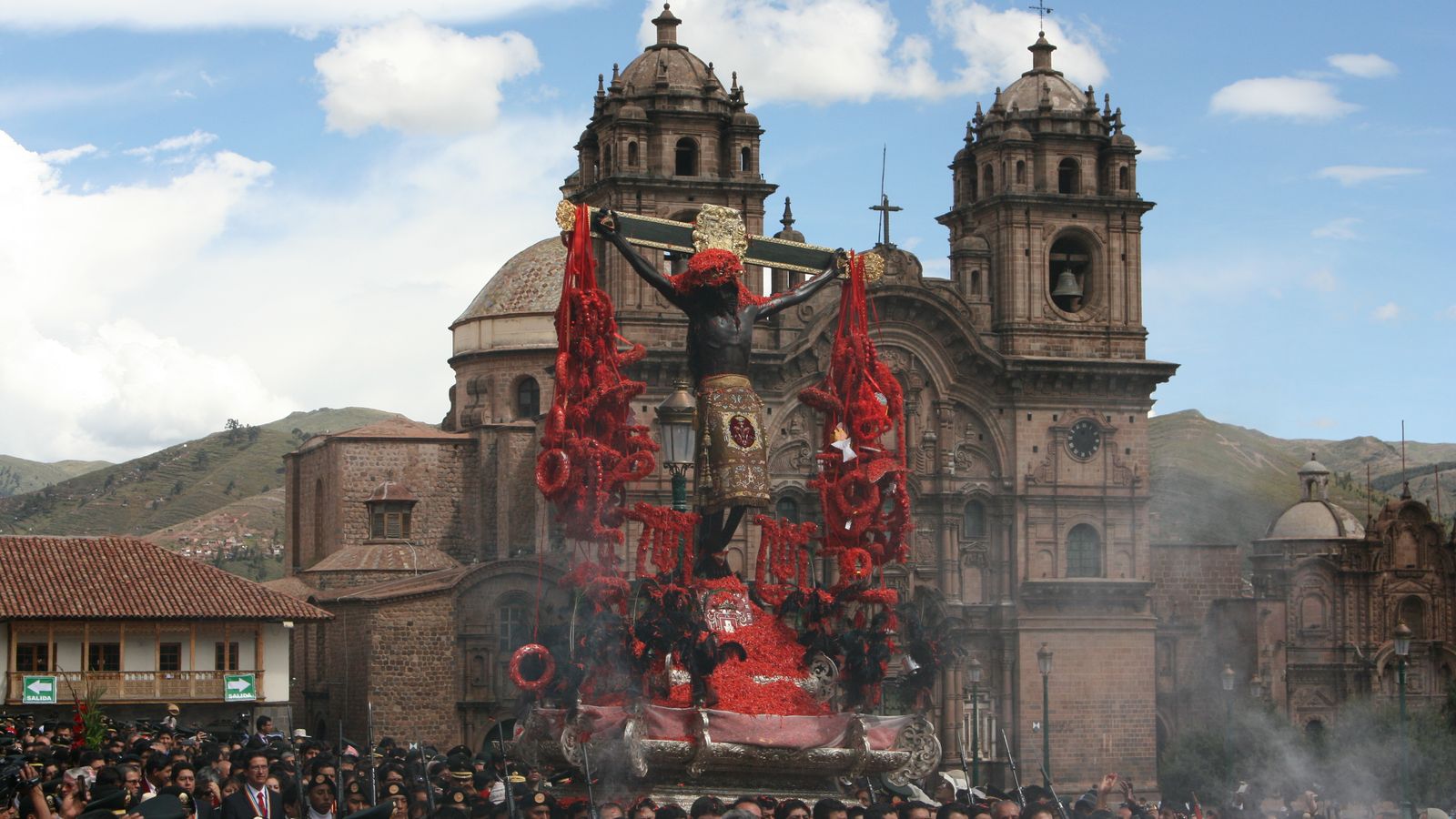
But this was no ordinary crucifix. It had been made in Cusco by local artisans, and it has a distinctly indigenous twist. The face and hair texture looked Incan, not European. It was still Jesus, sure, but it was an Incan Jesus.
The message was clear: the locals were willing to adopt Catholicism, but only on their own terms. The Spanish painting of the Virgin Mary was out, and Incan Jesus was in.
The crucifix became known as El Señor de los Temblores, or Taytacha Temblores in the local Quechua language, which translates to “Lord of the Earthquakes.” From that day forward, this crucifix was revered as a holy object that had miraculously stopped the Cusco earthquake. Today, it remains one of the most iconic crucifixes in the world.
With so much of the city destroyed, the Spanish decided to rebuild Cusco as an ideal colonial city. This meant building lots of Catholic churches full of Catholic art. However, most of the city’s artists were indigenous and wanted to mix their own culture and beliefs into their work. The Spanish didn’t like it, but the art was too good to pass up. As a result, the earthquake ushered in a new visual movement called the Andean Baroque that combined Catholic subjects with indigenous imagery and practices.
And nowhere was this new combination religion more evident than in the yearly parade of El Señor de los Temblores through the city streets. Originally, this happened on March 31st, the anniversary of the earthquake. Today, it happens on the Monday of Holy Week. The statue is dressed in an elaborate sudario and draped in red ñuk’chu flowers. Songs in both Spanish and Quechua accompany the procession through the city, a sign of the mixed cultural heritage that continues to this day.
Without the earthquake, the local indigenous population might never have embraced Catholicism, and the Spanish colonial government wouldn’t have had to tolerate the hybrid art that resulted from it. And there definitely wouldn’t be a life-sized statue of a dark-skinned Jesus paraded through Cusco every year as part of the lead-up to Easter.
Lisbon Earthquake, 1755
It started out as a usual holiday in Lisbon. This medieval city was the capital of the Portuguese Empire, which stretched from the Azore Islands to Brazil, Africa, and India. An influx of Brazilian gold meant that some of the city’s churches had gotten an upgrade, but Lisbon mostly remained the same confusing jumble of narrow streets and crowded houses familiar in previous centuries.
Portugal also remained a devoutly Catholic country. It’s estimated that in 1750, the country had around 200,000 priests for a population of less than three million people. The country’s prime minister, the Marquis de Pombal, found this incredibly frustrating. He wanted to modernize Portugal and make it competitive on the world stage, but all these old-fashioned priests and aristocrats kept getting in his way.
The King, Joseph the First, was absolutely no help. If it wasn’t riding, playing cards, or going to the theater, he wasn’t interested.
The morning of Saturday, November 1st changed everything. It was All Saint’s Day, a religious holiday that started with a morning Mass and was followed up with visiting friends and family or paying respects at a local graveyard. At nine o’clock in the morning, the faithful were dutifully sitting in the pews of the many churches. At about nine-thirty, the ground began to rumble.
At first, it sounded like nothing more than an approaching horse-drawn carriage. But the noise grew louder and more insistent, and the ground began to shake. At nine-forty, gigantic fissures ripped open the ground in the city center and all of the church bells began to ring. Minutes later, those same bell towers collapsed onto their faithful congregations.
Within about six minutes, thirty thousand people were dead.
Those who survived the initial quake ran for their lives as the city crumbled around them. Many fled to the open waterfront, where they stared in astonishment as the Atlantic coastline receded before their eyes, revealing a muddy plain dotted with shipwrecks. Some understood that this meant they should run. Most, however, did not.
The tsunami hit the city forty minutes after the earthquake. The initial wave is estimated to have been six meters tall, which is almost twenty feet. It was soon followed by two more. Hundreds of people drowned, many of them refugees that had climbed onto ships in an effort to get away. And all across the city, overturned hearths and votive candles lit for the holiday set fire to the wooden buildings, and soon the flames consumed the wreckage. The cumulative disasters destroyed 85% of Portugal’s capital.
Watch the Video
Open Video
Video Briefing
5 Awful Disasters...with Good Consequences
The 1755 Lisbon earthquake is widely considered to be the strongest seismic event ever to hit Europe. It was at least a 7.7 on the Richter scale, potentially as high as a 9. The source of the quake was underwater, along the city’s Atlantic coast. Exactly which fault or how many caused this huge earthquake is still up for debate.
However, the now highly traumatized survivors didn’t know anything about fault lines or Richter scales. The usual explanation for earthquakes was that they were God expressing His wrath. But the disaster had happened on a holy day, as the faithful were dutifully worshiping at Mass. Respectfully, what more could God want?
In the vacuum that followed the crisis, the Marquis de Pombal swooped in to take control. He needed Lisbon up and running again as soon as possible, and he had the organizational know-how to make it happen. All able-bodied adults were not allowed to flee the city; instead they had to help put out the fires, dig survivors out of the rubble, and gather the dead to be buried at sea.
The Marquis de Pombal also sent out a survey to every Portuguese parish to figure out basic facts like when the earthquake began, how long it lasted, and what were the casualties. There was no mention of God. The Marquis planned to use this disaster to drag the city of Lisbon, and all of Portugal behind it, into the modern era. He wanted wide, modern streets and earthquake-proof buildings. In his opinion, church fearmongering and guilting was only going to get in the way.
Around this time, Europe was moving away from explanations of the natural world that were offered by the Catholic Church. Instead, people were making their own observations in a movement widely called the Enlightenment. Prior to 1755, the idea that earthquakes occurred naturally had floated around some geological circles. Now, everyone was, suddenly, very interested. And since it was the era of the printing press, mentioning the earthquake was a surefire way to publish a bestseller.
This was still the 1700s, so the theories were not exactly accurate. One posited that it was large bubbles of underground gas suddenly breaking free. Another proposed it was electricity. But however inaccurate, they agreed that this was something natural. It wasn’t the wrath of God, and the people of Lisbon had done nothing to deserve this.
The Church, obviously, pushed back. A Jesuit priest named Gabriel Malagrida published a pamphlet titled An Opinion On the True Cause of the Earthquake that used no uncertain terms: “Learn, O Lisbon, that the destroyers of our houses, palaces, churches, and convents, the cause of the death of so many people and of the flames that devoured such vast treasures, are your abominable sins, and not comets, stars, vapors and exhalations, and similar natural phenomena.”
This attitude pissed off a lot of people, including the Marquis de Pombal. He had been dying for a chance to get rid of the priests that kept ruining his modernization plans, and finally, it looked like the people were on his side. So, without further ado, he kicked all Jesuit clergymen out of the royal court. It was a move that transparently solidified his own power, but it also sent a message: the age of religious explanations was over. Science, and what it said about the natural world, was here to stay.
Tambora Eruption, 1815
On April 10th, 1815, a small island in what is now Indonesia changed the course of history. Sumbawa is a medium-sized island on the eastern side of the archipelago. It was conveniently located along trade routes that connected various islands. This prime real estate and excellent natural resources meant that it was constantly getting invaded.
In 1815, the latest conqueror was the Dutch East India Company, who discovered that coffee grew surprisingly well along the slopes of the island’s largest mountain. In hindsight, this should have been a warning. The high-quality soil was the result of volcanic eruptions. Mount Tambora was, in fact, a ticking time bomb.
The volcano was an impressive 4,300 meters or 14,000 feet tall. It was one of the largest peaks in Indonesia, an area that sits along the Ring of Fire. Here, the Pacific Tectonic plate rubs into other, smaller plates, in this case, the Australian and the Sunda plate. All this crashing around makes Indonesia one of the most seismically active places in the world.
But despite all the activity, Tambora hadn’t erupted in approximately one thousand years. It turned out that she was saving all her energy for a one-in-a-lifetime demonstration of her power.
After a small throat-clearing eruption in 1812, the volcano rumbled again. This time, it was on the evening of April 5th, 1815. All across Indonesia, British colonial officials tried to figure out why someone was firing a cannon. Some dispatched soldiers to repel imaginary invaders, while others sent out boats to look for a vessel in distress. Little did they know that the cannon was actually a volcano, and the explosions were only going to get louder.
The next morning, ash began to fall on East Java, which was two islands to the west. Over the next few days, the cannon noises continued. Then, around 7pm on April 10th, 1815, it was time for the main event.
Observers from around thirty kilometers or eighteen miles away saw three huge plumes of flame explode from the mountain’s peak. They merged into an enormous column of fire that rose to a height of 43 kilometers or 26 miles. Minutes later, the whole mountain seemed to glow with liquid fire. Volcanic ash and pumice began pelting down on Sumbawa and nearby islands. Volcanic wind uprooted trees and other objects.
Approximately 1,200 meters or 4,000 feet of rock was blasted off the mountain’s height in less than three hours. As the enormous eruption column collapsed at around 10pm, pyroclastic flows roared down the sides of the volcano, destroying everything in its path. A village, later called the Pompeii of the East, was completely buried. A massive crater formed in the mountain’s summit, six to seven kilometers or about four miles in diameter.
Over eight hundred miles away, the British Lieutenant-Governor of Java wasn’t initially too concerned. He’d already gotten used to the volcano noises and decided to go to bed as normal. However, when he woke up the next morning, he realized that it was still dark out and he had to light candles just to find his way around.
Understandably, the Lieutenant-Governor wanted to know what the heck was going on. So, he started asking around and keeping a record. In the groundbreaking 1830 book Principles of Geology, the scientist Charles Lyell wrote, “but for the accidental presence of Sir Stamford Raffles, then governor of Java, we should scarcely have heard in Europe of this tremendous catastrophe.”
Because of the limited documentation, it’s hard to know exactly what happened during the eruption. Some estimate that 10,000 people on Sumbawa died from the pyroclastic flows and poison gases, others think it was 11,000 or 12,000. As for the amount of volcanic ash that was thrown into the air, it could be anywhere from 100 to 150 cubic kilometers or 24 to 36 cubic miles.
However, everyone agrees that the Tambora eruption was absolutely massive. It’s one of a handful that holds a 7 on the volcanic explosivity index. That’s four times bigger than Krakatoa and a hundred times bigger than Mount St. Helens. This is the kind of eruption that has consequences for the entire world.
Since the eruption column reached into the stratosphere, much of the volcanic ash was injected directly into the earth’s atmosphere. From there, it was carried far and wide across the globe. The ash particles shaded the earth, much like a tree provides a cool respite on a sunny day. However, in this case, the tree can cover an entire continent, and we have all learned far too well what happens when the earth’s temperature changes by just a few degrees.
The year after the eruption, the ash cloud reached Europe and North America. There, 1816 was known as “The Year Without a Summer.” The earth’s average temperature dropped by three degrees celsius. Crops died from unseasonably late frosts and a lack of sunlight. Food prices climbed and famines broke out across Europe, Canada, and the United States.
In Virginia, the July 4th Independence Day celebrations had to be moved inside. Over ten thousand people chose to leave the chilly state of Vermont and move west, and soon after, Indiana and Illinois officially joined the U.S. In Ireland, it rained for nearly eight weeks straight. In Germany, so many horses died from starvation that an inventor came up with a new form of transportation: the bicycle.
But perhaps the most enduring result of this gloomy and cold summer comes from a group of friends attempting to enjoy a holiday on the shores of Lake Geneva in Switzerland. The group was led by the famous British poet Lord Byron. Since the weather wasn’t cooperating with their plans of boating and laying in the sun, he suggested that they all sit by the fire and tell ghost stories. When they exhausted the pre-existing supply, Lord Byron suggested they each create their own.
The winner of this informal contest was a guest’s eighteen-year-old girlfriend. She told the story of a scientist with a desire to create life, only to be horrified when he finally succeeded. It was the perfect scary story for the rainy summer. In the next few years, the couple got married, the author changed her name to Mary Shelley, and the first edition of Frankenstein was published in London.
At the time, no one knew why the summer of 1816 had been so gloomy. No one yet understood how a volcano on the other side of the world had the power to change the weather. However, we now know that it was all connected: the ash in the atmosphere, the surprisingly cold temperatures, and the challenge Lord Byron gave his creative friends as they were all trapped indoors. It was a chain of events that went from catastrophe to immortal literary creation.
Hurricane Katrina, 2005
In 2005, a cataclysmic event offered an opportunity for a natural experiment. These are moments that forever change the way a group of people live their lives. They offer a rare opportunity to study a phenomenon that would be too difficult, or too unethical, to carry out in a lab. Famous examples include the Dutch Famine Study in World War II and John Snow’s “ghost map” during the London cholera outbreak in 1854.
Today, these events are remembered both for their tragedy and the scientific breakthroughs they inspired.
In mid-August in 2005, a storm began brewing in the Caribbean, growing in force as it hit the warm waters of the Gulf of Mexico. From there, the storm ballooned into a Category 5 hurricane. The screens of American weather services lit up with images of a huge spiraling white cloud with a dark, black eye at its center. Soon, the whole world would know about Hurricane Katrina.
Directly in the storm’s path was the major U.S. city of New Orleans, which was home to almost half a million people. Many of the poorest residents were living in neighborhoods built on drained swampland that was below sea level. Many did not want to leave their homes; others had nowhere to go.
On Saturday, August 27th, the city issued a voluntary evacuation order and residents slowly began making their way out of the city. Approximately 200,000 people did not have access to a car, so the plan was to provide buses. About 100,000 people planned to stay.
Nineteen hours before the storm hit, New Orleans issued its first-ever mandatory evacuation order. But there weren’t nearly as many buses as the city expected, and many of the licensed bus drivers had evacuated with their families. So instead of fighting through the traffic that was clogging routes out of the city, the limited drivers dropped people at emergency shelters like the local football stadium known as the Superdome. Everyone braced for impact.
Hurricane Katrina surged into the coast with wind speeds of 125 miles or 200 meters per hour. In nearby Mississippi, there was a storm surge of 28 feet or 8.5 meters of water. But for a moment, it almost looked like New Orleans would be spared. Electricity, sewage, water, and communication had all been knocked out by the storm, but the city was largely untouched by the wind and rain. However, the worst was yet to come.
As the city woke up on Tuesday, August 30th, they realized there was a problem. The storm might be over, but the city’s many levees built to hold back frequent floodwaters had been overwhelmed by the storm surge. Areas of the city that were below sea level were slowly and steadily filling with water. By the end of the day, eighty percent of the city was flooded. Those who were able to, climbed onto the roof of their home to avoid the rising water. Those who couldn’t, drowned.
As the rest of the country slowly realized that New Orleans was in crisis, the survivors desperately searched for food and water. It was clear that everyone just needed to just get out. On September 1st, the city’s mayor told a local radio station, “I need 500 buses…get every doggone Greyhound bus line in the country and get their asses moving to New Orleans.”
Five days after the storm, a mass evacuation effort began moving everyone out of the city. The survivors were sent all across the country until a plan could be made for their return. Overall, the storm displaced over one million people that would have otherwise stayed in the New Orleans area.
And this is where the natural experiment begins. See, there had long been a theory that poverty could be alleviated simply by moving poor people to less poor areas. However, telling a bunch of poor people that you are forcibly relocating them in the name of science is not only unethical, it puts the researcher at risk of bodily harm. As a result, no one was able to test it.
Before Hurricane Katrina, 1 in 4 residents of New Orleans lived below the poverty line. Now those people were spread out across the country in all kinds of different neighborhoods. It was a perfect chance to see if the theory would work.
In 2014, the National Bureau of Economic Research published a paper that analyzed the tax returns of people who had been displaced by the storm. To their surprise, the Katrina victims had higher earnings and were less likely to receive unemployment benefits. Further analysis showed that while higher income (and mostly white) residents quickly returned to the city, lower income (and mostly black) residents hesitated, or did not return at all.
Those who chose not to return mostly settled in other parts of Louisiana or the neighboring state of Texas. These areas had a lower poverty rate, greater access to higher education, and better schools. Ten years after the hurricane, approximately forty percent of evacuees were living somewhere else. For some people, they had no other choice. But for many, life outside New Orleans was too nice to pass up.
In a study on how the storm affected the lives of low income young adults, interviewers asked their subjects about the most significant negative event of their lives. A few said the hurricane, but most listed things from the day-to-day trauma of living in poverty. When asked about positive events, seven people said that “the most important good thing” to ever happen to them was Hurricane Katrina.
Without the hurricane, it would have been impossible to study whether or not moving to opportunity can affect generational poverty. Through all the devastation, there was now a glimmer of hope for a better future.
Conclusion
Disasters are often remembered for the devastation they cause, whether it’s taking human lives or the costly damages. But sometimes, natural disasters can have surprising consequences. They can change the course of human events in a way that no one saw coming. In fact, scientists are still analyzing past disasters to better understand how they have affected us today. It turns out the earth itself has quite the role to play, and for that reason, we are constantly trying to understand its next move.
Key Takeaways
- The St. Lucia’s Flood of 1287 reshaped the Netherlands, turning Amsterdam into a major trade hub.
- The 1650 Cusco earthquake led to a blend of Incan and Catholic beliefs, creating the iconic crucifix El Señor de los Temblores.
- The 1755 Lisbon earthquake accelerated the shift from religious to scientific explanations of natural events.
- The 1815 eruption of Mount Tambora caused global climate changes, inspiring Mary Shelley’s ‘Frankenstein’.
- Hurricane Katrina in 2005 provided a natural experiment, showing that relocating from poverty-stricken areas can improve economic outcomes.
SideProjects Editors
The SideProjects editorial team researches, fact-checks, and structures explainers about the lesser-known tales, side narratives, and spin-offs behind major historical and contemporary subjects.
Frequently Asked Questions
What was the impact of the St. Lucia’s Flood on Amsterdam?
The St. Lucia’s Flood in 1287 reshaped the Netherlands and transformed Amsterdam into a major trade hub. The flood destroyed competing commercial towns and created new waterways, allowing Amsterdam to become the capital city of the Netherlands and a world capital of commerce and culture during the Dutch Golden Age.
How did the Cusco Earthquake of 1650 affect religious practices in the region?
The Cusco Earthquake led to a theological transformation where the indigenous population embraced Catholicism but on their own terms. A life-sized statue of Christ with Incan features, known as El Señor de los Temblores, became revered as a holy object that stopped the earthquake. This event also led to the development of the Andean Baroque art movement, which combined Catholic subjects with indigenous imagery and practices.
What were the long-term effects of the Lisbon Earthquake of 1755?
The Lisbon Earthquake of 1755 led to a shift away from religious explanations for natural disasters towards scientific understanding. It also marked the beginning of the Enlightenment in Portugal, with the Marquis de Pombal using the disaster to modernize Lisbon and reduce the influence of the Catholic Church.
How did the Tambora Eruption in 1815 influence literature?
The Tambora Eruption caused a global climate anomaly known as the “Year Without a Summer” in 1816. This led to a group of friends, including Lord Byron, gathering in Switzerland and telling ghost stories, which inspired Mary Shelley to write the novel “Frankenstein.”
What was the impact of Hurricane Katrina on poverty in New Orleans?
Hurricane Katrina displaced over one million people from New Orleans, providing a natural experiment to test the theory of moving poor people to less poor areas. Studies showed that displaced residents had higher earnings and were less likely to receive unemployment benefits, suggesting that relocation can alleviate generational poverty.
How did the St. Lucia’s Flood change the landscape of the Netherlands?
The St. Lucia’s Flood in 1287 reshaped the Netherlands by transforming a small inlet into the Zuiderzee, a large body of water. This flood also destroyed many towns and created new waterways, significantly altering the country’s geography and trade routes.
What architectural changes occurred in Cusco after the 1650 earthquake?
After the 1650 earthquake, the Spanish decided to rebuild Cusco as an ideal colonial city with many Catholic churches. This led to the development of the Andean Baroque art movement, which blended Catholic subjects with indigenous imagery and practices, reflecting the hybrid cultural heritage of the region.
How did the Lisbon Earthquake affect the power dynamics in Portugal?
The Lisbon Earthquake of 1755 provided the Marquis de Pombal with an opportunity to reduce the influence of the Catholic Church and modernize Portugal. He used the disaster to implement wide, modern streets and earthquake-proof buildings, marking a shift towards Enlightenment ideals and away from religious explanations for natural events.
What were the global consequences of the Tambora Eruption in 1815?
The Tambora Eruption in 1815 caused global climate changes, leading to the “Year Without a Summer” in 1816. This resulted in widespread crop failures, famines, and unusual weather patterns across Europe, North America, and other regions, significantly impacting agriculture and human activities.
How did Hurricane Katrina provide an opportunity for scientific research?
Hurricane Katrina displaced over one million people from New Orleans, allowing researchers to study the effects of relocating poor individuals to less impoverished areas. This natural experiment provided valuable insights into how moving to opportunity can affect generational poverty and improve economic outcomes.