

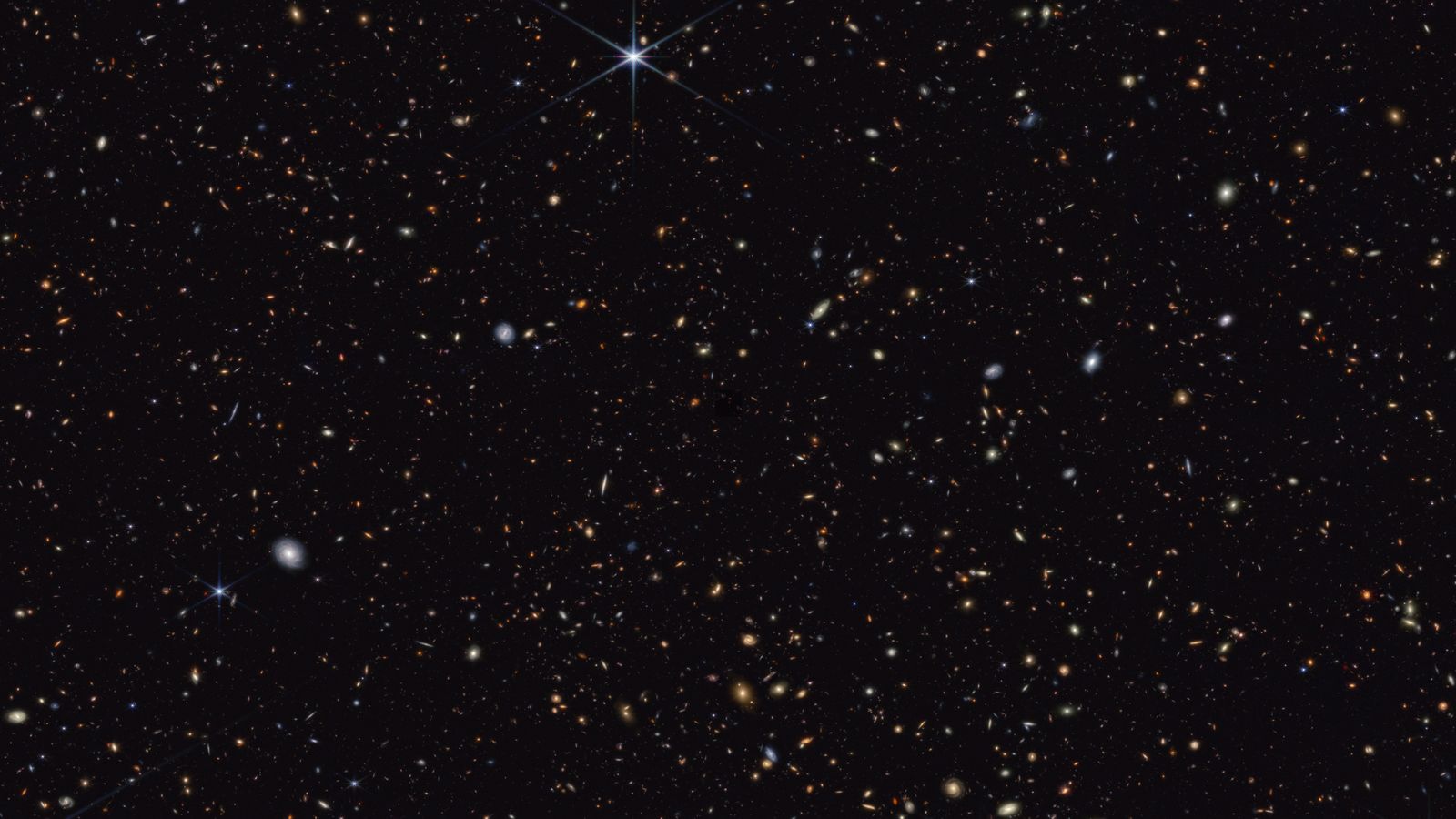
In the ever-evolving landscape of scientific research and exploration, humanity’s brightest minds continue to push the boundaries of knowledge at a rate faster than ever before. So far, 2024 has been no exception, and while we’re only a few months into the year, there have already been several fascinating discoveries from a wide variety of fields.
Today we’re going to bring you 5 of these recent findings, from what might be the oldest black hole ever found, to a new innovation that might be the key to the future of the world’s batteries, and much more.
The Big Ring
Sifting through data from the Sloan Digital Sky Survey, PhD student Alexia Lopez was studying the distant universe when she spotted something incredible. 9.2 billion light-years away from us is a massive circle of galactic clusters so large that it defies all possible reasoning.
Key Takeaways
- The Big Ring, a massive circle of galactic clusters, challenges established cosmological principles.
- Australian researchers developed recyclable water batteries, offering a safer and more sustainable alternative.
- The oldest known black hole in the observable universe defies current models of black hole formation.
- Chinese scientists successfully cloned a rhesus monkey, overcoming previous challenges with placenta development.
- Washington State University created the world’s smallest robots, modeled after insects, with potential applications in various fields.
It’s been nicknamed the Big Ring, and with a diameter of 1.3 billion light-years and a circumference of 4 billion, it might just be the largest structure in the observable universe. But there’s a problem with the Big Ring, and that’s the fact that its mere existence casts doubt on some well-established cosmological principles.
To understand how the ring is forming cracks in the foundation of astrophysics, we need to rewind time, all the way back to the Big Bang. During the first few hundred thousand years after the big bang, the universe was filled with an ocean of dense plasma. As waves rippled through this plasma, it created peaks and valleys. This is known as Baryonic Acoustic Oscillation, or BAO, and it’s believed that the places where matter bunched up on these primordial waves is what led to the distribution of matter we see throughout the universe today, as well as the patterns of the Cosmic Microwave Background Radiation.
The problem here is that analysis of the Big Bang and current models of BAO indicate that the upper limit for cosmic structures should be somewhere in the ballpark of 1.2 billion light years in length, which sounded great until we started discovering things larger than this upper limit, such as the Big Ring.
But the oddities don’t end there. What makes the Big Ring even stranger is that it is adjacent to another limit breaker that was discovered in 2021, the Giant Arc in the Sky, which, by the way, was also discovered by the same PhD student Alexia Lopez. The Giant Arc is considered by some to be larger than the Big Ring, as it spans 3.3 billion light-years, only it doesn’t form a complete circle like its recently-discovered neighbor.
To put into perspective just how immensely large these structures are, the cluster of galaxies that our Milky Way resides in, the Laniakea Supercluster, is only about 520 million light-years in diameter, meaning that despite containing an estimated 100,000 galaxies, it is absolutely dwarfed by the Big Ring. And the Giant Arc is so large that if it were visible to human eyes in the night sky, it would take up the space of 20 full moons lined up side-by-side, and, overall, takes up about 1/15th the radius of the entire visible universe.
So, with the addition of 2024’s Big Ring, we now have two supermassive structures whose origins defy explanation, and whose surprising proximity raises further questions. As Lopez herself put it:
“The Big Ring and the Giant Arc, both individually and together, gives us a big cosmological mystery… And their ultra-large sizes, distinctive shapes and cosmological proximity must surely be telling us something important — but what exactly?”
Batteries of the Future
Batteries are crucial to the functioning of our society. They’re in our phones, computers, cars, and nearly every other piece of critical infrastructure that makes modern life possible. But while they afford us the luxury of storing and transporting electrical energy, they have brought about their own set of problems, namely, the extraction of the resources needed to make them.
One of the most concerning of these resources is lithium, a crucial component for the type of battery used in electric vehicles. Lithium mining is no easy task, and requires the use of chemicals like sulfuric acid and sodium hydroxide, which can poison the local ecosystem, the diversion of huge quantities of local fresh water, deforestation, etcetera. In fact, while electric cars themselves drastically reduce emissions compared to traditional combustion engines, their production is actually more polluting.
On top of this, lithium sources aren’t endless, and, like with any other resource, eventually the cost of lithium extraction is going to climb as newer methods are needed to reach deeper or more challenging reserves. Alongside lithium-ion batteries are several other types with various uses around the world, such as alkaline, lead-acid, and nickel-cadmium, all of which come with their own advantages and disadvantages.
All of this is why finding a more sustainable or cheaper resource for batteries would have far-reaching benefits for the world, and alter the future of things like mobile devices, transportation, and the efficiency of solar panels. Which is exactly what two teams have accomplished this year, one in Australia and the other from China.
The team from Australia, led by researchers from the Royal Melbourne Institute of Technology, have developed what they call “recyclable water batteries”. In every battery, you need a positive end, called the cathode, a negative end, called the anode, and an electrolyte that connects the two and turns chemical energy into electrical energy.
Usually, this electrolyte is a hazardous, such as sulfuric acid in the case of lead-acid batteries. And this why you’re not supposed to throw most types of batteries in the trash with the rest of your household waste, as it can pose problems to its disposal location down the line. The Australian team’s breakthrough is that their prototype battery’s electrolyte is none other than water, with a little bit of salt.
They’re calling their invention an aqueous metal ion battery, and the advantage here is that once the water-based electrolyte has run out of charge, it can easily be removed and replaced, potentially prolonging the battery’s lifespan indefinitely. Water-based electrolytes don’t pose the risk of chemical pollution that lead-acid batteries do, and they don’t carry the risk of intense fires that lithium-ion batteries do. Not only that, but they’re also much cheaper.
So far, the team has created prototypes of several small-scale batteries, such double A and the small cell-type batteries found in watches. Each battery contains the potential to be recharged at least 500 times, and have shown to retain 80 percent of their capacity after more than 700 charging cycles.
One of the keys to maintaining its capacity is the team’s innovative use of rust. Normally, over the lifespan of a battery, tiny metal spurs called dendrites will form on the anode, which can eventually reduce the battery’s effectiveness and ability to hold a charge. The team stopped their formation by coating their anode in a thin layer of bismuth, after which they allowed it to oxidize, or rust, preventing these spurs from forming in the first place.
Meanwhile, a team in China has come up with a different solution: calcium. Scientists from Fudan University announced in February 2024 that they’d created a calcium-based battery that could handle 700 recharging cycles. Calcium is far more abundant than lithium is, about 2500 times more abundant, on its own making up about 4% of the earth’s crust and is the third most common metal.
If the number of recharging cycles can be improved, as well as their size and overall power, this on its own promises a much cheaper alternative to lithium-ion batteries, but there’s another aspect of calcium that makes it even more attractive.
It turns out that calcium batteries are highly flexible, and its creators demonstrated that small-scale models could be built into thin fabrics, potentially giving us a glimpse of next-generation wearable devices disguised as everyday clothing. On top of this, there is some hope for one specific variant, the calcium-oxygen battery, which theoretically would have the highest total capacity and energy density. These batteries would take oxygen out of the air to use as power, which would be an incredible technological leap, but unfortunately, these systems aren’t stable at room temperature, so they require far more energy to maintain than they can currently deliver.
Regardless, with 2024’s announcements of water and calcium batteries, the future of energy is looking pretty optimistic.
A Puzzling Black Hole
Watch the Video
Open Video
Video Briefing
5 New Scientific Discoveries in 2024
In 2016, data from the Hubble Space Telescope was examined by a team working on the CANDELS, one Hubble’s most ambitious data projects, peering at the far-reaches of the cosmos. The team announced that further analysis of the galaxy Gn-z11 had revealed that it existed an estimated 13.4 billion years ago, just 400 million years after the big bang. At the time, this was the oldest known galaxy in the universe, as well as one of the most-distant.
Since then, teams working with the James Webb Space Telescope, or JWST, have identified a few candidates that are likely further way, causing some of the hype from Gn-z11 to die down over the years.
However, the JWST isn’t just remarkable because it can see further and find things that Hubble couldn’t, it’s also useful for reexamining the findings of Hubble to give us a clearer picture and sharper data.
And this is exactly what a team of astronomers did in January 2024. The James Webb Space Telescope took a better look at Gn-z11, but this time, what caught the researcher’s attention was the black hole at the center of the galaxy, which is now believed to be the oldest in the observable universe.
But, as the researchers noted, it isn’t JUST the exact age of the black hole that’s all that surprising, after all, much of this that had already been covered a few years earlier. What was shocking was its newly realized immense size, which doesn’t seem to line up with its age whatsoever.
The size of the black hole was noticed due to the galaxy’s higher-than expected brightness. Originally, it was assumed that the galaxy’s luminosity arose from the sheer quantity of stars, but further investigation revealed that much of the light is actually coming from hot gasses swirling around the black hole, radiating their heat before they fall past the event horizon.
What’s intriguing here is that this scale of stellar consumption isn’t what should have been happening so relatively soon after the big bang. According to current models of black hole formation, if the one in Gn-z11 grew at what is believed to be the standard rate, it would have taken about a billion years to reach its current size, not the 400 million years that we see. It’s like seeing a young boy that you’re certain was only born 10 years ago, but already looks like a grown man with a full beard, it just doesn’t make sense, something we think we know must be wrong.
This can mean a few things. Perhaps black holes in the early universe grew at a faster rate than those today, or maybe they simply started out larger, as it’s been suggested that some of them may have formed from the collapse of giant gas clouds. It also could mean that our estimates of time overall are incorrect, either for the age of the galaxy in question, or for the universe as a whole.
Whatever the answer may be, these new findings only add to the puzzling existence of black holes, a mystery that continues to deepen.
A Cloning Breakthrough
In 1996, the first ever animal was successfully cloned. This was Dolly the sheep, and her existence was a sign that genetic engineering had the potential to go beyond anyone’s wildest dreams.
In the three decades since then, more than 20 other species have successfully been cloned, including dogs, cats, and even cattle. What all of these clones had in common was that they were created using the same technique, somatic cell nuclear transfer, or SCNT. This process involves removing the nucleus of an egg cell and replacing it with a nucleus taken from a somatic cell, which can be taken from any other part of the body.
Under the right conditions, and after stimulating the newly forged cell with a shock, it will start to divide. If taken care of properly, these cells can eventually grow into a fully functioning, living creature, and an exact clone of its parent because it only contains one set of genetic material.
Like we said, this technique has been used on many, many animals, but it always proved to be difficult with primates. It wasn’t until 2018 that the first monkeys were finally cloned using this method, a pair of macaques named Zhong Zhong and Hua Hua. However, while the cloning of macaques was certainly considered progress, the real goal was a rhesus monkey, due to their genetic similarities to humans.
It wasn’t until 2024 that the first rhesus monkey was cloned using SCNT, named ReTro. The researchers at the University of Chinese Academy of Sciences finally made the breakthrough when they realized that the reason so many previous attempts had failed due to defective placentas. For some reason, rhesus monkeys created from SCNT couldn’t properly use their placenta and umbilical cord to intake enough nutrients, a problem which was solved by taking healthy cells from a non-cloned monkey and growing the placenta from those, which ultimately resulted in the clone ReTro, the first of his kind.
According to the researchers, genetically identical monkeys are a necessity for the future of the medical field, as their similarity to each other means more certainty in testing results. Overall, they claim that this would result in fewer monkeys being used for testing, but this all still comes off as quite concerning to many people.
First of all, this only stokes fears that one day, human cloning will be possible, because, despite the fact that every ethics board, and most geneticists, are against this, progress in the field of genetics continues to take steps toward this outcome. The other concerns are from animal rights’ activists who don’t believe monkeys should be experimented on in the first place, much less have a special genetic line of them created specifically for disease and drug testing.
Either way, despite the recent success, we’re still a long way off from being able to consistently clone rhesus monkeys. After all, ReTro was just one viable baby from 113 total embryo attempts, a success rate of less than 1%. Still, what the researchers have done is show that it is possible, opening up many doors for geneticists around the world.
World’s Smallest Robots
With all these other advances in science and technology, it should come as no surprises that the field of robotics moves forward just as quickly.
In January 2024, Washington State University announced that their School of Mechanical and Materials Engineering had successfully created two insect-like robots, the smallest of their kind in the world.
The smaller of the two, called mini-bug, weighs in at just 8 milligrams, while the other, modeled after a water strider, weighs about 55 milligrams. What’s most impressive is their movement speed, with each of them moving about six millimeters per second, definitely a lot slower than biological insects, but much faster than any of their micro-robotic peers.
The secret to their speed is their tiny actuators, which, using a new technique, were shrunk down until they weighed less than a single milligram. The way that these operate is by using shape memory alloys, a metal that can change shape when heated but return to its original shape after cooling back down. Each actuator contains two wires made from this shape memory alloy, and the wires are able to be heated up and cooled down rapidly using a small electric current, allowing the mechanical parts of the robots to move incredibly quickly. In the case of the water strider, it can flap its fins more than 40 times per second.
And the researchers aren’t done there. They’ve spent time studying the insects they’ve used as models, and identified things that make them quicker, which they hope to implement in future iterations. Also, on the to-do list is to create a super tiny battery to allow these mini machines to function without being tethered to a power source.
The uses for robots of this size are endless, such as robot-assisted surgery, environmental monitoring, and materials manufacturing. There’s also hope that one day swarms of mini-robots like these could be used for artificial pollination in places or with plants that are naturally hard to pollinate.
Key Takeaways
- The Big Ring, a massive circle of galactic clusters, challenges established cosmological principles.
- Australian researchers developed recyclable water batteries, offering a safer and more sustainable alternative.
- The oldest known black hole in the observable universe defies current models of black hole formation.
- Chinese scientists successfully cloned a rhesus monkey, overcoming previous challenges with placenta development.
- Washington State University created the world’s smallest robots, modeled after insects, with potential applications in various fields.
SideProjects Editors
The SideProjects editorial team researches, fact-checks, and structures explainers about the lesser-known tales, side narratives, and spin-offs behind major historical and contemporary subjects.
Frequently Asked Questions
What is the Big Ring and why is it significant?
The Big Ring is a massive circle of galactic clusters located 9.2 billion light-years away, with a diameter of 1.3 billion light-years and a circumference of 4 billion light-years. It is significant because its size challenges established cosmological principles and the upper limit for cosmic structures.
What are the environmental concerns associated with lithium-ion batteries?
Lithium mining involves the use of chemicals like sulfuric acid and sodium hydroxide, which can poison local ecosystems, divert huge quantities of fresh water, and cause deforestation. Additionally, lithium sources are finite, and extraction costs are expected to rise as deeper or more challenging reserves are accessed.
What is the significance of the water-based batteries developed by the Australian team?
The water-based batteries, or aqueous metal ion batteries, use water with a bit of salt as the electrolyte, making them recyclable and non-hazardous. They are also cheaper and safer, with prototypes showing the ability to be recharged at least 500 times while retaining 80% of their capacity after more than 700 charging cycles.
What makes calcium-based batteries a promising alternative to lithium-ion batteries?
Calcium is about 2500 times more abundant than lithium, making it a cheaper alternative. Calcium-based batteries are also highly flexible and can be integrated into thin fabrics, potentially leading to next-generation wearable devices. Additionally, calcium-oxygen batteries theoretically have the highest total capacity and energy density.
What is unusual about the black hole in the galaxy Gn-z11?
The black hole in Gn-z11 is believed to be the oldest in the observable universe, existing just 400 million years after the Big Bang. Its size is unusually large for its age, suggesting that black holes in the early universe may have grown faster or started out larger than current models predict.
What was the breakthrough that allowed for the successful cloning of a rhesus monkey in 2024?
The breakthrough involved solving the issue of defective placentas in previous attempts. Researchers used healthy cells from a non-cloned monkey to grow the placenta, ensuring proper nutrient intake for the clone, named ReTro.
What are the potential applications of the world’s smallest robots developed by Washington State University?
The tiny robots, weighing between 8 and 55 milligrams, have potential applications in robot-assisted surgery, environmental monitoring, materials manufacturing, and artificial pollination. Future iterations aim to include a super tiny battery for untethered operation.
How do the tiny actuators in the insect-like robots work?
The actuators use shape memory alloys, which change shape when heated and return to their original shape when cooled. They are heated and cooled rapidly using a small electric current, allowing the robots to move quickly.
What is the Giant Arc in the Sky and how does it relate to the Big Ring?
The Giant Arc is another supermassive structure discovered in 2021, spanning 3.3 billion light-years. It is considered by some to be larger than the Big Ring and is adjacent to it, raising further cosmological questions due to their proximity and immense sizes.
What is the significance of the James Webb Space Telescope’s observations of the galaxy Gn-z11?
The JWST provided clearer data on Gn-z11, revealing that the galaxy’s brightness is largely due to hot gases swirling around a massive black hole at its center. This observation challenges current models of black hole formation and growth in the early universe.