
A wise man once said that if an idea is stupid, but works, then it’s not a stupid idea, and nowhere does that wisdom hold more true than with weapons, as over the years a LOT of them have been produced that seem utterly bizarre from the outside looking in, but, when they were given a chance, did actually work – or kind of did anyway.
And today, we shall be having a look at five such weapons… so let us begin!
1. War Pigs
Let’s kick things off with War Pigs; yes, you heard us right – War Pigs.
Key Takeaways
- War pigs were used in ancient battles to scare war elephants, exploiting the elephants’ fear of pigs’ squeals.
- The Lantern Shield, used in Renaissance Italy, combined a shield, lantern, and spikes for nighttime combat.
- The Davy Crockett Weapon System, a nuclear bazooka, was deployed by the US Army during the Cold War to counter Soviet tanks.
- Early fast-firing guns, like the Pepperbox Revolver and Volley Gun, used multiple barrels to increase rate of fire.
- The Lunge Mine, a Japanese weapon from WWII, was a shaped charge on a stick used in desperate anti-tank attacks.
We suspect that you’ll be just as disappointed as we were to learn that a War Pig was not a pig which was ridden into battle cavalry style, as that would have been incredible, but instead, were pigs that were deployed as counter measures; the ancient equivalent to chaff being thrown out of the back of a jet to throw off guided missiles.
But, counter-measures to what?
The answer lies in the war elephant; colossal beasts that were the ancient equivalent of armoured tanks, i.e., pure and unbridled death machines that were abjectly terrifying to face, and capable of breaking through enemy lines as if they weren’t even there.
Fortunately, for those on the receiving end of them, every weapon has a flaw that can be exploited, and for elephants, that was that fact that, as living creatures, they were capable of fear. Invoke that feeling in them, and in an instant, they would break and rout from the battlefield.
And turns out; you can do that by setting pigs on fire and running them at the elephants – who knew?
We have no idea how this was first discovered, as that detail has long since been lost to time, and in fact, we barely even know who made use of them and how, so old is the history we are discussing, and so scant the surviving evidence as a result.
We do have the odd tidbit of information here and there however, an example of which can be found in the works of Polyaenus, a Greco-Roman writer hailing from the 2nd century AD.
He spoke of War Pigs in his Strategemata, an eight volume work that compiled strategies and tactics from the best Generals of the day, quote:
“At the siege of Megara, Antigonus brought his elephants into the attack; but the Megarians daubed some swine with pitch, set fire to it, and let them loose among the elephants. The pigs grunted and shrieked under the torture of the fire, and sprang forwards as hard as they could among the elephants, who broke their ranks in confusion and fright, and ran off in different directions.”
Other sources, however, don’t mention explicitly that the pigs had to be set alight, and instead simply allude to their having to be injured or frightened in some way to get them squealing. This may indeed have been with fire, with the sources just omitting that detail, or it may have been by another method, we just don’t know.
As for an example of such a source, consider Naturalis Historia, a 1st Century AD work by Pliny the Elder, a Roman Naturalist, which says the following, quote:
“(Elephants) bear down the body of the army, and stamp (the armed men) underfoot. But these same are affrighted with the grunting of swine; and if wounded or put into a fright, they always go backward, with scarcely less mischief to their own side.”
Then there are sources that don’t mention the pigs as having to be injured at all, and instead say that merely their presence was enough to terrify war elephants, an example of which comes from De Natura Animalium, a 2nd or 3rd Century AD work by Claudius Aelianus, a Greco-Roman author and teacher of rhetoric, quote:
“The Elephant has a terror of a horned ram and of the squealing of a pig. It was by these means, or they say, that the Romans turned to flight the perfumes elephants of Pyrrhus of Epirus, and that the Romans won a glorious victory.”
Thanks to those surviving sources then, and others like them, we can be pretty certain that war pigs were indeed used as a counter-elephant weapon in the Ancient Period… but that’s about all we can say on the matter with any certainty, with the combined evidence for more specific assertions simply not existing.
However, and we REALLY can’t stress this enough, do remember to approach ancient texts with a healthy scepticism, as this is what follows our last quote:
“This same animal is overcome by beauty in a woman and lays aside its temper, quite stunned by the lovely sight.”
Professional zoologists we are not, but yeah, we’re pretty sure that ain’t how it works; like we say – healthy scepticism!
2. The Lantern Shield
We’ve all been there, folks; you want to stab someone, you want to stop yourself from being stabbed, and you want to be able to see yourself doing both of those things – but alas, God only gave you two hands, whatever is one meant to do in such situations?!
Well, worry no longer, because the clever sorts of Renaissance Italy have got you covered with THIS: the Lantern Shield.
It was a weapon that was an elaborate combination of a small shield, a lantern, spikes, and an armoured gauntlet; all of it fused together to provide both offensive and defensive capabilities while maintaining the ability to see in low-light conditions.
The shield itself was usually perfectly round, barring a small cut out to allow the wrist to bend back, with holes that were big enough to save a bit of weight, but not so big that they compromised the shield as a defensive implement.
A weapon as seemingly bizarre as this was naturally crafted for a VERY specific purpose, which in this instance was to offer a practical solution for nighttime duels and urban patrols; and while outwardly bizarre, you can get the logic, can’t you? It’s one less hand for lighting, and one more for fighting!
Further still, integrated as it was into the Lantern Shield, the lantern itself could become a weapon, as you could stick it right in the face of your enemy; potentially disorientating them in the heat of combat without risk of it being smashed.
Or rather, we should say that all that is how we THINK the Lantern Shield was used, as, on account of its age, coming from the 15th and 16th centuries to be precise, there is a LOT about it we don’t know due to sources just not surviving to the current day.
For example, it is commonly believed, as we just stated, that it was used for nighttime patrols, but by whom, because did you notice that every single surviving example of a Lantern Shield looks RATHER fancy? That isn’t just selective presentation, that is just how all the surviving examples look; so were people REALLY procuring such expensive armour just for their period’s equivalent of the police…
In two words: yes, maybe. When you consider that suitably well-heeled Italians were buying stuff like this for their guards… it suddenly isn’t inconceivable at all. Or, it could just be that the fancy and expensive ones were the only ones they bothered to look after, and thus are the only ones that survive today – who knows!
Then there’s the question of whether they were ever used in REAL combat, i.e., military combat. The answer to that, at present, is usually a no, with most historians believing they were used purely for duelling and night patrols, as we’ve already laid out. But with so much of our understanding of renaissance and medieval history being pieced together from whatever scraps of sources happened to survive into the current day… you can never say never!
3. The Nuclear Bazooka
Would you believe us if we were to tell you that the US Army had a Nuclear Bazooka in its arsenal back in the black and white days of the Early Cold War?
It sounds crazy, doesn’t it? And yet, that’s EXACTLY what they did have. Kind of anyway, because while the term ‘Bazooka’ has become a common term nowadays for referring to any shoulder fired missile system, in reality, if we wish to be pedantic, and believe us we do, the term only applies to a very specific family of American made recoilless rifle anti-tank rocket launchers, one that began with the original M1 Bazooka first produced in 1942, and ended with the M20 Super Bazooka, which started rolling out of the factories in 1952.
And while no, there wasn’t a nuclear tipped one of THOSE, the US did have a separate, and much, MUCH larger recoilless rifle that fired nukes, and that’d be the ‘Davy Crockett Weapon System.’ So, by common parlance; yes – they did indeed have a Nuclear Bazooka!
Watch the Video
Open Video
Video Briefing
5 Strange Weapons That Somehow Worked
Oh, and if you’re wondering, because it is a term you don’t come across too much nowadays, a ‘recoilless rifle’ simply refers to a type of weapon that fires a projectile in a way that negates the recoil of traditional artillery or shoulder-fired systems. It achieves this by way of a whopping great hole out the back, which allows the mass of gas that would normally create recoil to pass straight out of the weapon without exerting any force upon it.
As for the Davy Crockett specifically, however, it came in two different flavours: the M28, which had a range of 2km, and the M29, which doubled that to 4km. And if you are thinking that they sound like awfully short ranges for a nuclear weapon, at least from a crew staying alive perspective, hold that thought, because we think it just might not be quite as bad as it first sounds.
It’s a bold take when it comes to the Davy Crockett, we know, but bear with us, because we just might be onto something here.
Both variants fired the exact same munition; a ‘M388 Nuclear Projectile’ – inside of which was a W54 miniature warhead, which, when tuned for the Davy Crockett, made a bang in the 20 tonnes of TNT equivalent kind of area. This is an absolutely tiny yield, with the ‘Little Boy’ bomb that was dropped on Hiroshima in August 1945, which was already nothing by modern standards, having a yield 750 times greater than it.
This tiny yield was just about enough to produce a fireball 18.5m in diameter, within which nearly everything would be instantly vapourised, a damage radius of 125m, inside of which all but the most heavily reinforced concrete buildings would collapse, and a radiation radius of 425m, a lengthy exposure to which would likely prove fatal a month or so down the line.
So, while many like to paint the Davy Crockett as an ‘instant death weapon’ for its crews, by the numbers alone, you can see how there were ranges at which it could be deployed without posing any threat at all to its operators; so long as they were stood down wind of it of course – upwind would be a WHOLE other matter.
As for when and how it was used, it was in service between 1961 and 1971, with the first six of those years being spent on active deployment in West Germany, where, were war to break out, they were tasked with decimating advancing Communist Armoured Formations primarily, and secondarily, using the radiation emitted during those attacks to ‘poison’ land scorched earth style, thus slowing the Communist advance. This is in keeping with the wider NATO plan to whittle the Communists down as part of a protracted initial fighting retreat through Western Europe.
Knowing that then, is it fair to consider it a ‘suicide weapon,’ when not only was it long enough ranged to not hit its crews, if deployed correctly, but NATO forces weren’t even intending to be going anywhere near their detonation sites for a long, LONG time afterwards? Either way, after its six years of field deployment, it then spent four years in storage, before finally being scrapped and retired.
And get this, it wasn’t even retired for being dangerous and ridiculous too; with the ACTUAL reason being the development of more effective battle doctrines and conventional weapons that could decimate armoured formations just as effectively, without any of the security and control risks that came with having nuclear weapons floating around small and out of the way garrisons.
Does all of this mean that it wasn’t a testimony to the ignorant naivety of the Early Atomic Age, and one of the single most ridiculous weapon systems ever deployed? No, of course not, but while both of those things are absolutely true, we can also recognise that the usual ‘suicide gun’ line that gets thrown around isn’t really a fair assessment of the thing.
But all of that, ultimately, is just our own musing on the topic, and we certainly don’t claim to be beyond reproach; so there’s every chance we could be wrong - but hey, we’d far rather take a risk and encourage some interesting debate on the topic instead of just regurgitating the usual talking points!
4. Ye Olde Fast Firing Guns
In terms of rate of fire, firearms design in the Early Modern Period was stagnant, with their basic go-to design, the super slow single shot muzzle loader, essentially having remained unchanged for centuries.
This stagnation sparked no joy for the gunsmiths of the time, as they knew that faster-firing guns were theoretically possible, and that such advancements would be absolute game-changers once perfected, but they were shackled by the primitive technology of their time, which made fast-firing guns—anything like what we know today—flatly impossible. That didn’t stop them from trying to make them though, which led to all manner of weird and wacky gun designs emerging as they attempted to achieve faster rates of fire within the constraints of their period’s technology.
And since it was loading the gun that took ages, some went down the route of adding multiple barrels to their guns. Sure, this would mean that loading would take an absolute age, but it could be done in the comfort of your own home, in your own time, when no one was trying to kill you, leaving you with a bugger load of rounds immediately on hand, and ready to go, when the proverbial brown and stinky hit the fan.
For examples of the kind of designs they came up with, consider things like THIS, the Pepperbox Revolver. It was a multi-barrelled handgun popular in the early to mid-19th century, and it achieved a faster rate of fire by way of a distinctive cluster of rotating barrels; simply give a spin after firing, and happy days, you’ve got another fully prepped barrel ready to go! They normally came with around 4-6 barrels, but, if the gunsmith got carried away, they could go WAY higher.
The ‘Pepperbox’ design wasn’t just limited to pistols too; as you could get rifles that worked in the same way, as Russian examples show, but do note, these were VERY rare, with pistols being the most common sort of Pepperbox you would come across.
Pepperboxes also had a forerunner in the Volley Gun, a type of design which in one form or another dates back to the 15th century, and that, despite (sometimes) being outwardly similar to the Pepperbox, varies in one key way: whereas the Pepperbox allowed you to place single shots at your leisure, a Volley Gun, as the name suggests, let the whole lot rip with a single trigger pull.
This, naturally, limited its utility somewhat, but when it found its niches, in situations where a whole area had to be covered with lead VERY quickly, it was a devastatingly effective tool, with bank guards often using them so that they could (hopefully) put down a whole armed gang at once.
They too were also not limited to a single weapon type, with Volley Guns coming in pistol form, long arm form, and even artillery form. For examples, consider the 18th century ‘Duckfoot Pistol,’ a sub-type so named for the arrangement of its eight barrels, the ‘Nock Gun,’ which the British Royal Navy used to sweep the decks of enemy ships before boarding, and the 17th century ‘Organ Gun.’
Not every early fast firing gun just upped the number of barrels, however, as the Harmonica Gun can attest to. With the earliest known example coming from a Swiss Gunsmith in 1742, the Harmonica Gun used a single barrel and a sliding metal block, known as a ‘slide’ or ‘bar,’ containing a series of preloaded chambers lined up horizontally that resembled the reeds in a harmonica, hence the name.
To fire it, the shooter would manually align each chamber with the barrel and the ignition mechanism, typically a flintlock or percussion system. After firing a shot, the shooter would slide the block sideways to bring the next chamber into position, and they were good to discharge another round.
It too came in pistol and longarm form, and is yet another great example of the, to us modern observers at least, WEIRD ways that the gunsmiths of old tried to get ever faster rates of fire out of their creations.
5. The Lunge Mine
It’s well known that the Japanese loved themselves a good Banzai during WWII - their RATHER enthusiastic mass bayonet charges. But while sometimes effective against enemy infantry, SURELY, they never employed them against tanks, right?
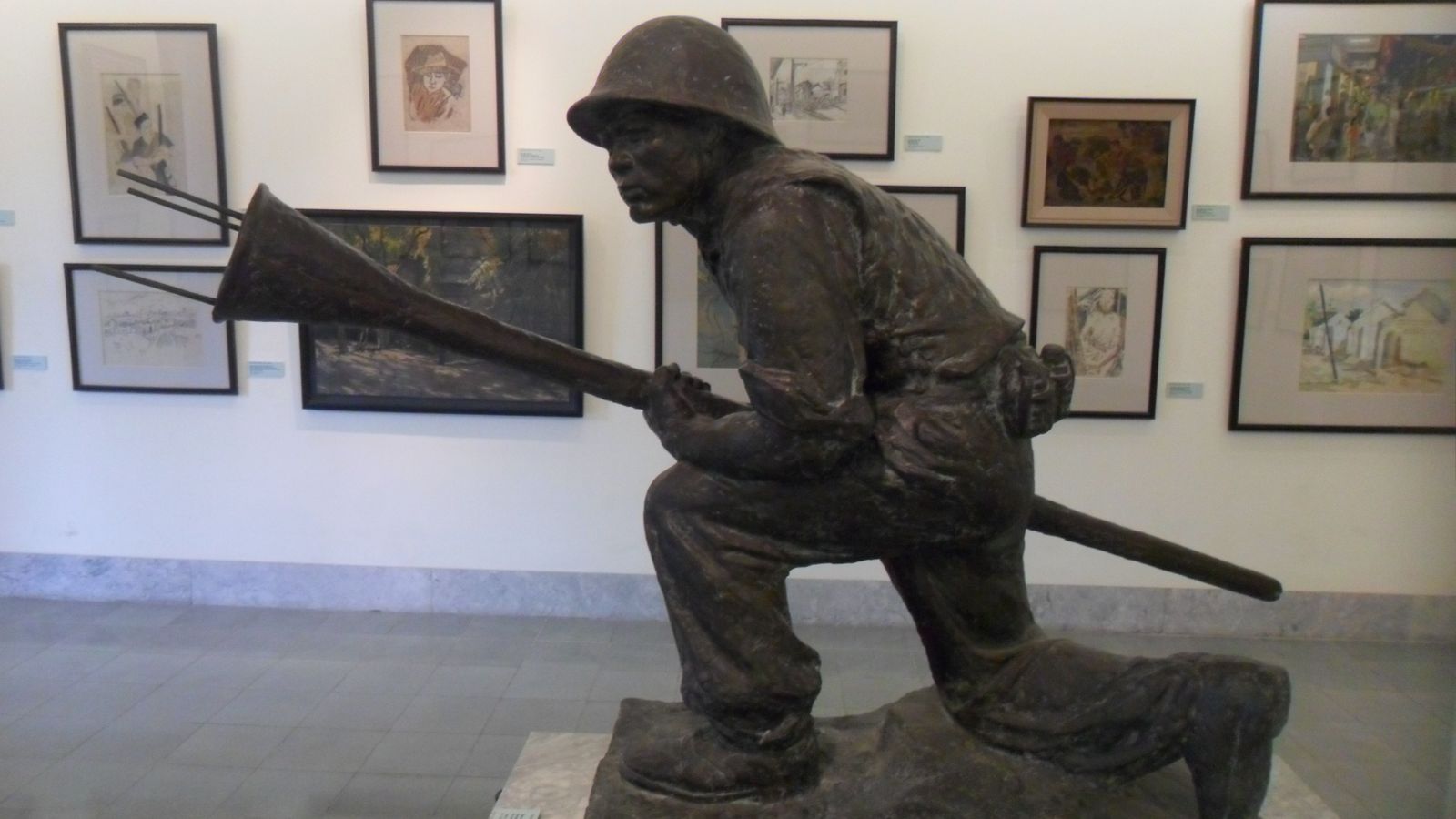
Well, actually, yes – yes they did, but they didn’t use regular old bayonets when doing so, because that would be utterly ridiculous, and about as much use as a chocolate tea pot. Instead, they used THIS, the ‘Shitotsubakurai,’ or ‘Lunge Mine.’
And now, having seen one, we know what you are thinking: “wait, is that just an explosive on the end of a stick?” And to that, all we can say is yes; that is EXACTLY what it is, with the Lunge Mine being comprised of a conical hollow charge encased in a metallic container affixed to the end of a 150cm long wooden pole.
The charge itself was 29cm in length, 20cm in diameter, and contained 3kg of TNT explosive. Quite cleverly too, it wasn’t just a ‘dumb’ explosive, but was actually a shaped charge, a specialist type of munition that takes all the energy of a blast, which normally emanates out in all directions, and focuses it onto a single point so that it can better penetrate hardened armour plate. Quite cleverly too, those three little prongs poking out the front made sure that the explosive charge detonated at the ideal distance for inflicting the most damage.
This means that, quite shockingly we have to say, the Lunge Mine did ACTUALLY work as an effective anti-tank weapon, with it being shown in post war testing that it could get through give or take 150mm of steel plate if it impacted at a perfect angle of 90 degrees, and around 100mm if it impacted at 60 degrees. This was more than enough for the typical types of tanks that the Americans were fielding in the Pacific Theatre, with even the beefiest and most juiced up M5A1 Stuart Light Tank maxing out at 50.8mm of armour, and the most highly optimised M4A3 Sherman Medium Tank topping out at 107.9mm.
We should clarify, however, when we say that the Lunge Mine worked as an effective anti-tank weapon, that was very much under IDEAL conditions, i.e., when the operator could actually get up to a tank to poke, because the US Military, like basically EVERY military ever in fairness, deployed supporting infantry alongside its tanks to protect them from anti-tank capable enemy equivalents… and, as many a Japanese soldier found out, it takes way less time to shoulder your rifle and squeeze a trigger than it does to leap out of a bush and sprint up to a tank.
The vast majority of Lunge Mine operators, therefore, were killed before they ever had a chance to put it to use.
This also means that while it was TECHNICALLY effective, in real terms, it was actually utter junk.
If you are wondering why Japan would ever create such a thing, they were a VERY late-war development, first appearing at the Battle of Leyte in December 1944. This late in the war, Japan knew full well it had no hope of defeating the Americans, but also didn’t want to surrender, and so it kept dreaming up increasingly weird, almost Wallace-and-Gromit-esque contraptions to make up for the facts that its factories lay in absolute ruin, and it had all but completely lost access to strategic resources as its military situation collapsed.
Oh, and if you’re wondering, yes, Lunge Mines did kill their operator too.
Key Takeaways
- War pigs were used in ancient battles to scare war elephants, exploiting the elephants’ fear of pigs’ squeals.
- The Lantern Shield, used in Renaissance Italy, combined a shield, lantern, and spikes for nighttime combat.
- The Davy Crockett Weapon System, a nuclear bazooka, was deployed by the US Army during the Cold War to counter Soviet tanks.
- Early fast-firing guns, like the Pepperbox Revolver and Volley Gun, used multiple barrels to increase rate of fire.
- The Lunge Mine, a Japanese weapon from WWII, was a shaped charge on a stick used in desperate anti-tank attacks.
SideProjects Editors
The SideProjects editorial team researches, fact-checks, and structures explainers about the lesser-known tales, side narratives, and spin-offs behind major historical and contemporary subjects.
Frequently Asked Questions
What were War Pigs used for in ancient warfare?
War Pigs were used as counter-measures against war elephants. They were set on fire or injured to make them squeal, which would terrify the elephants and cause them to break ranks and flee.
Who mentioned the use of War Pigs in their writings?
Polyaenus, a Greco-Roman writer from the 2nd century AD, mentioned the use of War Pigs in his work ‘Strategemata’.
What was the Lantern Shield used for?
The Lantern Shield was used for nighttime duels and urban patrols. It combined a small shield, a lantern, spikes, and an armored gauntlet to provide both offensive and defensive capabilities while allowing the user to see in low-light conditions.
What was the Davy Crockett Weapon System?
The Davy Crockett Weapon System was a recoilless rifle that fired nuclear projectiles. It came in two variants: the M28 with a range of 2km and the M29 with a range of 4km. It was used by the US Army during the early Cold War.
What was the yield of the Davy Crockett’s nuclear projectile?
The Davy Crockett’s nuclear projectile had a yield of approximately 20 tonnes of TNT equivalent.
What were Pepperbox Revolvers?
Pepperbox Revolvers were multi-barrelled handguns popular in the early to mid-19th century. They achieved a faster rate of fire by rotating a cluster of barrels, allowing the user to fire multiple preloaded shots in succession.
What was the Lunge Mine used for during World War II?
The Lunge Mine, or ‘Shitotsubakurai’, was used by the Japanese as an anti-tank weapon during World War II. It consisted of a shaped explosive charge on the end of a wooden pole, designed to penetrate tank armor.
How effective was the Lunge Mine against American tanks?
The Lunge Mine could penetrate up to 150mm of steel plate at a 90-degree angle and around 100mm at a 60-degree angle, making it effective against most American tanks in the Pacific Theatre, such as the M5A1 Stuart Light Tank and the M4A3 Sherman Medium Tank.
Why were Lunge Mines considered ineffective in real combat?
Lunge Mines were considered ineffective in real combat because operators were often killed by supporting infantry before they could get close enough to use them on tanks.
What was the Harmonica Gun?
The Harmonica Gun was an early fast-firing gun that used a single barrel and a sliding metal block containing preloaded chambers. The shooter would manually align each chamber with the barrel to fire multiple shots in succession.