

Where is everybody?
This haunting question was pondered by physicist Enrico Fermi as he peered into the night sky. The universe is so unbelievably vast, he thought to himself, so densely populated with innumerable galaxies in every direction we look. Each of these galaxies contains billions of stars, and billions more planets. And if even a small percentage of planets are habitable, given the sheer number of them, the universe must be teeming with life.
And if the universe is teeming with life, at least some of them must have become intelligent, perhaps space-faring civilizations. But if that’s the case, why haven’t we found anyone? What we have is a logical train of thought that tells us alien civilizations likely exist, while simultaneously finding absolutely zero evidence that they do.
Key Takeaways
- The Fermi Paradox questions why, despite the vast number of stars and planets, we have not found evidence of extraterrestrial civilizations.
- The Dark Forest hypothesis suggests that alien civilizations may be hiding to avoid detection by potentially hostile others.
- The Great Filter theory proposes that there is a barrier in the evolution of life that prevents most civilizations from becoming space-faring.
- Communication with alien civilizations may be impossible due to vastly different methods or advanced intelligence.
- It is possible that we are alone in the universe, challenging the Copernican Principle that Earth is not special.
This contradiction forms the basis of what is known as the Fermi Paradox, and there are many, many resolutions to it. Some are a bit strange, like the Zoo Hypothesis, which basically states that earth was created by aliens as some sort of experiment, and the reason we can’t find any aliens in our galactic neighborhood is because they are intentionally hidden from our view. Other solutions are downright laughable, like the idea that various governments have made contact and are simply hiding the evidence from the public.
But on the more serious side of things, there are many resolutions to the Fermi Paradox that are not only plausible, but perhaps even concerning. Without further ado, here are five of them that are particularly unsettling, the ones we really hope aren’t true.
The Dark Forest
Our first solution is that there are indeed other civilizations, perhaps in star systems quite close to us, but we’ve yet to find them because they are all actively hiding from us and each other. In this scenario, everyone is listening, and no one is talking, afraid that even a single transmission could attract a hostile civilization. This is known as the dark forest hypothesis, in which the universe is likened to a quiet forest, and each civilization is like a creature that inhabits it, too afraid to speak out. Perhaps other civilizations are already aware of the danger surrounding them, and that’s why they remain silent, while our naïve planet continues to call out into the trees, unaware that the forest is filled with hungry wolves.
This was perfectly described in the 1987 novel The Forge of God, in which one of the characters explains:
“We’ve been sitting in our tree chirping like foolish birds for over a century now, wondering why no other birds answered. The galactic skies are full of hawks, that’s why.”
And the idea that other civilizations might be hostile isn’t very far-fetched when you look at how humans have even treated each other on earth when two different worlds have collided—just remember what happened when Europe discovered the Americas. Perhaps the galactic forest isn’t filled with a bunch of docile creatures avoiding an apex predator, but rather populated only by hunters, all poised to strike first out of self-preservation.
Some theorists have taken this a step further, and pointed out that perhaps it is actually the nature of intelligent life to destroy others that it comes across. If the galaxy has a limited number of useful resources, say, rocky planets, then it would be in the best interest of a super-advanced civilization to wipe out any competition in sight and keep all the resources for itself, in a way similar to how humans have taken over the earth. It’s generally accepted that the most efficient way for a super-predatorial civilization to do this would be through the use of lethal probes, which would be sent to star systems showing signs of life. This is known as the Berserker Hypothesis, and it implies that if we ever do come across an alien spacecraft wandering through our solar system, we have no way to know if its purpose is communication, exploration, or our annihilation.
With all the unknowns, perhaps it is best to stay quiet until we better understand the dangers in the dark.
The Great Filter
Our next resolution is the idea that at some point along the path of evolution, somewhere between the formation of life and becoming a space-faring civilization, there exists some sort of barrier, which either prevents life from advancing or destroys it entirely. This barrier is known as the Great Filter, first put forward by economist Robin Hanson in the 1990s.
Hanson’s original publication listed nine steps that must be met before one can travel the stars:
- A habitable star system, including stable solar weather and habitable planets.
- The formation of reproductive molecules, like RNA.
- The combination of these molecules into simple, single-celled prokaryotic organisms.
- The evolution to complex single cell-life, or eukaryotic organisms.
- The development of sexual reproduction, which greatly enhances genetic diversity.
- The evolution of multi-cellular life.
- The rise of intelligent creatures capable of using tools.
- The formation of these creatures into a civilization, with the potential to explore space (which is where humanity currently is).
- An exponential rate of colonial expansion into the cosmos.
The idea is that the Great Filter could lie among any one of these steps, preventing the majority of life from advancing to space colonization, and therefore preventing us from easily finding them. For example, if mass extinction events, like asteroid impacts or super volcanic eruptions, occur too frequently, there could be millions of planets around the galaxy perpetually stuck at Step 6, unable to evolve into intelligent beings that use tools because life on their planet keeps getting wiped out and starting over.
Or, perhaps, the great filter is self-destruction at some point in Step 8, as a civilization advanced enough to explore the universe is also advanced enough to invent weapons to destroy itself, such as nuclear bombs.
The problem this all poses to mankind is that we don’t know if we’ve already passed the Great Filter, or if it still lies ahead of us. Finding more clues around the galaxy could help us narrow this down. For example, if we found independent multicellular life on Mars, we could assume that the earlier steps don’t contain the Filter, as it would be unlikely for two adjacent planets to both pass through it. This would actually be bad news, as it would mean the filter is more likely to be ahead of us.
On the other hand, it could be that Step 2, the formation of reproductive molecules, is far rarer than we originally thought, and life is therefore less common than we anticipated. If this is true, it would mean that we’ve long passed the Great Filter, and we aren’t in imminent danger of extinction.
And, tying in with the Berserker Hypothesis from the Dark Forest, perhaps the Great Filter is another civilization, snuffing out those who reach Step 8 and begin to pose a threat.
There are dozens of possible filters. It could be that the first few steps are easy, and planets everywhere are swarming with microscopic life, but that it rarely advances past this. Or, the filter could be time itself, as it may simply take an incredibly long time to advance from step to step, leaving life exposed to any number of catastrophes. Or maybe interstellar travel is too expensive, too difficult, or too dangerous.
On a lighter note, though, it is possible that the filter stopping civilizations from exploring the Galaxy isn’t some grandiose extinction, but that they simply don’t feel like it. Some theorists have argued that if a civilization reaches a certain point of comfort and sustainability in their solar system, they may simply see no need to expand outward. If this is true, it may be humanity’s curiosity that makes us truly unique.
Watch the Video
Open Video
Video Briefing
5 Unsettling Solutions to the Fermi Paradox
Impossible Communication
An unfortunate possibility of finding an alien civilization is that we may have absolutely no way to communicate with them. On this line of thinking, the resolution to the Fermi paradox is that alien civilizations are in fact broadcasting messages throughout space—we just either can’t detect them or don’t even recognize them as messages.
It’s been hard enough cracking codes that other humans have left behind for us, like deciphering ancient Egyptian hieroglyphs, and just imagine how long it would take to get an understanding of the language spoken on the isolated North Sentinel Island, if it’s even possible at this point. But, as complex as human languages get, at least people everywhere share things in common, like emotion and biology, which can serve as a foundation for understanding each other. Not to mention that the majority of our languages likely share common roots, even if those roots do go back hundreds or thousands of years.
But we have absolutely no clue how an alien species could communicate, and this could be the reason we’ve yet to find them. Humanity sends out waves in the electromagnetic spectrum to send long distance messages, but we have no idea if other civilizations would use or understand these. They might communicate in other ways, like by sending streams of neutrinos, adjusting the color or composition of their host star, or using some natural phenomena that we’ve yet to even discover.
It’s also possible that the issue of communication might not be a result of how different the species themselves are, but of how advanced one of them has become. If another civilization is sufficiently advanced, it’s possible that they do indeed understand our messages, but simply disregard them as we are far too primitive to even bother with. On a biological level, there is only a fairly small difference between us and chimpanzees, but this tiny difference has allowed us to dominate the planet, invent computers, airplanes, and Coca-Cola.
Imagine if an alien life form is just that tiny bit smarter than us. We might be simply incapable of understanding them or their goals in the slightest, much the same way that a gorilla has no chance of understanding how GPS works.
Looking in the Wrong Place
Another resolution to the Fermi Paradox says that the universe is indeed full of life, but we are simply looking in all the wrong places.
As humans, we live on a rocky planet, which orbits a G-type main sequence star, also known as a yellow dwarf, even though its light is actually white. Because of this, our search for life across the cosmos generally consists of looking for rocky, earthlike planets near stable stars similar to our sun.
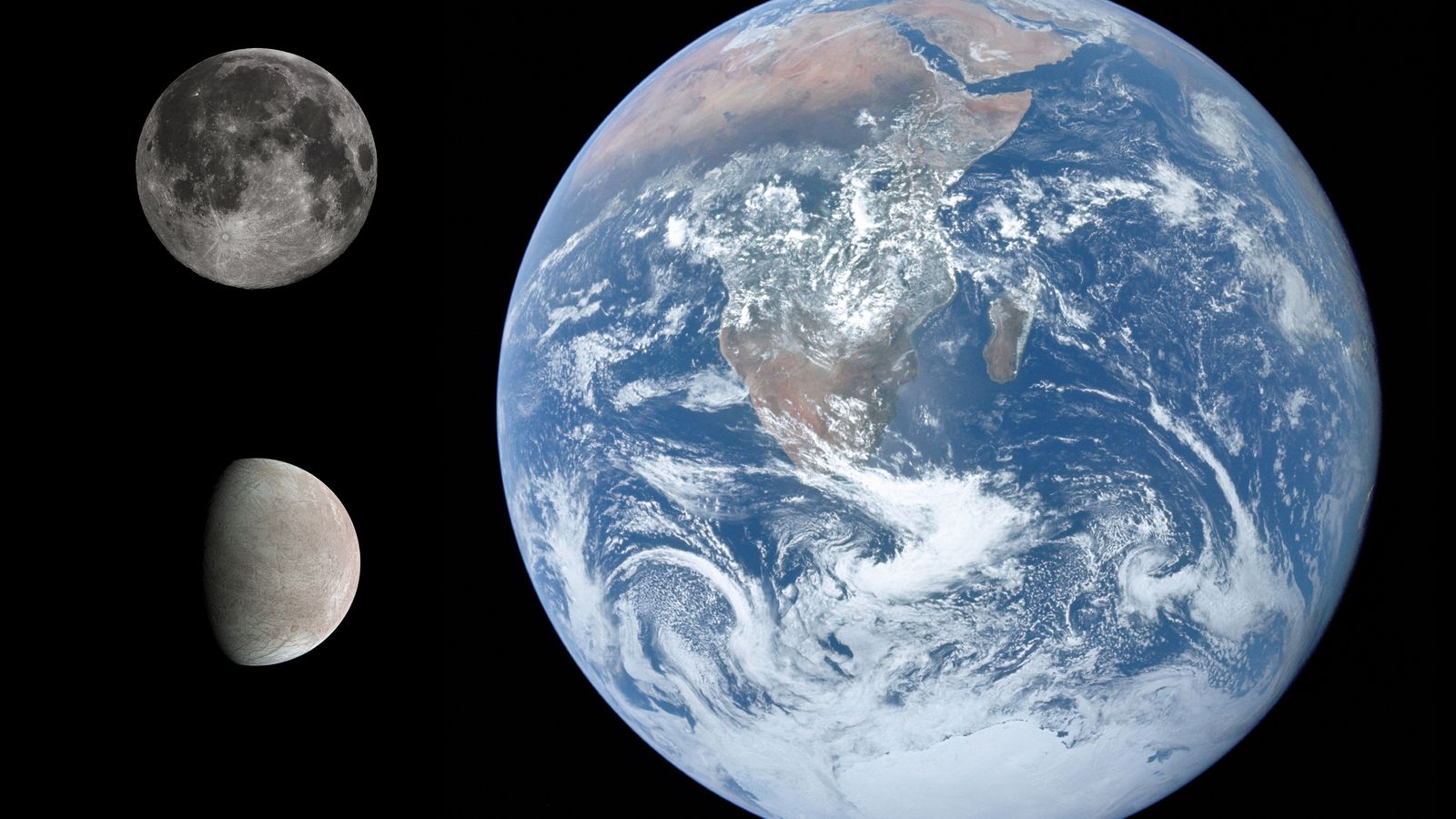
But what if we are the exception? According to Planetary Scientist Alan Stern, the more common form of life might not be on rocky planets, but rather on icy moons. If moons like Jupiter’s Europa, with a thick outer layer of ice, and presumably a liquid interior, contain the necessary ingredients for life, they may be the most common habitat in the galaxy. After all, living in the subsurface ocean of an icy world would grant extra protection against asteroid impacts, solar events, and other dangers from outer space.
It would also make a wider range of orbits habitable around its sun.
If these underwater worlds across the galaxy harbor the majority of intelligent life, it would make sense why we haven’t found them yet. Their structure would, by nature, block much of their transmissions, making them harder to detect, while also making them overall less likely to explore their surroundings. If such worlds exist, they might have entire eons in which civilizations rise and fall without ever venturing through the ice layer, unaware that an entire universe exists outside their moon. It would be very difficult to locate such life, as we would likely have to physically land on the moon before we could detect signs of it.
On a similar note, others have suggested that apart from the icy moons, the dominant habitable planets may be water worlds—rocky planets similar to earth, but with far less continental landmass. It could be on these oceanic planets that intelligent life develops, but is never able to take to the stars. As one scientist put it:
“In which case, the evolution of creatures like us, with hands and fire and all that sort of thing, may be rare in the galaxy… In which case, when we do build starships and head out there, perhaps we’ll find lots and lots of life… but they’re all dolphins, whales, squids, who could never build their own starships.”
It would certainly be a surprise to find out that land-based life forms are the exception in the galaxy, but it would certainly explain why we’ve yet to receive any radio signals from alien civilizations: they simply don’t have that kind of technology.
It’s also been proposed that highly advanced civilizations might not live on planets, or moons, at all, and have instead moved on to permanently live on space stations. This would allow the civilization to move freely around their solar system, or perhaps even between stars, and sadly, would mean that our exhaustive search for earth-like exoplanets is rather pointless. These stations would likely be so small that it would be very difficult for us to detect them at all unless they came rather close to our solar system.
We Are Alone
The final, and perhaps most unsettling resolution of all, is that there is no paradox. That our assumption that life in the universe is common is simply false, and humanity, and earth, is an abnormality. This isn’t a resolution that sits well with most people, not just because it paints a bleak picture of an empty universe, but because it seems to violate the Copernican Principle. The Copernican Principle is the general assumption in cosmology that earth isn’t special.
That, based on probability, there’s a very, very low chance that we are always the exception, some irregularity or surprise. It’s far more likely that we are average, meaning we must not be alone.
But our very existence may be what breaks this principle. If our exhaustive searches of the galaxy continue to come up empty-handed, we may be forced to accept that we are the anomaly, and are actually alone in the Milky Way.
But just because we might be alone right now, doesn’t mean we always will be. Perhaps our strangeness is not in the location or method in which we evolved, but simply when we evolved. We may just be far ahead of our galactic peers on the evolutionary timescale, the first to develop space travel, telescopes, and advanced mathematics, while on other planets intelligent life is just starting to figure out the use of basic tools or how to start fires.
On another note, we aren’t actually certain if interstellar travel is possible. If it turns out that it takes far too long or is simply not worth the resources, civilizations may never make contact, and remain isolated in their solar systems.
But this is all just speculation. As of right now, as far as we can tell, our civilization is the only one around, and we may need to come to terms with the fact that the endless expanse of space is indeed entirely devoid of life.
Key Takeaways
- The Fermi Paradox questions why, despite the vast number of stars and planets, we have not found evidence of extraterrestrial civilizations.
- The Dark Forest hypothesis suggests that alien civilizations may be hiding to avoid detection by potentially hostile others.
- The Great Filter theory proposes that there is a barrier in the evolution of life that prevents most civilizations from becoming space-faring.
- Communication with alien civilizations may be impossible due to vastly different methods or advanced intelligence.
- It is possible that we are alone in the universe, challenging the Copernican Principle that Earth is not special.
SideProjects Editors
The SideProjects editorial team researches, fact-checks, and structures explainers about the lesser-known tales, side narratives, and spin-offs behind major historical and contemporary subjects.
Frequently Asked Questions
What is the Fermi Paradox?
The Fermi Paradox is the contradiction between the high probability of the existence of extraterrestrial civilizations and the lack of contact or evidence for such civilizations.
What is the Dark Forest Hypothesis?
The Dark Forest Hypothesis suggests that other civilizations are actively hiding from each other, afraid that any transmission could attract hostile civilizations.
What is the Great Filter?
The Great Filter is a theoretical barrier that prevents life from advancing to space-faring civilizations, which could be at any stage of evolution.
What is the Berserker Hypothesis?
The Berserker Hypothesis proposes that advanced civilizations might use lethal probes to eliminate competition for resources, making the galaxy dangerous for emerging civilizations.
Why might we be looking in the wrong places for alien life?
We might be looking in the wrong places because the majority of life could be on icy moons or water worlds, which are harder to detect and less likely to develop space-faring technology.
What is the Copernican Principle?
The Copernican Principle assumes that Earth is not special and that there is a low probability that we are the exception in the universe.
What if we are alone in the universe?
If we are alone, it means that our assumption that life is common in the universe is false, and humanity is an abnormality.
What are some possible reasons for the Great Filter?
The Great Filter could be due to frequent mass extinction events, self-destruction of advanced civilizations, the rarity of forming reproductive molecules, or the difficulty and danger of interstellar travel.
Why might communication with alien civilizations be impossible?
Communication might be impossible because alien civilizations could use methods we don’t understand or recognize, or they might be too advanced for us to comprehend.
What are some alternative habitats for life in the galaxy?
Alternative habitats for life could include icy moons with subsurface oceans, water worlds with minimal landmass, or space stations inhabited by advanced civilizations.