
The date is 2000 BCE. The sun rises over a bustling city in the Indus Valley. Streets are laid out in perfect grids, and the air carries the scent of fresh grain from the bustling marketplace. Potters spin their wheels, while skilled artisans carve seals with mysterious symbols. Children play by the wells as women draw cool water in clay jars, their bangles jingling softly. Inside homes, meals simmer in hearths while farmers lead their oxen to the fields beyond the city walls.
This civilisation was far ahead of its time, thriving in the shadows of grand granaries and advanced drainage systems—long before the Romans even considered aqueducts. It used healthy trade networks stretching from Mesopotamia to Central Asia. It practised equality in a way we can only dream of. And yet, this civilisation vanished, leaving behind little more than ruins and mysteries.
The Indus Valley Civilisation is one of human history’s most fascinating and enigmatic societies. It didn’t leave behind towering pyramids or massive monuments, but it did leave a legacy of innovation and mystery. How did it organize its cities so perfectly? Why did its civilisation crumble? And perhaps the biggest question of all—what happened to these people? Did it simply fade into history, or are they still with us, assimilated into other groups?
Key Takeaways
- The Indus Valley Civilization thrived around 2000 BCE with advanced urban planning, trade networks, and social equality.
- Mohenjo-Daro and Harappa featured grid-patterned streets, efficient drainage, and standardized construction, showcasing their engineering prowess.
- The civilization’s decline around 1900 BCE is attributed to environmental changes, economic issues, and potential disease outbreaks.
- The Indus Valley people were skilled traders and farmers, cultivating wheat, barley, and cotton with advanced irrigation systems.
- Their legacy includes mysterious script, sophisticated art, and a model of societal harmony that remains enigmatic.
The People of the Indus Valley
The Indus Valley Civilisation—also called the Harappan Civilisation—wasn’t just some small, isolated community. It was one of the most significant civilisations of its time, stretching across what is now Pakistan and northwest India. At its height, around 2500 BCE, it covered over 1.25 million square kilometres (nearly 490,000 sq miles), which is more than double the size of modern France.
But what really set them apart wasn’t just their size. It was how they lived. Unlike other ancient civilisations that revolved around grand temples or palaces, the Indus Valley cities didn’t seem to have any single dominant ruler or centralised authority. There were no sprawling ziggurats like in Mesopotamia, no Pyramids like Egypt, and no royal tombs filled with treasures. Instead, their cities were marvels of planning and, as far as we know, equality.
The streets of Harappa and Mohenjo-Daro were laid out in precise grids, like a modern city. Their brick houses were uniform in size and design, suggesting a society where wealth was much more evenly distributed than in, say, ancient Egypt or Mesopotamia. There’s little evidence of huge wealth gaps or oppressive rulers. It’s as if they prioritised order and functionality over displays of power.
Then there’s their economy. The Indus Valley people were brilliant traders. They developed extensive trade networks that connected them to distant lands. Archaeologists have found their seals—small, carved artefacts used for trade and identification—thousands of miles from their homeland. These weren’t isolated farmers; they were international traders long before the word globalisation existed.
And let’s not overlook their cultural sophistication. Their pottery, jewellery, and art are stunning, marked by geometric patterns and elegant designs. Yet, perhaps the most intriguing part of their culture is their script. The Indus script, found on seals and pottery fragments, remains undeciphered to this day, meaning we have absolutely no idea what they wrote about.
There are no epic tales, religious texts, or accounts of rulers. Just symbols, silent and mysterious. This is perhaps what makes the Indus Valley Civilisation so intriguing. They were hugely advanced for their time, yet we know practically nothing about them.
The Cities
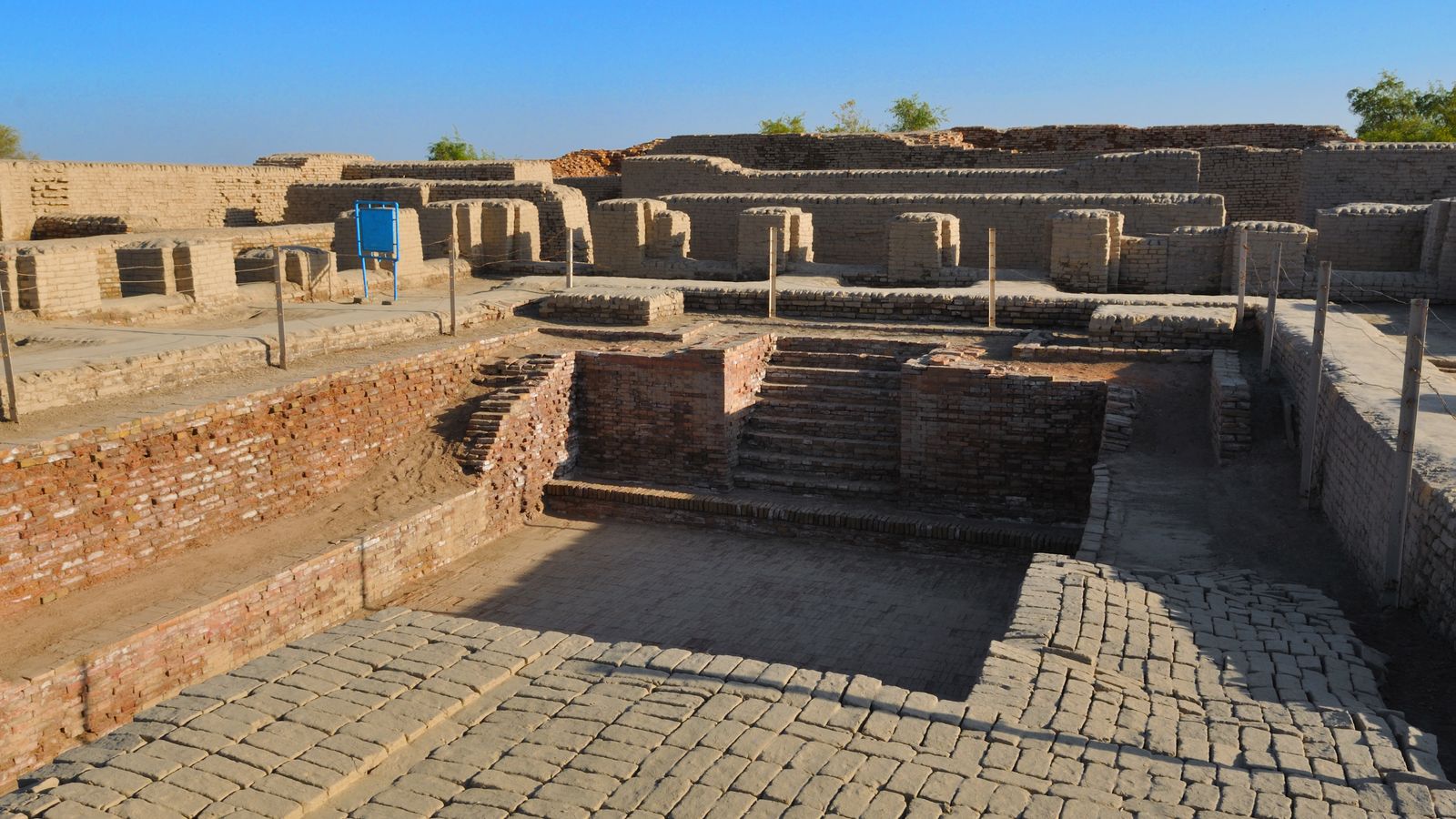
Mohenjo-Daro was the glory of the Indus Valley. Its remains, which is a UNESCO World Heritage Site, are located in modern-day Sindh Province, Pakistan, near the Indus River, approximately 40 kilometres (25 miles) southwest of Larkana. The name “Mohenjo-Daro” translates to “Mound of the Dead,” reflecting its status as an ancient settlement buried and preserved under layers of earth.
Here, the streets were laid out in a precise grid pattern, with wide avenues that allowed for the smooth movement of people and goods. Each street intersected at right angles, creating a beautiful design that was first laid out sometime around 2600 BCE - that’s more than 4,000 years before New York famously started doing the same.
Mohenjo-Daro’s drainage and sewer system stands as one of the most impressive feats of ancient engineering. Every street had a carefully constructed network of brick-lined drains covered with removable slabs for maintenance. Wastewater from homes, including kitchens and baths, flowed into these drains, which directed it out of the city. Individual houses were often connected to this system by private drains, ensuring efficient sanitation.
Large public drains along the main streets carried away excess water, while soak pits and settling tanks managed debris. And again, this is what makes the Indus Valley so extraordinary. This sewer system was in place nearly 5,000 years ago. Way before the Minoans, who came next, followed by the Babylonians, the Greeks, and, of course, the Romans.
And it wasn’t just the public spaces that were brilliantly designed. Their homes were equally impressive. Many houses had wells, bathrooms, and even rudimentary forms of indoor plumbing. While most of the world was still grappling with building huts, the Indus Valley people were installing water systems right inside their homes.
The Great Bath of Mohenjo-Daro is one of the Indus Valley’s most iconic structures. This massive, watertight pool, built with meticulously laid bricks and sealed with bitumen, was believed to have been used for ritual bathing, pointing to the importance of cleanliness and water in their culture.
But there was also an obsession with standardisation that would today probably be borderline OCD. The Indus Valley people used uniform bricks in their construction, all of the same sizes, whether for homes, walls, or public buildings, suggesting a high degree of organisation and possibly central oversight. They even standardised their weights and measures, which must have made trade and commerce remarkably efficient. And this wasn’t just in a single location.
Artefacts and city layouts exhibit remarkable standardisation across thousands of miles, suggesting a highly cooperative system.
They were also well ahead in terms of agriculture. They didn’t just rely on luck with their crops—they developed advanced irrigation systems to control water flow from rivers like the Indus. They cultivated wheat, barley, and even cotton, making them among the earliest producers of textiles. The Indus Valley people were pioneers in farming as much as they were in city planning.
These achievements weren’t just impressive for their time—they were revolutionary. They reveal a civilisation prioritising practicality, order, and long-term sustainability over short-term glory. While other cultures built massive monuments to gods and kings, the Indus Valley people created systems that benefited their entire society.
But for all their brilliance, their story takes a dark turn. Around 1900 BCE, something changed. Cities that had thrived for centuries began to crumble, and the civilisation that seemed so stable suddenly vanished.
The Sudden Decline
By 1900 BCE, their grand cities—Mohenjo-Daro, Harappa, and others—were abandoned or reduced to shadows of their former selves. So, what happened? The truth is, no one knows for sure, but the clues left behind are fascinating.
One of the first signs of trouble comes from the ruins themselves. Archaeologists have found evidence of declining urban standards. Streets, once kept clean, became clogged with debris. Buildings weren’t repaired; instead, people started reusing older, crumbling materials. Trade goods, once abundant, became scarce, and the once-bustling cities emptied.
Watch the Video
Open Video
Video Briefing
Did This Ancient Civilization Vanish Without a Trace?
And it wasn’t just the cities, either. Across the region, agriculture—the lifeblood of any civilisation—seemed to falter. Crops failed, irrigation systems fell into disrepair, and the stable, organised society that had lasted for centuries began to fragment.
Some theories point to environmental changes. The Indus Valley depended heavily on rivers like the Indus and the now-dry Saraswati for water. Evidence suggests these rivers may have shifted course or dried up due to tectonic activity or long-term climate changes. Without reliable water sources, farming would have become nearly impossible, forcing people to leave their cities for better land.
Others argue that disease may have played a role. No matter how well-planned, urban centres can become breeding grounds for illness—especially when sanitation systems fail. Could a widespread epidemic have driven people out? It’s possible, though hard to prove.
There’s the theory of economic collapse. The Indus Valley wasn’t isolated; it thrived on trade with regions like Mesopotamia. But around the time the civilisation started declining, Mesopotamia was dealing with its problems—political instability and economic downturns. If those trade routes were disrupted, the Indus Valley economy might have taken a hit that it couldn’t recover from—a domino effect, if you will.
And then there’s the invasion theory. Early archaeologists speculated that an invading group—the Aryans—might have swept through the region, conquering the Indus Valley people and forcing them to flee. The Indus people left no evidence of large-scale warfare or weapons, hinting at a relatively peaceful society. Were they swamped by another violent, power-hungry people?
There’s little evidence to support this: no mass graves, no signs of large-scale violence, nothing to suggest a sudden, catastrophic invasion. Most modern historians have largely dismissed this idea as more myth than fact.
Finally, there’s the migration theory. Some experts believe the Indus Valley people didn’t vanish—they simply dispersed. Faced with environmental or economic pressures, they may have left their cities and moved into smaller, rural settlements. Over time, they likely blended with other cultures, and their legacy lived on in modern South Asia’s DNA, languages, and traditions.
So, what are we left with? Perhaps the most likely explanation is a combination of factors. Environmental changes, economic decline, and the gradual erosion of social cohesion could have created a perfect storm, leading to the civilisation’s slow collapse. It’s not as dramatic as an invasion or a single catastrophic event, but history rarely offers simple answers.
The lack of a clear resolution makes the Indus Valley Civilization’s decline particularly haunting. They didn’t leave behind records to explain what happened. There were no texts, monuments, or desperate pleas to their gods—just silence. It’s as if they disappeared into the mists of time, leaving us to piece together their story from the fragments they left behind.
Legacy of the Indus Valley Civilization
Though the Indus Valley Civilisation disappeared thousands of years ago, its legacy still burns within the imagination. Although they may not have left behind towering monuments or grandiose declarations of their existence, what they did leave speaks volumes about their ingenuity and lasting influence.
For a long time, the outside world remained entirely ignorant of the extraordinary civilisation that once stood near the Indus River. The first excavations of the Indus Valley began in the early 20th century, shedding light on one of the world’s oldest urban cultures. In 1921, archaeologist Rai Bahadur Daya Ram Sahni unearthed the ruins of Harappa in Punjab, now in modern-day Pakistan.
Shortly after, in 1922, R.D. Banerji discovered the site of Mohenjo-Daro in Sindh, and together, these discoveries marked the beginning of a systematic exploration into an advanced Bronze Age civilisation that had long remained hidden beneath centuries of sediment.
Led by Sir John Marshall, Director-General of the Archaeological Survey of India, subsequent digs uncovered more cities, highlighting the civilisation’s vast extent across modern India and Pakistan. The findings completely changed earlier notions of the origins of urbanism and revealed a society beyond one’s imagination. The world has known about the glories of Ancient Egypt pretty much since its heyday, but we only became aware of this great civilisation that equalled and even surpassed Egypt in some ways around 100 years ago.
Their advancements in the fields of sanitation, agriculture, urban planning, and social equality meant that this mysterious civilisation was about as forward-thinking and developed as any location on the planet. Many scholars believe the Indus Valley people laid the groundwork for aspects of South Asian traditions that persist today. The seals they left behind, with their intricate designs of animals and symbols, may have inspired later artistic and religious motifs in the region. Some even argue that elements of the Indus Valley script influenced the development of later Indian writing systems, though this remains speculative until their script is fully deciphered.
Of course, there’s a message for our resource-hungry societies of the modern era. The Indus Valley Civilisation flourished because it worked harmoniously with its environment, using resources wisely and creating systems that benefited the collective. When environmental changes and societal pressures emerged, however, it couldn’t sustain its way of life. Whatever the exact reasons were for the collapse, one of the most advanced groups on the planet was powerless to prevent its own demise.
Perhaps their greatest legacy is the mystery they left behind—both in terms of what happened to them and why they lived like they did. The Indus Valley people didn’t build monuments to glorify rulers. They didn’t carve their stories into stone for future generations to find. Over the next few thousand years, the world saw numerous rises and falls of great empires, often led by power-hungry zealots who pushed them as far as they could go before it all came crashing down in a fiery inferno.
As far as we can tell, the Indus Valley Civilization wasn’t like this. It wasn’t loud and brash. It wasn’t a society with great gaping gaps between the rich and poor. There was an equality here that even we in our equality-driven world have still fallen spectacularly short of. Its name isn’t spoken about in the same terms as Egypt, Mesopotamia, Greece, or Rome, but who’s to say that the Indus Valley people weren’t even better in many aspects?
The exact reasons for this great civilisation’s collapse will almost certainly remain a mystery, at least without further extensive archaeological work or a breakthrough in understanding their language. It’s impossible to make firm conclusions, and in all probability, it was due to a combination of the theories we outlined earlier. As we’ve seen countless times in history, the fate of grand societies can turn on a knife edge. And for the Indus Valley, that knife fell dramatically and definitively around 4,000 years ago.
Olivier Guiberteau
Key Takeaways
- The Indus Valley Civilization thrived around 2000 BCE with advanced urban planning, trade networks, and social equality.
- Mohenjo-Daro and Harappa featured grid-patterned streets, efficient drainage, and standardized construction, showcasing their engineering prowess.
- The civilization’s decline around 1900 BCE is attributed to environmental changes, economic issues, and potential disease outbreaks.
- The Indus Valley people were skilled traders and farmers, cultivating wheat, barley, and cotton with advanced irrigation systems.
- Their legacy includes mysterious script, sophisticated art, and a model of societal harmony that remains enigmatic.
SideProjects Editors
The SideProjects editorial team researches, fact-checks, and structures explainers about the lesser-known tales, side narratives, and spin-offs behind major historical and contemporary subjects.
Frequently Asked Questions
What was the Indus Valley Civilization known for?
The Indus Valley Civilization was known for its advanced urban planning, extensive trade networks, and a society that prioritized equality and functionality over displays of power. They had well-organized cities with precise grid patterns, advanced drainage systems, and a high degree of standardization in construction and trade.
Where was the Indus Valley Civilization located?
The Indus Valley Civilization was located in what is now Pakistan and northwest India. At its height around 2500 BCE, it covered over 1.25 million square kilometers, more than double the size of modern France.
What are some of the major cities of the Indus Valley Civilization?
Some of the major cities of the Indus Valley Civilization include Mohenjo-Daro and Harappa. Mohenjo-Daro, located in modern-day Sindh Province, Pakistan, is known for its precise grid pattern streets, advanced drainage systems, and the iconic Great Bath.
What was the economy of the Indus Valley Civilization like?
The Indus Valley Civilization had a robust economy based on extensive trade networks that connected them to distant lands. They were skilled traders and developed standardized weights and measures, which facilitated efficient commerce. Their seals, found thousands of miles from their homeland, indicate their international trade activities.
What is the significance of the Great Bath in Mohenjo-Daro?
The Great Bath in Mohenjo-Daro is one of the most iconic structures of the Indus Valley Civilization. It was a massive, watertight pool used for ritual bathing, highlighting the importance of cleanliness and water in their culture.
What happened to the Indus Valley Civilization around 1900 BCE?
Around 1900 BCE, the Indus Valley Civilization began to decline. Cities like Mohenjo-Daro and Harappa were abandoned or reduced to shadows of their former selves. The reasons for this decline are not fully understood but may include environmental changes, economic collapse, disease, or a combination of these factors.
What is the legacy of the Indus Valley Civilization?
The legacy of the Indus Valley Civilization includes their advancements in sanitation, agriculture, urban planning, and social equality. Their influence can be seen in modern South Asian traditions, and their mysterious decline continues to fascinate historians and archaeologists.
Why is the Indus script significant?
The Indus script, found on seals and pottery fragments, remains undeciphered to this day. This means we have no direct knowledge of what the Indus Valley people wrote about, adding to the mystery and intrigue surrounding their civilization.
What are some theories about the decline of the Indus Valley Civilization?
Theories about the decline of the Indus Valley Civilization include environmental changes such as shifts in river courses or climate changes, economic collapse due to disrupted trade routes, disease outbreaks, and the migration theory, which suggests the people dispersed and blended with other cultures.
What makes the Indus Valley Civilization unique compared to other ancient civilizations?
The Indus Valley Civilization is unique because it prioritized practicality, order, and long-term sustainability over short-term glory. Unlike other ancient civilizations that built massive monuments to gods and kings, the Indus Valley people created systems that benefited their entire society, with a high degree of equality and functionality.