
Throughout the history of mankind, countless civilizations have crumbled and fallen, due to war, internal conflict, natural disasters, and much more. Many of these collapses are well-known and documented in detail, such as the fall of Rome or the conquest of the Aztecs, but others remain shrouded in mystery. Despite years of research and significant advances in technology, there are some civilizations that just seemed to have abruptly ended, vanishing without much of a trace.
The Minoans
Often regarded as one of the first civilizations of Europe, the Minoans were a people that lived on the island of Crete, with evidence showing that urban communities first began coming together as long ago as 2,000 BC. Because this was in the distant past, a lot of the details are quite murky, but from the archaeological evidence we do have, it is clear that Minoan society was quite advanced, with highly skilled craftsmen, artisans, and architects. They also had well-connected trade routes with other civilizations around the Mediterranean, and their artists were so talented that they were even hired by Egypt to paint frescoes at Avaris. Along with frescoes, the Minoans left behind pottery, statues, and every other type of art you can imagine.
They also constructed impressive palaces, with their most famous being the one at Knossos, home to Europe’s first paved roads and running water.
Key Takeaways
- The Minoans, an advanced civilization on Crete, vanished around 1500 BC, with theories suggesting volcanic activity or internal conflict.
- Ancestral Puebloans abandoned their cliff dwellings in the 13th century, possibly due to drought or warfare with nomadic tribes.
- The Khmer Empire’s decline in the 15th century may have been caused by water management issues, extreme weather, or plague.
- Pre-Columbian Amazon civilizations were more advanced and populous than previously thought, with estimates reaching 20 million.
- Disease, particularly from European explorers, likely decimated Amazon civilizations, reducing the population by 99% by 1900.
One thing we don’t know is the language that they spoke. It appears that the island developed two forms of written language over the years, which have been dubbed Cretan Hieroglyphs and Linear A. These have yet to be fully deciphered, but from what we have learned so far, the language doesn’t seem to be closely related to any familiar tongue.
The bigger mystery, though, is what on earth happened to them. Sometime around 1500 BC, Minoan society went into a sharp decline and essentially disappeared from the map.
For a while, it was assumed that the end of the Minoans was related to the greater Late Bronze Age collapse, but in fact the end of the Minoan civilization came a few hundred years too early to be confidently included with this. However, one event that very closely coincides with the collapse is the volcanic eruption at Thera, today also known as Santorini, a smaller island to the north. This was an immense eruption, and could have caused tsunamis to strike the island the Minoans called home, as well as deposit thick layers of ash and harm their agriculture, all of which could easily contribute to the end of a society.
But recent evidence shows that there actually wasn’t much ash, as it seems that the wind had been blowing in the opposite direction, along with clay tablets that appear to have been written more than 50 years after the volcano’s eruption, detailing architectural projects that wouldn’t be expected in a destroyed economy. This has led to the theory that the volcanic eruption didn’t end the civilization in an instant, but rather, led to severe environmental effects that slowly squeezed the life out of the island over a few generations, eventually forcing their descendants to abandon Crete.
But other historians dispute the claim that the volcano had much to do with the collapse at all. Key to this claim is the evidence of destruction around the island that doesn’t seem consistent with natural disasters, as certain areas seem to have been spared from the carnage. For instance, the town at Knossos was burned to the ground, while the palace was left untouched. Natural disasters would have destroyed all of it indiscriminately, but internal warring parties may have spared their most sacred building during an armed conflict.
In any case, we don’t have all the answers. Perhaps completely deciphering their written records will shed some light on what really happened, but as for right now, the cause of their collapse is still largely a mystery.
The Ancestral Puebloans
Also called the Anasazi, the Ancestral Puebloans were an ancient Native American culture that inhabited the American Southwest, centered mostly near the four corners area of Utah, Arizona, Colorado, and New Mexico.
Their larger settlements are among the most well-known Native American architecture, comprised of cliff dwellings carved and built on the underside of large rock faces, such as Cliff Palace in Mesa Verde National Park in Colorado. These cliff communities housed up to several hundred people, contained communal areas for worship, and display clear evidence of agriculture. However, sometime around the 13th century, these beautiful homes were suddenly abandoned.
As for what could cause these tribes to leave such well-established communities behind and search for a new place to live, there are a few theories.
The first is that their move was necessitated by drought. Investigations have shown that many of these settlements were constructed during periods of heavy rainfall, which made agriculture simpler and didn’t require advanced irrigation. However, beginning around 1150, North America went through a period known as the Great Drought, which could have degraded soil quality and made this style of farming no longer viable, forcing the communities to pack their bags and move to more favorable locations.
But warfare is always a potential explanation. In this case, some academics posit that the true reason for the abandonment of the sites was the arrival of other tribes that were more nomadic in nature, such as the Utes and Paiutes, bringing violence that forced the Puebloans to leave as their large cities made them easy targets for raids. Evidence for violence was found in a 1997 excavation that unearthed 24 skeletons showing clear indications of a violent death and even cannibalism.
However, others argue that this isn’t conclusive evidence, and that the cannibalism and violent death have many other possible explanations, such as ritual combat for religious purposes, or even that the bones aren’t from the Puebloans themselves, and are simply from a smaller nomadic tribe that took refuge in the site for a few years long after it was abandoned by its creators.
Unlike many other civilizations in this video, the Puebloans did not die out completely, and their descendants are still alive and known today, with many of their oral histories maintained throughout the many generations, but unfortunately, without written language, we may never know the true reason they suddenly left their grand cities.
The Khmer Empire
Watch the Video
Open Video
Video Briefing
Ancient Civilizations that Just... Vanished
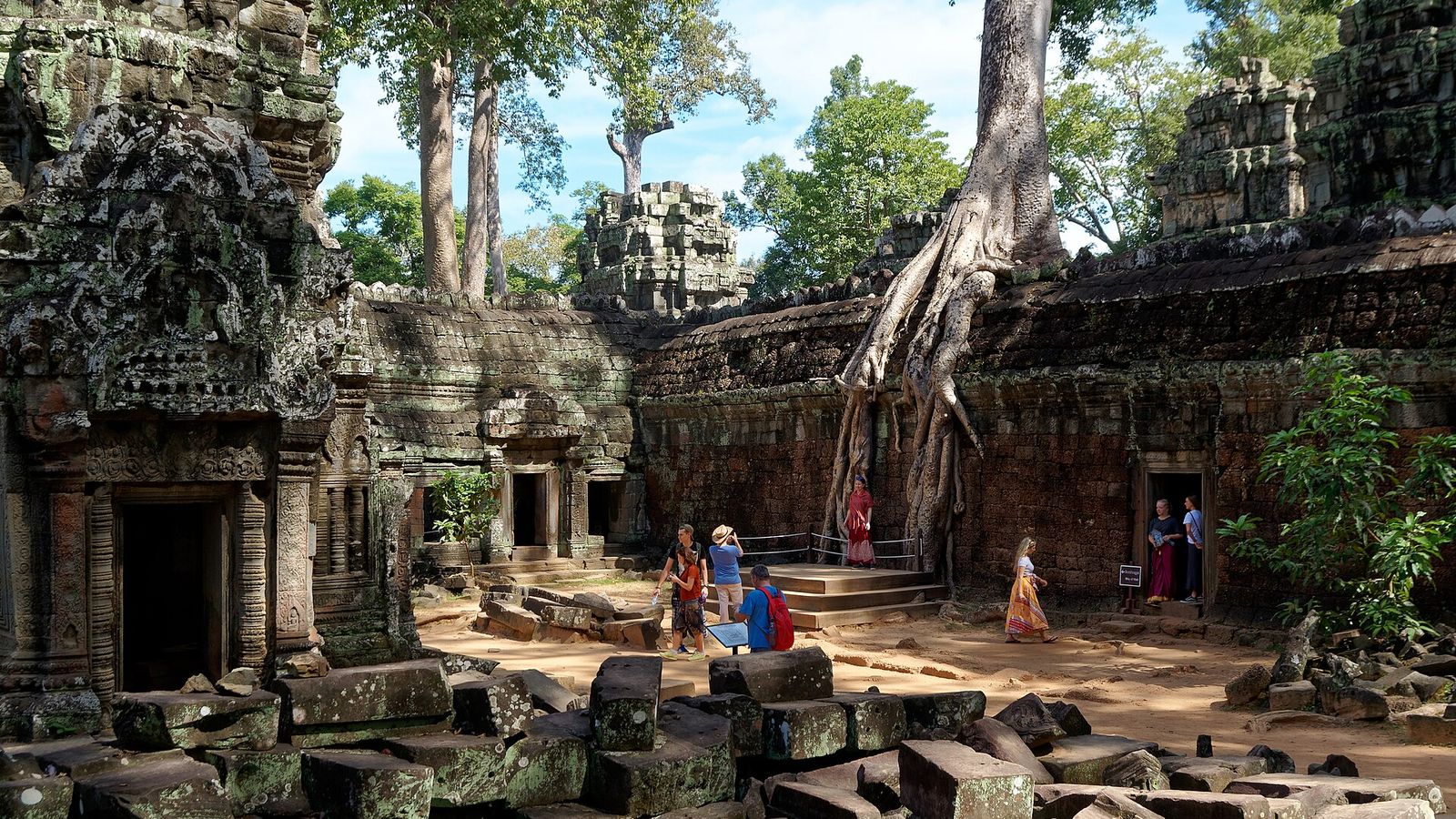
At its peak, the Khmer Empire ruled over most of southeast Asia, and during their time in power, the civilization constructed impressive monuments such as the famous Angkor Wat, and are believed to have been the most complex pre-industrial society on earth, even inventing what is regarded as the first healthcare system, spread out over more than a thousand hospitals. However, this all came to an end in the mid-15th century, where the archaeological record suddenly contains a near 300-year gap in writing, only showing that the majority of sites were abandoned and then later reinhabited by many different groups.
Traditionally, this sudden decline has been attributed to war with the Siamese Ayutthaya Kingdom, who conquered the capital Angkor in the 1400s, but many scholars point out that in such a large empire, the changing of power in the capital might not have been enough to completely destroy a civilization that spanned such a large area, and so there seems to be more going on than meets the eye.
One of the main theories centers on water management. The Khmer had an extensive canal and irrigation system in place with numerous reservoirs that were used for cultivating rice. Their agriculture was so effective that they were clocking in three rice harvests per year, which is what allowed their population to rise so steadily for so many decades.
However, this rising population may have outpaced the water system, which, combined with a couple minor droughts, could have brought the whole rice economy to a breaking point and resulted in anarchy. There’s also the opposite theory, that instead of some small droughts, there were a few years of heavy, intense monsoons, which were so strong that they damaged the water canals across the region to the point that they couldn’t be repaired before chaos erupted and everyone had to fend for themselves.
There’s also the theory that the plague was to blame. After all, it was during the 14th and 15th centuries that the Black Death was ravaging Europe, and the Bubonic Plague was known to haves struck China as well. With such a large population and such complex urban settlements, if it arrived, the plague could have devastated the Khmer, leaving them vulnerable to all manner of other threats at the same time.
The Amazon
Our final civilization for this video isn’t just one, per say, but an entire geographic region. Due to a lack of written records, it isn’t known for certain just how many people lived in central and South America before the arrival of European powers, and the true numbers have been debated for many years. But the important thing to note here is that while for years these people have been typically portrayed as jungle-dwelling tribes that were still largely hunter-gatherer types, we now know that there were many civilizations that were actually quite advanced in the pre-Columbian era. For instance, a new study from 2024 found one city in the Amazon that had been hidden by thick vegetation for thousands of years, and showed evidence of neatly paved roads, gardens, and canals, and may have been home to a hundred thousand people.
The idea that there were numerous cities and even large, organized civilizations spanning the continent is consistent with the records of early European travelers who explored the region, such as Gaspar de Carvajal, who wrote of seeing huge numbers of peoples, settlements, and tribes as he floated along the Amazon River. He described them as being so numerous and advanced that once his chronicles were published back in Europe, they were widely dismissed as wild exaggerations or even outright lies, a sentiment that remained the consensus for hundreds of years. It was thought that the soil was too acidic in the Amazon for large agriculture to take place, and, of course, there was no shortage of racism involved in thinking that these people were too primitive to form such advanced societies.
However, in recent years, more and more findings have emerged showing that Carvajal wasn’t exaggerating at all, and in fact, that his words didn’t even capture the full scope of just how many people lived in the Amazon at the time.
The key to these new findings is a technology called LiDAR, which scans an area using lasers to paint a picture of the surface, able to spot things like stone structures even if they’re covered by thick vegetation. Using LiDAR from aircraft, researchers have found thousands upon thousands of hidden structures across the amazon, indicating that there were indeed massive populations here throughout history, and that they were far more organized than previously believed. Investigating these sites on foot, scientists have found charcoal, pottery shards, tools, and rock art.
Most impressive of all, in 2018, a team of archaeologists discovered what they believed to be a series of interconnected, fortified settlements, spanning over a thousand miles, indicating that the population was over a million people in just 7% of the Amazon rainforest. This was in direct contradiction to the long-held belief that the population of the entire Amazon at the time was just 2 million.
Jose Iriarte, one of the archaeologists on the team, said that the finding was so significant that, “We need to re-evaluate the history of the Amazon.”
And the more we search, the more we find, bringing estimates of the total population upwards of 20 million or more in the region. But, in just a few short decades, the vast majority of these civilizations would vanish off the face of the earth, and disappear without a trace, leaving their cities to be reclaimed by the Amazon and lost for hundreds of years, becoming myths that would only be confirmed by modern technology. By 1900, the population of the area was estimated to be just 200,000, meaning that potentially 99% of the region’s people had died off.
The culprit here is almost certainly disease. The adventures of early explorers through the region introduced the locals to old-world diseases, such as smallpox, for which they had no previous exposure or immunity. And with our new knowledge of how interconnected and vast the societies were across the Amazon, its even easier to see how things like smallpox and measles could spread rapidly and bring an entire continent to its knees. Genocide was also a factor for the settlements unfortunate enough to be directly harmed by conquest, especially in central America, but disease outpaced warfare across the continent, likely killing most with sickness before guns and swords even had a chance.
It’s terribly tragic, and even more so because these people left almost no records behind, leaving potentially hundreds or even thousands of years of the history of tens of millions of people a complete and utter mystery.
Key Takeaways
- The Minoans, an advanced civilization on Crete, vanished around 1500 BC, with theories suggesting volcanic activity or internal conflict.
- Ancestral Puebloans abandoned their cliff dwellings in the 13th century, possibly due to drought or warfare with nomadic tribes.
- The Khmer Empire’s decline in the 15th century may have been caused by water management issues, extreme weather, or plague.
- Pre-Columbian Amazon civilizations were more advanced and populous than previously thought, with estimates reaching 20 million.
- Disease, particularly from European explorers, likely decimated Amazon civilizations, reducing the population by 99% by 1900.
SideProjects Editors
The SideProjects editorial team researches, fact-checks, and structures explainers about the lesser-known tales, side narratives, and spin-offs behind major historical and contemporary subjects.
Frequently Asked Questions
What are some theories about the collapse of the Minoan civilization?
Theories about the collapse of the Minoan civilization include a volcanic eruption at Thera (Santorini), which may have caused tsunamis and environmental damage, and internal conflicts or warfare, as evidenced by selective destruction around the island.
What evidence supports the theory that the Ancestral Puebloans left due to drought?
Evidence supporting the theory that the Ancestral Puebloans left due to drought includes the construction of settlements during periods of heavy rainfall and the occurrence of the Great Drought around 1150, which could have degraded soil quality and made agriculture unsustainable.
What are some possible reasons for the abandonment of Ancestral Puebloan cliff dwellings?
Possible reasons for the abandonment of Ancestral Puebloan cliff dwellings include drought, warfare with nomadic tribes like the Utes and Paiutes, and evidence of violence and cannibalism found in excavations.
What are some theories about the decline of the Khmer Empire?
Theories about the decline of the Khmer Empire include warfare with the Siamese Ayutthaya Kingdom, water management issues due to population growth and droughts or heavy monsoons, and the impact of the plague.
What evidence suggests that there were advanced civilizations in the Amazon before European contact?
Evidence from LiDAR technology and archaeological findings, such as paved roads, gardens, canals, and fortified settlements, suggests that there were advanced civilizations in the Amazon with populations numbering in the millions.
What role did disease play in the disappearance of Amazonian civilizations?
Disease, particularly old-world diseases like smallpox and measles, introduced by European explorers, likely played a significant role in the disappearance of Amazonian civilizations, leading to the deaths of potentially tens of millions of people.
What is known about the language of the Minoans?
The Minoans developed two forms of written language, Cretan Hieroglyphs and Linear A, which have not been fully deciphered. The language does not seem to be closely related to any familiar tongue.
What are some notable architectural achievements of the Minoans?
The Minoans constructed impressive palaces, including the famous one at Knossos, which featured Europe’s first paved roads and running water. They also created highly skilled art, including frescoes, pottery, and statues.
What is the significance of the LiDAR technology in studying Amazonian civilizations?
LiDAR technology has been crucial in discovering hidden structures and cities in the Amazon, revealing the extent of advanced civilizations that were previously unknown or underestimated. It has led to a re-evaluation of the history and population of the Amazon region.