
When you think of ancient civilizations, there are a few that probably come to mind. The Egyptians, the Greeks, the Romans, the Chinese, and the Mayans are the most well known ancient peoples. These are the ones that history books tend to focus on in varying degrees, largely because they are the ones who left behind the most for us to study.
But ancient civilizations existed for a long time all over the world, and there are entire civilizations that often go overlooked. Today we’ll be taking a look at some of these other ancient civilizations that you’ve probably never heard of.
Nok Culture
The Nok civilization, usually referred to as Nok culture, was one of the earliest known societies in Western Africa. Unfortunately, they did not have a written language so knowledge about their society is very limited. In fact, we didn’t even know they existed until the 20th century.
Key Takeaways
- The Nok culture, an early Western African society, was unknown until the 20th century when terracotta artifacts were discovered.
- The Vinča culture, predating the Greeks and Romans, had high population densities and introduced bread wheat and oats to Europe.
- The Caral-Supe civilization, the oldest in the Americas, developed advanced irrigation systems and built large monuments.
- The Dong Son culture, known for advanced bronze work, created numerous large bronze drums used for various ceremonial purposes.
- The Nok culture uniquely transitioned directly from stone tools to iron tools, bypassing the copper and bronze ages.
In 1928, Colonel Dent Young, the co-owner of a mining company, was mining for tin near the village of Nok in modern day Nigeria. It was there, buried 7 meters (24 feet) under the ground that the first artifacts from the Nok culture were found in the form of some terracotta statues.
The area remained quiet for another 15 years until 1943 when tin miners again accidentally unearthed terracotta figurines. A clerk who was overseeing the mine took home the head of one of these sculptures to use as a scarecrow in his yam field. The scarecrow stood for about a year until it was noticed by Bernard Fagg, a British archeologist and museum curator who was working extensively in Nigeria at the time.
When Bernard saw the scarecrow, he immediately noticed how similar it was in style to the previous terracotta pieces that had been discovered by Young. He traveled to the mining site where he was shown more pieces of art they had unearthed. It became immediately clear to Bernard that the mining was accidentally both discovering and destroying these priceless archaeological artifacts, but it would take nearly 20 years for proper archeological excavations to begin.
Within the first week of preliminary excavations, the discoveries of wrought iron and iron slag were made, leading to the classification of the Nok culture as an Iron Age civilization. Archeologists were able to use the artifacts found to date the Nok culture as having existed from roughly 1500 BC to 500 AD.
However, nobody is entirely sure where these people came from. The crops they grew, particularly millet, are indigenous to the Sahel region in Africa leading many to speculate that the Nok culture began in northern Africa before migrating to modern day Nigeria in Sub-Saharan Africa, though this cannot be stated conclusively yet.
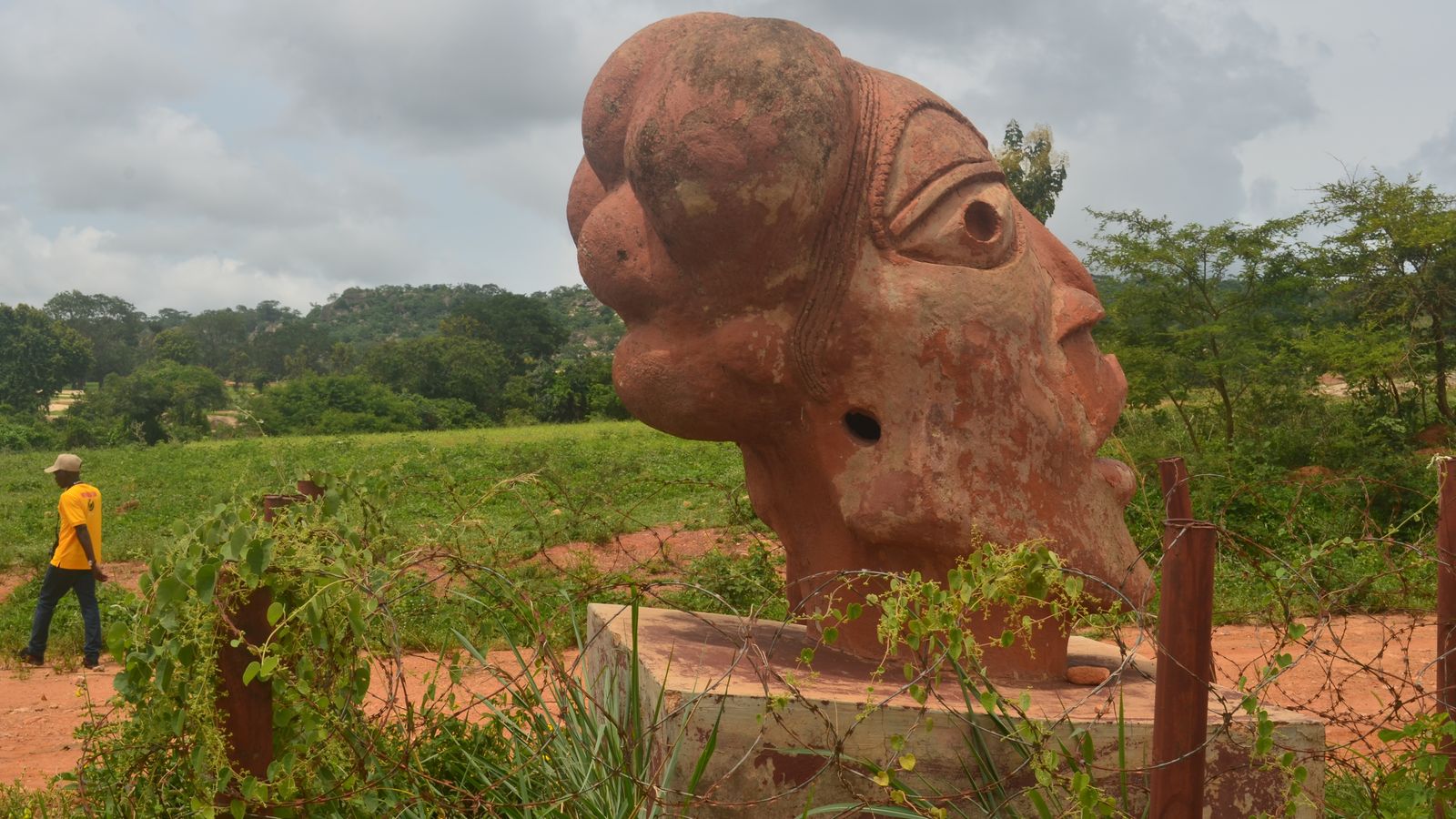
The terracotta figurines remain the most iconic part of Nok culture, both because of their abundance and their distinctive style. Though fully intact sculptures are exceedingly rare, there are many examples of terracotta heads. The heads are nearly life sized, and are easily identifiable by their triangular eyes and by their detailed and elaborate hairstyles. Though the heads are nearly the size of a full grown adult, the bodies are not.
One example, which can be found in the Louvre, shows a full Nok terracotta figure with a head nearly the size of the entire rest of the body.
These sculptures have been found across an area of 78,000 square km, which is roughly the size of South Carolina. However, analysis of the clay shows that all of it almost certainly came from a single, centralized source. This suggests that the Nok culture were all part of one expansive civilization rather than various tribes using a similar art style.
In addition to their terracotta art, the Nok are also known for their use of iron tools. Archeologists have found over a dozen iron smelting furnaces, and there are numerous examples of iron tools and weapons, as well as intricately crafted iron decorations. They were very advanced metalworkers, and there is strong evidence that they developed iron metallurgy between 750 and 550 BC, with some evidence even suggesting it may have been developed before 1000 BC.
But, what makes the Nok culture’s skill with iron so fascinating is that they began phasing out their stone tools for iron ones. That may not sound like a big deal at first; metal tools are better than stone ones, so of course they would have made this trade. However, that’s not what happened throughout the rest of the world.
Sure, everybody else abandoned their stone tools as well, but civilizations went from the Stone Age to the Copper Age to the Bronze Age and then finally the Iron Age. The jump from using stone tools to iron is almost entirely unprecedented, with nearly the entire world smelting copper for a full millennium before developing iron metallurgy.
And then, by around 200 AD, the Nok culture was gone. There is evidence of a very sudden and rapid decline in population, but we don’t have any idea what happened. It’s possible that they may have depleted their resources of either iron or coal, but for now all we can do is speculate.
Vinča Culture
Long before the Greeks, the Romans, or even the Egyptians, there was the Vinča culture. The Vinča culture occupied an area in southeastern Europe containing all of modern day Serbia and Kosovo, as well as portions of modern day Romania, Greece, Bulgaria, and more. They were active from around 5700 BC until 4500 BC, give or take a couple hundred years on either side.
One of the main defining characteristics of the Vinča was their population density. When farming was introduced to the region, it led to the unprecedented growth of settlements. Vinča cities were not only much larger than any contemporary culture, but they were even larger than the Bronze Age cities that would exist a millennium later.
The average population density of a Vinča settlement was 50-200 people per hectare, with that number falling to 50-100 people per hectare in the latter period of the Vinča culture. Since those numbers almost certainly mean nothing to you, as a comparison the density of modern day London is 56 people per hectare and modern day New York City is 96 people per hectare. Their average population density over 7,000 years ago was higher than we see in most of the largest cities in the world. In fact, Manila is currently the only city in the world with a population density higher than 200 people per hectare.
So with all of those people packed so tightly together, what exactly did they do? For the most part, people would have been tasked with helping to provide food for their society. This included farming, hunting and foraging, and animal husbandry. Agriculture was particularly focused on high yield grains that would help sustain such a dense population.
The Vinča were the first to introduce bread wheat, oat, and flax to this region of Europe. They also began keeping animals alive for milk production rather than just slaughtering them for their meat.
While the Vinča culture is generally considered to be part of the Stone Age, they possess the world’s earliest known examples of copper smelting. However, though some copper tools from the civilization do exist, the majority of their metallurgical skill was dedicated to trinkets rather than to tools.
Because the Vinča were a prehistoric civilization, there is only so much we can know about their everyday lives. The Sumerians wouldn’t invent written language until over 1,000 years after the decline of the Vinča, so there is no record of anybody’s comings and goings. That is unless we examine the Vinča symbols, the most exciting thing left behind by this civilization.
The first artifacts containing Vinča symbols were discovered during an archeological excavation in 1875 in modern day Romania, with many more found since. It is believed by some that these symbols are the earliest example of a form of proto-writing, though this theory remains hotly contested among experts.
The symbols appear on all sorts of clay artifacts including tablets and pottery, but there is no agreement on what they might mean. There are nearly 700 unique symbols, with some arguing that these symbols represent both words and numbers. Others counter that, because most artifacts contain very few symbols, it is unlikely they were meant to convey any meaningful text.
Watch the Video
Open Video
Video Briefing
Ancient Civilizations Youve Probably Never Heard Of
About 85% of inscriptions contain only a single symbol, though others can become more lengthy with 50 or more symbols. Unfortunately, there’s unlikely to be any way for us to know for sure what these alleged texts mean. Many attempts have been made to discern some sort of meaning from the symbols, but since they aren’t arranged in any obvious pattern researchers can’t even tell if they’re trying to read the tablets upside down or not.
Caral-Supe Civilization
The Caral-Supe Civilization, also known as the Norte Chico or simply the Caral, was an ancient civilization in the Caral region of modern day Peru. Archeologists have only been particularly aware of ancient sites in the area since the 1940s, but it is now the oldest known civilization in the Americas, predating the Olmec by 2,000 years.
Precisely how old the civilization is has yet to be determined. There is some indication that people began settling the region as early as 9200 BC, but it is generally agreed that the first large scale cities began being built around 3500 BC.
What makes the Caral so intriguing is how differently they developed from civilizations in Eurasia. Unfortunately these differences, while fascinating, severely limit our knowledge of these ancient people. Particularly, it is their complete lack of ceramics and thus artwork that hinders our ability to learn about their daily lives. While ceramics and artwork would have been invaluable in that regard, there is still much that can be deduced.
The Caral civilization flourished along three major rivers in the area: the Fortaleza, the Pativicla, and the Supe. While it’s common if not expected for ancient civilizations to have formed along rivers or by freshwater seas, the area is particularly arid. This is obviously less than ideal for early agricultural civilizations, and the rapid development of widespread irrigation was key for their survival.
Because the Caral were near the Pacific coast, there were both coastal cities and inland cities. These cities are believed to have been vastly different from one another, with the coastal cities focusing on maritime activities and the inland cities focusing on agriculture. While it is believed that crops like squash, sweet potatoes, beans, and guava were cultivated inland, there is one other crop they had that was far more important than the rest: cotton.
It may not have been edible, but cotton was the greatest commodity that the inland cities could provide with their irrigation. In addition to creating textiles for clothing, it would have allowed the inland cities to create a mutual dependency with the coastal cities. Those living in farming communities needed to rely on the coastal fishermen for the bulk of their protein in the form of both fish and shellfish, but the fishermen relied on the cotton produced inland for the production of fishing nets, bags, and various other utilities.
But the fishermen provided more than just food. Sure, that was the majority of it, but the inedible parts of their catches could provide utility as well. For example the Caral used vertebrae from blue whales as stools.
There is also evidence that suggests the Caral may have developed some sort of proto-writing system. This evidence came in the form of quipu, a type of string based recording device. It would probably take an entire video to properly explain quipu and how it is believed they were used to represent both numerical information and writing, but the easiest way to explain it is as a crude abacus made out of string.
However, above all else, the Caral civilization was known for its densely constructed cities with large monuments, pyramids, and plazas. The largest of their structures was 160 by 150 meters and 18 meters tall (520 x 490 x 59 feet). Though dwarfed by the Pyramid of Giza, which would have been built at around the same time, the Caral buildings were still impressive for the time.
By about 1800 BC, the Caral civilization began to decline. It is believed that their extensive knowledge of irrigation, which was once their greatest asset, led to their eventual downfall. Though the society had successfully thrived, they had also picked a pretty lousy location for it.
With much more fertile territory both to the north and south of Caral, the people eventually just dispersed and took their knowledge of irrigation with them. This would eventually lead to bigger and better things for the people of South America as a whole, but it was the end of the Caral-Supe civilization.
Dong Son Culture
The Dong Son culture gets its name from the village of Dong Son, south of Hanoi, where artifacts from their civilization were first discovered in 1920. Though this is where the artifacts were first discovered, it was not the cultural center of the Dong Son people. They were actually centered in the Red River Valley from 1000 BC until the first century AD, and are the ancestors of the Vietnamese.
They were an agricultural society with a focus on cultivating rice, breeding pigs and water buffalo, and fishing. However, what the Dong Son are most known for is their incredible skill as bronze workers. The Dong Son were the most advanced bronze working culture in Southeast Asia. It is unclear whether bronze casting first developed in Southeast Asia and spread to China or if they developed the practice independently of one another, but there is little dispute that the Dong Son people were without equal.
Chief among the Dong Son people’s casting were their bronze drums. These drums had many uses including rallying troops for battle, during feasts, and in times of mourning. The artwork cast into the bronze demonstrated an unparalleled talent, featuring scenes from daily life, recreations of battles, wildlife, boats, and sometimes just elaborate geometric patterns.
The drums created by the Dong Son aren’t just notable because of the skilled craftsmanship, but because of how numerous they are. To date hundreds of these bronze drums have been unearthed, and they were by no means small. The average Dong Son drum was 63 cm tall (just over 2 feet), and could weigh up to 100 kg (220 lbs). To cast a drum of that size would have required smelting between 1 and 7 tons of copper ore, but they got much bigger as well.
To date, the largest known Dong Son drum is the Moon of Pejeng. It’s not just the largest Dong Son drum, it’s the largest single-cast bronze kettle drum in the entire world. It comes in at just over 1.8 meters (6 feet) tall and weighs a staggering 1,000 kg.
As for what ultimately happened to the Dong Son people, once again we aren’t completely sure. Theories range from drought to invasion from the Chinese to economic decline as other civilizations began to produce bronze more efficiently. While we can’t say for certain which factors played the largest role in their decline, we can still marvel at the massive bronze drums that they left behind.
Key Takeaways
- The Nok culture, an early Western African society, was unknown until the 20th century when terracotta artifacts were discovered.
- The Vinča culture, predating the Greeks and Romans, had high population densities and introduced bread wheat and oats to Europe.
- The Caral-Supe civilization, the oldest in the Americas, developed advanced irrigation systems and built large monuments.
- The Dong Son culture, known for advanced bronze work, created numerous large bronze drums used for various ceremonial purposes.
- The Nok culture uniquely transitioned directly from stone tools to iron tools, bypassing the copper and bronze ages.
SideProjects Editors
The SideProjects editorial team researches, fact-checks, and structures explainers about the lesser-known tales, side narratives, and spin-offs behind major historical and contemporary subjects.
Frequently Asked Questions
What is the Nok civilization known for?
The Nok civilization is known for its terracotta figurines and advanced iron metallurgy. The terracotta heads are nearly life-sized with distinctive triangular eyes and elaborate hairstyles. They also developed iron tools and weapons, phasing out stone tools directly for iron ones, which is unprecedented in world history.
How was the Nok civilization discovered?
The Nok civilization was discovered in 1928 when Colonel Dent Young found terracotta statues while mining for tin near the village of Nok in modern-day Nigeria. More artifacts were found in 1943, leading to archaeological excavations that began nearly 20 years later.
What is the Vinča culture known for?
The Vinča culture is known for its high population density, being one of the earliest civilizations to practice copper smelting, and its unique symbols that some believe to be an early form of proto-writing.
Where was the Vinča culture located?
The Vinča culture occupied an area in southeastern Europe, including modern-day Serbia, Kosovo, portions of Romania, Greece, and Bulgaria.
What is the Caral-Supe civilization known for?
The Caral-Supe civilization is known for its densely constructed cities with large monuments, pyramids, and plazas. It is also known for its advanced irrigation systems and the use of cotton as a major commodity.
How did the Caral-Supe civilization decline?
The Caral-Supe civilization began to decline around 1800 BC. Their extensive knowledge of irrigation, which was once their greatest asset, led to their eventual downfall as they dispersed to more fertile territories.
What is the Dong Son culture known for?
The Dong Son culture is known for its advanced bronze working, particularly the creation of large bronze drums used for various purposes. These drums feature intricate artwork and are some of the largest single-cast bronze kettle drums in the world.
Where was the Dong Son culture located?
The Dong Son culture was centered in the Red River Valley from 1000 BC until the first century AD, and they are the ancestors of the Vietnamese.
What caused the decline of the Dong Son culture?
Theories for the decline of the Dong Son culture range from drought to invasion from the Chinese to economic decline as other civilizations began to produce bronze more efficiently.
What was the significance of the Vinča symbols?
The Vinča symbols are believed by some to be the earliest example of a form of proto-writing, though this theory remains hotly contested among experts. The symbols appear on various clay artifacts, but their meaning is still unknown.