
The streets are alive with the sound of sandals slapping against stone, carts creaking under the weight of goods, and voices shouting in Latin—orders, bargains, gossip. Above it all, aqueducts tower, carrying water across the landscape with a precision that seems to defy the ancient age. This is the beating heart of ancient Rome, an empire that didn’t just conquer lands but bent nature itself to its will and redefined what was possible.
Rome wasn’t built in a day, but what they built has outlasted centuries. Roads that stretched beyond the horizon, aqueducts that defied gravity, and structures that remain engineering peals to this day. At its peak, Rome was a dizzying, astonishing place to be, quite unlike anywhere on Earth.
Roads That United an Empire
Let’s start with something deceptively simple: roads. Today, a cracked highway or a detour can derail your day, but back in Rome’s heyday, their roads weren’t just infrastructure—they were the empire’s lifeline. And they were built to last.
Key Takeaways
- Ancient Rome’s infrastructure, including roads and aqueducts, was built to last, connecting vast territories and supplying essential resources.
- The Colosseum showcased Rome’s engineering genius with its complex underground systems and retractable awnings, accommodating up to 80,000 spectators.
- Roman concrete, made with volcanic ash, was remarkably durable, enabling the construction of enduring structures like the Pantheon’s dome.
- Roman bathhouses featured advanced heating and plumbing systems, serving as social hubs and wellness centers for citizens.
- Rome’s sanitation system, including the Cloaca Maxima, efficiently managed waste and maintained public health for a population of over 1 million.
Rome built over 400,000 kilometres (nearly 250,000 miles) of roads—more than the distance from Earth to the moon. Of these, about 80,000 kilometres (50,000 miles) were paved with stone, connecting cities, ports, and military outposts across three continents. These roads weren’t just functional; they were masterpieces of engineering.
The secret to it all? Layers. Roman roads weren’t just stone slapped onto dirt. They were built with a meticulous multi-layer system: a foundation of heavy stones, followed by smaller stones or gravel, then sand or cement, and finally topped with large, flat paving stones. The results were roads that could handle centuries of traffic, from horse-drawn carts to marching armies.
Aqueducts
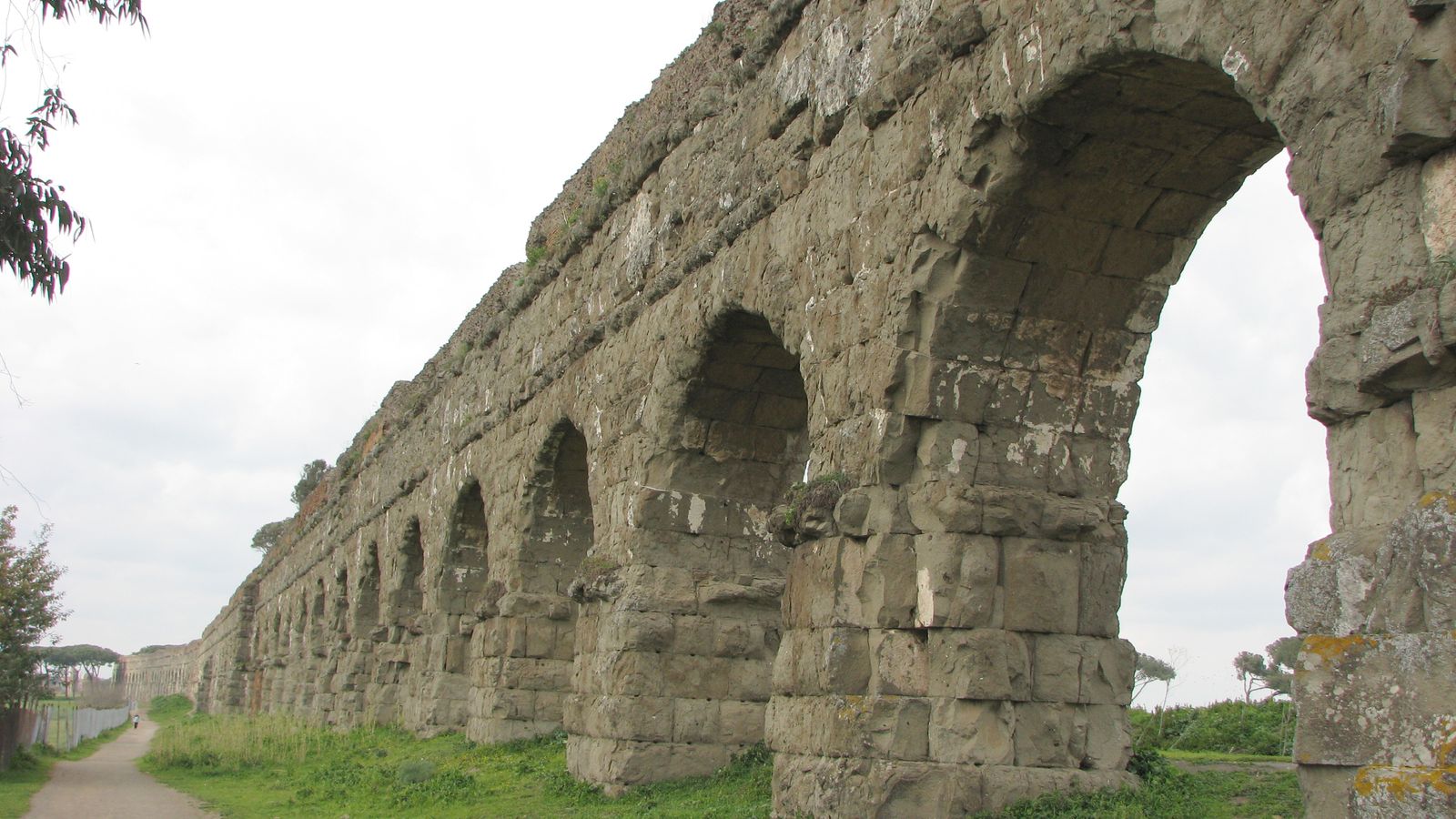
If Roman roads were the empire’s veins, their aqueducts were its arteries, carrying life itself: water. Fresh, clean water ran from distant mountains to the cities, towns, and baths that defined Roman civilisation.
The scale here is ridiculous. Rome’s aqueducts spanned hundreds of miles, delivering millions of gallons of water daily. The Aqua Claudia, for example, stretched over 69 kilometres (43 miles) and had a capacity of approximately 50 million litres (13 million gallons) of water per day, supplying fresh water throughout Rome. It was completed in 52 AD, meaning it’s not too far off being 2,000 years old.
And don’t think these were constrained to the glories of the Roman capital. The Pont du Gard in modern-day France transported 20 million litres (5.3 million gallons) of water daily from a spring near Uzès to the Roman colony of Nemausus (modern-day Nîmes)—a distance of 50 kilometres (31 miles). It’s also gloriously beautiful and built with 22,000 tons of limestone blocks, cut and precisely fitted together without using mortar.
The Colosseum
Few structures are as synonymous with Rome as the Colosseum. Rising like a stone giant from the city’s heart, this massive amphitheatre wasn’t just a place for entertainment; it was a stage for the empire’s power, brutality, and engineering genius. The Colosseum had, and still has, an extraordinary wow factor.
Completed in 80 AD, the Colosseum could hold up to 80,000 spectators. That’s the equivalent of a modern sports stadium, designed with the same priorities: efficiency and spectacle. The Romans were masters of crowd control, and the Colosseum had 80 entrances, allowing it to be filled or emptied rapidly.
The Colosseum’s engineering was groundbreaking. Beneath the arena floor lay the hypogeum, an underground network of tunnels and chambers used to house animals, gladiators, and elaborate props. With a system of pulleys and trapdoors, wild beasts could be released into the arena as if by magic, creating jaw-dropping moments for those in attendance. The floor itself could even be flooded for mock naval battles.
And then there was the velarium, an ingenious system of retractable awnings that provided shade for spectators. Operated by a vast team, these massive sails were a feat of engineering in their own right, demonstrating that no detail was too small for the Romans to perfect.
Today, as tourists wander its corridors, it’s easy to marvel at the structure’s enduring power, but this was also a place of thousands of grim deaths. The Colosseum’s story, like Rome’s, is one of contrasts—beauty and bloodshed, innovation and exploitation.
Rome’s Hidden Weapon
What’s the secret ingredient that helped Rome build an empire that still stands two millennia later? It wasn’t marble or stone—it was concrete. You’ve probably walked past a thousand concrete structures in your life without giving them a second thought. But Roman concrete, or opus caementicium, wasn’t just any concrete—it was a game-changer and literally built the empire.
Roman concrete was made from a mix of volcanic ash, lime, and rubble—simple ingredients, but the results were nothing short of miraculous. Roman concrete was remarkably durable, unlike modern concrete, which can crack and crumble over time. In fact, many Roman structures have stood for over 2,000 years, while some modern buildings barely last a century—the secret lies in the volcanic ash. When mixed with water, it created a chemical reaction that made the concrete stronger over time, especially in contact with seawater.
The Pantheon is perhaps the greatest example of the power of Roman concrete. Its dome, still the largest unreinforced concrete dome in the world, is a marvel of engineering. The dome is 6.7 metres (20 feet) thick at its base, tapering to just 2.2 metres (7.5 feet) at the oculus—a hole in the centre that allows light to stream through. Without Roman concrete, such a massive structure simply wouldn’t have been possible.
But the Romans didn’t stop at temples. They used concrete to build aqueducts, bridges, harbours, and even entire cities. The Port of Caesarea in modern-day Israel was constructed using underwater concrete, creating one of the largest artificial harbours of its time. What’s incredible is that modern scientists are still trying to replicate the durability of Roman concrete.
Roman concrete wasn’t just a building material but a tool of the empire. It allowed Rome to create bigger, bolder, and more enduring structures than anything the world had seen before. In doing so, it cemented Rome’s place in history—excuse the pun.
Roman Bathhouses
Roman bathhouses were where their engineering brilliance met the everyday lives of their citizens. These were social hubs, areas of relaxation, and showcases of advanced Roman technology.
Watch the Video
Open Video
Video Briefing
Ancient Rome's Most Incredible Engineering Achievements
The Roman baths, or thermae, were feats of engineering disguised as ancient leisure centres. At their core was the hypocaust system, a revolutionary method of heating. Beneath the floors, an intricate network of tunnels allowed hot air to circulate, warming the floors and walls. Fires in adjacent furnaces, often stoked by slaves, generated heat, and the system was so efficient that bathhouses could maintain multiple rooms at varying temperatures. From the steamy caldarium to the lukewarm tepidarium and, finally, the chilly frigidarium, bathers could move through a carefully orchestrated temperature gradient, an experience as indulgent as it was therapeutic.
But the baths weren’t just about water. They featured elaborate plumbing systems that supplied fresh water and drained waste, keeping the facilities clean and functional. Some of the larger complexes, like the Baths of Caracalla in Rome, even boasted libraries, gardens, and exercise spaces. These were more than bathhouses—they were wellness centres centuries ahead of their time.
Sanitation System
Soaring aqueducts and imposing coliseums are all well and good, but no society can be considered truly great if they’re wallowing in their own faeces. Rome’s sanitation system may not be the flashiest engineering marvel, but with a population that topped 1 million, it was arguably the city’s most important feature.
At the heart was the Cloaca Maxima, one of the world’s earliest and most advanced sewer systems. Initially constructed in the 6th century BC during the reign of the Etruscan kings, the Cloaca Maxima was designed to drain the swampy land of the Roman Forum. But over time, it evolved into a full-fledged sewer network that serviced much of the city.
The Cloaca Maxima was lined with stone and later reinforced with concrete—an innovation that Romans perfected. Its massive underground tunnels, some wide enough to walk through, funnelled stormwater, wastewater, and, yes, human waste out of the city and into the nearby Tiber River.
What made Rome’s sanitation system so incredible wasn’t just the sewers themselves but how seamlessly they integrated with other infrastructure. Public baths, such as the famous Baths of Caracalla, were connected to the system, ensuring used water didn’t stagnate. Aqueducts, which supplied fresh water to the city, also helped flush the sewers, maintaining their functionality.
Then, there were the public latrines—a curious mix of practicality and social awkwardness. These communal bathrooms, with rows of stone benches featuring cut-out holes, were connected to the sewer system—a continuous flow of water underneath carried waste away, reducing the, um, buildup below. For added hygiene, a running water trough in front of the benches allowed users to clean themselves with sponges attached to sticks—though whether that sponge was shared is a question better left unanswered.
The sheer scale of this system is mind-blowing. As we’ve said, Rome’s sanitation infrastructure at its peak supported over 1 million residents, a feat unmatched in Europe for centuries after the empire’s fall. This wasn’t just about convenience; it was a matter of public health. By efficiently removing waste and controlling water flow, the Romans drastically reduced the spread of diseases that would have otherwise ravaged a population of that size.
Today, remnants of the Cloaca Maxima still exist, and parts are even functional. It’s a reminder that while Rome may be remembered for its conquests and culture, its real genius lay in the details—like keeping its streets clean and its citizens healthy.
Caesar’s Bridge Over the Rhine
We’ll finish with a piece of construction that no longer exists—in fact, it didn’t exist for very long at all—but stands as a perfect example of how Rome used its astonishing engineering prowess to dominate.
The year was 55 BC, and Julius Caesar had just conquered Gaul. But across the Rhine River, the Germanic tribes loomed—a formidable presence representing both a threat and a challenge. Caesar wasn’t content to simply defend his territory—he wanted to send a message that no river, no matter how wide or deep, could stop the might of Rome.
The Rhine was a massive obstacle. The exact length across has long been debated—and no doubt mixed with mythical murmurings—but it was somewhere between 140 to 400 metres (roughly 460 to 1,300 ft), 9 metres deep (30 ft), with a vicious current. It wasn’t the kind of river you casually cross, especially not with thousands of soldiers, horses, and supplies. For most armies, this would’ve been a logistical nightmare. But Caesar? He saw it as an opportunity.
Instead of using boats or waiting for a better crossing, Caesar decided to build a bridge. And he didn’t just want any bridge. He wanted it fast, sturdy, and intimidating enough to strike fear into the Germanic tribes. With the help of his military engineers, the construction began.
The bridge was built entirely from wood, using an innovative and efficient technique. Massive wooden piles were driven into the riverbed at an angle to counteract the strong current. Crossbeams were then lashed to these piles, creating a sturdy foundation. The whole process required precision, coordination, and steel nerves.
But the most incredible part? Caesar’s men built this bridge in just 10 days. Think about that. Modern engineers with cranes and power tools would probably take longer. But this was Rome—an empire built on relentless determination and unmatched ingenuity.
The moment the bridge was complete, Caesar led his entire army across. The Germanic tribes, who had relied on the Rhine as a natural barrier, were stunned. Caesar didn’t even need to engage in a full-scale battle; the mere act of crossing the river was enough to prove Rome’s dominance. After a brief incursion to make his point, Caesar ordered the bridge dismantled—another message to his enemies: “We don’t just conquer; we choose when to come and go.”
Astonishing Engineering
Rome’s engineering marvels still burn in the imagination. The sheer scope and complexity of what the Romans achieved without the aid of modern machinery is nothing short of extraordinary.
Rome’s engineers didn’t just build for their time—they built for all time. Their creations have not only withstood the ravages of millennia but also laid the foundation for much of the technology and design principles we use today. From the bustling marketplaces of Trajan’s Forum to the awe-inspiring arches of the Pont du Gard and from the imposing glory of the Coliseum to the practical wonder of the sanitation system, Rome’s engineering legacy shows us what humanity can achieve when vision meets determination.
Most agree that Rome’s peak was sometime between 110 and 120 AD, at which point it stretched 5 million square kilometres (1.9 million square miles) across Europe, Africa, and Asia. It was big, brash, absolutely bloodthirsty—but bold beyond imagination. Nearly 2000 years later, its engineering marvels remain among humanity’s most glittering achievements.
Olivier Guiberteau
Key Takeaways
- Ancient Rome’s infrastructure, including roads and aqueducts, was built to last, connecting vast territories and supplying essential resources.
- The Colosseum showcased Rome’s engineering genius with its complex underground systems and retractable awnings, accommodating up to 80,000 spectators.
- Roman concrete, made with volcanic ash, was remarkably durable, enabling the construction of enduring structures like the Pantheon’s dome.
- Roman bathhouses featured advanced heating and plumbing systems, serving as social hubs and wellness centers for citizens.
- Rome’s sanitation system, including the Cloaca Maxima, efficiently managed waste and maintained public health for a population of over 1 million.
SideProjects Editors
The SideProjects editorial team researches, fact-checks, and structures explainers about the lesser-known tales, side narratives, and spin-offs behind major historical and contemporary subjects.
Frequently Asked Questions
How many roads did the Romans build?
The Romans built over 400,000 kilometers (nearly 250,000 miles) of roads, with about 80,000 kilometers (50,000 miles) paved with stone.
What was the capacity of the Aqua Claudia aqueduct?
The Aqua Claudia had a capacity of approximately 50 million litres (13 million gallons) of water per day.
How many spectators could the Colosseum hold?
The Colosseum could hold up to 80,000 spectators.
What was the secret ingredient in Roman concrete?
The secret ingredient in Roman concrete was volcanic ash, which created a chemical reaction that made the concrete stronger over time.
What was the hypocaust system used for in Roman bathhouses?
The hypocaust system was used to heat the floors and walls of Roman bathhouses by circulating hot air through an intricate network of tunnels.
What was the Cloaca Maxima?
The Cloaca Maxima was one of the world’s earliest and most advanced sewer systems, designed to drain the swampy land of the Roman Forum and later evolved into a full-fledged sewer network.
How long did it take Julius Caesar to build a bridge over the Rhine?
Julius Caesar’s men built a bridge over the Rhine in just 10 days.
What was the size of the Roman Empire at its peak?
At its peak, the Roman Empire stretched 5 million square kilometers (1.9 million square miles) across Europe, Africa, and Asia.
What was the Pont du Gard used for?
The Pont du Gard transported 20 million litres (5.3 million gallons) of water daily from a spring near Uzès to the Roman colony of Nemausus (modern-day Nîmes).
What was the velarium in the Colosseum?
The velarium was a system of retractable awnings that provided shade for spectators in the Colosseum.