Even if you attended a school that provided you with a quality education, history classes still can’t cover everything. There’s simply too many events and details in human history, and it isn’t realistic to expect all of these to be taught to students around the world. More often than not, students will learn quite a bit about the history of the country they grew up in, and about important world events, like the Roman empire, the conquests of the Mongols, the World Wars, etc.
Which is why today we’re going to fill in a few of those educational gaps, and highlight four things that probably weren’t talked about in much detail or may have been entirely skipped over in your history classes.
When The Allies Invaded Russia
By the later years of the First World War, the notion of pointlessly dying in waves on the eastern front was becoming increasingly unpopular with citizens of the Russian Empire. As support dwindled, soldiers deserted their posts, offensive attempts failed miserably, and the political scene in Russia began coming apart at the seams. People were hungry, they were poor, and they were sick of it.
Key Takeaways
- The Allies invaded Russia after WWI to stop the spread of communism, but failed and may have boosted Bolshevik support.
- The Port Chicago disaster in 1944 highlighted racial discrimination and unsafe working conditions, leading to a significant civil rights moment.
- China’s annexation of Tibet in the 1950s remains controversial, with ongoing debates about cultural genocide and territorial rights.
- The Gulf of Tonkin Incident in 1964 was likely fabricated to justify U.S. involvement in the Vietnam War, escalating the conflict significantly.
- History classes often overlook these events due to the vast amount of information and focus on major world events.
It was at this period of economic and social instability that a revolution erupted in Petrograd, modern-day St. Petersburg, with crowds of protesters violently clashing with forces loyal to the monarchy, causing well over a thousand casualties. This event is known as the February Revolution, and it resulted in the abdication of Tsar Nicholas II, ending Russian royalty and installing a provisional government to lead in its place.
But the provisional government wasn’t everything it had been hyped up to be, and at the same time, a separate form of government had emerged, Soviet councils. Between these two rival powers, several groups fought for influence, but, over the months, one rose above the rest, the Bolsheviks, a Marxist faction, headed by Vladimir Lenin.
Later that year, Lenin had gained enough support to initiate a complete takeover, a coup d’etat known as the October Revolution, in which the Bolsheviks took total control of the government and began reforming the Russian empire into a socialist nation. The early stages of this included the founding of the Cheka, a secret police force that eliminated anyone deemed an enemy of the state.
Now, while its true that the Bolsheviks indeed had a lot of domestic support, especially from the poorer classes that they were pledging to aid, they also had plenty of enemies, and it didn’t take long for a full-blown civil war to erupt. The two sides of the war were the Reds, mainly the Bolsheviks and other Marxist supporters, and the Whites, a coalition of basically every other political party that opposed their rule.
During all this political turmoil, the Central Powers took the opportunity to attack their weakened opponent, and smashed into the eastern front, capturing huge swaths of territory in the modern-day areas of Belarus and Ukraine, and threatened to push even further. Under this pressure, Lenin signed a treaty with the central powers in early 1918, ending their involvement in the war, but seriously pissing of Britain and France in the process, who felt betrayed by Russia’s abandonment of the Great War, especially since the United States had just joined the cause. On top of this, they were now concerned that Russia might begin sending supplies into Germany, which could turn the tide of battle in the west.
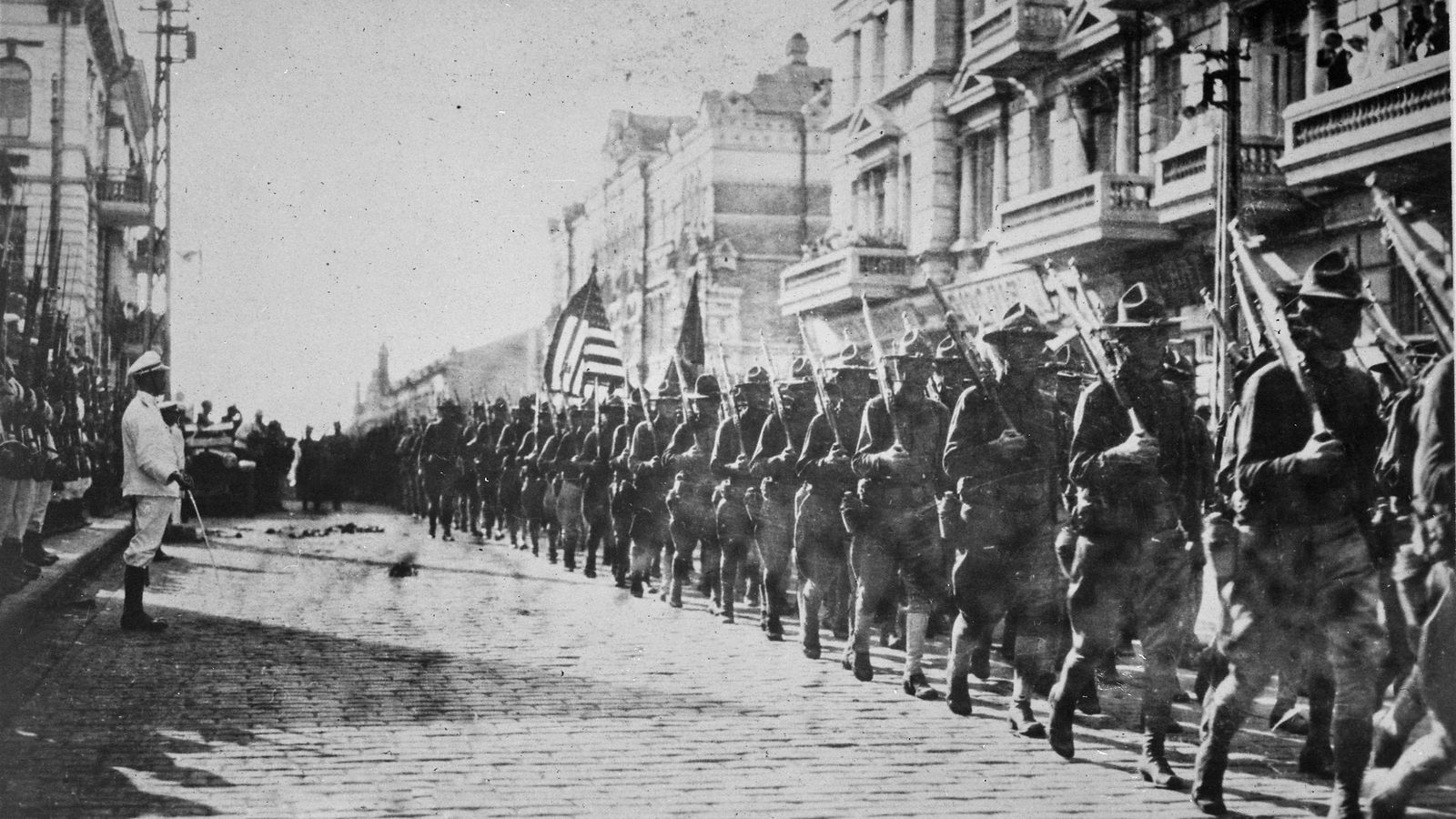
It was at this moment that the Western Allies put their full support behind the Whites, setting up funding, supply routes, and even landing their own troops in an effort to overthrow the Bolsheviks, desperate to prevent communism from taking over one of the most powerful nations on earth.
In the end, troops were sent by Britain, France, the United States, Greece, Estonia, Serbia, Italy, Romania, Canada, and even a couple thousand from China. The largest force though was sent by Japan, who supplied 70,000 men for the intervention. It was essentially the rest of the world powers joining together to stop communism before it took hold.
In early March, allied forces landed in Murmansk, a port city in Russia’s far north, beyond the arctic circle. This city was captured quickly, as well as another port city called Arkhangelsk, and the Allies began marching inland. However, a few hundred miles in, Bolshevik ambushes and gunboat attacks were crippling the allied lines, made only worse when reports began circling that the Reds had used poison gas against British troops. The gas didn’t cause many casualties, but it certainly reinforced the British public support for the intervention.
Regardless, the allies struggled to move forward, and also struggled to recruit a large local army for the Whites, who often deserted to the Reds. Further casualties forced them to retreat, eventually all the way back to the port cities they’d captured, and by October, 1919, the Northern Russia campaign had been abandoned.
Similar fates faced the French who landed in southern Ukraine, and a large British division that failed to take St. Petersburg. In Siberia, the advancing allies were also held off, and it was here that the last Japanese forces left Russia in 1922, signaling the end of the failed intervention.
In fact, according to many historians, the intervention not only failed to stop the Bolsheviks, but it may have even had the opposite effect, boosting support for them, who used the events in their propaganda campaigns to paint themselves as national saviors, defending Russia from meddling foreign powers and gaining favor with the people. It didn’t help that the way the Allies treated their local militias was so allegedly so demeaning that they often caused Whites to change their allegiance.
All in all, it’s a strange part of history that is often brushed over for more notable events around the same time period, but the allied invasion of Russia had the potential to change the course of history. If they’d succeeded, they would have prevented the formation of the Soviet Union, preventing Stalin from rising to power, saving untold millions from starvation in the Holodomor and Soviet labor camps, and who knows what else, the butterfly effect in time after such an event would be unfathomable.
Winston Churchill was the most upset at the campaign’s failure though, as he was often shut down when he pressed for a stronger campaign and more support from America at the time. He later lamented:
“I think the day will come when it will be recognized without doubt, not only on one side of the House, but throughout the civilized world, that the strangling of Bolshevism at its birth would have been an untold blessing to the human race… If I had been properly supported in 1919, I think we might have… but everybody turned up their hands and said, ‘How shocking’.”
The Port Chicago Disaster
By the summer of 1944, the Port Chicago Naval Magazine, located in California, had become a crucial hub for the loading of munitions destined for the Pacific theater of World War II. Here, workers transported and handled bombs, torpedoes, naval mines, and artillery shells, which were delivered via rail and then loaded by the workers onto cargo ships.
But hidden under this feverish pace of urgent wartime industry were deep-seated racial tensions and systemic discrimination. Most of the enlisted men working at Port Chicago were African American, and they’d been segregated into labor units that generally handled the most dangerous tasks, loading the munitions onto ships by hand and crane. Not only were they given inadequate training for the job, but they were also under significant pressure to meet demanding daily quotas.
These conditions are ripe for disaster in any sort of work environment, but due to the nature of this work, when an accident inevitably struck, it was horrific. On the night of July 17th, 1944, workers were busy loading up the newly christened SS Quinault Victory, a job that was supposed to begin at midnight, but they had gotten started a couple hours early. Handled that night were large numbers of 650-pound incendiary bombs, which were live, and so had to be carefully loaded one at a time.
Next door was the SS E.A. Bryan, which had been docked for four days and was now holding 4,600 tons of explosives, while on the pier was a boxcar filled with 250 pounds of torpex, an explosive element highly sensitive to physical impact, along with 16 rail cars holding around 2,000 tons of TNT.
At 10:18 PM, bystanders recalled hearing a noise that sounded like “a metallic sound and rending timbers, such as made by a falling boom.” Soon after, a small explosion had gone off, and a fire had started on the pier. Then, suddenly, an enormous explosion ripped through Port Chicago as all these tightly packed munitions detonated simultaneously.
Molten and glowing metal rained down for miles, and burning chunks of debris were launched 12,000 feet into the air. The pier, the boxcars, rails, shacks, cargo containers, and locomotives were all instantly obliterated in the gargantuan blast. The scene was utter chaos, with windows shattering in nearby towns and the earth shaking so strongly that seismographs at the University of California Berkely recorded the equivalent of an earthquake measuring at a 3.4 on the Richter scale.
Unexploded munitions were launched into the air and dropped back down like artillery, and shrapnel rained down on the port’s barracks.
Watch the Video
Open Video
Video Briefing
Astonishing Historical Events that Aren't Taught in Schools
All 320 men working on the pier died almost instantly in the blast, with many of their bodies so horrifically ripped apart that only 51 of them would later be identified. 390 other nearby civilians and military personnel were seriously injured. The majority of these casualties were African-Americans, with 202 dead and 233 injured, shockingly accounting for 15% of all African-American casualties in the entire Second World War.
The Navy approached Congress and asked for a compensation of 5,000 dollars to be sent to each family, but this amount was dropped down to 3,000 under pressure from Representative John. E. Rankin, who insisted the compensation be reduced after he learned that most of the victims were black.
Investigations revealed that there was no indication of sabotage, and, surprisingly, also found no evidence of unsafe work conditions, ordering everyone to resume their normal duties once the harbor had been cleaned up.
About a month later, hundreds of servicemen began refusing to work until safer work conditions were implemented, in an event known as the Port Chicago Mutiny. During this mutiny, the workers were threatened by their admiral with death by firing squad for desertion, scaring the majority back to work, but 50 men stuck with their strike. These 50 thankfully didn’t end up being executed, but were convicted of mutiny, dishonorably discharged, and sentenced to 15 years of prison and hard labor.
But the event had now caught the public’s attention, and as news spread, people began openly speculating about the legitimacy of the court proceedings that had convicted the sailors. Under this public pressure, in 1945 the Navy reconvened the courts, only to confirm the previous rulings. This sparked widespread protest, not only from civilians who supported equal rights, but from other African-American military personnel around the world.
For instance, at a naval base in Guam, 1,000 black sailors staged a hunger strike to protest discriminatory conditions. For some perspective, at this point in the Navy’s history, they were commanding 100,000 black soldiers, yet they didn’t have a single black officer.
Eventually, the strikes, protests, and pressure forced the Navy’s hand in desegregating their ranks, and by 1946 they had released all 50 men convicted of mutiny. In the end, the Port Chicago disaster was not only a tragedy of historic proportions, but a crucial moment in the history of the US civil rights movement that doesn’t get nearly the attention it deserves.
Chinese Annexation of Tibet
In the modern era, its well known that China is a very large country, generally coming in 3rd or 4th place depending on how you measure landmass. However, a large piece of this territory was gained only recently in the 20th century, in a very controversial act that is still protested to this day.
For hundreds of years, Tibet was ruled by a theocratic government, led by the Dalai Lama, but by the 1950s, this spiritual region found itself in the crosshairs of a rapidly changing world. China had just seen the victory of the communists in its civil war, and as they asserted full control over the nation, they were also looking to expand their influence. Specifically, Mao Zedong’s government asserted that they had a historic right to the territory of Tibet, a claim rooted in old relationships between Tibetan rulers and Chinese emperors.
Regardless of this claim’s legitimacy, Mao was already making his move. In October 1950, the Chinese People’s Liberation Army launched a military offensive into eastern Tibet, near the border with China’s Sichuan province. The PLA, equipped with modern weaponry, battle-hardened from their civil war and World War 2, and backed with an extensive logistical network, were an overwhelming force compared to the ill-prepared Tibetan resistance fighters. This led to several key victories in just a few months, and the tide of the war was clear.
Amidst the military campaign, the Tibetan government, led by the 14th Dalai Lama, sought peaceful negotiations with Chinese leadership, hoping to end the war while maintaining some of their land and independence. However, faced with threats of an even greater military escalation, in 1951 Tibet signed the “Seventeen Point Agreement”, affirming Tibet’s status as an autonomous region within China, with assurances of cultural and religious freedoms.
However, these assurances weren’t really in good faith. Chinese authorities swiftly moved to take full control over Tibet’s governance and administration, and the constant presence of Chinese military in the region served as a reminder of Beijing’s grip on Tibet.
In 1959, these simmering tensions erupted into open revolt in the capital, Lhasa. As the protests grew, the Chinese response was swift and harsh. Brutal force was implementing in the crushing of the rebellion, leading to thousands of deaths and widespread arrests. Tibetan monasteries were subjected to intense scrutiny and control, with monks and nuns forced to undergo re-education programs and restrictions on certain religious practices.
Amidst the violence, the Dalai Lama fled into India, where he established a government-in-exile that continues to advocate for Tibetan independence to this day.
In the aftermath of the uprising, China moved to modernize Tibet, portraying their efforts as an attempt to bring the modern way of life to the isolated region, but critics argue that the move was instead intended to gain further control over Tibet’s economy, and further marginalize Tibetan culture in their homeland.
Over the decades that have followed, the controversy has remained alive. The Chinese government defends its actions as necessary for maintaining unity and stability in its borders, and the Tibetan government in exile calls their acts cultural genocide, in a debate that rages on to this day.
Gulf of Tonkin Incident
The controversies of the Vietnam War are no stranger to most people familiar with the conflict. Arguments and debates are still common regarding whether or not the United States should have been involved at all, the failure of the intervention and the many documented war crimes that left a scar on both nations’ legacies.
These days, history classes in the United States aren’t so afraid to touch on this subject, however, one thing that still seems to escape education is the fact that the US government at the time was so eager to go to war in Vietnam that they most likely fabricated an entire attack on an American ship to justify military action.
This was the Gulf of Tonkin Incident, and it all began in August, 1964. On August 2nd, the destroyer USS Maddox was conducting a reconnaissance mission in international waters when it reported being attacked by three North Vietnamese torpedo boats. The Maddox returned fire, with the support of air cover from the nearby aircraft carrier USS Ticonderoga, and reported that they had successfully repelled the attackers. Though the exchange was brief, and the Maddox only sustained minor superficial damage, the North Vietnamese reportedly suffered several deaths.
Keep in mind, at this time, the United States and North Vietnam were not at war, so this was quite a shocking event, especially because it occurred in international waters. However, the second attack is one that has incurred the most controversy. Two days later, the Maddox, now accompanied by the USS Turner Joy, reported another attack by North Vietnamese forces. According to initial reports, the destroyers detected multiple incoming torpedoes and engaged in defensive maneuvers and retaliatory fire.
However, the reports of the incident were a bit conflicting. Radar and sonar readings were inconsistent, and some crew members openly expressed uncertainty that they were under attack at all. Subsequent investigations revealed that weather conditions and inexperienced sonar operators may have contributed to a false alarm.
Despite these ambiguities, US President Lyndon B. Johnson leapt at the opportunity to present the attacks as justification to escalate American involvement in Vietnam. Just a couple days later, Congress passed the Gulf of Tonkin Resolution with overwhelming support, granting the president authority to use military force in Southeast Asia without a formal declaration of war.
More specifically, it allowed the president to take “all necessary measures to repel any armed attack against the forces of the United States and to prevent further aggression.” Basically, it was a blank check, the US granting itself permission to do whatever it pleased in the region with no repercussions. The conflict massively escalated shortly thereafter, and by the end of 1965, there were over 180,000 American soldiers stationed in the country.
It also gave justification to intensify Operation Rolling Thunder, the devastating bombing campaigns against North Vietnam’s logistical networks that devastated massive areas in Vietnam.
Ultimately, the US would withdraw from Vietnam as the North took full control of the South, and 58,000 US servicemen would lose their lives.
And as more evidence is uncovered, it seems that all of this may have been a result of a complete and utter lie. In 1971, the Pentagon Papers, a classified Department of Defense study of U.S. political and military involvement in Vietnam, were leaked to the public. The documents revealed that the Johnson administration had manipulated information about the Gulf of Tonkin events to secure Congressional approval for the resolution. Then, in 2005, declassified National Security Agency documents confirmed that there was indeed no second attack at all, and that the second incident was based purely on erroneous reports and conflicting statements.
The Gulf of Tonkin Incident serves as a cautionary tale to how misinformation and government manipulation can lead to far-reaching and devastating consequences, as well as the dangers of hasty military action, which is why it ought to be taught extensively alongside any in-depth discussion of the Vietnam War and the wider backdrop of the Cold War.
Key Takeaways
- The Allies invaded Russia after WWI to stop the spread of communism, but failed and may have boosted Bolshevik support.
- The Port Chicago disaster in 1944 highlighted racial discrimination and unsafe working conditions, leading to a significant civil rights moment.
- China’s annexation of Tibet in the 1950s remains controversial, with ongoing debates about cultural genocide and territorial rights.
- The Gulf of Tonkin Incident in 1964 was likely fabricated to justify U.S. involvement in the Vietnam War, escalating the conflict significantly.
- History classes often overlook these events due to the vast amount of information and focus on major world events.
SideProjects Editors
The SideProjects editorial team researches, fact-checks, and structures explainers about the lesser-known tales, side narratives, and spin-offs behind major historical and contemporary subjects.
Frequently Asked Questions
What was the February Revolution?
The February Revolution was a violent uprising in Petrograd (modern-day St. Petersburg) that resulted in the abdication of Tsar Nicholas II, ending Russian royalty and installing a provisional government.
What was the October Revolution?
The October Revolution was a coup d’état initiated by Vladimir Lenin and the Bolsheviks, resulting in the Bolsheviks taking total control of the Russian government and beginning the transformation of the Russian Empire into a socialist nation.
What was the Allied intervention in Russia?
The Allied intervention in Russia involved multiple countries, including Britain, France, the United States, and Japan, sending troops to support the White forces against the Bolsheviks during the Russian Civil War. The intervention ultimately failed and was abandoned by 1922.
What happened at the Port Chicago Naval Magazine in 1944?
On July 17, 1944, a massive explosion occurred at the Port Chicago Naval Magazine in California, killing 320 men and injuring 390 others. The majority of the casualties were African-American workers who were handling munitions under dangerous and discriminatory conditions.
What was the Port Chicago Mutiny?
The Port Chicago Mutiny was a refusal by hundreds of servicemen to work until safer conditions were implemented following the Port Chicago disaster. Fifty men were convicted of mutiny, dishonorably discharged, and sentenced to 15 years of prison and hard labor, but were later released in 1946.
How did China annex Tibet in the 20th century?
China annexed Tibet in the 20th century through a military offensive in 1950, followed by the signing of the Seventeen Point Agreement in 1951, which affirmed Tibet’s status as an autonomous region within China. Despite assurances of cultural and religious freedoms, China took full control over Tibet’s governance and administration.
What was the Gulf of Tonkin Incident?
The Gulf of Tonkin Incident involved the reported attacks on the USS Maddox and USS Turner Joy by North Vietnamese forces in August 1964. The incident was used to justify the escalation of American involvement in Vietnam, but later investigations revealed that the second attack was likely fabricated.
What was the Gulf of Tonkin Resolution?
The Gulf of Tonkin Resolution was passed by Congress in 1964, granting President Lyndon B. Johnson authority to use military force in Southeast Asia without a formal declaration of war. It allowed the president to take ‘all necessary measures to repel any armed attack against the forces of the United States and to prevent further aggression.’
What was the impact of the Gulf of Tonkin Incident on the Vietnam War?
The Gulf of Tonkin Incident led to the escalation of American involvement in Vietnam, with over 180,000 American soldiers stationed in the country by the end of 1965. It also justified the intensification of Operation Rolling Thunder, the bombing campaigns against North Vietnam.