

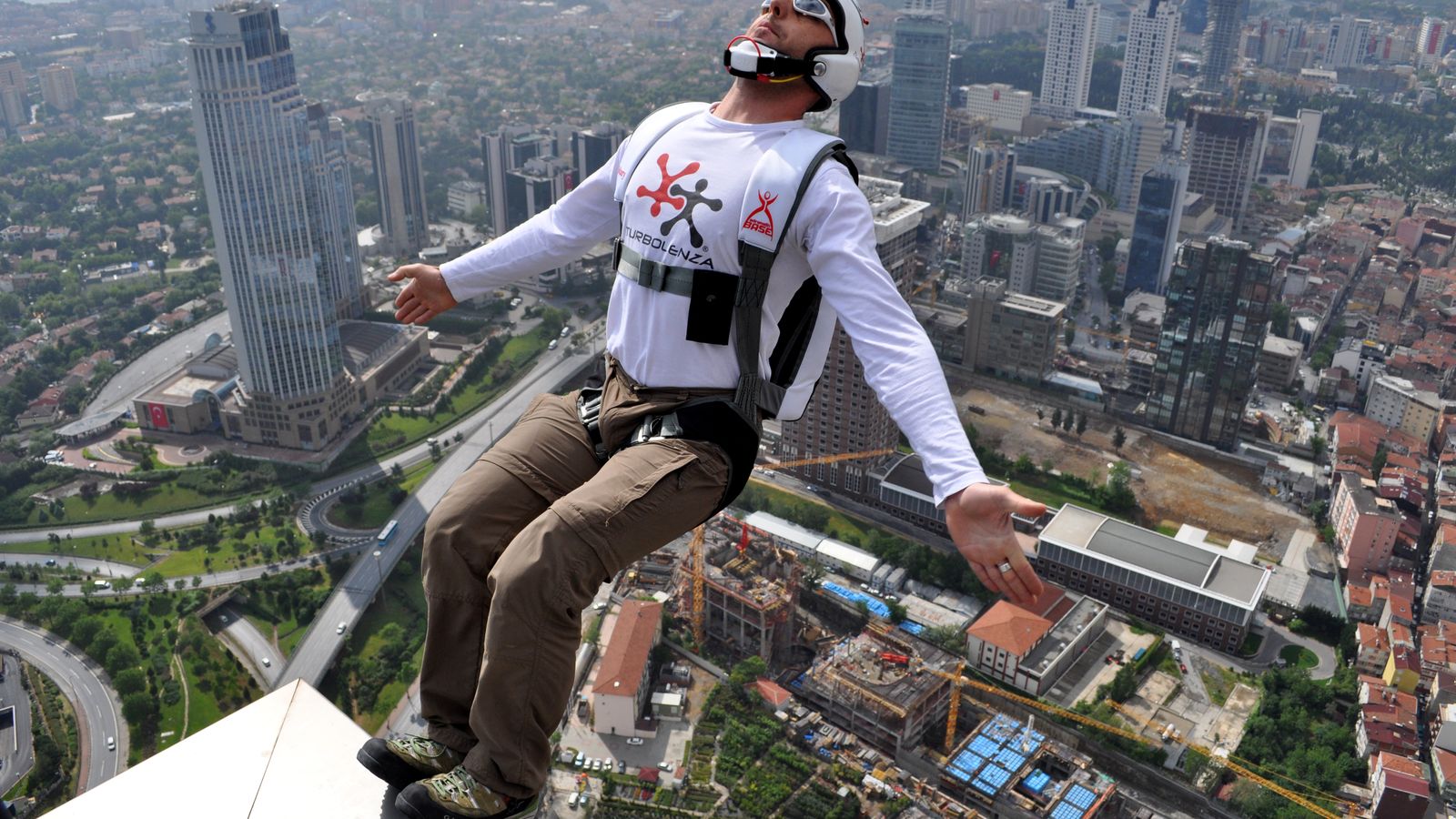
There is literally no limit to the number of deadly things a person can legally do. Until such a time as stupidity is outlawed, people will always find new and creative ways to injure, maim, or kill themselves.
But most of those are isolated incidents of rather unique and creative stupidity, rather than larger trends. For example, in most places it wouldn’t be illegal to take a selfie with a bear, it’s just an incredibly dumb idea. However, such acts of wanton ignorance aren’t the sort of things that are going to catch on and become popular pastimes.
So while you undoubtedly could think of things you could do that carry a much higher risk of death, today we’re going to be focusing on the deadliest things people can do that are actually popular.
Key Takeaways
- BASE jumping is legal in most places and has a high fatality rate due to low jump altitudes.
- Free solo climbing is the deadliest form of climbing, with about 10 deaths per year.
- Cave diving is dangerous due to the removal of the emergency exit strategy and disorienting cave environments.
- Horseback riding is more dangerous than many full-contact sports due to the unpredictability of horses.
- Climbing Mount Annapurna has a high fatality rate due to avalanches and unpredictable weather.
BASE Jumping
BASE jumping is an acronym that stands for buildings, antennas, spans, and earth (with the latter two referring to bridges and cliffs). The concept of BASE jumping has existed for hundreds of years, though not originally by that name. It was less of a sport and more just one off instances of inventors testing out their prototype parachutes, with unfortunately predictable results.
Even once parachutes were invented, BASE jumping didn’t take off as a sport or recreational activity for quite a while. Skydiving became popular immediately following World War II, but BASE jumping didn’t catch on for another decade. And even then, it wasn’t a recreational activity. Jumping off cliffs or antennas was primarily done as a training exercise to practice low altitude skydive jumps, and occasionally as publicity stunts.
That all changed in 1978 when American cinematographer Carl Boenish filmed himself jumping off El Capitan in Yosemite National Park. He wasn’t the first person to make this jump (the first two people to do so injured themselves pretty badly), he was just the first person to film himself doing so. More importantly, he was filming it purely as a recreational endeavour rather than as a publicity stunt or part of training. This was considered the birth of BASE jumping, a phrase coined by Carl and his wife.
He would go on to die six years later while BASE jumping, which wasn’t a great start for this sport.
While BASE jumping has only grown since then, it’s still a pretty niche activity. The target audience for BASE jumping is people who like the idea of skydiving but don’t find it nearly deadly enough. To be fair, skydiving is pretty safe with only 1 death in every 220,000 solo jumps and 1 in every 500,000 tandem jumps.
For BASE jumping, however, that number used to be 1 in every 60. Part of that was the equipment being used. Originally people used traditional skydiving equipment, followed by skydiving equipment that was modified for the needs of BASE jumping. Neither of these was ideal, and safety improved once there was purpose built equipment for the sport. However, there is still a lot of inherent risk in BASE jumping.
Most obvious is the altitude. Skydivers usually jump out of planes at an altitude of 10,000 feet, providing ample time to open a parachute and then to cut it away and deploy a reserve chute in case of malfunction. But the average BASE jump height is only 300-1000 feet, so they don’t use reserve parachutes. If the first chute fails, there simply isn’t time to deploy another before hitting the ground.
Another big problem is that people, especially inexperienced BASE jumpers, may open their parachutes too early. When jumping from such a low altitude there isn’t much time to fully deploy the parachute, but opening it before you gain enough horizontal distance can cause a person to get slammed back into whatever it was they jumped off of.
Because these jumps are made off of structures like buildings or cliffs, there’s also a lot less margin for error when it comes to landing. People choose where to jump based on the altitude they can get rather than the surrounding terrain, so landing zones for BASE jumpers tend to be extremely small compared to skydiving drop zones. This makes colliding with obstacles on the way to the ground is much more likely.
Despite these risks, the safety of BASE jumping has increased considerably from the 1 in 60 statistic we mentioned earlier. Exact numbers are difficult to find, but the Kjerag Massif in Norway reported a fatality rate of 1 in 2,317 jumps. That’s only one specific location, but it does give some baseline at least. Of course, this has all been discussing BASE jumping with a parachute. There are also wingsuits, a special suit that basically turns a person’s body into a glider.
Wingsuits aren’t inherently unsafe, but they allow for forward speeds of 100 mph (160 kmh) or faster, which is much faster than descending with a parachute. This speed provides even less room for error, as reactions and adjustments need to be made extremely quickly.
But despite being one of the deadliest and most dangerous things a person can do, BASE jumping itself is legal in most places and doesn’t even require a permit. That said, a person may face related trespassing charges, especially when jumping off of buildings or antennas.
Free Solo Climbing
Recreational climbing has been popular for nearly two centuries, though it has seen an explosion of growth since the 1990s thanks to the abundance of indoor climbing gyms. There are tens of millions of climbers worldwide, though numbers for outdoor rock climbers are harder to pin down. That said, according to surveys there are over 2 million rock climbers in the United States alone.
There are many different ways to climb, most of which use ropes and other climbing and safety equipment. These safety measures are obviously important, as mistakes while climbing can have deadly consequences. However, there are two ways in which people will often climb “unroped”.
The first is called bouldering. These are free climbs up boulders, usually no more than 6 meters (20 feet) in height. While there are no ropes because of the low elevation, people will often use a spotter and have boulder crash mats in the event of a fall. Bouldering climbs were traditionally designed as puzzles used in training for larger climbs, though it has become popular as a sport in its own right, with some high bouldering challenges approaching double the height we mentioned.
But the use of crash pads and spotters combined with minimizing the heights of these climbs makes bouldering generally safe.
That brings us to the other unroped type of climbing, known as free solo climbing. In free solo, people will climb larger, traditional routes without any climbing or safety equipment. All they are allowed to use are climbing shoes, chalk to improve their grip, and ice tools if they are climbing an icy surface. This is the deadliest form of climbing, and it’s not even close.
Approximately 30 people die climbing every year, usually from rock climbing, though deaths from falls off indoor walls are not unheard of. Of those 30 deaths, about 10 each year were from people free solo climbing. Ten deaths per year doesn’t seem like a lot until you consider just how niche a sport this is.
As we said, there are millions of outdoor rock climbers in the United States alone, so 20 deaths is a tiny percentage. It’s a very counterintuitive statistic because of the perceived risk, but rock climbing results in fewer deaths per 100,000 participants than bicycling does. That’s when all the appropriate safety measures are taken into account, though. Remove all of those safety measures, and you get free solo climbing.
Unfortunately, there is little information about how many free solo climbers there are, as it’s generally a solitary and unregulated endeavor. We know there aren’t that many people doing it, just not what the exact number is. Regardless, 10 deaths per year from free solo climbing represents a meaningful percentage of people engaging in the sport. In the minds of many people, death from free solo climbing isn’t a matter of “if”, it’s a matter of “when”, and many of the most famous free solo climbers have already died either while climbing or from other extreme sports.
Of course, it’s not like people are intentionally trying to gamble with their lives when free solo climbing. Climbs are usually done using routes the person has experience climbing with ropes multiple times, and they aren’t climbs that push the absolute limit of their abilities. Even so, nature can be unpredictable. Be it weather or falling rocks, unexpected things can disrupt the best laid plans of even the most seasoned climbers.
Which is exactly why most experienced climbers still use safety equipment, so that unpredictable events don’t send them falling hundreds or even thousands of feet to the ground.
Cave Diving
Watch the Video
Open Video
Video Briefing
The Deadliest Things You Can (Legally) Do
Much like rock climbing, SCUBA diving is another activity with a much higher perceived level of danger than the stats bear out. Incidents of death in SCUBA diving are only 1.8 deaths in every 1 million dives, in no small part thanks to the safety regulations surrounding diving. It’s not technically illegal to SCUBA without a license, but in practice most locations will require you to either have a diving certification or to be accompanied by a certified instructor in order to go diving.
Most recreational divers also don’t get to extreme depths. The maximum depth for recreational divers is about 40 meters (130 feet), and the average recreational diver may only ever go half that depth. Going any deeper requires additional training and specialized gas mixtures, rather than the standard mix of oxygen and nitrogen in most tanks.
But beyond your typical recreational diving lies the world of cave diving. This can be done as an extreme sport, for the purposes of scientific research, or in search and rescue missions, like the famous 2018 Thai cave rescue that Elon Musk had a lot of opinions about. And it requires considerably more training.
Cave diving is sometimes broken up into different levels depending on the depths at which the dive is occurring, but the general premise is all the same: people dive into underwater caves just to explore and see what’s there. But it’s that very premise that makes cave diving so dangerous.
No matter what you are doing, even if it’s something as simple as making a grilled cheese sandwich, things can always go wrong. If things go wrong while you’re SCUBA diving, the usual solution is to immediately resurface, ideally utilizing the backup regulator from another diver’s tank. But because cave diving introduces a ceiling to the equation, quickly surfacing in the case of an emergency is no longer an option.
At its core, this removal of the emergency exit strategy is what makes cave diving so dangerous. However, the nature of these caves only compounds that danger. Caves are dark and can be full of branching paths, and divers may penetrate thousands of feet into a cave system. Bringing light sources is crucial, but it can still be incredibly easy to get lost or disoriented.
This is combated by the use of guide lines that are attached to a fixed, stable object at the entrance of the cave, then strung through the cave throughout the dive so that divers can find their way back to the exit.
Usually this works fine, but sometimes guide lines do break. This can make it difficult to find the way out, especially with the low visibility and disorienting nature of many caves. A broken line, getting lost or disoriented, and light sources that were either dropped or burnt out can all cause divers to panic, which increases air consumption and hinders decision making. There is also the risk of nitrogen narcosis (which is basically like being drunk), a risk that increases if the cave takes divers deeper than they had planned.
Of course, even if you’re not cave diving, it’s always important to plan your dive. Cave diving requires considerably more planning, and with proper planning these risks can be largely mitigated. Unfortunately, compared to the 1.8 deaths per million dives for regular SCUBA diving, in cave diving it is estimated to be at about in 1 death in every 3,300 dives. Most deaths are the result of poor planning or divers without the proper level of experience or training, so even if you have experience as a recreational SCUBA diver, it would be best to avoid cave diving without getting properly trained in how to do it safely.
Horseback Riding
When you think of dangerous sports, you probably think of things like football, rugby, hockey, or MMA fighting. These are full contact sports, one of which even has the competitors carrying weapons and wearing blades on their feet. But when it comes to deadly and dangerous sports, there is no mainstream sport more dangerous than horseback riding.
That may come as a surprise, since humans have been riding horses for at least 5,000 years. You’d think that by now people would have got the hang of it and made it safer, and to an extent they have. Ignoring the deaths from cavalry who were killed by an opposing military, the historical record is full of descriptions of how dangerous it was to train both cavalry and the horses.
They didn’t keep the sort of statistics that we do now, but evidence suggests accidental injury or death from horseback riding was at least as common in antiquity as it is today, and it was probably more common. Back then, most horses being ridden were larger and more aggressive animals that had been bred for war. Recreational horseback riding and racing use much more docile horses, but they still pose a very serious threat.
And the more you think about it, the more sense it makes that horseback riding would be deadlier than other sports. The sports we mentioned earlier may be full contact, but they also involve humans working towards a specific goal, such as getting a ball into the end zone. The opposing team may use force to try to prevent this, but there are rules and stuff, so the people aren’t actively trying to kill one another. Even in MMA, where the fighters actually are trying to hurt one another, there are still rules, referees who can stop a match, and fighters can tap out if needed.
And sure, horse racing and other equestrian sports may also have rules, but it’s not like the horses know what those rules are. They may be trained to do what they’re expected to, but it’s not like they understand that they’re in a competition or what the rules are. They are massive, averaging 900-2000 lbs (400-900 kg) depending on the breed, and they can be extremely unpredictable. Some horses are just unpredictable and temperamental by nature, but even the best trained horses can exhibit unpredictable behaviour.
No matter how well trained a horse is, at their core they are still prey animals. This means they have extremely strong flight instincts that can be triggered by any perceived danger, such as loud, unexpected noises. Not only are horses heavy, they’re also about 5 ft (1.5 m) tall on average. That may not sound like too much, but a fall from that height on its own can still cause serious injuries, especially head trauma depending on how you land.
However, the biggest danger isn’t the fall itself, it’s being trampled by a horse once you’ve hit the ground. Trampling injuries are the most serious, and usually lead to either death or permanent injury.
Then of course there’s the kicking. They always say never to walk behind a horse, and with good reason. As we said, horses can be easily startled, and if they are startled by an unexpected presence behind them their instinct is to kick. A full force kick to the torso or especially the head is often fatal, as their kicks can shatter bones and crush organs.
As for the numbers, 1 in every 10,000 horse riders is killed every year. It may not be the deadliest thing we’ve talked about today percentage wise, but with 30 million people riding horses every year in the United States alone, the numbers add up quickly. Beyond just death, there are also tens of thousands of ER admissions in the US every year from horse related incidents, with 10-30% of all horseback riders being injured every year. And for an individual person’s lifetime, 81% of all riders will be injured by a horse with 20% suffering a serious injury.
Climbing Mount Annapurna
There is no mountain in the world more famous than Mount Everest. Not only is it the highest mountain in the world with an elevation of 8,849 m (over 29,000 feet), but it is renowned for how dangerous it is to climb. Though experienced Sherpas can help people ascend to the world’s highest peak, it’s still a dangerous feat for skilled climbers. As such, there are over 200 unrecovered dead bodies that litter the path up Mount Everest.
However, Everest is far from the deadliest mountain on Earth. Despite being famous for how difficult a climb it is, the fatality rate for people attempting to climb Mount Everest is only about 1%. That’s still incredibly high compared to most things a person will do in their lives, but it pales in comparison to its fellow Himalayan mountain, Mount Annapurna.
Standing at 8,091 m (over 26,000 feet) tall, Annapurna is the 10th highest mountain in the world. In 1950, it became the first “eight-thousander” (mountains over 8,000 m tall) to be successfully climbed. The French expedition was led by Maurice Herzog, and they reached the summit on June 3 of that year. Of course, while it was the highest summit ever reached at that point, it wasn’t actually the highest climb anyone had made.
Climbs of 8,500 meters had already been achieved on Everest in the 1920s, even if those climbs fell just short of reaching the summit.
In 1970, a British expedition led by Chris Bonington became the first to scale Annapurna’s south face, which is considered one of the most difficult climbs in the world. The south face in particular features extended sections of climbing that are extremely steep and exposed. The average slope is between 50 and 70 degrees, while some sections approach 85 degrees, making them almost completely vertical climbs.
While climbing an icy surface like that certainly looks cool when done successfully, because the climbing routes are so exposed, they leave people susceptible to the deadliest part of Annapurna: avalanches. The mountain receives heavy snowfall on these incredibly steep slopes, and those conditions make avalanches an inevitability. While all large, snow-covered mountains will experience avalanches, the routes up Annapurna require climbers to spend more time in avalanche zones. The weather is also much more volatile and unpredictable than the other eight-thousanders because it’s located further west in the Himalayas, making it more susceptible to monsoon weather from the Bay of Bengal.
These factors combined to give Annapurna a fatality rate of 32%, or nearly 1 in 3 people. Despite being almost a full kilometer higher, over 7,000 people have reached the summit of Mount Everest, while, as of 2022, only 365 people reached the summit of Annapurna. Granted a lot more people tried to climb Everest in the first place, but that does speak to the dramatically increased danger in climbing Annapurna, not just the fame of Everest.
Fortunately, thanks to advances in weather predicting technology and new routes on the north face of the mountain that try to limit time spend in avalanche zones, that fatality rate has dropped considerably. Over the past two decades, the fatality rate on Annapurna has fallen to 20%. It’s a marked improvement, but most people would still rather avoid activities where your chances of death are higher than a round of Russian Roulette.
Key Takeaways
- BASE jumping is legal in most places and has a high fatality rate due to low jump altitudes.
- Free solo climbing is the deadliest form of climbing, with about 10 deaths per year.
- Cave diving is dangerous due to the removal of the emergency exit strategy and disorienting cave environments.
- Horseback riding is more dangerous than many full-contact sports due to the unpredictability of horses.
- Climbing Mount Annapurna has a high fatality rate due to avalanches and unpredictable weather.
SideProjects Editors
The SideProjects editorial team researches, fact-checks, and structures explainers about the lesser-known tales, side narratives, and spin-offs behind major historical and contemporary subjects.
Frequently Asked Questions
What does BASE jumping stand for?
BASE jumping stands for buildings, antennas, spans, and earth (with the latter two referring to bridges and cliffs).
What is the fatality rate for BASE jumping?
The fatality rate for BASE jumping used to be 1 in every 60 jumps. However, it has improved to 1 in 2,317 jumps at the Kjerag Massif in Norway.
What is free solo climbing?
Free solo climbing is a type of climbing where individuals climb larger, traditional routes without any climbing or safety equipment, using only climbing shoes, chalk, and sometimes ice tools.
How many people die from free solo climbing each year?
Approximately 10 people die from free solo climbing each year.
What makes cave diving dangerous?
Cave diving is dangerous because it removes the emergency exit strategy of quickly surfacing, and the nature of caves can be disorienting and full of branching paths, making it easy to get lost.
What is the fatality rate for cave diving?
The fatality rate for cave diving is estimated to be about 1 in every 3,300 dives.
Why is horseback riding considered one of the deadliest sports?
Horseback riding is considered one of the deadliest sports because horses are large, unpredictable, and can cause serious injuries through falls, trampling, and kicks.
What is the fatality rate for horseback riding?
The fatality rate for horseback riding is 1 in every 10,000 riders per year.
What makes climbing Mount Annapurna particularly dangerous?
Climbing Mount Annapurna is particularly dangerous due to its steep, exposed routes, heavy snowfall, and high susceptibility to avalanches, especially on the south face.
What is the fatality rate for climbing Mount Annapurna?
The fatality rate for climbing Mount Annapurna is 20% over the past two decades, though it was previously as high as 32%.