
By Kevin Jennings
Technology is always evolving. Computers used to be the size of a room, refrigerators were cooled using poisonous gasses, and penny-farthings were for some reason a thing people willingly rode. But some inventors just get it. Every now and then a new piece of technology will be developed that seems like it can’t possibly be improved upon. Whether it’s the typewriter, Betamax, or fax machines, it’s clear that some designs are built to last the test of time.
Okay, those may not have been great examples. But whether it’s been 100 years or 50,000 years, today we’ll be looking at inventions whose designs were so optimized from the start that they just never changed.
Key Takeaways
- Paperclips, invented in the 1800s, remain unchanged in design, with over 11 billion sold annually in the U.S.
- Spoons, dating back to Ancient Egypt, have maintained their basic bowl-and-handle design for thousands of years.
- Dice, used since at least 3100 BC, have kept their six-sided design, with only materials changing over time.
- Brooms, referenced in ancient texts, have seen minimal design changes, mainly in materials and durability.
- Wheels, invented by the Sumerians, have remained fundamentally the same, with spoked and solid designs still in use.
Paperclips
The exact origin of the paperclip is unclear, but it was invented sometime in the mid to late 1800s. There were roughly 50 different patents filed in the US alone at this time for various bent wire clips, though none of these are similar to what we would consider to be a paper clip. The first patent for such a device was awarded to Samuel B. Fay in 1867, but this design is more reminiscent of a bobby pin than a paperclip.
This original patent also specified that it was designed to attach tags to fabric, like for a laundry service or coat check room. However, while all of these various patents were being filed in the United States, the Gem Manufacturing Company in the UK had already created the modern paperclip. Probably, anyway. It’s believed that they were already selling paperclips at that point, but Gem never filed for a patent so it’s hard to know exactly when their production began.
Early advertisements for these paperclips didn’t include a picture so it’s possible it was slightly different than the modern design, but by 1893 advertisements for the Gem Paper Clip included a picture of the device that looks exactly like what you would be familiar with. It was advertised as being better than pins and clamps, which could mutilate papers, and was quick and easy to attach and remove.
And since then, the standard paperclip has remained unchanged. Though some different shapes are now available, none have managed to exceed the utility of the original design. Plastic paperclips exist now as well, though bent metal wire is still the standard. Since 2010, over 11 billion paperclips have been sold each year in the United States alone. But interestingly enough, while the design hasn’t had a need to evolve, the use of paperclips certainly has.
The majority of paperclips sold today aren’t actually used to attach papers. Because of their malleable nature, paperclips are often used as makeshift tools. They can reset an electronic device or eject a SIM card, unclog a spray bottle, or provide a temporary fix for a broken zipper. Kids and teenagers will also make jewelry out of paperclips, as they can be colourful and are very affordable.
But despite all the additional uses that have been found for paperclips, they continue to provide the optimal solution for temporarily attaching papers.
Spoons
Spoons are considered by some to be the oldest eating utensil, even predating knives. According to those people, spoons date all the way back to Paleolithic times some 2.6 million years ago, millions of years before modern humans even evolved. However, this definition includes the use of things like sea shells to consume broth, which is not really how most people think of spoons. To qualify as a genuine spoon, most would argue that it needs to have a handle as well as a bowl.
By that definition, we have to fast forward all the way to about 1000 BC in Ancient Egypt. It is from there that the oldest known modern spoon originates. Though similar makeshift devices had been utilized before by attaching sticks to bowl shaped objects, this is the oldest known example of a spoon with a handle that was crafted as a singular item.
And for thousands of years, all spoons have been largely the same. The materials may differ, with early spoons mostly being made from bone and wood rather than metal, and Asian spoons tend to have a shorter handle and deeper bowl, but by and large they are all of a similar design. If you looked at any spoon from throughout all of human history, it would be immediately recognizable as a spoon.
Once it became common for spoons to be made of metal, including precious metals like silver, it also became common for the handles to be made more ornate. This wasn’t a functional design change though, it was just a way for the wealthy to show off how much money they had. And really, what’s to improve? A spoon is just a little bowl attached to a handle for consuming meals with a lot of liquid; there isn’t really a lot of room for practical innovations.
Interestingly enough, the same could not be said about the fork. Forks were large tools used as serving or cooking utensils in ancient times, but not really as eating utensils. That didn’t begin until likely the 4th century, but early forks were nothing like the table forks we think of today. Even if you were to look at Persian forks from the 8th or 9th century, they would look more like a tool or weapon than an eating utensil.
But for as much as the design of forks has changed, the humble spoon has remained as it was for thousands of years.
Dice
Chances are there are some dice somewhere in your home. Even if you don’t play tabletop games, you might have your childhood copy of Monopoly or other board games tucked away in the attic somewhere. And if a person who lived 5,000 years ago were to get their hands on those dice, they would have few if any questions.
The invention of dice predates recorded history, and they have been found at various archaeological sites around the world. Dice found in Iran were dated to as far back as 2800 BC, while dice found in Scotland potentially go as far back as 3100 BC. But those are just the oldest ones we’ve found so far, and it’s believed that the origin of dice is much older than that.
Just like in modern times, these dice were used by ancient people both for board games like backgammon and for the purposes of gambling. While some dice used characters on the faces, like those constructed by the ancient Egyptians, most used pips to represent the different numbers. Even the specific configuration of the pips on each face was the same as what is still used today, such as five pips forming an X or two being placed on opposite corners.
There are only two main differences between ancient and modern dice. The first is the materials used. While modern dice are almost universally plastic, ancient dice were made from bone, rock, terracotta, or metal. Older dice were also usually “unbalanced”, as it refers to the arrangement of numbers.
On modern dice, each pair of opposite faces adds up to seven. On ancient dice, you would usually find 1 opposite 2, 3 opposite 4, and 5 opposite 6. Of course, this wasn’t uniform by any means. At least one terracotta die found in the Indus Valley and dating back over 4,000 years had the modern arrangement of numbers.
When it comes to the typical six sided die, there just isn’t really a lot of room for improvement. Early dice were often poorly weighted, but this was a result of how they were produced and the materials used rather than a deliberate design decision. Other than standardizing production so that dice are weighted more fairly, there isn’t really anything that can be done to improve on the simple six-sided die.
Of course, some of you may now be thinking about other dice used in games like Dungeons & Dragons. Tabletop games use lots of dice beyond just the standard six-sided die, but this isn’t anything new either. Ancient civilizations also created dice with 12, 14, 18, and 20 sides each. Some were used for games, though Egyptian 20 sided dice were likely used in divination.
But really, that wouldn’t have been that different from playing D&D anyway. Instead of your party’s rogue making a saving throw against poison to save their own life, an Egyptian seer would have made a saving throw against drought to save the year’s harvest.
Brooms
Watch the Video
Open Video
Video Briefing
Designs Through History that Just Never Changed
While vacuums are better at picking up dirt and dust, especially on carpets, they can be a bit cumbersome and need to be plugged in. If there’s a small mess on a tile or hardwood floor that needs to be dealt with and doesn’t necessitate lugging the vacuum around your house, your solution to the problem would be the same as a person who lived 2,000 years ago: just grab your trusty broom to sweep up the mess.
A broom is just a bunch of stiff fibers tied to a stick and used for sweeping, and the same has been true since its invention. We can’t actually tell you where or when it was invented because nobody knows, but there are plenty of references to brooms in ancient texts, including several biblical passages.
Throughout all that time, there have been few changes made to the design of the broom. From a functional standpoint, the only real innovation is that the heads of brooms are typically flat now, with the bristles all extending the same length. However, this change is more the product of better manufacturing processes than anything else. People almost certainly would’ve loved a flat broom head 1,000 years ago, and the thought likely crossed their minds.
However, creating one was easier said than done, and likely more trouble than it was worth.
For the majority of history, brooms were homemade objects. People would use reeds, twigs, or whatever other natural materials were available to them to tie together and make their own brooms. The average person managing to find materials of all equal length was extremely unlikely, and like we said it just wasn’t worth the trouble. As a result, ancient brooms tended to be round.
These early brooms weren’t durable and the heads would need to be frequently reconstructed. It wasn’t until the 19th century that brooms became more durable thanks to the widespread use of sorghum, also known as broom corn. Thanks to improved manufacturing capabilities, these brooms quickly became popular. A high quality corn broom could last upwards of 15 years.
Of course, today modern broom bristles are typically made of nylon, polypropylene, and other synthetic materials, while the handles are made out of metal or plastic. But apart from changes to the materials used and the resulting increase in lifespan in each broom, the typical household broom has the same design as it did when they were first invented. Whenever that was.
Wheels
The wheel is one of mankind’s most important inventions, at least for most parts of the world. For a civilization like the Incas who lived in the mountains, the wheel had little practical application. But for most of the world, developing the wheel was a major game changer for any society.
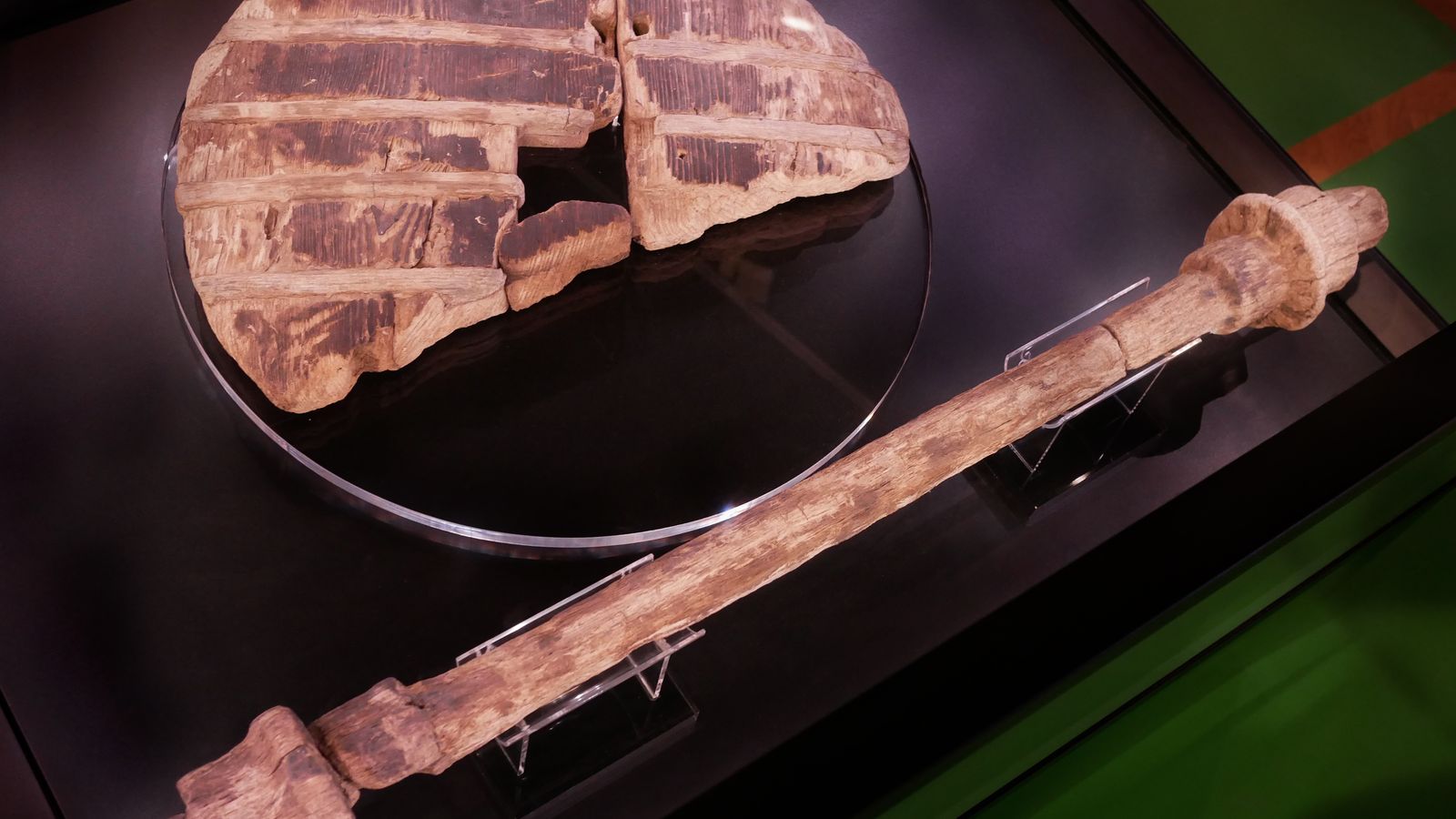
It’s believed that the first wheel and axle was invented by the Sumerians in the 4th millennium BC. These early wheels were solid discs of wood attached to an axle, though by 2000 BC people figured out that they could hollow out the wheels to make them lighter without damaging their structural integrity. Around the same time the spoked wheel was also invented, and this was the last major design change in the history of the wheel.
Over the next couple thousand years, countless inventions would be created to harness the power of the wheel. From wheelbarrows to spinning wheels to threshing machines, the potential applications of wheels seemed limitless. But throughout all this, the design of the actual wheels themselves has remained largely unchanged. Most wheels are now made from either metal or plastic rather than wood, but the overall design is fundamentally the same.
Both solid wheels and spoked wheels have continued to be used for thousands of years without a need for any major design change. There’s an argument to be made that the invention of the tire was a fundamental design change to the wheel, and people can have differing opinions on this.
Tires provide shock absorption and certainly improved the comfort of cyclists, and later motorists. However, aside from the shape of the rim being adjusted to better accommodate pneumatic tires, the wheels themselves are unchanged. As such, the tire can be seen as a separate invention that improves the utility of wheels in certain situations rather than a fundamental design change.
In this regard the tire is similar to the addition of plastic covers and drinking straws to cups from takeout restaurants. Though some people would argue this was a design change to the cup, it might be better described as a related invention to prevent spilling.
Rope
The wheel and axle are what Renaissance scientists referred to as one of the “six simple machines”. These were machines with few if any moving parts that could increase the force applied to an object beyond what a human could normally produce. Another of these six simple machines was the pulley, which is mostly just a wheel with some rope running over it.
And the fundamental design of that rope is the same as it was tens of thousands of years ago. Though the oldest fragments of rope found only date back about 15,000 years, impressions in fired clay from 28,000 years ago provide evidence that rope had existed all the way back then. A tool from 35,000-40,000 years ago was also discovered that is believed to have been used for making rope.
That all certainly makes sense, since the design of rope is extremely simple and something that could have been deduced by prehistoric humans. Early humans would have used naturally occurring plant fibers to pull, fasten or hang objects. However, if the load was too heavy, the fibers would break. Once that happened, the next logical step would be to just use more fibers. After all, the more of them were used, the heavier a load they should be able to bear.
From there, it wouldn’t take long to realize that the fibers could be made even stronger by twisting or braiding them together. And that, at a fundamental level, is all that rope is: a bunch of fibers combined in such a way to maximize their strength. Obviously we’ve come a long way from using whatever vines happened to be growing nearby, but the design of the rope itself hasn’t really changed.
Whether the rope is twisted, braided, double braided, or a combination of both, these designs have existed for all of recorded history. As a simple generalization, twisted ropes are stronger while braided ropes are more flexible. This obviously varies depending on the exact materials used and the construction methods, and that is the main way in which ropes have evolved.
Early ropes were made from whatever the strongest plants in the area were. As agriculture and manufacturing improved, ropes were typically made from hemp, linen, or jute among others. We also now have synthetic materials like nylon and polyester that are much stronger than ropes made with natural materials. They are also less likely to rot and typically float on water, making them generally more appealing for most uses.
Beyond just the materials used, how rope is made has evolved as well. Rope was all made by hand until just a couple centuries ago, so there were practical limitations to how long a rope could be. The two main limiting factors were space and the length of the plants. But this changed during the Middle Ages with the creation of rope walks.
Rope walks were extremely long buildings solely dedicated to the manufacturing of rope. This large space gave rope makers the opportunity to create ropes that were up to 270 m (900 feet) long. While finding enough plant fibers that long was unlikely, a skilled rope maker could splice together multiple lengths of rope into a single rope.
But no matter what material is used or how it is manufactured, rope is still just a bunch of individual strands twisted together to make something stronger than the individual pieces.
Key Takeaways
- Paperclips, invented in the 1800s, remain unchanged in design, with over 11 billion sold annually in the U.S.
- Spoons, dating back to Ancient Egypt, have maintained their basic bowl-and-handle design for thousands of years.
- Dice, used since at least 3100 BC, have kept their six-sided design, with only materials changing over time.
- Brooms, referenced in ancient texts, have seen minimal design changes, mainly in materials and durability.
- Wheels, invented by the Sumerians, have remained fundamentally the same, with spoked and solid designs still in use.
SideProjects Editors
The SideProjects editorial team researches, fact-checks, and structures explainers about the lesser-known tales, side narratives, and spin-offs behind major historical and contemporary subjects.
Frequently Asked Questions
When were paperclips invented?
The exact origin of the paperclip is unclear, but it was invented sometime in the mid to late 1800s.
Who was the first to patent a paperclip?
The first patent for a device similar to a paperclip was awarded to Samuel B. Fay in 1867.
What is the oldest known modern spoon?
The oldest known modern spoon originates from Ancient Egypt around 1000 BC.
How old are dice?
The invention of dice predates recorded history, with some found in Iran dated to as far back as 2800 BC.
What were ancient dice made of?
Ancient dice were made from bone, rock, terracotta, or metal.
When were brooms first mentioned in ancient texts?
There are plenty of references to brooms in ancient texts, including several biblical passages.
Who invented the wheel?
It is believed that the first wheel and axel was invented by the Sumerians in the 4th millennium BC.
What is the oldest evidence of rope?
Impressions in fired clay from 28,000 years ago provide evidence that rope had existed all the way back then.
What are the two main types of rope designs?
The two main types of rope designs are twisted ropes, which are stronger, and braided ropes, which are more flexible.
What were early ropes made from?
Early ropes were made from whatever the strongest plants in the area were, such as hemp, linen, or jute.