
If your idea of Persia comes from movies like 300, you probably picture a swarm of shrieking lunatics in capes and eyeliner, flailing their way across the ancient world.
It is a great image. It is also mostly garbage.
The truth is, the Persians built one of the largest empires on Earth, stitched together cultures across three continents, and created systems of rule so effective that even Alexander the Great, after smashing his way through the empire, kept a lot of them in place.
Key Takeaways
- The Persian Empire was a vast, sophisticated, and multiethnic superpower.
- Persia’s administrative systems were advanced, including roads and courier networks.
- Persian rulers often allowed conquered peoples to retain their religions and customs.
- The Persian military, including the elite Immortals, was formidable but not supernatural.
- The Persian Empire’s decline was gradual, involving internal strife and economic issues.
So why do so many people still imagine the Persians as decadent, irrational villains? Because most of the story came down to us through their greatest arch-nemesis: the Greeks.
So let’s put the biggest myths about the Persian Empire on the table and see how much of the Greek version was actual history, and how much was enemy fan-fiction.
Myth #1: The Persian Empire was a barbaric dictatorship
One of the biggest reasons the image of the Persian Empire as a giant mob of power-hungry barbarians stuck is Herodotus, the Greek historian often called the “Father of History,” who quite honestly would have had an amazing career in PR had he been alive today.
He is one of our main sources for the Greco-Persian Wars, the long clash between the Persian Empire and the Greek city-states in the early 5th century BCE, fought after Persian expansion into Asia Minor and Greek support for the Ionian Revolt dragged both sides into open war. Herodotus helped shape how Persia was remembered for centuries. For him, but also for other Greek writers like Aeschylus, Aristotle, and Isocrates, Persia stood for everything Greece wanted to define itself against: despotism instead of law, submission instead of freedom, luxury instead of discipline, and imperial excess instead of civic virtue.
The truth, as we’ll see, is a little bit more nuanced than that.
The Persian Empire, more properly known as the Achaemenid (uh-KEE-muh-nid) Empire, began in the sixth century BCE under Cyrus II, better known as Cyrus the Great, who ruled from 559 to 530 BCE. Cyrus started as ruler of the Persians in Persis, in what is now southwestern Iran, but at that point, Persia was still living in the shadow of Media, the dominant power in the region under the Median king Astyages (uh-STY-uh-jeez). If Cyrus wanted security, independence, and any real future beyond being a subordinate player, he had to move first.
So he did. He united the Persian tribes, rebelled against the Medes, and defeated them, toppling the dominant power in the region and turning Persia from a subject people into the new force everyone had to reckon with.
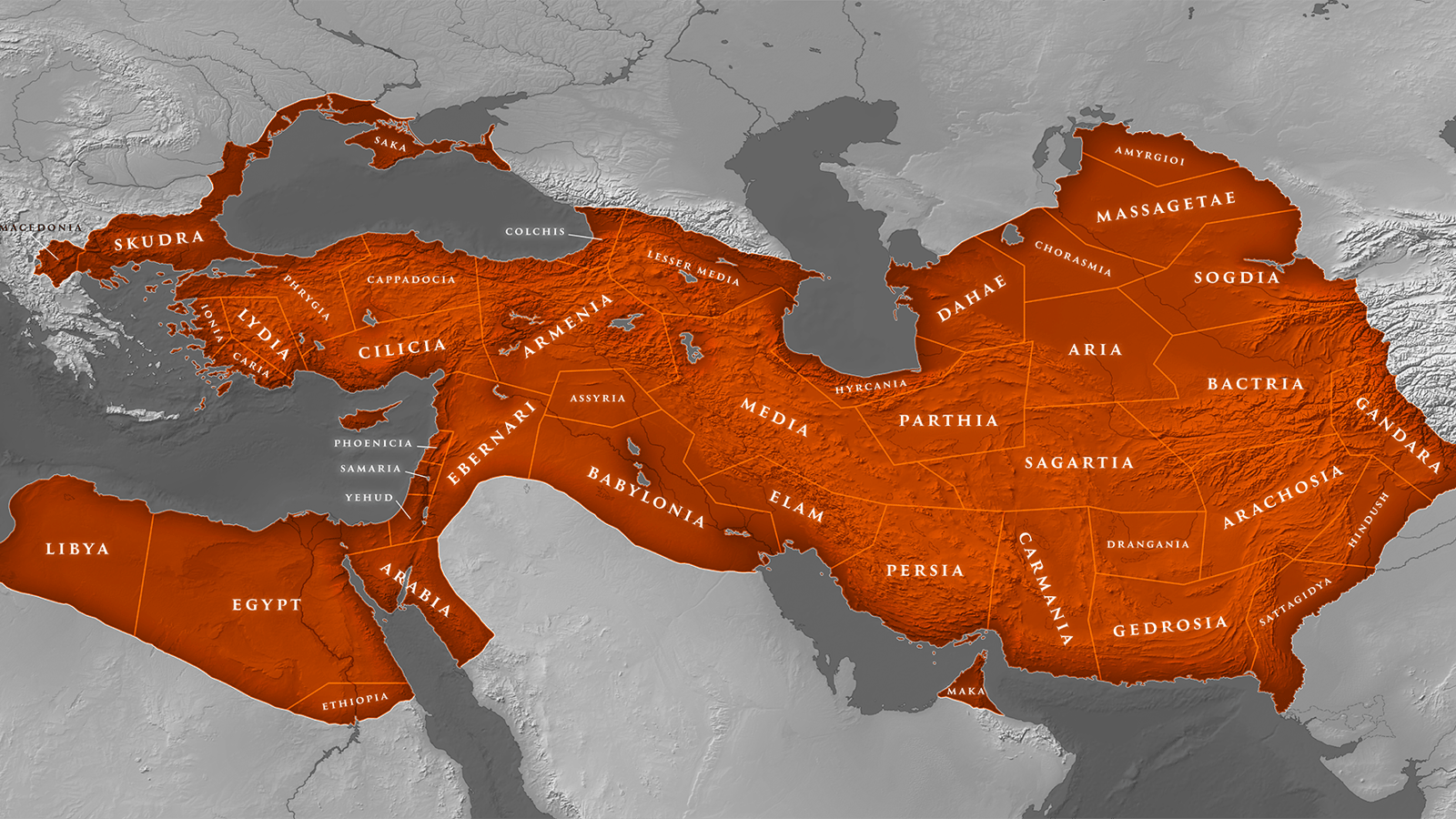
From there, Cyrus crushed Lydia in Anatolia, one of the richest kingdoms of the age, then pushed east and south to absorb more territory. In 539 BCE, he captured Babylon, one of the greatest cities in the ancient world, without destroying it, and added its lands to his growing empire. By the end of his reign, Cyrus had brought together an enormous stretch of territory from the Aegean Sea in the west to the Indus River in the east, creating the largest empire the world had yet seen, the ancient equivalent of ruling from Greece or western Turkey all the way to modern-day Pakistan.
That meant ruling over Babylonians, Egyptians, Lydians, Phoenicians, Jews, Medes, Greeks in Ionia, and many others, speaking languages like Aramaic, Egyptian, Greek, Babylonian, Elamite, and Old Persian, all with their own religions, local laws, and ways of life across a vast territory. An empire that size could not function if every problem had to be solved by marching in angrily with spears and a trumpet.
So instead of trying to micromanage every city, village, tax dispute, and local headache from the royal court, Cyrus split the empire into large provinces called satrapies. Each one was run by a satrap, basically a provincial governor, whose job was to keep order, collect taxes, enforce royal authority, and make sure the place did not suddenly decide it had outgrown the empire. It was a clever system because it gave the Persians control without forcing them to crush every region into the same shape.
Cyrus built a well-oiled imperial machine, and one of the biggest reasons that machine held together was that he ruled with a surprisingly light touch in matters of religion and culture. Instead of forcing conquered peoples to abandon their gods, their customs, or their local identity, he generally let them keep all of that, so long as they paid tribute and stayed loyal. Cyrus set that pattern after taking Babylon in 539 BCE.
We know this because of the Cyrus Cylinder, discovered in 1879 during excavations for the British Museum at Babylon by Hormuzd Rassam. The Cyrus Cylinder was basically Cyrus’s official version of the Babylon takeover, pressed into clay.
If we take the Cylinder at face value, this is the version of events Cyrus wanted the world to remember. Written in Babylonian cuneiform, it presents him not as a destroyer, but as the ruler chosen by Marduk—the chief god of Babylon—to set things right after the failures of its previous king, Nabonidus. According to the text, Cyrus entered Babylon “without a fight,” spared the city from chaos, eased the burdens imposed on its people, restored their temples and religious cults, returned divine statues to their proper sanctuaries, and gathered displaced populations back to their settlements.
In that telling, Cyrus did not behave like a conqueror kicking down the door and torching the furniture. He behaved like a restorer of order, a king who wanted conquest to look like repair, legitimacy, and calm after misrule.
Cyrus looks very different from the usual stereotype of the eastern despot. He is remembered not just in Persian tradition but in the Hebrew Bible, where he is praised as the ruler who freed the captive Jews exiled in Babylon and allowed them to return to their promised land and rebuild the Temple in Jerusalem.
The Cyrus Cylinder is generally regarded as the first declaration of human rights, globally famous as a symbol of tolerance, protection of subject peoples, and freedom of worship. It’s even translated into all six official languages of the United Nations, and its provisions mimic the first four articles of the Universal Declaration of Human Rights. And it helps explain why Cyrus was called “the Great” in the first place. He was not only the founder of the Persian Empire.
He was also the ruler who banned the tradition of enslaving conquered populations to build royal monuments and forbade his soldiers from looting or terrorizing the civilian population during a takeover. He prioritized settlement and restoration over destruction and hubris.
Even the Greek writer Xenophon had good things to say about him. In Cyropaedia, 150 years after Cyrus’s death, he writes that Cyrus “honoured his subjects and cared for them as if they were his own children; and they, on their part, reverenced Cyrus as a father.” So even in a Greek source, Cyrus is not remembered as a raving despot, but as a ruler whose authority was tied to care, order, and loyalty. Another fun fact: those words inspired even some of the Founding Fathers. Thomas Jefferson reportedly owned not one but two copies of Cyropaedia (sy-ruh-pee-dee-uh).
Other Persian rulers who took over after Cyrus continued to perfect how the empire was governed. One of the most famous examples was Darius I, who ruled from 522 to 486 BCE. Known as a master administrator, during his reign, he tightened the satrapy system, improved administration, and pushed a level of standardization that made the empire easier to tax, govern, and trade across.
For example, he introduced the famous gold coin called the daric, along with the silver siglos, creating an imperial monetary standard built on older Lydian coinage but scaled up to serve a much larger world, and also standardized weights and measures, and a fair taxation system.
During his time, the Persians also built one of the earliest courier networks, later known as the Chapar Khaneh (chah-PAR khah-NEH), running along the Royal Road, the long state route from Susa to Sardis stretching more than 2,400 kilometers. Riders and fresh horses were stationed at intervals, so official messages could be passed relay-style across the empire with extraordinary speed. Even good ol’ Herodotus was impressed. So much so that he wrote that these couriers were stopped by “neither snow nor rain nor heat nor darkness” from completing their appointed course, a line that later inspired the famous unofficial U.S. postal creed.
The point was not just speed for its own sake. This was how Persian rulers governed lands spread across three continents without having to personally jog from province to province, asking if everyone had received the memo. Roads, relay stations, mounted couriers, inspectors, governors, tax records, and central oversight all worked together as a layered bureaucracy. So when people picture Persia as some clumsy, decadent giant held together only by fear, it is worth remembering that this so-called despotism had highways, express post, and administrative reach that many later empires would have killed for.
Darius I was also the first Persian king to officially promote Zoroastrianism as the ideological foundation of the empire. Zoroastrianism, the dominant Persian religion at the time, prized truth over lies, order over chaos, and just rule over pointless cruelty. And the bigger legacy of that religious world was enormous. Zoroastrianism helped push into prominence some of the most durable moral ideas humans ever came up with: the struggle between truth and falsehood, the idea that people are morally responsible for their choices, judgment after death, heaven and hell, and the belief that history is moving toward a final renewal rather than just spinning in circles forever.
Now, unlike Cyrus and Darius, Xerxes I was most known for his failures. And since his disastrous war against Greece gave Greek writers exactly the villain they wanted, he ended up doing more than anyone else to make Persia look like the final boss in a Greek nightmare.
Xerxes was the son of Darius I and ruled from 486 to 465 BCE. He inherited an empire that was already dealing with revolts in Egypt and Babylon, plus one very public insult: His father had already tried and failed to crush the Greeks at Marathon in 490 BCE, where the Persian defeat more or less slammed the door shut on the First Persian Invasion of Greece.
Xerxes clearly had no intention of letting that sit. First he took care of things at home, smashed the revolt in Egypt, brought Babylon back under control, and then turned west to settle the Greek problem.
What followed was the most famous campaign of his reign and one of the most colossal military expeditions of the ancient world. In 480 BCE, Xerxes launched the invasion of Greece, crossing the Hellespont on massive pontoon bridges and dragging behind him the full spectacle of Persian imperial power. But Xerxes was also something of a nutjob. In one notorious incident at the Hellespont, after a storm wrecked his bridge, he supposedly ordered the water itself to be given 300 lashes.
Yes, the water. Right, Xerxes. That’ll teach the sea. This was the campaign that gave the Greeks everything they needed for a legend: an enormous army, a king dripping with authority and vengeance, and an empire that seemed like a force of nature.
Xerxes’ invasion started off alarmingly well. The Persians forced the pass at Thermopylae, marched into Athens, and burned the Acropolis, which is about the fastest possible way to make sure future Greek writers absolutely hate your guts. For a while, it looked as though Persia might crush the Greek resistance outright.
But Xerxes lacked the lighter political touch that had made Cyrus so admired and the calmer administrative instinct that had made Darius so effective. So when the tide turned at Salamis and Plataea (pluh-TEE-uh), Greek writers had exactly the story they wanted: a Persian defeat that would become the stuff of legend, and the downfall of an arrogant ruler.
So were the Persian leaders harsh rulers?
Yes. Of course they were. They were ancient monarchs with enormous power, not neighborhood mediators. They put down revolts, collected tribute, launched campaigns, and expected obedience. But there is a real difference between saying “they were absolute rulers” and saying “they were barbaric tyrants ruling a chaotic evil empire.” If you lived under Persian rule, you were often free to keep your gods, your temples, your local customs, your language, and even much of your local law.
That does not make Persia a modern liberal paradise, obviously, but it is a very long way from the Greek image of an empire that existed only to crush everything beneath it. Xerxes’ invasion of Greece did a lot to darken that reputation, and Greek memory made him the face of Persian arrogance for centuries. But even with Xerxes in the picture, the Persian Empire still looks far more pragmatic, flexible, and workable than the Greek horror story would have you believe.
Myth #2: The Persian Army was 5 million strong
If you grew up with the usual version of the Persian Wars, then Xerxes did not invade Greece with an army. He invaded it with a moving continent.
According to Herodotus, the Persian host was so huge that it drank rivers dry, covered the land like a storm cloud, and came packed with so many men that counting them might induce a panic attack. In Histories Book 7, he gives Xerxes more than 2.6 million fighting men and then doubles the number when he adds servants and camp followers, arriving at the wonderfully unhinged total of over 5 million people.
And honestly, it’s a fantastic story.
A tiny collection of Greek city-states standing in the path of an army so large it could blot out the sun itself. It turns Thermopylae into a miracle, Salamis into divine payback, and the whole war into the ultimate underdog tale that would make Rocky Balboa weep tears of joy. The Greeks were apparently fighting most of the known human race.
The trouble is that once you stop admiring the storytelling and start asking some common-sense questions, the whole thing begins to wobble.
Questions like: where were these millions sleeping?
What were they eating?
What were they drinking?
How do you march several million people through the rough terrain of northern Greece without turning your own invasion route into the world’s largest traffic jam?
Armies need food, water, animals, wagons, roads, camps, timing, and space. Even a powerful empire cannot simply point two million men at a mountain pass and hope logistics sorts itself out.
And the Persian invasion of 480 BCE was already an enormous operation even before the numbers became absurd. This was the second major Persian attempt to break mainland Greek resistance after the failed campaign led by Darius I that ended at Marathon in 490 BCE. Xerxes inherited the project from his father, but Persia had been on a collision course with the Greeks for years. Greek cities in Asia Minor had revolted against Persian rule in the Ionian Revolt, and Athens and Eretria had helped them.
Persia saw that as interference in imperial territory. So the invasion was a massive punitive and strategic campaign against states that had meddled in the empire’s western edge and then embarrassed Persia at Marathon.
Now, to Xerxes’ credit, he planned big.
Really big.
The Persians bridged the Hellespont so the army could cross from Asia into Europe. They cut a canal through the Athos peninsula so the fleet would not have to risk the dangerous route around it again. They stockpiled supplies in advance. This was one of the most sophisticated military undertakings the ancient world had yet seen.
All that being said, modern scholars estimate that Xerxes crossed the Hellespont with about 360,000 soldiers and a navy of 700 to 800 ships. That is still enormous. It is still one of the greatest invasion forces of the ancient world. It is just not remotely close to two million, let alone five.
So why did Herodotus and other Greek writers blow the numbers up so far?
Watch the Video
Open Video
Video Briefing
Discoveries That Proved Historians Wrong About the Persian Empire
Partly because ancient number reporting was not exactly a science. But more importantly, huge numbers made for a better story.
If the Persians brought a merely enormous army, then the Greeks won a difficult war. If they brought a cartoonishly gigantic one, then the Greeks become the scrappy heroes who saved civilization.
That version is much better for national memory.
It turns the Greeks into heroic underdogs facing impossible odds, and it turns the Persians into a faceless, endless eastern mass. The bigger the Persian numbers get, the brighter the Greek glory shines.
So no, Xerxes did not march into Greece with millions of soldiers.
That army exists mostly in Greek memory for one reason.
To make the heroes look even better.
Myth #3: The Persian “Immortals” were some kind of supernatural death squad
This was basically one of the greatest military psyops in history, pulled off long before the term psyop was conceived by some of your favorite intelligence agencies. The Immortals were the Persian Empire’s elite 10,000-man guard, tied closely to the king and famous enough that their name outlived the empire itself. But in pop culture, the Immortals are often depicted as mask-wearing monsters or supernatural ancient X-Men. I’m sorry to disappoint you, but they were real, human soldiers who played a major role during Xerxes’ invasion of Greece in 480 BCE.
Their name comes from none other than Herodotus—a busy fellow, that one—who wrote the most famous account of Xerxes’ campaign. In Histories Book 7, he says:
“These Persians were called ‘Immortals,’ because, if any one of them made the number incomplete, being overcome either by death or disease, another man was chosen to his place, and they were never either more or fewer than ten thousand.”
So the Immortal army was always kept at exactly 10,000 men. If one soldier died or fell sick, another was brought in immediately, so the number never dropped. To Greeks, that made them look almost deathless. But sadly, they were called “Immortals” not because nobody could kill them, but because the unit itself never seemed to shrink.
That does not mean the Immortals were ordinary.
Far from it.
These men were elite infantry and the king’s personal guard. Herodotus places them under Hydarnes during Xerxes’ Greek campaign, and he describes a picked corps of 10,000 Persians with distinctive spear-butts: 1,000 with gold pomegranates on the ends of their spears and 9,000 with silver ones. Persian palace art from Susa shows rows of richly dressed guards with bows, quivers, spears, jewelry, and patterned robes. So they did not look like horror-movie mutants.
They looked like expensive, disciplined soldiers from one of the richest empires on Earth.
They were also not just for show.
They traveled with the royal court and fought in major campaigns. The clearest moment we see them in action is during Xerxes’ invasion of Greece. By then, Persia already ruled a huge empire stretching across many peoples and languages, and the Immortals were the polished edge of that machine.
Their most famous battle is Thermopylae, where they clashed with the legendary 300 Spartans.
In Thermopylae, they were sent in after earlier Persian attacks had struggled to break the Greek line in the narrow pass.
Once Xerxes learned of the mountain path that could be used to outflank the Greek position, Hydarnes led the Immortals on the night march around the pass. That maneuver is what helped seal the Greek warriors’ fate.
The Immortals fade from the record after the great Persian Wars, even though the Persian Empire itself lasted for another century and a half. By the time Alexander the Great destroyed the Achaemenid Empire in the late fourth century BCE, the old imperial system that had produced the Immortals was gone, and with it went the famous 10,000-man guard.
So no, the Immortals weren’t some kind of supernatural monsters, but they headlined one of the most memorable military legends of the ancient world.
Myth #4: Women’s rights were nonexistent
When people hear the words “ancient empire,” they immediately assume every woman in it spent her life locked in a room staring at a wall while men invented taxes.
And to be fair, a lot of ancient societies really were dreadful on this front.
According to Aristotle in Politics, “among the barbarians the female and the slave have the same rank.” He was not writing about Persia alone, but about non-Greeks as a category, and Persians were one of the main peoples Greeks stuffed into that box. Greek writers kept painting the East, especially Persia, as a world of servility, excess, and distorted social order, the perfect opposite of proud, free Greece. But let’s compare that image to how things were in Athens itself. Athenian women could not vote, could not hold office, were legally represented by a male guardian, and had sharply limited control over property and public life. So the civilization that gave the world democracy was, for half its population, not exactly running a five-star freedom package.
Now compare that with what the evidence from Achaemenid Persia actually shows.
The best evidence comes from the Persepolis Fortification Tablets, administrative records from the reign of Darius I. These tablets are basically the empire’s paperwork, and those records show women as people with economic roles, labor roles, and, at the top, serious wealth and influence. Royal women had economic independence, could travel in their own right, had direct access to the king, and in some cases even seemed to have held their own audiences.
That is not modern equality, obviously. But it is also not the depressing image people often imagine when they think of the Persian Empire—wait, do people even have a Persian Empire phase, or is that still just Rome?
And if you think that Persian women were glorified housewives, think again.
The tablets show royal women owning estates in Persis and beyond, including places like Babylonia, Syria, Egypt, and Media. They had their own workforces and officials attached to them. One royal woman, Irdabama, had her own seal, authorized transactions, and controlled a labor force that could reach around 480 workers.
And this was not limited to queens and princesses floating above ordinary life.
For example, regular women workers who had just given birth were given extra rations. Now, sure, there remain some grim details, such as the fact that mothers of newborn boys received more food than mothers of newborn girls. So no, nobody should be writing “Persia solved sexism” on a mug. But again, the records show women as visible economic actors inside the imperial machine, not as people who legally or socially did not exist.
That does not mean every Persian woman had a better life than every Greek woman. Spartan women, for example, had more freedom than Athenian women. But if your mental picture is still “Greece equals freedom, Persia equals oppression,” then you’re probably reading the wrong history books. Ones probably written by Herodotus—I’m never letting him off the hook, am I?—Poor Herodotus.
So no, women’s rights were not nonexistent in the Persian Empire.
They were very far from modern standards, but for much of its history, the Persian Empire remained one of the most progressive ancient cultures regarding the treatment of women.
Myth #5: The Persian Empire was built on the backs of slaves
Slavery existed in the Persian Empire, absolutely, but the empire was not running on some nonstop conveyor belt of chained workers. In the early Achaemenid period, most of the actual labor in agriculture and crafts was being done by free farmers, tenants, and artisans. So the usual image of Persia as one giant misery factory powered by slaves is, once again, more Greek nightmare than historical reality.
At Persepolis, the empire’s great ceremonial capital, the records show large groups of workers receiving rations through the royal administration. The Persian state used organized, rationed, professional labor on a big scale. Bureaucratic, yes. Glamorous, no. But that is how empires actually get things built.
And this fits the wider shape of Persian rule. The empire worked through administration, taxation, provincial government, and a paid or ration-supported workforce far more than through some fantasy version of all-purpose slave gangs. Even the categories of workers in Persian records are mixed and messy. Some royal workers were probably prisoners of war. Some were likely serving labor obligations. Some were free people working for wages or rations. It was not one neat category.
Which brings us to the Greeks, who are very important here, mostly because they never missed a chance to describe Persia as tyrannical while doing some extremely dark things at home.
Take Sparta. The helots, the slave laboring population under Spartan control, outnumbered their Spartan masters by about seven to one. The ephors—which were Spartan magistrates—formally declared war on them every year to legally justify killing them without violating religious taboos. Which meant a Spartan could kill a helot without it counting as murder.
Young Spartan soldiers were even sent into the countryside to hunt and kill helots, particularly the strongest ones, as a rite of passage. That’s not a society with “a slavery problem.” That is a society whose whole spine is made of slavery and something that only a, dare I say, barbaric leadership would conjure up.
So Sparta’s military culture was not floating in the air on noble principles. It was standing on the backs of people who worked the land and lived under permanent threat. Talk about one hell of a blind spot.
Athens was hardly innocent either. It gave the world democracy, philosophy, and theater, but Classical Athens relied heavily on slavery in household labor, agriculture, mining, and the wider economy. And when Athens wanted to remind everyone that its famous ideals came with some very selective terms and conditions, it could be brutally vicious. In 416 BCE, after the siege of Melos (MEE-loss), the Athenians killed the adult men and sold the women and children into slavery.
So the same civilization that later got remembered as the brave defender of liberty was perfectly comfortable turning defeated populations into property when it suited them. Ancient freedom, it turns out, often had a very selective guest list.
Now, Persia was not anti-slavery in some modern abolitionist sense. But Persian royal ideology leaned hard on order, justice, and relief from oppression.
Zoroastrian moral culture helps explain some of that tone. Its most famous ethical formula is “good thoughts, good words, good deeds.”
So the myth falls apart in two directions at once.
No, the Persian Empire was not built on the backs of slaves. Its foundations were free farmers, artisans, administrators, and large organized labor systems paid or provisioned through the state. Meanwhile, the Greeks, especially Sparta and often Athens too, were leaning far harder on slavery while patting themselves on the back about freedom. Which is one of the great ancient-world plot twists. The people shouting loudest about liberty were often the ones most dependent on unfreedom.
Myth #6: The Persian Empire collapsed “overnight”
If you only know the ending of the Persian Empire from the greatest hits version of history, it goes something like this: Alexander rides in, wins the Battle of Gaugamela, Darius III hits the panic button, and the whole empire falls over like a folding chair at a cheap wedding.
That story kind of makes history look like a video game, where one boss fight ends and the map instantly changes color. Real empires, annoyingly, do not usually work like that. Gaugamela in 331 BCE was a huge blow, but it was not some magical “game over” screen. Darius survived the battle, escaped, and was still trying to rally resistance afterward.
Even after Alexander took the empire’s great capitals, he still faced years of fighting in the east, because the Persian system did not simply vanish the second one king lost one battle.
That is the first thing people miss. The Achaemenid Empire did not die in one afternoon. It had been under strain for a long time. By the fourth century BCE, it had already gone through court murders, succession problems, and repeated rebellions.
Egypt had revolted more than once, broke away entirely in 404 BCE, stayed out of Persian hands for decades, and had to be conquered again in 343 BCE. Meanwhile, central control had weakened enough that satraps, the empire’s provincial governors, often behaved like semi-independent rulers.
And the satrap problem was a real headache, because the satrap system had once been one of Persia’s greatest strengths. It let a giant empire rule huge territories without trying to micromanage every village goat and tax receipt from the royal court.
But once central authority weakened, some satraps started acting less like governors and more like kings who had just forgotten to tell anyone they were no longer taking orders. In the 360s BCE, western satraps rebelled against Artaxerxes II in what became known as the Satraps’ Revolt. It was not perfectly coordinated, but it showed that the imperial machine was no longer humming the way it had under rulers like Cyrus the Great and Darius I.
The economy was not helping either. One long-running problem was the royal habit of hoarding massive stores of bullion. Persian kings and their treasuries accumulated huge amounts of gold and silver, sometimes melting precious metal down and storing it rather than circulating it widely. Xerxes also put heavy strain on the empire’s finances, pouring resources into lavish building projects while increasing the tax burden to help fund both those expenses and his massive invasion of Greece.
These were not the only reasons the empire weakened, but it did make the system more rigid. A giant empire works best when wealth moves. Sitting on mountains of metal may look impressive, but it is not the same thing as economic health. Smaug would have been a terrible finance minister.
Egypt is one of the clearest examples of how all this strain looked on the ground. Under Darius I, Persian rule there was relatively stable, temple income was partly restored, and irrigation and trade projects helped the economy. After the battle of Marathon, though, Egypt became far more restless.
A revolt broke out when Darius died in 486 BCE. Xerxes answered by reducing Egypt to a conquered province, sidelining Egyptians in administration, and earning the charming local nickname “the criminal Xerxes.” Later revolts followed and Egypt then spent decades outside Persian control after 404 BCE, until Artaxerxes III reconquered it in 343 BCE and stripped its wealth, trying to crush future resistance.
So when Alexander reached Egypt in 332 BCE, he did not have to batter his way in. He was welcomed as a liberator and took the country without a battle. That is not what happens when a healthy empire is holding all its pieces together.
Then there is Darius III, who had the distinct misfortune of inheriting this mess just in time to meet Alexander. He came to power after the two previous kings had been poisoned, and he himself had to force the eunuch Bagoas, who had put him on the throne, to drink poison when Bagoas tried the same trick on him. Which is not the sort of onboarding experience that usually leads to a calm first quarter.
Against Alexander, Darius fought at Issus and then at Gaugamela, but he also failed to stop Alexander’s crossings of the Euphrates and Tigris and twice tried diplomacy, including offering territory west of the Euphrates and the hand of his daughter in marriage. After Gaugamela he fled east, was deposed, and was killed not by Alexander in some final duel, but by his own follower Bessus, the satrap of Bactria. So the dynasty’s final blow came from the inside.
And even then, Alexander did not walk into the ruins, laugh at Persian weakness, and replace everything with a bright new Greek system. He did almost the opposite. He kept the satrapal structure. He preserved existing administrative frameworks across most of the empire.
He retained or replaced local officials within the same basic system. Then, from 330 BCE onward, he started adopting Persian court personnel, Persian dress elements, Persian ceremonial practices, and Persian-style offices. Some scholars have gone so far as to say that in geopolitical terms he acted like “the last of the Achaemenids.” That is a pretty wild thing to say about the man who supposedly destroyed Persia, but it makes sense.
Alexander did conquer the empire, yes. But he also stepped into a machine that already existed and kept using it, because throwing away one of the most sophisticated imperial systems in the world would have been deeply stupid, even by the impressive standards of ancient royal ego.
So the empire did not collapse overnight. It cracked over time. First there were the rebellious satraps, unstable successions, recurring trouble in Egypt, and a center that was not quite as strong as it looked from far away. By the time Alexander arrived, the Persian Empire was still huge, rich, and dangerous, but it was no longer as tightly held together as it had been under its strongest kings.
In the end, the fall of Persia was the end of a long, messy process in which the empire was weakened by its own size, its own politics, and its own internal rivalries.
Conclusion
If there is a real lesson here, it is not that Persia was secretly noble and Greece was secretly awful, or the other way around.
Persia was a vast, sophisticated and multiethnic superpower that gave the ancient world roads, imperial administration, long-distance communication, and one of the first serious models for how to govern a huge, mixed population without suffocating every difference inside it. Greece gave the world philosophy, drama, political thought, and the democratic tradition.
Both changed history. Both could be ruthless. So this was never good versus evil. It was civilization versus civilization.
But history is written by the victors. And in this case, the victors were very, very good writers.
Key Takeaways
- The Persian Empire was a vast, sophisticated, and multiethnic superpower.
- Persia’s administrative systems were advanced, including roads and courier networks.
- Persian rulers often allowed conquered peoples to retain their religions and customs.
- The Persian military, including the elite Immortals, was formidable but not supernatural.
- The Persian Empire’s decline was gradual, involving internal strife and economic issues.
SideProjects Editors
The SideProjects editorial team researches, fact-checks, and structures explainers about the lesser-known tales, side narratives, and spin-offs behind major historical and contemporary subjects.
Frequently Asked Questions
What was the Persian Empire also known as?
The Persian Empire was more properly known as the Achaemenid Empire.
Who was the founder of the Persian Empire?
The Persian Empire began in the sixth century BCE under Cyrus II, better known as Cyrus the Great.
What was the Cyrus Cylinder?
The Cyrus Cylinder was basically Cyrus’s official version of the Babylon takeover, pressed into clay. It is generally regarded as the first declaration of human rights.
How did Darius I improve the administration of the Persian Empire?
Darius I tightened the satrapy system, improved administration, and pushed a level of standardization that made the empire easier to tax, govern, and trade across. He introduced the gold coin called the daric, along with the silver siglos, and standardized weights and measures, and a fair taxation system.
What was the Chapar Khaneh?
The Chapar Khaneh was one of the earliest courier networks, running along the Royal Road, the long state route from Susa to Sardis stretching more than 2,400 kilometers. Riders and fresh horses were stationed at intervals, so official messages could be passed relay-style across the empire with extraordinary speed.
What was the size of Xerxes’ army during the invasion of Greece?
Modern scholars estimate that Xerxes crossed the Hellespont with about 360,000 soldiers and a navy of 700 to 800 ships.
What were the Immortals in the Persian Empire?
The Immortals were the Persian Empire’s elite 10,000-man guard, tied closely to the king. They were elite infantry and the king’s personal guard, known for their distinctive spear-butts and richly dressed appearance.
What evidence shows that women had economic roles in the Persian Empire?
The Persepolis Fortification Tablets, administrative records from the reign of Darius I, show women as people with economic roles, labor roles, and, at the top, serious wealth and influence.
How did the Persian Empire handle labor and slavery?
In the early Achaemenid period, most of the actual labor in agriculture and crafts was being done by free farmers, tenants, and artisans. The Persian state used organized, rationed, professional labor on a big scale.
How did the Persian Empire collapse?
The Persian Empire did not collapse overnight. It cracked over time due to rebellious satraps, unstable successions, recurring trouble in Egypt, and a weakened central authority. Alexander the Great’s conquest was the final blow, but he retained much of the existing administrative framework.
Sources
- Original Side Projects video: Discoveries That Proved Historians Wrong About the Persian Empire
- Hero image source by Hossein Shahni / openverse, by-sa.