
Ancient civilizations invented some impressive tech. Their advancements in architecture, metalwork, and agriculture laid the foundation for modern society. Sadly, over the centuries, we’ve lost some of their knowledge and skills. Masterpieces like Roman concrete and Damascus steel remain superior to modern attempts.
But for every classical savant there were classical flops, and occasionally what felt like progress only hindered people of the past. Here’s five examples of ancient civilizations doing things wrong before they got it right.
Roman Plumbing & Cooking
The Romans were one of the earliest civilizations to introduce indoor plumbing. Possibly as early as 200 BCE, pipes were being installed in upper-class homes to bring water on demand from their impressive aqueducts. But there was a downside to having access to tap water while wearing a toga… all that H2O was delivered by lead pipes.
Key Takeaways
- Lead pipes and vessels in Roman plumbing exposed citizens to high lead levels, potentially contributing to the empire’s decline.
- Ancient harness designs for horses limited their pulling capacity and caused choking, until improved Chinese designs increased efficiency.
- Slash and burn farming, while initially productive, led to soil depletion and ecosystem damage, contributing to the Mayans’ downfall.
- Ancient cosmetics often contained toxic ingredients like lead and arsenic, leading to health issues and even death.
- Historical crime and punishment systems were often brutal, with severe penalties and torture methods used without fair trials.
You can have access to the purest spring water in the world, but if its delivery method is toxic, so is the fallout. Lead levels pumped into high-born households were 100 times higher than natural water sources in the region. And if that wasn’t bad enough, lead vessels were very popular among the Roman elite. So not only was their drinking water sourced from lead, it was drunk from, carried around, and prepared in lead containers, too.
Popular recipes, such as the famed grape syrup called Sapa, demanded the ingredients be boiled in lead pots, upping the lead concentration and making their most popular sweetening agent incredibly toxic. Romans drank a lot of wine, as much as a liter per person a day, and that’s for lower-class citizens. Wealthier folks threw back a lot more. In a year of regular drinking, that’s a lot of lead.
Which is why some experts theorize that lead poisoning gradually, but most certainly, impaired the Roman leadership with complications like gout, anemia, and immunotoxicity and may have been a contributing factor to the fall of Rome.
Horse Power
Humans have been using horses for transportation and labor for thousands of years, but it wasn’t until fairly recently that we got the most traction out of that partnership. Turns out it was a design failure.
In many ancient cultures, horses were either ridden with a simple saddle/bridle combination or used to pull light chariots and carts, but rarely for more taxing work like heavy plowing, hauling, or logging because it was believed the animals could not handle the burden.
Sumerian, Egyptian, Minoan, Greek and Roman civilizations all used the same type of antiquated harness called a neck-girth. These primitive harnesses more closely resembled a wide dog collar, worn around the horse’s throat. Like us, horses use their throats to breathe, and so when the horse pulled too hard, or the load was too heavy, they choked. This limited the amount of weight the horse could pull based on what its trachea could withstand.
To make up for the weakness of a single horse, sometimes the neck-girth was attached to other horses’ collars to make a team and distribute the weight between animals. But they were harnessed together the same way oxen were, using a piece of wood that yoked them together and bore down on their necks.
It wasn’t until the Chinese developed a harness (some time between 481–221 BCE) that featured a strap that spanned across the horse’s muscular chest and shoulders, that horsepower started to thrive. This early improvement moved the stress on the horse’s neck to their bodies, vastly increasing their comfort and ability. But those early breast harnesses still depended on the horse to pull their burden, using shafts that attached the cart to the horse’s body. But horses don’t want to pull anything.
Their power is entirely in pushing.
It wasn’t until clever harness makers in China modified a padded-collar design used for camels, that horsepower was finally able to come into its own. This was a game changer, finally allowing the animals to “push” all their weight forward into the collar like linebackers instead of dragging things around by their necks. The horses could breathe properly, use their entire body as leverage, and not feel the burden at all when stationary on level ground. This allowed them to conserve energy when not moving, extending the time they could be used in the field.
Now horses were able to carry heavier loads over farther distances. They outperformed oxen, working as much as 50% longer than the best comparable bovine tech.
By the 6th century eastern-Asian kingdoms were outfitting their horses with proper collars, and by the 8th century the improved invention made its way west into Scandinavia. By the 12th century the padded collar became the European standard, making fully-actualized horsepower one of the greatest advancements in medieval history; changing transportation, labor, and food supplies forever. Had these ancient civilizations figured this out earlier their empires could have had options, range, and growth they couldn’t dream of.
Slash & Burn Farming
Growing food in one place is something us humans have been doing since the neolithic revolution, but we didn’t always do it well. For 11,000 years, we’ve been finding ways to cheat nature in the name of agriculture, and one of the most reckless examples was slash and burn farming.
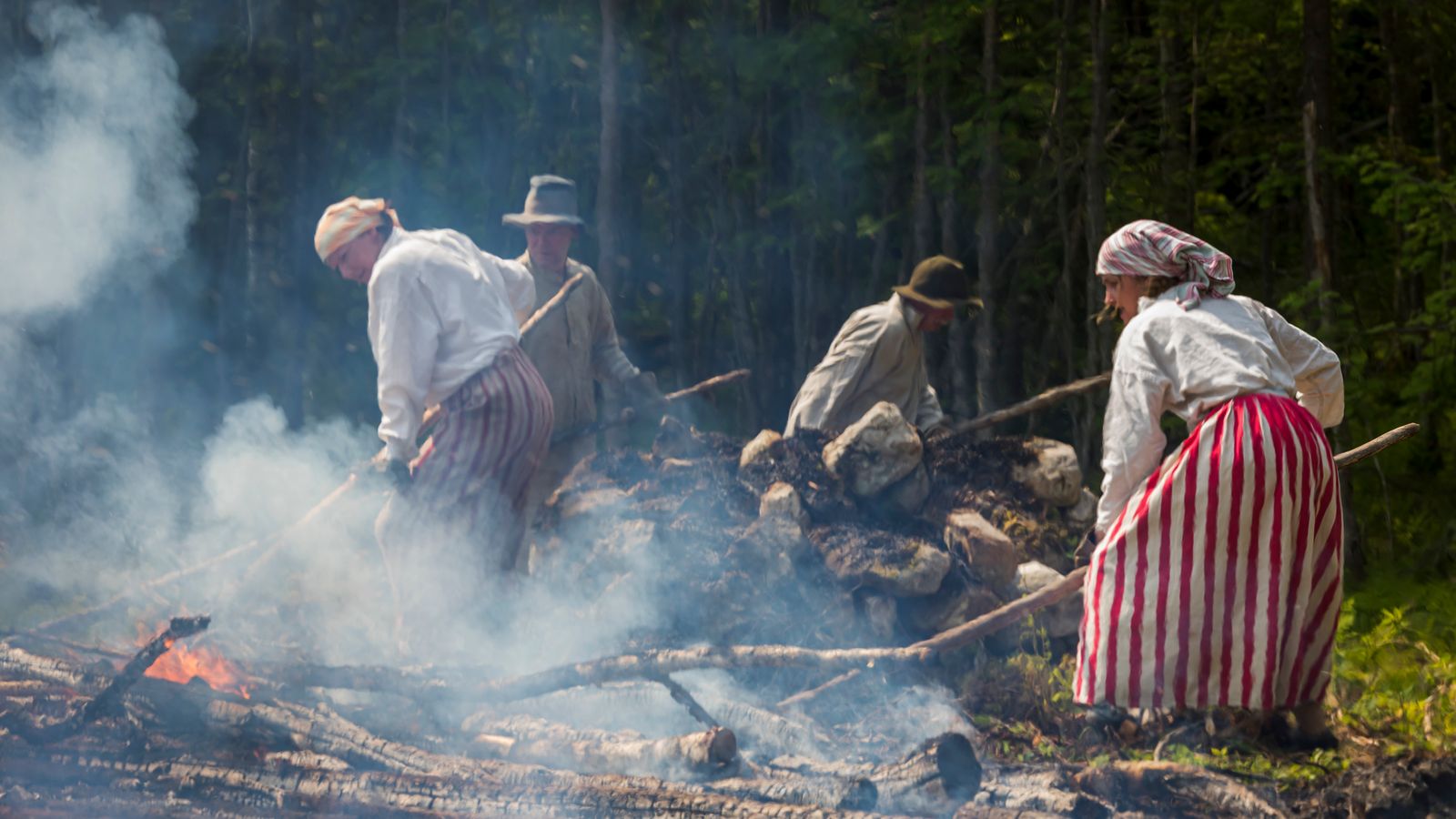
Called “slash and burn” because that’s the practice; clear cut any standing vegetation on a piece of land, let it die and dry out, and then set it on fire. Once the fires have had their way, it creates a perfect environment for food production.
Burning plants might seem counterintuitive to growing them, but fire is nothing if not rapid composting. The freshly-charred biomass creates a nutrient-rich ash. That ash mixed in with the newly-exposed soil skyrockets fertility. And besides making the once wild-land perfect for growing food, the burning eliminates weeds and pests.
The downside? The compost you made sacrificing all that carbon only lasts a few growing seasons. So after a few years, the ground is so deprived of nutrients it’s abandoned, left barren, and as useless for crops as a slab of concrete.
Slash and burn systems have been around since before recorded history. It’s been used all over the globe by many cultures, and for small populations it can be a safe and useful system. However, as populations spiked or demand for resources did (i.e. wars, empire expansions, and city construction) many cultures abused the practice to their detriment.
The Mayans, for example, abused this system to the point where it led to their inevitable collapse. If you use all your land this way, to produce a lot of food with less labor fast, you need to expand your acreage. The trick to using slash and burn farming well is you need to have either A LOT of land or a very low-density of people to feed.
Watch the Video
Open Video
Video Briefing
Five Ancient "Innovations" that Set Humanity Back
If enough land is forfeited to this practice in a short time, the cost of easy farming becomes dangerously expensive to future generations. Without plants to anchor the used-up soil it erodes down to bedrock, making land that can never be used to plant again. The forest (and their adjacent ecosystems) never recover, and what was once a source of game, foraging, firewood, and intentionally-planted food becomes a wasteland.
Today we understand that Slash and Burn methods of quick-fertilization aren’t worth the overall destruction and long recovery period. Not when better options exist like crop rotation and chemical fertilizers.
Cosmetics
Vanity has never gone out of style. In fact it’s one of the oldest human inventions. There’s evidence of the earliest Egyptians using eyeliner back in 6,000 BCE. That’s 3,000 years older than the wheel.
The makeup industry is still going strong, and while we don’t worry much about what we’re rubbing into our skin, there was a time when hiding a pimple used to mean slowly poisoning yourself to death in a myriad of disgusting ways.
Lead was a common ingredient in many ancient recipes for make up. It was used in creams, powders, and oftentimes as a main ingredient in cosmetics that needed to hold pigments, like blushes and eye shadows. The Egyptians used plenty of lead, especially in eyeliner recipes they called Kohl. Kohl was a mixture of ash, black soot and lead sulfide. It was applied directly on the skin and near tear ducts where it easily absorbed into the body and commonly caused eye-related illnesses.
Another way people grew sick from historic makeup was the practice of using animal feces, urine and bile as ingredients in beauty masks. Some cultures used dung as a face mask, to “prepare” the skin before applying makeup. For fair skinned civilizations a pale complexion was a sign of wealth and status, since it meant they could spend their summer days indoors not outside toiling in the fields. To achieve even paler skin, dried crocodile dung, a popular face powder.
Arsenic, more commonly known as rat poison, was used in facial creams and powders. It was also pressed into edible tablets that were used to remove facial blemishes. However, if a person ingested too many in an attempt to remove a pimple fast or had a bad case of acne, the main side effect of overuse was death.
And it wasn’t just topical cosmetics that used gnarly ingredients. Oxen hair was very popular among Greek women, implanted in the skin to achieve thicker eyebrows. They’d make little brow mirkens and attach them with a natural adhesive. Funnily enough, this is a trend that’s recently been revived, though it’s using human hair, not cow.
Crime and Punishment
Regardless of how you feel about your country’s justice system, there’s a good chance that if you break the law today, you’re better off than you would have been breaking the same law a couple centuries prior.
For example: the Mayans had a zero-tolerance policy for the crimes of murder, incest, rape, and arson. You were instantly sentenced to death. If the crime was accidental, the victim could negotiate a milder sentence for the perpetrator, or choose to accept a slave as payment for the crimes. Punishment intensity also depended on gender.
If a woman was guilty of adultery she was publicly shamed, but her male lover would be stoned to death. If a man was guilty of adultery, he was killed. To their credit, the Mayans also practiced a detailed pardon system, but the choice to relieve someone of their sentence was up to the victims.
In 5th-century BC Greece, thieves were called kleptai (the root of kleptomaniac), and in the worst cases could be sentenced to death. The Romans were a little more lenient about theft, in the sense they didn’t kill everyone that stole, but they did implement a system where if you were caught stealing you were sentenced to reimburse the victim up to five times the value of what was taken. Which would be like a person today being caught stealing a Porsche and needing to buy them a mansion as punishment.
Ancient policing was ruthless, but as civilization progressed retribution became ruthless. Enter torture: Torture wasn’t common until the earliest Catholic Inquisitions of the 13th century. This was a period when the church felt threatened by other religious movements and organizations spreading doubt. Painless inquisitions began, but weren’t very successful, So Pope Innocent IV drafted a religious proclamation called Ad extirpanda, allowing the use of torture to encourage confessions from anyone that even appeared to question the church.
This is when torture became more common, and while there were precautions put in place—such as a decree stating that no one could be killed, impregnated, or mutilated in the process of retrieving information—Inquisitors weren’t regulated and practices and implements were designed and used for exactly those things.
And we’re not talking guillotine and hangings… capital punishment via torture involved stretching human bodies until they ripped apart, or were eaten alive by starving rats by setting a metal cage on a victim’s torso, heating it with fire, and forcing the rat to chew through the human body to escape. Criminals were thrown to lions and bears for entertainment, their bodies displayed on pikes until they fell down from their own slow decay. It was barbaric and often, without a fair trial. From witch hunts to hearsay, folks lost their lives in horrific ways when the law was involved.
Sometimes medieval torture as punishment worked in the accused favor. For example, a light form of public torture was the Pillory. This wooden device didn’t actually harm the person, but trapped them in place. Perhaps you’ve seen it as a way to hold prisoners in a dozen movies?
But most people set into the pillory were given over to the public to decide their punishment. In one medieval case four men wrongly accused some neighbors of a crime that led to their hanging, and for sending the wrong men to death they were set in the town square in a pillory and rocks were hurled at them until they died. Another man, who was accused of cheating on taxes, was surrounded by fresh flowers.
Key Takeaways
- Lead pipes and vessels in Roman plumbing exposed citizens to high lead levels, potentially contributing to the empire’s decline.
- Ancient harness designs for horses limited their pulling capacity and caused choking, until improved Chinese designs increased efficiency.
- Slash and burn farming, while initially productive, led to soil depletion and ecosystem damage, contributing to the Mayans’ downfall.
- Ancient cosmetics often contained toxic ingredients like lead and arsenic, leading to health issues and even death.
- Historical crime and punishment systems were often brutal, with severe penalties and torture methods used without fair trials.
SideProjects Editors
The SideProjects editorial team researches, fact-checks, and structures explainers about the lesser-known tales, side narratives, and spin-offs behind major historical and contemporary subjects.
Frequently Asked Questions
What was the issue with Roman plumbing?
The Romans used lead pipes for indoor plumbing, which resulted in high lead levels in the water, leading to potential health issues like gout, anemia, and immunotoxicity.
How did the Romans’ use of lead affect their health?
The Romans’ use of lead in plumbing and cookware led to high lead levels in their drinking water and food, which may have contributed to health problems and possibly the fall of Rome.
What was the problem with ancient horse harnesses?
Ancient horse harnesses, known as neck-girths, were designed like wide dog collars and choked horses when they pulled heavy loads, limiting their effectiveness.
How did the Chinese improve horse harnesses?
The Chinese developed a harness that spanned across the horse’s chest and shoulders, allowing horses to pull heavier loads more comfortably and efficiently.
What were the drawbacks of slash-and-burn farming?
Slash-and-burn farming created nutrient-rich soil for a few growing seasons but eventually depleted the land, leading to erosion and long-term infertility.
How did the Mayans’ use of slash-and-burn farming contribute to their downfall?
The Mayans’ extensive use of slash-and-burn farming led to soil depletion and erosion, making their land unusable for agriculture and contributing to their collapse.
What harmful ingredients were used in ancient cosmetics?
Ancient cosmetics often contained lead, arsenic, and even animal feces, urine, and bile, which could cause health issues and even death.
What was the Mayan punishment for murder?
The Mayans had a zero-tolerance policy for murder, and the punishment was instant death.
How did ancient Greek and Roman societies punish thieves?
In ancient Greece, thieves could be sentenced to death in severe cases. The Romans punished thieves by making them reimburse the victim up to five times the value of what was stolen.
What was the purpose of the Pillory in medieval times?
The Pillory was a wooden device used to publicly display and sometimes punish criminals. The public often decided the punishment, which could range from being pelted with rocks to being surrounded by flowers.