

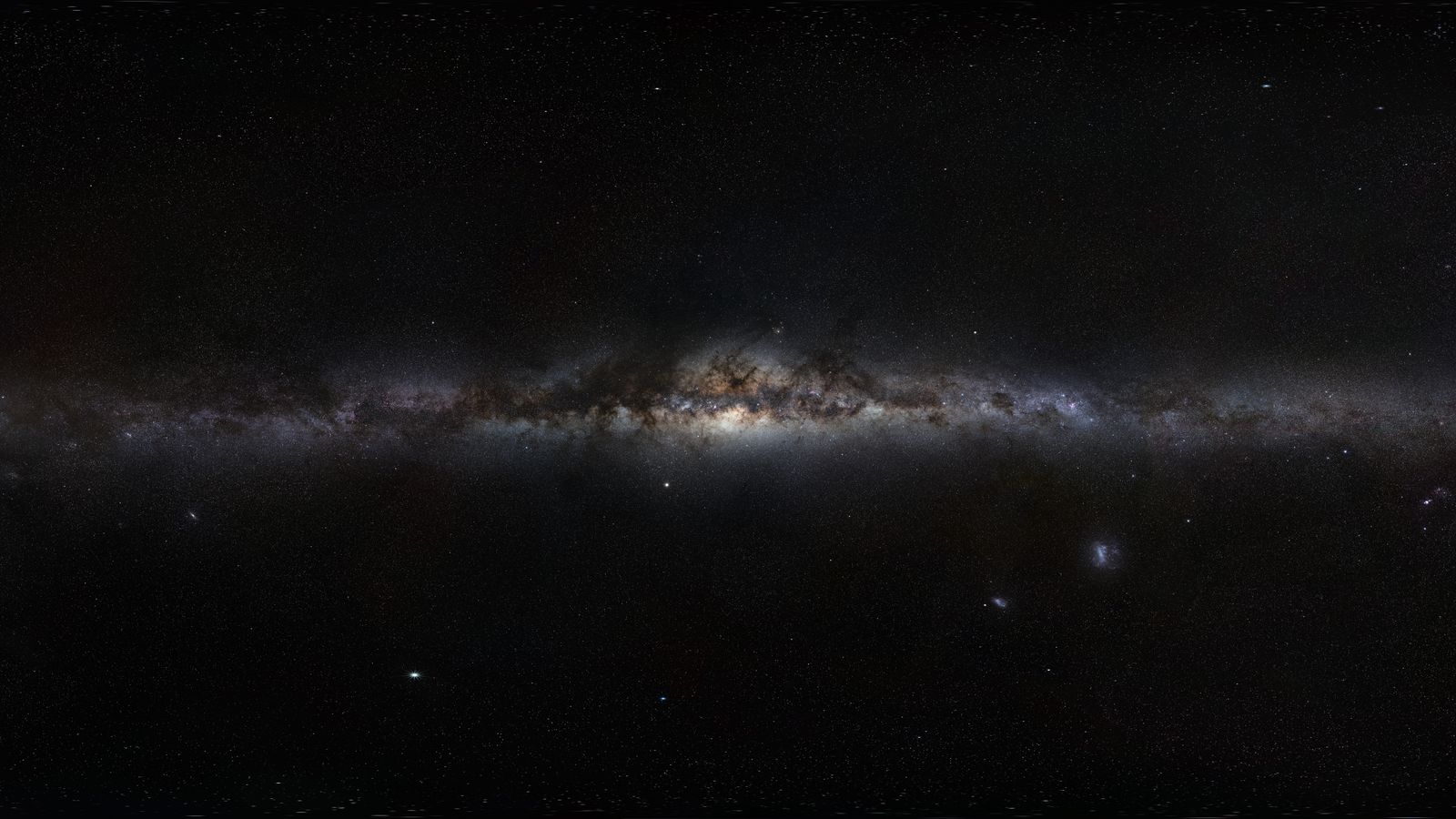
The universe is still a crazy place, full of seemingly impossible phenomena and natural laws that somehow managed to create the perfect conditions necessary for humans to exist. The only thing harder to imagine than how much we’ve learned about celestial bodies that are billions of light years away and the inner workings of the universe is how much we still don’t know.
This uncertainty can bring rise to lots of new theories that present mind blowing possibilities for our universe and the world around us.
Supermassive Black Holes May Predate the Big Bang
You’re almost certainly familiar with the concept of a black hole and how they form. Black holes are massive celestial bodies with infinite density and about 10 times the mass of our sun. Their key characteristic is that the gravitational force produced by a black hole is so strong that not even light can escape it, hence their name.
Key Takeaways
- Supermassive black holes may predate the Big Bang, suggesting a cyclical universe.
- The Great Attractor pulls our galaxy and neighbors, but its exact nature remains unknown.
- White holes are theoretical counterparts to black holes, potentially spitting out matter.
- The holographic universe theory proposes that our 3D reality is an illusion on a 2D plane.
- Unifying general relativity and quantum mechanics is a major goal in modern physics.
They are formed at the end of the life cycle of certain stars that supernova, during which the outer layers of the star explode outwards and what remains collapses in on itself to produce the black hole. It is impossible for us to directly observe a black hole since they can neither emit nor reflect light, so we rely on things like radiation and the gravitational effects on nearby stars to identify the existence of black holes.
This is most likely what you would have learned in school about black holes, and for the majority of them it’s all true. This is the description of stellar black holes, the ones made from stars, but there is a second category known as supermassive black holes. Instead of having a handful of times the mass of our sun, supermassive black holes have millions or even billions of times our sun’s mass.
Supermassive black holes have been found in the centers of galaxies, and it is believed though not yet proven that every galaxy in the universe has one at its center. The obvious questions this raises are where and when did they come from?
And the answer is that we don’t know. The oldest supermassive black hole identified so far only formed a few hundred million years after the big bang. While that sounds like a long time, on a cosmic scale it really isn’t. It certainly wouldn’t have been long enough for a stellar black hole to form and then somehow consume enough matter to have billions of times the mass of our sun.
One possible solution to this is that many of these supermassive black holes may actually predate the big bang itself. There is a well known theory that the universe may be somewhat cyclical. The idea was that the universe was formed by the big bang, and billions of years from now there will be a big crunch where the universe collapses back in on itself before another big bang. According to a more recent theory, some supermassive black holes may be the result of matter that didn’t collapse into the singularity before the big bang.
If true, this would have huge implications and raise a lot more questions. It would mean the universe is in fact cyclical and that it may have been repeating this process forever. It would also pose the question of how some matter was able to avoid the big crunch to create these primordial black holes.
Of course, this is currently all just speculation. There is some tenuous evidence to lend some amount of credibility to the idea, but nothing close to proof. At least not yet.
Scientists have been actively searching for primordial black holes that either predate the big bang or were created within the first fractions of a second after the big bang occurred, and many believe that finding them is a very strong possibility.
The Great Attractor
We are constantly peering off into the depths of the universe in all directions to see what marvels we can discover and how they can help us better understand physics and cosmology. All directions that is, except for one.
There is an area known as the Zone of Avoidance that is simply invisible to us. This is the area directly on the other side of the center of the Milky Way. Because everything in the Milky Way is so close to us, relatively speaking, there are too many stars and too much dust and gas for any visible light to pass through to us from the other side.
In 1929 it was discovered that the universe was expanding, and that rate of expansion is increasing. While galaxy clusters exist because of gravity pulling them together, all galaxies should be moving further away from one another over time thanks to the theoretical repulsive force of dark energy.
However, a series of test results in the 1970s showed that the Milky Way wasn’t traveling in the way that was expected. Instead we were being pulled towards something that scientists named the Great Attractor. The only problem was that the Great Attractor happened to be in the Zone of Avoidance. So something was pulling the Milky Way towards it, and we had no way to see what it was.
But it’s only visible light that is unable to pass through the Zone of Avoidance. As our understanding of x-ray and infrared astronomy increased, so too did our understanding of the Great Attractor. Scientists were able to put the location of the Great Attractor about 150 million light years away from the Milky Way near the Norma Super Cluster, a cluster of galaxies with a combined mass one quadrillion times that of our Sun. We also learned that it wasn’t just the Milky Way, but that all of our neighbouring galaxies were being drawn towards this point as well.
So mystery solved, right? Well no, because in 2005 it was discovered that the Norma Super Cluster wasn’t nearly massive enough to account for the attraction towards it. It only had a tenth of the necessary mass, however another discovery was made as well. Not only were we being pulled towards the Great Attractor, but the attractor was also being pulled towards the Shapley Super Cluster which conveniently has ten times the mass of the Norma Super Cluster.
This partially explained the debate over the apparent mass of the Great Attractor, but still not entirely. More importantly, we still don’t really understand why this is happening. The super cluster of 10,000 galaxies that includes the Milky Way is not dense enough to be gravitationally bound so it should be drifting apart, but for some reason it is being anchored to the Great Attractor which is in turn being attracted to the Shapley Attractor.
As for what this all means, that part is a bit up in the air. Some scientists believe that this is how the universe will end. They believe the Great Attractor could be one of the focal points for the big crunch, and that the 10,000 galaxies will all be drawn to the Great Attractor until they collide with one another.
Fortunately, this seems to be the minority opinion. Most scientists seem confident that the super cluster will eventually break apart and spread out the way super clusters always do. It’s a reasonable assumption, though we haven’t previously observed a super cluster that was being bound by a gravitational anomaly like the Great Attractor before so it’s hard to know for sure what will happen.
Luckily, regardless of whether the galaxies finally break apart or collide with one another at the Great Attractor, neither will happen for a few billion years so there’s no imminent danger.
Watch the Video
Open Video
Video Briefing
Four More Theories about the Universe to Blow Your Mind
White Holes
Black holes are regarded by most people as the most bizarre and poorly understood objects in the universe, but that doesn’t take into account their even more confusing cousin the white holes. Though white holes are entirely theoretical at this point, black holes were purely theoretical until 1964 so it doesn’t preclude their existence. The existence of white holes was also first theorized in 1964, predicted by part of a solution to the Einstein field equations.
So what is a white hole, and what would they look like? Despite the name, a white hole would probably look exactly like a black hole. The object itself would be invisible, and it would be surrounded by an event horizon of gases. However, unlike the gases surrounding a black hole that cannot escape, the gases surrounding a white hole would be unable to enter.
This is because a white hole is the exact opposite of a black hole. They are large bodies of mass with an event horizon that nothing can pass through, not even light. Instead of sucking up matter from the universe, white holes would instead spit matter out.
The theoretical existence of a white hole raises a lot of questions. Where did the matter come from? Why can’t anything enter them? Since this remains all speculation, there are a lot of speculative answers to these questions.
For example, white holes could exist at the singularity of a black hole, spewing out matter to create a smaller universe within the black hole. They also may be linked to black holes without actually being nested inside one another. In quantum mechanics, the no-hiding theorem states that information cannot be created or destroyed. But following certain models of the universe, quantum information would be genuinely lost when it entered a black hole.
Rather than destroying the information, it is theorized that it may enter a black hole and then be ejected from its connected white hole. Basically they would be two opposite ends of the same thing, such as a theoretical wormhole. And if this wasn’t confusing enough, the interconnected black and white holes wouldn’t even need to be located in the same universe.
The behaviour of a white hole isn’t fully agreed upon either. Some believe that it would slowly propel matter outwards, whereas others suggest that a white hole would release all of its matter in a single explosion, and that the big bang may have been such a white hole event.
The theories surrounding white holes are as numerous as they are mind blowing, but the majority of scientists don’t believe that we’ll ever actually find them in our universe. Though they were born from the math of Einstein’s field equations, other solutions didn’t require their existence. The majority also believe that information isn’t truly lost when it enters a black hole. Black holes slowly evaporate over time, and it’s believed that all of that quantum information will probably still be fine once a black hole has fully evaporated.
But the ultimate test of science is observation and experimentation, not popularity, so it’s still possible that those scientists who believe we may discover white holes in our universe could be correct.
The Holographic Universe
Physicists have a strong desire to unify general relativity with quantum mechanics. Relativity works on really big things like planets and quantum mechanics works on really small things like subatomic particles, but they don’t really work well together. The idea that the universe could have different sets of rules depending on the scale you’re looking at is unsatisfactory, and scientists have created all sorts of theories to try to unify the two sets of rules.
One growing trend in physics is to view the main component of the universe as information rather than matter and energy. Those things would still exist, but more as an incidental byproduct of information than as the main building block of the universe. Another growing trend in physics is to not bother explaining what they mean when they say information, but we thought you might prefer a little clarity since it’s a commonly used word with a lot of different definitions.
In this context, information is the description of all matter and energy in the universe. If we were to compare it to digital information, one byte could represent one particle of matter, specifically what type of particle it is, where it is, at what speed it’s traveling in what direction, and so on. This information has a causal effect on other information, and thus our entire universe starts to come together.
But even if we accept the idea that matter and energy are the byproduct of the information describing them, what is that actually changing? To answer that, we need to think about another question: how much space would it take to contain all the information in the universe? Could it all fit in a single grain of sand, in a computer the size of a planet, or inside your own brain?
Thanks to some research involving black holes, we know that the answer to all of those is “no” because there is an upper limit to how much information can fit in any volume of space. The maximum amount of information that can be contained in a volume is determined by its boundary.
In more simple terms, all of the information describing what is contained within a circle must be able to fit along its circumference. All the information describing the volume of a sphere must be able to fit along its surface area. Extending this beyond a simple sphere, all the information for a three dimensional universe must be able to fit on a two dimensional plane.
Much like how a hologram appears to exist in three dimensions despite only being a two dimensional image, our entire universe may exist on a two dimensional plane of information with the 3D reality that we perceive being an illusion. That’s not to say that you don’t exist and everything you see is a lie, just that all of our information is coded on a 2D surface and we are experiencing the holographic representation of that.
As bizarre as this may all sound, this is probably the least speculative of the topics we’ve discussed today. A holographic universe would actually solve some of the trickiest problems in trying to unify general relativity and quantum mechanics, and the theory should be testable.
Though the holographic theory is far from proven, there is a substantial amount of evidence to support the theory with nothing found yet that can disprove it. While some scientists have claimed to devise definitive tests to confirm the theory, either the claims were not widely accepted or the results were inconclusive. But it is a very popular theory, and there is a good chance that we will see some major developments within our lifetime.
Key Takeaways
- Supermassive black holes may predate the Big Bang, suggesting a cyclical universe.
- The Great Attractor pulls our galaxy and neighbors, but its exact nature remains unknown.
- White holes are theoretical counterparts to black holes, potentially spitting out matter.
- The holographic universe theory proposes that our 3D reality is an illusion on a 2D plane.
- Unifying general relativity and quantum mechanics is a major goal in modern physics.
SideProjects Editors
The SideProjects editorial team researches, fact-checks, and structures explainers about the lesser-known tales, side narratives, and spin-offs behind major historical and contemporary subjects.
Frequently Asked Questions
What are supermassive black holes?
Supermassive black holes are celestial bodies with millions or even billions of times the mass of our sun, found in the centers of galaxies. They are distinct from stellar black holes, which form from the collapse of stars.
How do supermassive black holes form?
The origin of supermassive black holes is not fully understood. One theory suggests that they may predate the Big Bang, potentially formed from matter that avoided the singularity before the Big Bang.
What is the Great Attractor?
The Great Attractor is a gravitational anomaly located about 150 million light years away from the Milky Way, near the Norma Super Cluster. It pulls the Milky Way and neighboring galaxies towards it, but its exact nature and mass are still debated.
What is the Zone of Avoidance?
The Zone of Avoidance is an area directly on the other side of the center of the Milky Way that is invisible to us due to the dense concentration of stars, dust, and gas. This area obscures our view of the Great Attractor.
What are white holes?
White holes are theoretical celestial bodies that are the exact opposite of black holes. They have an event horizon from which matter and light can escape but cannot enter. Their existence is purely speculative.
How do white holes differ from black holes?
Unlike black holes, which suck in matter and light, white holes would spit matter out. They are surrounded by an event horizon that nothing can pass through from the outside, but from which matter can escape.
What is the holographic universe theory?
The holographic universe theory suggests that the universe is fundamentally two-dimensional, with the three-dimensional reality we perceive being an illusion. All information describing the universe is coded on a 2D surface.
Why is the holographic universe theory significant?
The holographic universe theory addresses some of the challenges in unifying general relativity and quantum mechanics. It proposes that matter and energy are byproducts of information, and that the universe’s information is contained on a 2D plane.
What evidence supports the holographic universe theory?
There is substantial evidence supporting the holographic universe theory, particularly from research involving black holes. While no definitive tests have been widely accepted, the theory remains popular and testable.
What is the significance of the Great Attractor in the context of the universe’s end?
Some scientists believe the Great Attractor could be a focal point for the Big Crunch, where galaxies collide. However, most scientists think the super cluster will eventually break apart, though this is uncertain due to the gravitational anomaly.