
Assassins have shaped history in ways most people never realize. One well-placed bullet, a blade in the dark, or a single moment of treachery has toppled empires.
Some were professionals—hired killers, secret enforcers, executioners who turned death into an art. Others struck only once, but that single act sent shockwaves through the world, igniting revolutions, triggering wars, and toppling regimes.
And then there were the assassin brotherhoods—shadowy organizations that thrived on secrecy and silence, eliminating enemies with calculated precision. Their names became whispers of terror, their reach so vast that even the most powerful rulers feared they could be next.
Key Takeaways
- Assassins have significantly altered history through targeted killings, often igniting wars and revolutions.
- Julio Santana, a Brazilian hitman, killed over 500 people, making him the most prolific in recorded history.
- The Hashashin, an 11th-century assassin brotherhood, pioneered targeted killings, influencing modern assassination tactics.
- Vasili Blokhin, Stalin’s executioner, personally killed over 7,000 people in the Katyn Massacre.
- Gavrilo Princip’s assassination of Archduke Franz Ferdinand triggered World War I, reshaping global politics.
Julio Santana – The World’s Most Prolific Hitman
Many assassins are remembered for a single act—a single shot, a single moment that changed history. Julio Santana didn’t kill for revenge or ideology. He killed for money. Over a career that lasted more than three decades, he took the lives of over five hundred people, making him the most prolific hitman in recorded history.
Santana was born into a quiet, deeply religious family in the Brazilian rainforest. He was a hunter, skilled at tracking and shooting in the dense jungle, but his first human target came when he was just seventeen. His uncle, a corrupt police officer, offered him a job. The man was a traitor, he said. Killing him would mean nothing. Santana hesitated. Murder was a sin. But then he pulled the trigger.
That night, he fell to his knees and prayed for forgiveness. Then he did it again. At first, it was small jobs—rival criminals, informants, problem employees. Soon, word of his skill spread, and his targets became bigger—politicians, businessmen, and even law enforcement officials who had crossed the wrong people. He never left witnesses, used the same weapon twice, or asked questions. He was a ghost, moving through the underworld unseen, carrying out his contracts with ruthless efficiency.
But for all his precision, there was one thing he did differently from other contract killers. He kept a record. A ledger of death. A notebook filled with every name, every date, every job completed. Over the years, his reputation grew. He became the most sought-after hitman in Brazil, operating with impunity in the remote areas where the law was weak and justice was bought. He killed when he was told, collected his payment, and disappeared. After he got to the number 492, he stopped logging the deaths.
But eventually, even ghosts grow tired. After more than thirty-five years of killing, Santana walked away. He was never caught, never arrested. The only reason the world knows his name is because a journalist tracked him down and convinced him to tell his story. Today, he lives in hiding. No one knows where. No one knows if he’s still alive. History’s greatest hitman had vanished.
The Hashashin – The Original Masters of Assassination
The word assassin exists because of them. The Hashashin, also known as the Nizari Ismailis, were the first true masters of targeted killing, striking fear into the hearts of kings, sultans, and military commanders. For nearly two centuries, they eliminated their enemies with terrifying precision, proving that a dagger in the dark could be more powerful than an army in the field.
They emerged in the 11th century, during a time of war and political chaos in the Middle East. Their leader, Hassan-i Sabbah, built a network of fortresses high in the mountains of Persia and Syria, the most famous being Alamut, known as the Eagle’s Nest. From these strongholds, he created a brotherhood of highly trained assassins willing to die for their cause.
The Hashashin were not mercenaries. They did not kill for money. They were religious fanatics, warriors of a radical sect of Islam who believed that assassination was a divine tool to remove enemies and reshape the world. Unlike traditional armies, they didn’t rely on brute force. Instead, they used infiltration, deception, and patience.
They would send an agent to live among their target’s guards, servants, or advisors, sometimes waiting for the perfect moment for years. And when the time came, they would strike—almost always with a dagger, up close, leaving no doubt about who had sent them. Unlike other killers, they didn’t try to escape. They often accepted death immediately, knowing their mission was complete.
No one was safe. They killed sultans, generals, rival religious leaders, and even Christian Crusaders who had invaded the region. Their name became legend, whispered in fear throughout the medieval world. Kings slept uneasily, knowing that the Hashashin could be anywhere, disguised as a trusted servant or a silent observer in the shadows.
Even the mighty Saladin, one of history’s greatest military leaders, narrowly survived an assassination attempt. The Hashashin had crept into his tent under the cover of night and left him a message—a dagger embedded in the ground beside his bed. The warning was clear: next time, it would be his throat.
For nearly two hundred years, they terrorised rulers across the Middle East. But even assassins sometimes meet their match, and theirs was the Mongols. In 1256, Hulagu Khan, the grandson of Genghis Khan, launched an assault on their mountain fortresses. One by one, their strongholds fell. When Alamut was finally captured, the Mongols ensured the Hashashin were completely wiped out.
But their legacy never died. The very word assassin comes from their name. Their methods—stealth, infiltration, and psychological warfare—are still studied today. They proved that war isn’t always won with armies. Sometimes, all it takes is a single blade, placed in the right hands, at the right moment.
Vasili Blokhin – Stalin’s Executioner
Assassins usually kill in the shadows, striking quickly before disappearing. Vasili Blokhin didn’t hide. He didn’t run. He executed his victims face to face, one by one, night after night, turning murder into an industrial process. As the chief executioner of the People’s Commissariat for Internal Affairs (NKVD)—a position Stalin personally chose for him—Blokhin was, arguably one of history’s most prolific killers.
Born in 1895, Blokhin joined the Soviet secret police after the Russian Revolution and quickly made a name for himself. He was loyal, brutal, and efficient—precisely the kind of man Stalin needed. During the 1930s, as Stalin tightened his grip on the Soviet Union, Blokhin became his most trusted enforcer. His job wasn’t just to eliminate enemies of the state. It was to do it quietly, efficiently, and without hesitation.
His preferred weapon was a German Walther pistol. Unlike the standard Soviet revolver, it had less recoil and was less likely to jam—perfect for executing hundreds of people in a single night. He wore a leather apron, gloves, and a military cap pulled low over his eyes, a uniform designed for function, not rank.
His most infamous moment came in 1940 during the Katyn Massacre when Stalin ordered the execution of over twenty-two thousand Polish officers, intellectuals, and prisoners of war. The killings took place in secret over several weeks. In a soundproofed basement, Vasili Blokhin personally executed more than seven thousand men. One by one, they were led into the room, forced to kneel, and shot in the back of the head. Their bodies were dragged away, and the next prisoner was brought in.
Blokhin executed so many people that even the Soviet officials overseeing the massacre were disturbed by his efficiency. He worked like a machine, pausing only to reload. Ten hours a night. Night after night, for 28 days. On average, he killed somebody every 3 minutes.
For his service, Stalin rewarded him with medals and promotions. He was given a dacha, a pension, and official recognition as the Soviet Union’s most “loyal servant.” But Stalin’s favour didn’t last forever. When Stalin died in 1953, his successor, Nikita Khrushchev, turned against those who had carried out his purges.
Blokhin was stripped of his titles, and his pension revoked. The man who had executed thousands on Stalin’s orders was now seen as a disgrace. Two years later, he was dead. The official cause was suicide, but some believe the Soviet government had him eliminated to erase the memory of his crimes.
Gavrilo Princip – The Assassin Who Started a World War
Gavrilo Princip altered the course of history. He wasn’t a professional killer, a trained operative, or a hired gun. He was a nineteen-year-old revolutionary with a pistol and a cause. With two bullets, he set off a chain reaction that led to the deadliest war the world had ever seen.
By 1914, the Balkans were a powder keg, caught between the ambitions of Austria-Hungary and the nationalist dreams of Serbia. Among the Serbian underground was a secret society known as the Black Hand, a group dedicated to resisting Austrian rule. Gavrilo Princip was one of its most eager recruits. He was young, sickly, and burning with hatred for the empire that ruled his homeland.
When he learned that Archduke Franz Ferdinand, heir to the Austro-Hungarian throne, would be visiting Sarajevo, he saw an opportunity to strike.
The plan was simple: kill the Archduke and send a message. But from the start, everything went wrong. On the morning of June 28, 1914, Princip and five other assassins positioned themselves along the Archduke’s planned motorcade route. The first attacker lost his nerve. The second threw a bomb, but it bounced off the Archduke’s car and exploded behind it, wounding bystanders but leaving Franz Ferdinand unharmed. The motorcade sped away, and the assassins scattered. It looked like the plan had failed.
Watch the Video
Open Video
Video Briefing
History’s Deadliest Assassins...
Disheartened, Princip wandered the streets, thinking about his next move. He stopped outside a café, frustrated, exhausted, ready to give up. Then fate bizarrely intervened.
The Archduke’s driver, unaware that the route had changed after the bombing, took a wrong turn. The car slowed to a stop—right in front of the café where Princip was standing. The young man didn’t hesitate. He pulled out his pistol, stepped forward, and fired two shots.
The first struck the Archduke’s wife, Sophie, killing her instantly. The second hit Franz Ferdinand in the neck. He slumped forward, blood spilling onto his uniform. His last words were to his wife: “Sophie, don’t die.
Stay alive for our children.” Minutes later, he was dead.
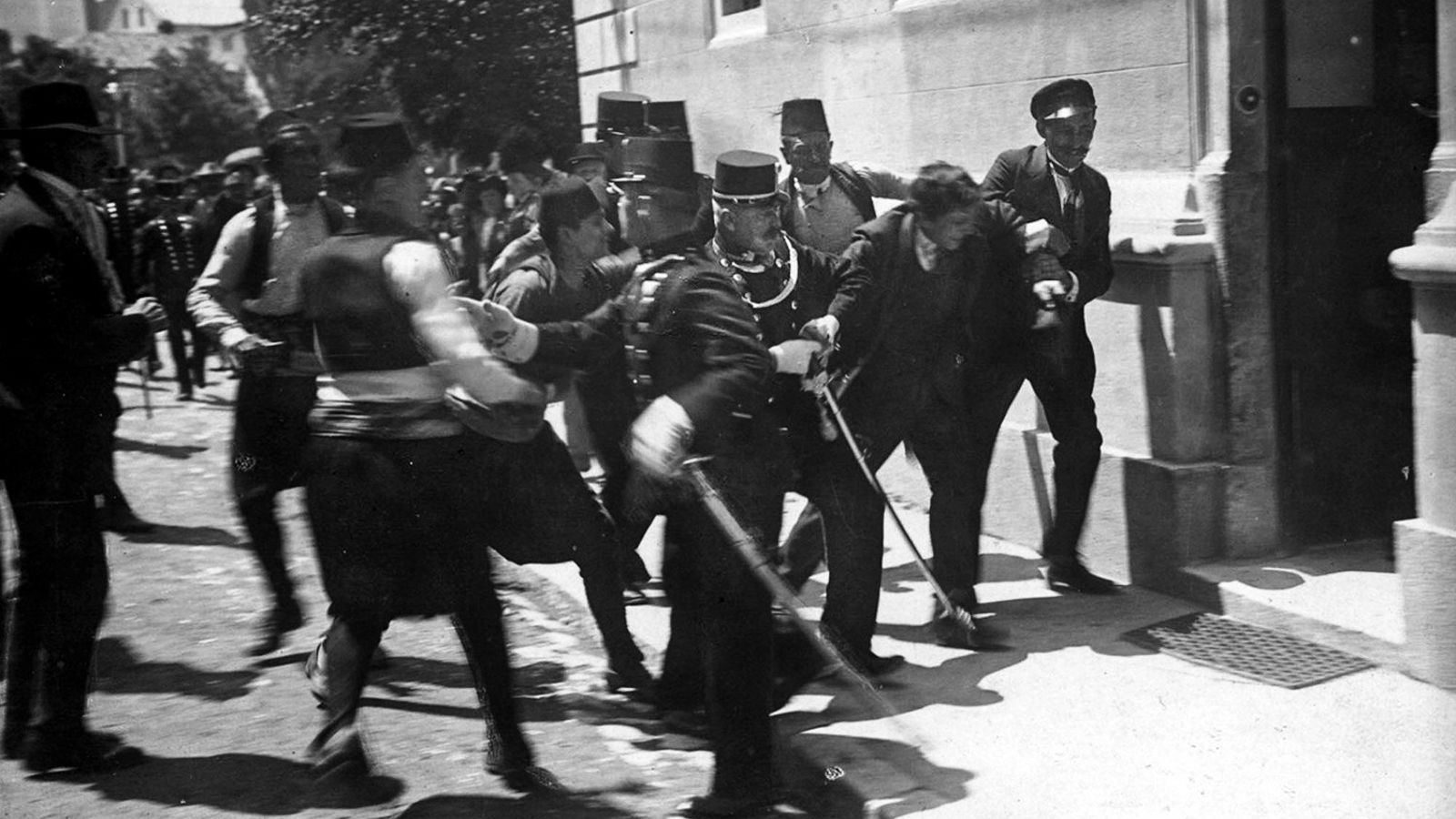
Princip was tackled to the ground before he could turn the gun on himself. He was arrested, beaten, and thrown into prison. He never saw the full consequences of his actions. Austria-Hungary blamed Serbia for the assassination and declared war. Alliances were triggered, and within weeks, the world was at war. Four years later, more than twenty million people were dead. Empires had fallen, entire nations had been reshaped, and the seeds of an even deadlier conflict—World War II—had been sown.
Gavrilo Princip wasted away in prison, dying of tuberculosis before the war he had started even ended. He never saw the trenches, the gas attacks, the millions of lives lost because of two bullets. Most assassins kill a person. Gavrilo Princip killed much of a generation.
Richard Kuklinski – The Mafia’s Most Chilling Hitman
Richard Kuklinski didn’t kill for a cause; he killed because it was his profession. He didn’t care about politics, revenge, or loyalty. He was a contract killer, an enforcer for the Mafia, a man who took life without hesitation and without remorse. Throughout his career, he murdered over a hundred people—maybe more—but the actual number died with him.
Kuklinski was not a man you would have suspected of being a killer. He lived in the suburbs of New Jersey, had a wife, children, and a respectable outward life. He was the picture of a devoted family man. But in the world of organised crime, he was known as The Iceman, a ruthless, emotionless hitman who killed without hesitation.
His criminal career started early. As a teenager, he enjoyed violence, beating and robbing people just to see them suffer. That quickly escalated to murder. By his twenties, he was working as a contract killer for the Gambino crime family, taking jobs that required silence, efficiency, and absolute deniability.
Unlike most hitmen, Kuklinski didn’t have a preferred method. He killed with whatever was available. Guns, knives, cyanide, crossbows—he used them all. But his most infamous technique, the one that gave him his nickname, was freezing his victims’ bodies to disguise the time of death. He would store a corpse in an industrial freezer, then dump it weeks or months later, making it nearly impossible for law enforcement to establish a timeline. It was a trick that worked for years, allowing him to kill undetected.
He was meticulous. He never left witnesses, never made mistakes, never second-guessed his actions. When a job was done, it was done. No emotions. No hesitation. He would return home, kiss his wife, and sit down for dinner with his children as if nothing had happened.
But every killer makes a mistake eventually. In the 1980s, law enforcement began closing in. The FBI set up a sting operation, sending an undercover agent to pose as a hitman looking for work. Kuklinski, growing arrogant, bragged too much. He spoke about his methods, about his cyanide tricks, about the bodies no one would ever find. That was all they needed.
In 1986, Richard Kuklinski was arrested and sentenced to life in prison. He spent the rest of his days behind bars, where he gave chilling interviews, describing his kills in detail, never once showing regret.
The Sicarii – The Ancient Terrorists of Rome
Long before modern assassins, long before political hitmen and secretive brotherhoods, there were the Sicarii. They were more than killers. They were extremists, insurgents, the world’s first known urban terrorists. Operating in 1st century Judea, they waged a brutal campaign of public assassinations against Roman rulers and any Jew they deemed a traitor.
Their name came from their weapon of choice—the sica, a short, curved dagger that could be easily concealed in the folds of a robe. It was the perfect tool for a quick, silent kill. Unlike warriors who fought on the battlefield, the Sicarii struck in broad daylight in crowded streets or at religious festivals. They would slip through markets and temples, find their target, stab them once or twice, and vanish into the masses before anyone realised what had happened.
Their targets were not just Roman officials but also Jewish leaders they saw as collaborators—those who had accepted Roman rule rather than resist. The Sicarii believed that only through violence could Judea be free. And so, they waged a war of fear, cutting down anyone who stood in their way.
Their campaign of terror helped fuel the First Jewish-Roman War in 66 CE, a revolt that would ultimately lead to the destruction of Jerusalem and its sacred Second Temple. But even as Rome crushed the rebellion, the Sicarii refused to surrender. They fled to the desert, making their final stand at the mountain fortress of Masada.
They held off the Roman army for months, surviving in their isolated stronghold. But the Romans were patient. They built siege ramps, slowly tightening the noose. The Sicarii knew what was coming. When the Romans finally broke through, they found only silence. Nearly a thousand men, women, and children lay dead—each killed by their own hands, choosing mass suicide over capture.
The Sicarii were gone, but their legacy remained. They were among the first to weaponise assassination as a form of rebellion, proving that fear itself could be a weapon. In their minds, they were liberators, willing to do whatever it took to resist oppression. But history remembers them differently—as zealots, fanatics, and the earliest example of a movement that would be repeated for centuries: kill in public, spread terror, destabilise the enemy.
Ramón Mercader – Stalin’s Perfect Assassin
Ramón Mercader was a trained Soviet operative, moulded for a single purpose: to eliminate Joseph Stalin’s greatest enemy. And he did it with an ice axe.
By the late 1930s, Stalin had secured absolute control over the Soviet Union, purging anyone who opposed him. But one man still stood against him—Leon Trotsky, the exiled revolutionary once second only to Lenin. Trotsky had been driven from the Soviet Union and forced into hiding, but his words still carried enormous weight. He was still a threat. Stalin wanted him silenced permanently.
The NKVD devised a plan. They needed someone to get close to Trotsky, gain his trust, and strike when he least expected it. They found their man in Ramón Mercader, a loyal communist trained in deception and manipulation. His orders were clear: infiltrate Trotsky’s circle, wait for the right moment, and kill him.
Mercader assumed a false identity, posing as Jacques Mornard, a European intellectual. He seduced Sylvia Ageloff, a woman close to Trotsky, using her to gain access to the revolutionary’s inner circle in Mexico City. For months, he played the role perfectly—charming, patient, unassuming. Trotsky never suspected a thing.
On August 20, 1940, Mercader arrived at Trotsky’s home to show him an article he had written. Trotsky, always willing to engage in debate, welcomed him in. As Trotsky leaned over the desk to read, Mercader pulled out an ice axe—small, heavy, designed for climbing—and drove the pointed blade into the back of Trotsky’s skull.
But Trotsky didn’t die instantly. He let out a cry, struggling, fighting back. Guards burst into the room and beat Mercader nearly to death, but the damage was done. Trotsky was rushed to the hospital, where he succumbed to his wounds the next day. His final words condemned Stalin’s betrayal of the revolution.
Mercader had expected to be rescued by Soviet agents, but Stalin abandoned him. He was convicted of murder and sentenced to twenty years in a Mexican prison. When he was finally released in 1960, he was greeted in Moscow as a hero, awarded the Order of Lenin, and given a pension for his service. He spent the rest of his life under the protection of communist regimes, dying in Cuba in 1978.
Mercader’s act was the final blow in a power struggle that had begun decades earlier, a conflict between two titans of revolution. His ice axe didn’t just end a man’s life—it ended an idea—the last real challenge to Stalin’s rule. And we all know what came next.
History’s Deadliest Assassins
An assassin’s work ends the moment their target falls, but the consequences rarely settle so cleanly. Some act with conviction, certain they are striking a blow for justice or change, only to see their actions lead somewhere unexpected. Others kill for money, power, or orders they don’t question, their role reduced to a task completed and a life erased.
A few live long enough to witness the aftermath of their deeds. Others don’t survive the moment of the kill. Some crave recognition, only to be erased from history. Others slip away unnoticed, their legacies carried only in fearful whispers that are still discussed thousands of years later.
Olivier Guiberteau
Key Takeaways
- Assassins have significantly altered history through targeted killings, often igniting wars and revolutions.
- Julio Santana, a Brazilian hitman, killed over 500 people, making him the most prolific in recorded history.
- The Hashashin, an 11th-century assassin brotherhood, pioneered targeted killings, influencing modern assassination tactics.
- Vasili Blokhin, Stalin’s executioner, personally killed over 7,000 people in the Katyn Massacre.
- Gavrilo Princip’s assassination of Archduke Franz Ferdinand triggered World War I, reshaping global politics.
SideProjects Editors
The SideProjects editorial team researches, fact-checks, and structures explainers about the lesser-known tales, side narratives, and spin-offs behind major historical and contemporary subjects.
Frequently Asked Questions
Who is the most prolific hitman in recorded history?
Julio Santana is the most prolific hitman in recorded history, with over five hundred confirmed kills over a career spanning more than three decades.
What was the Hashashin’s primary method of assassination?
The Hashashin primarily used daggers in close-quarters assassinations, often striking in broad daylight and then accepting their own death immediately after completing their mission.
How did Vasili Blokhin execute his victims during the Katyn Massacre?
Vasili Blokhin personally executed over seven thousand Polish officers and prisoners of war by shooting them in the back of the head with a German Walther pistol in a soundproofed basement over several weeks.
What was the immediate consequence of Gavrilo Princip’s assassination of Archduke Franz Ferdinand?
The assassination of Archduke Franz Ferdinand by Gavrilo Princip led to Austria-Hungary declaring war on Serbia, which triggered a series of alliances and ultimately resulted in World War I.
What was Richard Kuklinski’s signature method of disposing of bodies?
Richard Kuklinski, also known as The Iceman, would freeze his victims’ bodies in an industrial freezer to disguise the time of death, making it difficult for law enforcement to establish a timeline.
What weapon did the Sicarii use for their assassinations?
The Sicarii used a short, curved dagger called a sica, which could be easily concealed in the folds of a robe, allowing them to strike quickly and silently in crowded public places.
How did Ramón Mercader assassinate Leon Trotsky?
Ramón Mercader assassinated Leon Trotsky by striking him in the back of the skull with an ice axe while Trotsky was leaning over a desk to read an article.
What was the ultimate fate of the Sicarii after the First Jewish-Roman War?
After the First Jewish-Roman War, the Sicarii fled to the desert fortress of Masada, where they chose mass suicide over capture when the Roman army finally breached their defenses.
What was Julio Santana’s first human target?
Julio Santana’s first human target was a man his uncle, a corrupt police officer, identified as a traitor. Santana hesitated due to his religious beliefs but ultimately pulled the trigger.
What was the Hashashin’s primary motivation for their assassinations?
The Hashashin were religious fanatics who believed that assassination was a divine tool to remove enemies and reshape the world according to their radical sect of Islam.