
Over the roughly 4 billion years that our planet has existed, its surface has gone through constant change. Through the movements of the tectonic plates, water erosion, volcanic eruptions, and much more, the earth is positively brimming with natural wonders, some of which are so incredible that they’ve captivated mankind’s attention for thousands of years. And scattered among these majestic mountains, deserts, and jungles are some specific natural formations that are so peculiar, you wouldn’t be alone in thinking that they were made not by nature, but by humans. Today we’re going to explore 4 of the world’s natural formations that are so extraordinary, they almost look man-made.
The Richat Structure
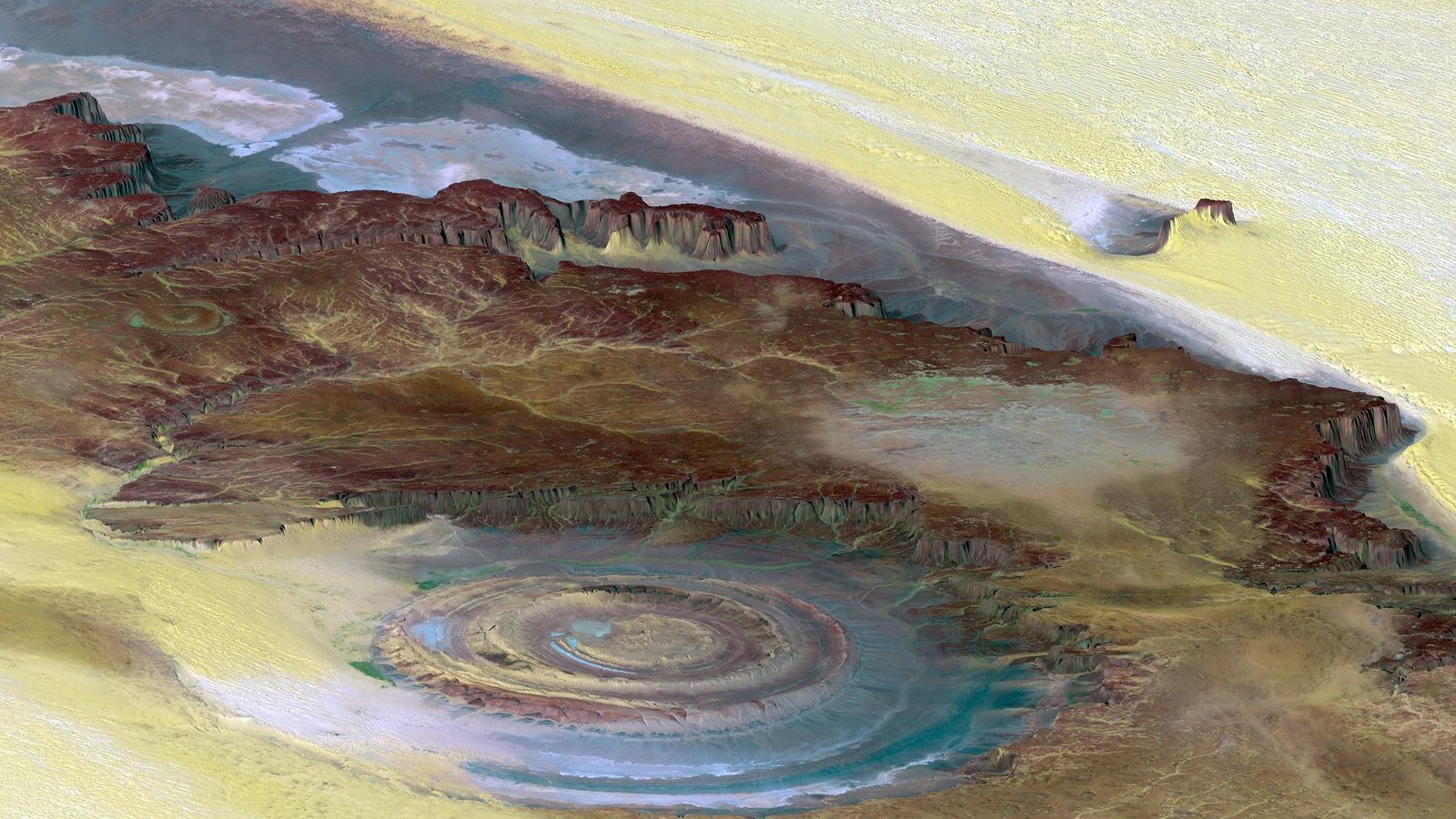
Asteroids, aliens, and Atlantis. All of these are constantly thrown around as an explanation for one of the world’s strangest sights, the Richat Structure, also known as the Eye of the Sahara. It’s easy to see how it got its name, and it’s also easy to see how this giant circular formation in Mauritania is the subject of so many conspiracy theories. Not only are the concentric circles an odd sight on their own, oddly similar to a crashed flying saucer, but the thing is also massive, with a diameter of 40 kilometers, or 25 miles, so big that you can see it very clearly from low-earth orbit.
This circularity is what made scientists first guess that an asteroid impact had created the Richat Structure, but in the 1950s further analysis by geologists found no evidence for an extraterrestrial impact, meaning it was more likely to have been created within the earth itself. Currently, scientists are pretty certain that the Eye of the Sahara is what’s known as a geologic dome. Essentially what happened is the earth’s crust weakened here hundreds of millions of years ago, allowing a dome of molten rock and metal from the earth’s mantle to rise upward.
Key Takeaways
- The Richat Structure, or Eye of the Sahara, is a massive geologic dome formed by molten rock and metal rising from the earth’s mantle.
- Pamukkale in Turkey features white travertine terraces formed by hot springs depositing calcium carbonate over thousands of years.
- The Giant’s Causeway in Northern Ireland consists of over 40,000 basalt columns, primarily hexagonal, formed by cooling lava.
- Devil’s Tower in Wyoming is an igneous butte made of cooled magma, with hexagonal columns similar to those at the Giant’s Causeway.
- Several natural formations, like the Giant’s Causeway and Devil’s Tower, have unique hexagonal columns formed by efficient stress relief during cooling.
Over millions more years, layers of this magma pushed through the crust and cooled, with the most recent cooling finishing up about 100 million years ago. What makes the Richat Structure even more fascinating is the presence of something called breccia, a type of rock that looks like tons of different fragments all cemented together. Here, the pieces of it are so big that they’re called megabreccia, and they’re incredibly rich in silicon dioxide.
A 2011 analysis found that salts within this rock were likely created by low-temperature hydrothermal activity, adding another layer of complexity to the structure’s history.
Not only does it attract the attention of geologists, but also of archaeologists, as the outer rings of the Eye are rich with artifacts from early humans. Neolithic spear points, small axe heads, and more have been found, indicating that many thousands of years ago, people used the quartz outcrops on the Richat Structure to make primitive tools.
Now, a mention of the Eye of the Sahara wouldn’t be complete without mentioning Atlantis, because while most of us think it sure does look a bit man-made, many Atlantean enthusiasts are convinced that it is evidence left behind of the famous lost civilization. Fans of this theory point out supposed coincidences in ancient Egyptian and Greek tales of Atlantis being in this general area, Plato’s description of Atlantis describing it as rings of land and sea, supposed old maps showing its location, and, of course, modern government coverups. We all know it’s a bunch of bullsh*t, but, hey, the more you know.
Pamukkale
Our next location takes us to southwestern Turkey, to a place known as Pamukkale. Pamukkale, which means ‘cotton castle’ in Turkish, is a site covered in snow-white rock, with bright-blue pools scattered throughout, giving it the look of a fancy hotel spa instead of a natural formation. Local tradition says that it was formed when ancient giants left their cotton out to dry, but there’s a much more down-to-earth explanation.
The area has about 17 major hot springs, which range in temperature from 35 degrees Celsius, or 95 degrees Fahrenheit, all the way to boiling. For thousands of years, this mineral water has carried sediments up to the surface, most notably calcium carbonate. Water from the springs drips down the mountainside and slowly deposits this calcium carbonate, which cools and hardens, eventually crystalizing and becoming a type of limestone known as travertine, which formed the iconic white terraces. The waters here have been the subject of myth for thousands of years, supposedly having healing properties capable of curing various ailments like arthritis.
And right next to Pamukkale is a city, founded sometime in the 7th century BC by the Phrygian people. This city would later be known as Hierapolis, and would be a religious and cultural center for many generations, housing the tombs of great figures such as Philip the Apostle. Hierapolis also features an interesting cave that is filled with suffocating carbon dioxide, a byproduct of geothermal reactions below the rocks.
Anything left in this cave is met with certain death, so ancient inhabitants of the region believed it to be the gateway to the underworld. For a good chunk of history there were nearby merchants selling small birds, which you could throw in the cave to test its powers if your curiosity got the best of you.
In 1988, both the city Hierapolis and the limestone terraces of Pamukkale were added as a UNESCO World Heritage Site, and the city is a popular tourist attraction to this day. If you can’t make it to Turkey, there are several similar sites around the world, such as the massive Huanglong pools in China, or the colorful Badab Soort in Iran, which features red limestone due to the presence of iron.
Giant’s Causeway
If you were one of the first humans to lay eyes on what is today known as the Giant’s Causeway, you probably would have assumed that someone had been hard at work there with a hammer and chisel for many years. That’s because this stretch of coastline in Northern Ireland has some of the strangest rock formations on earth, more than 40,000 basalt columns, most of which have a peculiar hexagonal shape.
Local legend says that the columns were built by a giant, Fionn mac Cumhaill, also called Finn McCool, who was challenged to fight the Scottish giant Benandonner. He accepted the challenge, and built the causeway across the northern channel so he could meet his foe. However, when he realizes that his Scottish opponent is much bigger than anticipated, Finn runs, and his wife disguises him as a baby.
When the Scottish giant sees the size of this “baby”, he assumes that its dad must be even larger, and runs for his life. As he runs back across the Northern Channel, he destroyed the causeway to prevent anyone from chasing him, and now the only remnants are left on the coast of Northern Ireland and a small section on the coast of Scotland, called Fingal’s Cave.
But how did these pillars actually form? Well, for a while it was actually a bit of a mystery. Scientists knew that it was a result of lava cracking as it cooled, but details were a bit lacking.
In 2015, scientists from the Dresden University of Technology made a bit of a breakthrough, finding that as lava cooled, the surface contracts more quickly than the lava underneath, and this stress from the shrinking is released by the formation of cracks, no surprises there. What they found, however, was that in the first phase of cooling, cracks intersecting each other at 90 degree angles were the most efficient way to release this energy, and, as the cooling continues, this ideal angle approaches 120 degrees, the same interior angles found in regular hexagons. Basically, these hexagonal cracks just turn out to be the most efficient way to relieve the pressure caused from the cooling.
However, this is only true at a certain temperatures, which was found by researchers at the University of Liverpool to be around 850 degrees Celsius, after they experimented with lava samples from the Eyjafjallajökull volcano in Iceland.
If you book a trip to the Giant’s Causeway, you’ll have the chance to not only see but also walk on top of thousands of these basalt columns, some of which are 12 meters tall, or 39 feet. And not all of the columns actually ended up with the hexagonal shape, some of them have less sides, just 4 or 5, and some even have more, with as many as 8. There’s also unique features such as the tall Chimney Stacks and the strange Giant’s Boot.
Watch the Video
Open Video
Video Briefing
Incredible Natural Formations that Look Artificial
Other famous examples of these spectacular hexagonal columns can be found around the world, such as in the Basaltic Prisms of Santa María Regla in Mexico, Svartifoss in Iceland, or Hexagon Pool in Israel.
Devil’s Tower
For our last entry, we’re heading to the least populated state in the US, Wyoming. Wyoming has no shortage of natural wonders, like Yellowstone national park or the Grand Tetons, but there’s one in particular that fits this list quite well, and that’s Devil’s Tower.
Devil’s Tower is a massive, igneous butte that protrudes straight up out of the ground, seemingly in the middle of nowhere. From the base to the top, it has a height of 265 meters, or 867 feet, making it stand out like a sore thumb from the surrounding prairies and smaller hills. Native Americans have revered the site as sacred for hundreds or even thousands of years, and various native names for the tower include Bear’s Lodge, Tree Rock, and Brown Buffalo Horn.
According to the Kiowa and Lakota peoples, the tower was created when the Great Spirit lifted up a rock to save two young girls from a bear. In the Sioux version, the bear is massive, and claws the side of the rock, giving it the lines you see today.
Geologists, however, tell a different story. The current consensus is that the obelisk is formed of cooled magma that was lifted up through the surface of the earth around 50 to 60 million years ago, the same time that the Rocky Mountains were uplifted. But other than this, not much is certain, and isn’t known if the rock cooled while it was still below the surface or after it had risen above it.
Many of the columns along the side of the tower will look familiar, often hexagonal shaped, just like the pillars at the Giant’s Causeway. These formed in a similar way, but the rock they’re made of is actually quite uncommon, known as phonolite porphyry if you’re curious, and much of it has reddened over the years due to oxidation of the iron content in the stone. These pillars are constantly breaking off and falling, and judging by the amount of scattered rock at the base of Devil’s Tower, we can assume that it was once wider than it is today.
Perhaps the craziest thing about Devil’s Tower is the fact that thousands of people climb it every year. This was originally done using wooden pegs that were hammered into the rock face, but more sophisticated equipment has been set up since, though the daring visitors still prefer to free climb it. There is a bit of controversy surrounding the climb, as we stated before that the site is sacred to several tribes in the area and they don’t appreciate people climbing on it, but a compromise was made and now the park requests that people don’t scale the tower in June. This is the month when the tribes perform their ceremonies in the area, and the majority of people respect this request, which is nice to hear.
What we definitely don’t recommend is the attempt by an absolute mad lad named George Hawkins to parachute onto the tower in 1941. George wanted to prove that parachutists could land on a relatively small target, which he did prove when he landed on top of the tower without issue, but his second parachute, dropped out of the plane behind him and carrying his ropes and anchors, didn’t land on the mark, and slid off the top before he could save them. Without his ropes, George had no way to descend the tower, and was stuck on the very top.
While the National Park service brainstormed ways to save him, they dropped him food and water from an airplane, but he still had to deal with the rain, cold, and wind for six whole days. Eventually, Jack Durrance arrived, a man who had scaled the tower just a few years earlier. Durrance made his way to the top and helped George descend.
By the end of the ordeal, George was surprisingly in great spirits. When the United States entered World War 2 a few months later, his experience proved to be useful when he trained new airborne infantry divisions on how to safely use a parachute.
Key Takeaways
- The Richat Structure, or Eye of the Sahara, is a massive geologic dome formed by molten rock and metal rising from the earth’s mantle.
- Pamukkale in Turkey features white travertine terraces formed by hot springs depositing calcium carbonate over thousands of years.
- The Giant’s Causeway in Northern Ireland consists of over 40,000 basalt columns, primarily hexagonal, formed by cooling lava.
- Devil’s Tower in Wyoming is an igneous butte made of cooled magma, with hexagonal columns similar to those at the Giant’s Causeway.
- Several natural formations, like the Giant’s Causeway and Devil’s Tower, have unique hexagonal columns formed by efficient stress relief during cooling.
SideProjects Editors
The SideProjects editorial team researches, fact-checks, and structures explainers about the lesser-known tales, side narratives, and spin-offs behind major historical and contemporary subjects.
Frequently Asked Questions
What is the Richat Structure?
The Richat Structure, also known as the Eye of the Sahara, is a giant circular formation in Mauritania with concentric circles, making it look like a man-made structure or a crashed flying saucer. It has a diameter of 40 kilometers and is visible from low-earth orbit.
How was the Richat Structure formed?
The Richat Structure is a geologic dome formed when the earth’s crust weakened, allowing a dome of molten rock and metal from the earth’s mantle to rise upward. Over millions of years, layers of magma pushed through the crust and cooled, with the most recent cooling finishing up about 100 million years ago.
What is Pamukkale and how was it formed?
Pamukkale, meaning ‘cotton castle’ in Turkish, is a site covered in snow-white rock with bright-blue pools. It was formed by hot springs carrying sediments, notably calcium carbonate, which deposited and crystalized into travertine, creating the iconic white terraces.
What is the Giant’s Causeway?
The Giant’s Causeway is a stretch of coastline in Northern Ireland featuring over 40,000 basalt columns, most of which have a hexagonal shape. These columns were formed by lava cooling and cracking in a way that released stress efficiently.
How were the basalt columns at the Giant’s Causeway formed?
The basalt columns at the Giant’s Causeway were formed as lava cooled and contracted, releasing stress through the formation of cracks. The most efficient angle for these cracks to intersect is 120 degrees, which is the interior angle of a regular hexagon.
What is Devil’s Tower and how was it formed?
Devil’s Tower is a massive igneous butte in Wyoming that protrudes straight up from the ground. It was formed by cooled magma that was lifted up through the surface of the earth around 50 to 60 million years ago, during the same time the Rocky Mountains were uplifted.
Why is Devil’s Tower considered sacred by Native Americans?
Devil’s Tower is considered sacred by Native Americans, who have revered the site for hundreds or even thousands of years. Various native names for the tower include Bear’s Lodge, Tree Rock, and Brown Buffalo Horn. According to the Kiowa and Lakota peoples, the tower was created when the Great Spirit lifted up a rock to save two young girls from a bear.
What is the controversy surrounding climbing Devil’s Tower?
The controversy surrounding climbing Devil’s Tower arises from the fact that the site is sacred to several tribes in the area, who do not appreciate people climbing on it. A compromise was made, and the park requests that people do not scale the tower in June, the month when the tribes perform their ceremonies in the area.
What is the legend behind the Giant’s Causeway?
Local legend says that the columns at the Giant’s Causeway were built by a giant, Fionn mac Cumhaill (Finn McCool), who was challenged to fight the Scottish giant Benandonner. Finn built the causeway to meet his foe but ran when he saw Benandonner’s size, and his wife disguised him as a baby. Benandonner, seeing the size of the ‘baby,’ assumed its father must be larger and ran away, destroying the causeway.