
The Bible is packed with fantastical stories and supernatural showstoppers. From angels and giants to fish multiplication and ladies turning to salt—it’s truly wild. As a result, scholars and historians have been trying to decode this enigmatic work for centuries—to distinguish between fact and fiction.
While opinions have flipped back and forth over the years, the general consensus as of late seems to be that it’s probably a bit of both: Historical records mixed with memories, infused with a healthy dose of divine intervention. But what about the places where all of this allegedly went down? Not heaven or the depths of hell, but the real physical locations in which these events are supposed to have happened.
Where are they? Fortunately, there are a number of scholars and archeologists who have dedicated their lives to answering this very question. Thanks to them, many Biblical cities once thought lost have already been rediscovered, further fueling the ongoing race to uncover the rest.
Key Takeaways
- The Bible is a mix of historical records, memories, and divine intervention.
- Scholars and archaeologists have rediscovered many Biblical cities, fueling ongoing searches.
- Akkad, the capital of the Akkadian Empire, is believed to be near the Tigris and Euphrates rivers.
- Bethsaida’s location is debated, with two sites, El-Araj and Et-Tell, both claiming evidence.
- The search for Ziklag is contentious, with multiple sites proposed and debated among experts.
Akkad
Our first lost city once lay at the heart of the great and enormously influential Akkadian empire. Stretching from modern-day Iraq to the Mediterranean, the empire’s culture, trade, politics, and language would shape society for centuries to come. But before that came the city of Akkad itself—the elusive base and birthplace of this once majestic empire.
The earliest known record of Akkad comes from the Old Testament. Here, it is said that the city belonged to Nimrod, a descendant of Noah—the one with the ark. Not a huge amount is known about Nimrod; he was said to be a mighty man and hunter, but more importantly, he is traditionally credited with the founding of this early version of Akkad.
Unfortunately, the Bible gives little away in regards to Akkad’s location, but it does note its close proximity to other biblical cities that have been found—cities like Babel and Erech, which are located in what was Southern Mesopotamia and what is now Southern Iraq. That’s all quite vague though, and the Bible can be a bit loose with the truth sometimes, so what other evidence have we got?
Well, quite a lot, actually. The development of the city has been fairly well documented through a combination of archaeological discoveries and historical records. We know that the first cities in southern Mesopotamia were established between approximately 4100 and 2900 BC, so most scholars agree that this is also when Akkad was founded.
A people known as the Akkadains would inhabit the city, developing their own culture and language over time, while the surrounding regions would remain under the control of the Sumarians. This was a rival population that controlled much of southern Mesopotamia prior to the Akkadian Empire. But the Sumarians ruled through independently governed city states that were often in conflict with the early Akkadians as well as each other.
That’s until around 2300 BC, when the aptly titled fellow Sargon the Great, otherwise known as Sargon of Akkad, entered the scene. Part man, part myth, some believe that Sargon and the aforementioned Nimrod were in fact the same person—a legendary founding father-type figure. Though this is a highly disputed claim.
The story of Sargon shares many similarities with that of Moses, and according to ancient texts, Sargon was popped in a tar-covered basket as a baby and floated down a river into the King’s household. As Sargon grew up, he would go on to form a close relationship with the king before eventually overthrowing him. After a very long, convoluted, and semi-magical chain of events, Sargon took control of the king’s land as well as the surrounding Sumarian city states. This meant that for the first time, the Sumarians and the Akkadians were united under one rule, something that would prove extremely prosperous for all parties involved.
With peace in the region, the empire quickly expanded, developing sophisticated administrative, political, and legal systems, many of which are still in use in some form today. New diplomatic relations and trade routes were established, as well as a powerful military that would go on to conquer much of Mesopotamia and beyond. With stability and wealth on its side, the city of Akkad would thrive, becoming a hub of art, culture, literature, and invention. The Akkadian language would spread across the Near East, becoming the lingua franca, or common tongue, and for a good few centuries this is how things would remain.
But nothing good lasts forever, and by around 2100 BC, the empire appears to have collapsed. No one knows exactly why, but it’s generally agreed that it was likely a combination of factors. The Sumarian city-states previously united under Sargon would start to break away. While rival groups invaded Akkadian territories, with these conflicts disrupting trade routes and draining resources.
Then, to top it all off, a massive drought would sweep the region, destroying the agricultural industry and causing widespread famine, which would have likely decimated the population. As a result of all of this Akkad, the city at the heart of this once great empire would be abandoned, and eventually its location lost to time.
So, what are the chances of us actually unearthing this long-lost site? Given its cultural and historical significance, a number of ancient texts and inscriptions not only reference Akkad but also give us some indication as to where it was. The problem with many ancient accounts, however, is that they tend to describe locations in relation to other locations or landmarks that either no longer exist or have also been lost.
In the case of Akkad, most sources place it around the point where the Tigris and Euphrates rivers merge. So mystery solved, right? How can you possibly miss the confluence of the region’s largest rivers? Unfortunately for archeologists, rivers have an annoying tendency of not staying in the same place for thousands of years.
Due to both natural and human-driven change, they can grow, recede, and change course considerably in just a few decades. So over 4000 years later, it’s not quite as easy to pin down as you might think. Regardless, many scientists and scholars have proposed a number of sites, with various suggestions continuing to pop up to this day.
The most widely accepted theory places the city along the western bank of the Tigris River, just north of Babylon in present-day Baghdad. This location is favoured for several reasons, including its strategic position along the Tigris, which would have allowed easy access to both the northern and southern reaches of the empire. Additionally, it’s close to other major Akkadian cities like Babylon and Kish, as described in a number of sources.
Early archeological surveys of the area managed to uncover some evidence of Akkadian occupation, causing great excitement in the archaeological community. Unfortunately, many of the likely sites in the area lie only a few tens of kilometres away from modern-day Baghdad, an area that has since been developed heavily. It’s thought that this once great city has been covered by roads, streets, homes, and workplaces; understandably, few locals are keen on having their neighbourhood dug up because we might have found Akkad. Throwing a bit of a spanner in the works when it comes to excavations.
All is not lost, though. There are various schemes, charities, and projects that are working towards both the excavation and preservation of these sites. In addition to this, advances in non-invasive archaeological techniques provide hope for future archeologists who might want to pick up the torch.
Other theories of Akkad’s location do exist, and no one has yet been able to say with certainty exactly where it once stood. But what we can say is that given the city’s supposed size and status, and relatively well documented history, it’s completely possible that we will eventually find Akkad. As to when that will be, that’s anyone’s guess.
Bethsaida
Next, we have the biblical fishing village turned opulent Roman city of Bethsaida. First mentioned in the Bible as the home of apostles Peter, Andrew, and Phillip, the city is later cited as the place where Jesus restored a blind man’s sight and fed the 5,000. So, given these rather miraculous claims, how can we be certain that Bethsaida truly existed?
Well, there are a few ways historians and scholars have approached this question. The first is etymologically—that is, through the study of the origins and meanings of words. Much like there was definitely a man, nay many men, called Jesus living in 1st century Israel, it’s likely that there was at least one city or region called Bethsaida in existence around this time. This can be attributed to 1st century Greco-Roman naming conventions, whereby areas were often named after their primary industry.
Take Bethlehem, for example. In Hebrew, “Beth” translates to “house,” while “Lehem” means “bread,” so the name Bethlehem literally translates to “House of Bread.” This makes sense given that ancient texts as well as archaeological discoveries suggest Bethlehem was a prosperous farming region.
Further to this, as the traditional birthplace of Jesus, who seemed to have a special affinity for bread, the name then came to represent ‘the house of bread’ in a more symbolic manner. Similarly, Bethsaida translates to ‘house of fishing,’ which again makes sense as it’s generally agreed that the city was in close proximity to the sea of Galilee—we just don’t know exactly where. Then, having allegedly been where Jesus found his fishermen, turned disciples, the area later became associated with spiritual fish.
Lucky for us, there are also a variety of extra biblical sources that not only verify Bethsaida’s existence but also give us some clue as to where it might be. The earliest historical record of the city comes from Jewish historian Josephus, who lived between around 38 and 100 CE. According to Josephus, in approximately 30 CE, Bethsaida, which had been a small Jewish fishing village, was renamed Julias and rebuilt as a much bigger Roman city.
He also gives us an idea as to where the city was, but again, only in relation to other areas and landmarks. For example, when detailing the course of the river Jordan, Josephus notes that after passing Lake Semechonitis, the river runs for “another hundred and twenty furlongs” before reaching the city of Julias—Bethsaida 2.0. As mentioned, because of the way landscapes evolve over time, it is hard to say exactly where 120 furlongs from Lake Semicontis would be today.
Not to mention the furlong having long fallen out of fashion.
And unfortunately, things only get murkier from there. Bethsaida virtually disappears from historical records for about 200 years until the 4th century AD, when Christian historian and theologian Eusebius published The Onomasticon. This was a sort of geographical dictionary that aimed to identify and describe Biblical locations. In his work, Eusebius supports the idea that Bethsaida was the birthplace of St. Peter, basing this conclusion on a combination of Christian tradition, oral history, and early geographical knowledge. By the sixth century AD, a church had appeared in Bethsaida, which was purportedly built atop the remains of St. Peter’s house, and, for the next few centuries, this would be a site of pilgrimage. It attracted Christians and explorers from all over the world, some of whom documented their journeys—this is how we know about the church. But, by the late 8th century, these accounts seemed to dry up. Abandoned or destroyed, the church fell into obscurity, and its location along with that of Bethsaida itself became lost to us once more.
Or so we thought! In 2016, a surprising discovery was made in El-Araj, a site that lies on the northeastern shore of the Sea of Galilee. Over seven seasons, archaeologists uncovered what they believe to be this very church. The Byzantine-era structure, thought to have been built in the 6th century, features a host of inscriptions and artefacts that honour St.
Peter. The remaining art and architecture suggest that the church was once a grand, sizable, and spiritually significant site. And as the only church of this scale discovered in the area, many believe that this is in fact THE church and thereby Bethsaida.
But the problem with this assertion is that it relies on two tenuous assumptions: first, that Bethsaida was indeed the birthplace of St. Peter, and second, that the Byzantines who built the church several centuries later got the correct place. Without further evidence, neither of these ideas can be confirmed with any degree of certainty.
This being said, the church is not all El-Araj has to offer by way of evidence. Buried beneath the layers of Byzantine occupation was a 1st century Jewish fishing village, which is exactly what one would expect to find in Biblical Bethsaida. Unfortunately, given the history of occupation in the area, this is not terribly uncommon.
Long before excavations at El-Araj had even begun, there was another site that many believed to be Bethsaida. known as Et-Tell, it’s also home to a 1st century Jewish fishing village buried beneath Byzantine-era artefacts and architecture. Additionally, it contains the remains of a Roman temple dedicated to Julia, the city’s former namesake.
With the two sites only 2 km apart, both fit the vague historical descriptions of Bethsaida’s location. Given the supporting evidence for each, some scholars suggest that both sites may have been part of Bethsaida at different points in time, while others vehemently disagree, arguing for one, the other, or even neither.
Watch the Video
Open Video
Video Briefing
Lost Biblical Cities: Which Ones Might We Find?
As of 2024, excavations are ongoing, with new evidence and discoveries emerging on a fairly regular basis. This means there’s a strong possibility that one or both locations could eventually yield the findings needed to resolve this decades-long debate.
Ziklag
If you were to perform a quick Google search on our next entry, chances are you’d be met with a host of headlines reading something like “Archeologists find lost city of Ziklag” or “Biblical Ziklag discovered.” You may even come across a few Ziklag walking tours. But, once you start actually delving into these pieces, the narrative seems to change a bit.
It’s not quite “Ziklag has been found,” but rather “This specific team of archeologists think Ziklag might have found.” - Not quite as snappy, I know, but much more truthful. The second issue is that the next article you read will say something very similar to the last, but it will be in reference to a completely different archaeological team excavating a completely different site—one that they also think might be Ziklag. In fact, as of 2024, more than a dozen locations have been proposed as this city, each backed by its own unique set of evidence.
But, to understand exactly why this, we first need to know what it is they’re all looking for.
Naturally, we begin with the Bible. Here, Ziklag is mentioned around fifteen times, most notably in relation to King David. A highly contentious semi-historical figure, this is the same David that slayed Goliath and would go on to unite the tribes of Israel. He was also a keen harpist and had a beautiful singing voice. Apparently.
According to the Old Testament, David, once a military commander under King Saul, found himself on the run after Saul grew jealous of his growing success. Consumed with envy, Saul launched a manhunt of mass proportions, forcing David to flee to the Philistine-controlled city of Ziklag. The Philistines, who were actually at war with the Israelites, allowed David to use Ziklag as a base in their now mutual struggle against Saul.
But, while David and his men were occupied with this conflict, another threat emerged—this time from the Amalekites, an additional rival group at war with both the Philistines and the Israelites. When David returned to Ziklag, the women and children had been taken, and the city had been burned to the ground. Fortunately, he was able to retrieve his lost people before rebuilding the city, where he continued to live until Saul’s death just a few months later.
With Saul gone, David became the new king of a united Israel, and Ziklag remained under his control before mentions of the city more or less cease.
So, was it real? If so, where is it? And what happened to it? Unlike Akkad and Bethsaida, almost all direct references to Ziklag come from the Bible, making these questions infinitely harder to answer. With little in the way of extra biblical evidence, many have questioned if Ziklag ever existed at all, arguing that it was merely a symbol of safety and refuge as opposed to a physical place.
But some archaeologists argue otherwise, pointing to the broader historical context of the area and how this seems to align with Ziklag’s story. For example, we know the Israelites, Philistines, and Amalekites coexisted in the same geographical region. Their close proximity, combined with their differing beliefs, makes it likely they engaged in some kind of warfare at some point—a theory that is supported by evidence from other archaeological sites.
Then there’s David. Still the subject of speculation, most scholars and historians do believe that David was a real person. Like many biblical figures, his story was expanded over time, embellished with religious symbolism and divine power.
But it is thought to be based on truth—the truth being that there was probably a man called David who existed around 1000 BC and rose to power as some kind of Israelite ruler. Exactly how much power he held is still a bit of a mystery, but we know that a number of cities were either built or developed during his reign or in his honour—these being what we now know as Davidic cities. All of this is to say that the broad strokes of the biblical story do seem to fit quite well within the wider historical context.
And so, for nearly 150 years now, a handful of historians, scholars, and archeologists have been searching tirelessly for the remains of this specific city.
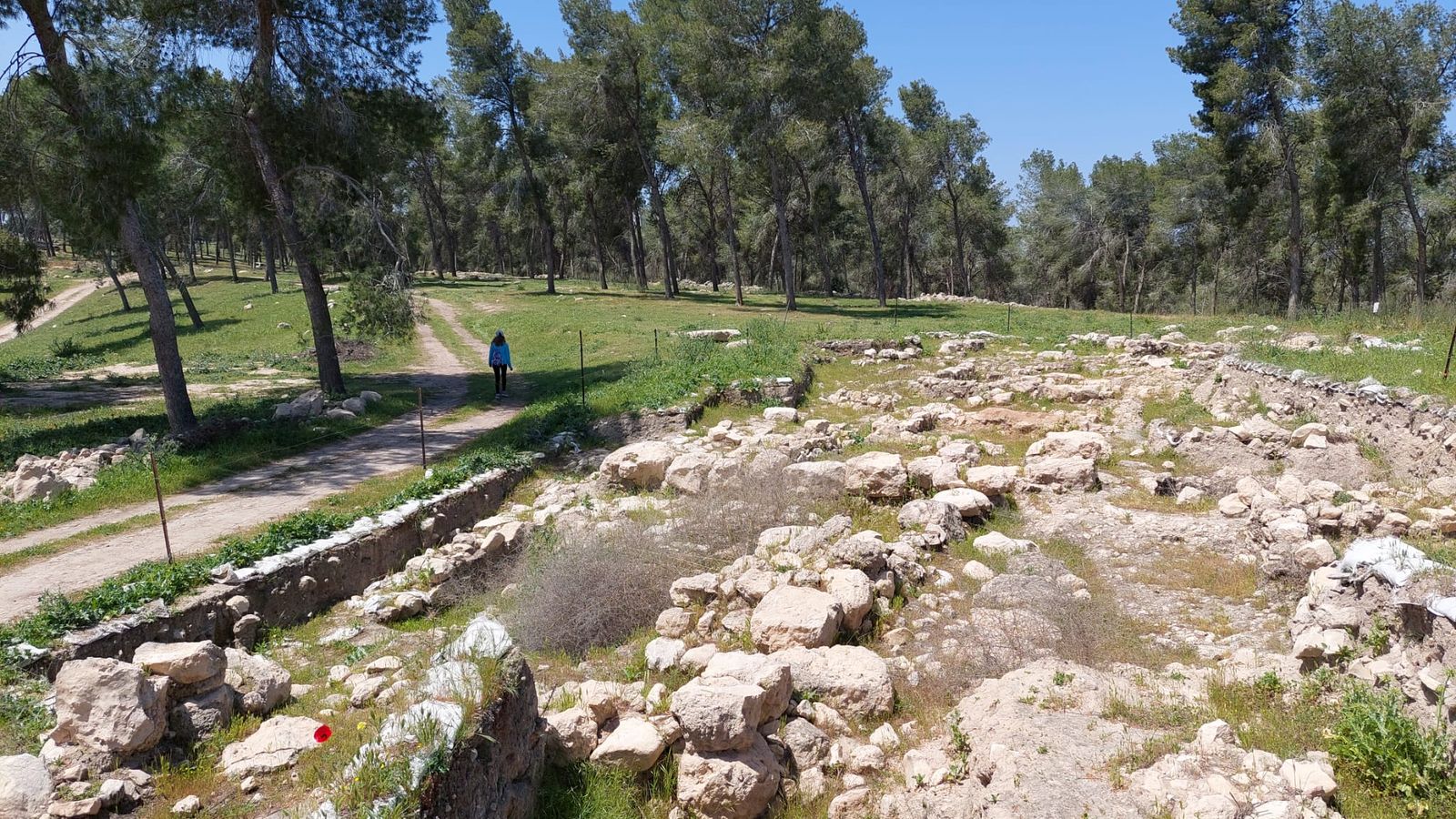
Then, in 2019, professor and archeologist Yosef Garfinkle made international headlines when he claimed to have discovered Ziklag basically by accident. While excavating a site in south-central Israel, Garfinkle unexpectedly uncovered the remains of an early 10th-century Judean settlement. This is around the time when David is thought to have been king and contains similar artefacts to the ones found in other Davidic cities.
Underneath this, however, were the remains of an 11th-century Phillistine settlement as well as signs of a relatively smooth transition between the two periods of occupation. And the cherry on top? A destruction layer—signs of a fire that damaged much of the city’s infrastructure, a lot like the one described in the Amalekite attack.
These findings have prompted Garfinkle to come forward very publicly with claims of having found the lost city. This is where the majority of those “Ziklag found” headlines come from and has led to many locals adopting the site as Biblical Ziklag.
But this assertion has sparked fierce debate amongst the archaeological community, and we mean fierce. Aren Maeir, another leading biblical archeologist, pulled no punches whatsoever when he essentially called Garfinkel’s theory complete rubbish, stating,
“There is simply no basis for this. I don’t know how he got to it.”
Fellow archeologist Israel Finkletstein even went so far as to say, “When I sit in a conference abroad and [Garfinkle] goes onstage and says primitive things, I want to die from embarrassment.”
So, safe to say, they think Garfinkles is wrong.
And to be fair, there are a number of reasons for this. The first is location, with many arguing that Ziklag should lie further south. Chronology also presents a challenge, as some argue that the site should have shown signs of longer and slightly different periods of occupation. There are also numerous other sites that contain similar evidence. So why does this particular theory, despite its many holes and competing alternatives, continue to draw so much attention?
Well, it’s partly because, unlike many older discoveries, this one had mass media and the internet on its side, helping to push the story beyond the realms of Biblical archeology and into the wider world. Garfinkel’s findings were also presented to the public in a way that was easier to understand than a lot of other archaeological projects. The three distinct layers consisting of Philistine and Jewish settlements as well as the destruction layer depict a simple and linear narrative that, at first glance, seems to fit perfectly with the Biblical story.
In addition to this, Garfinkle emphasises the importance of this site as a Davidic city. This is significant as David is still a hugely controversial historical figure, so when evidence of his influence is found, it tends to be quite a big deal. All of this has culminated in a somewhat sensationalised story that has managed to seep into the public consciousness.
But the thing is, we can’t really disprove it. It’s not uncommon for two archeologists to reach completely different conclusions based on the exact same evidence. Excavations rarely provide a complete picture of anything really, forcing archeologists to fill in the gaps based on a wide range of factors that will differ between teams and sites.
Lots of things are down to interpretation. What one person thinks is an 11th-century Philistine pot, another may think is a 10th-century Judean pot. Archeologists will draw from their own personal knowledge and experience as well as that of historians, geologists, environmental scientists, anthropologists, and even geophysicists.
This combination of voices and to what extent they’re listened to will impact the way evidence is interpreted. A similar idea also applies to the methodologies used. While one team might prioritise radiocarbon dating, another may focus on the style of artefacts or changes in the soil.
And even then, the results are never exact.
All of this makes it easy for those who want to believe that Garfinkle’s site is Ziklag to do exactly this. But whether it is in fact the lost city is still very much a mystery. And until we dig up a giant sign that says “welcome to Ziklag,” it will most likely remain that way.
Sodom
Often paired with its sister settlement, Gomorrah, Sodom has long been associated with sin and wickedness, destroyed by God’s wrath in a rain of fire and brimstone. But religious retribution aside, was it a real place? Unfortunately, there is no general consensus on this. Many scholars and historians argue that Sodom was purely symbolic, while others believe that it was a real city, destroyed by some kind of cataclysmic event.
In order to understand both viewpoints, we must first look to the Bible. And as biblical stories go, it’s a wild one.
So, according to the book of Genesis, Sodom was a city filled with sex fiends, sinners, and reprobates—all except holy man Abraham and his nephew Lot. Rather unhappy about the state of things, God thought it best to destroy the city, but not before warning these righteous few. When Lot and Abraham heard of their city’s impending doom, they attempted to bargain with God, eventually agreeing that if they could find ten good people in the whole of Sodom, the city would be spared.
In order to suss out these ten, two beautiful man angels were sent to Sodom. Taken in by Lot and his family, they were treated with the utmost respect, but before long, a mob of angry, horned-up men arrived, demanding that the angels be brought out so they can “know them.” Which is traditionally interpreted as “to have sex with them.”
Seeing this as very rude, Lot said no. But still desperate to save his city, he offered up his two daughters so the men might “know them” instead. Lucky for the Lot’s daughters, these particular men just weren’t interested, and so knowing the city was doomed, the family fled as Sodom fell behind them, engulfed in a rain of fire and brimstone… Then Lot’s wife turned around to have a look at this epic scene, so God turned her into salt.
For some reason.
As charming as this story is, it contains very little in the way of hard evidence or facts. But it does give us some useful clues as to the potential fate and even whereabouts of the city. Before its destruction, the Bible describes Sodom as a lush, fertile land, likely making it a prominent agricultural and urban centre in the region.
This, along with scattered references throughout the biblical narrative, has led some archaeologists to propose that Sodom was a significant city with notable cultural influence. The Biblical accounts also hint at its location, identifying it as one of the five “cities of the plain,” which most scholars interpret as the plains near the Jordan River.
The next clue we have comes from that infamous and all-encompassing “fire and brimstone.” Whilst fire is fairly self-explanatory, brimstone is widely accepted to be synonymous with sulphur—that chemical element you think smells of eggs. And while sulphur is found all over the world, it’s usually at its most noticeable in exploding volcano form. This has led many to believe that Sodom was destroyed by a volcanic eruption, which would make sense.
Championing this theory is Professor Vladimir Trifninov, a Doctor of Geology and Mineralogy. In a 2007 paper, Trifninov argues that two settlements in southern Syria, destroyed by a volcanic eruption, may correspond to the biblical cities of Sodom and Gomorrah. These sites, dating back to the third millennium BC, revealed a layer of buildings, tools, artefacts, and waste—evidence of established settlements—followed by layers of hardened basalt rock, which forms when basalt lava cools.
Trifninov proposes that the biblical story of Sodom and Gomorrah’s destruction is rooted in the memory of the eruption that claimed these two settlements. However, this would place the cities in southern Syria, which isn’t where you’d expect to be. To reconcile this, Trifninov suggests that over time, the memory of this eruption became conflated with another disaster—such as an earthquake or flood—closer to the right region.
There is, however, another alternative theory that’s been gaining quite a lot of attention in recent years, even making headlines on occasion. Not a volcano or an earthquake or a flood, but something completely different and arguably even more terrifying. In 2005, archaeologists began excavating Tall el-Hammam in Jordan. There, they found the remains of a city dating back to the 2nd millennium BC, which they claim to be Biblical Sodom.
Features like defensive walls, gates, and a complex urban layout are consistent with the idea of Sodom being a major city in the region. It’s also roughly where one would expect Sodom to be. What makes this site truly remarkable, though, is the five-foot layer of ash and debris it was buried under. Initially, this might seem like the aftermath of a volcanic eruption, but further evidence would suggest otherwise.
Amidst the destruction, researchers found diamanoids. These are the microscopic components of diamonds that usually take millions of years to form under the earth. Yet, at this site, it happened instantly.
In a fraction of a second, materials like wood and plants were put under so much heat and pressure that they literally turned to diamond—something volcanoes are simply not capable of doing. This has led researchers to suggest that the city was actually destroyed by a cosmic airburst. The theory goes that an incoming meteor exploded midair, causing a burst of energy 1,000 times more powerful than that of the Hiroshima atomic bomb.
Chemical analyses suggest that temperatures reached an excess of 2000 °C, vaporising almost everything in the area. So, safe to say this city was absolutely obliterated; no one’s arguing against that, but is it the city we’re looking for? Well, sorry to disappoint, but as is almost always the case, we don’t really know.
Key Takeaways
- The Bible is a mix of historical records, memories, and divine intervention.
- Scholars and archaeologists have rediscovered many Biblical cities, fueling ongoing searches.
- Akkad, the capital of the Akkadian Empire, is believed to be near the Tigris and Euphrates rivers.
- Bethsaida’s location is debated, with two sites, El-Araj and Et-Tell, both claiming evidence.
- The search for Ziklag is contentious, with multiple sites proposed and debated among experts.
SideProjects Editors
The SideProjects editorial team researches, fact-checks, and structures explainers about the lesser-known tales, side narratives, and spin-offs behind major historical and contemporary subjects.
Frequently Asked Questions
What is the significance of the city of Akkad?
Akkad was the base and birthplace of the Akkadian empire, which stretched from modern-day Iraq to the Mediterranean. The empire’s culture, trade, politics, and language significantly shaped society for centuries.
Who is traditionally credited with the founding of Akkad?
Nimrod, a descendant of Noah, is traditionally credited with the founding of Akkad.
What is the most widely accepted theory about the location of Akkad?
The most widely accepted theory places Akkad along the western bank of the Tigris River, just north of Babylon in present-day Baghdad.
What challenges do archaeologists face in locating Akkad?
Archaeologists face challenges due to the changing courses of rivers over thousands of years and the heavy development in the area, which may have covered the city with modern infrastructure.
What is the significance of Bethsaida in the Bible?
Bethsaida is mentioned as the home of apostles Peter, Andrew, and Phillip, and the place where Jesus restored a blind man’s sight and fed the 5,000.
What evidence supports the existence of Bethsaida?
Evidence supporting the existence of Bethsaida includes etymological studies, historical records from Josephus and Eusebius, and archaeological discoveries at sites like El-Araj and Et-Tell.
What are the two main sites proposed for the location of Bethsaida?
The two main sites proposed for the location of Bethsaida are El-Araj and Et-Tell, both of which contain evidence of a 1st-century Jewish fishing village and Byzantine-era occupation.
What is the biblical significance of Ziklag?
Ziklag is mentioned in the Bible in relation to King David, who used it as a base while fleeing from King Saul and later rebuilt it after it was destroyed by the Amalekites.
What challenges do archaeologists face in locating Ziklag?
Archaeologists face challenges due to the lack of extra-biblical evidence, the debate over the historical context, and the numerous sites proposed as Ziklag, each with its own set of evidence.
What theories exist about the destruction of Sodom?
Theories about the destruction of Sodom include a volcanic eruption, as proposed by Professor Vladimir Trifninov, and a cosmic airburst, suggested by researchers at Tall el-Hammam in Jordan.