Aeronautics was perhaps the most revolutionary innovation that humanity ever created. Their impact cannot be understated – weather, transport, warfare, and many more things besides were irrevocably changed by the advent of flight. Even more incredible, however, is the speed at which aviation evolved and developed. Think about it: someone born in 1900 lived through the Wright Brothers, then Great War biplanes, then World War 2 prop planes, then post-war jet planes.
In just 50 years, humans went from not flying at all, to flying supersonic. That’s jet-aircraft level fast.
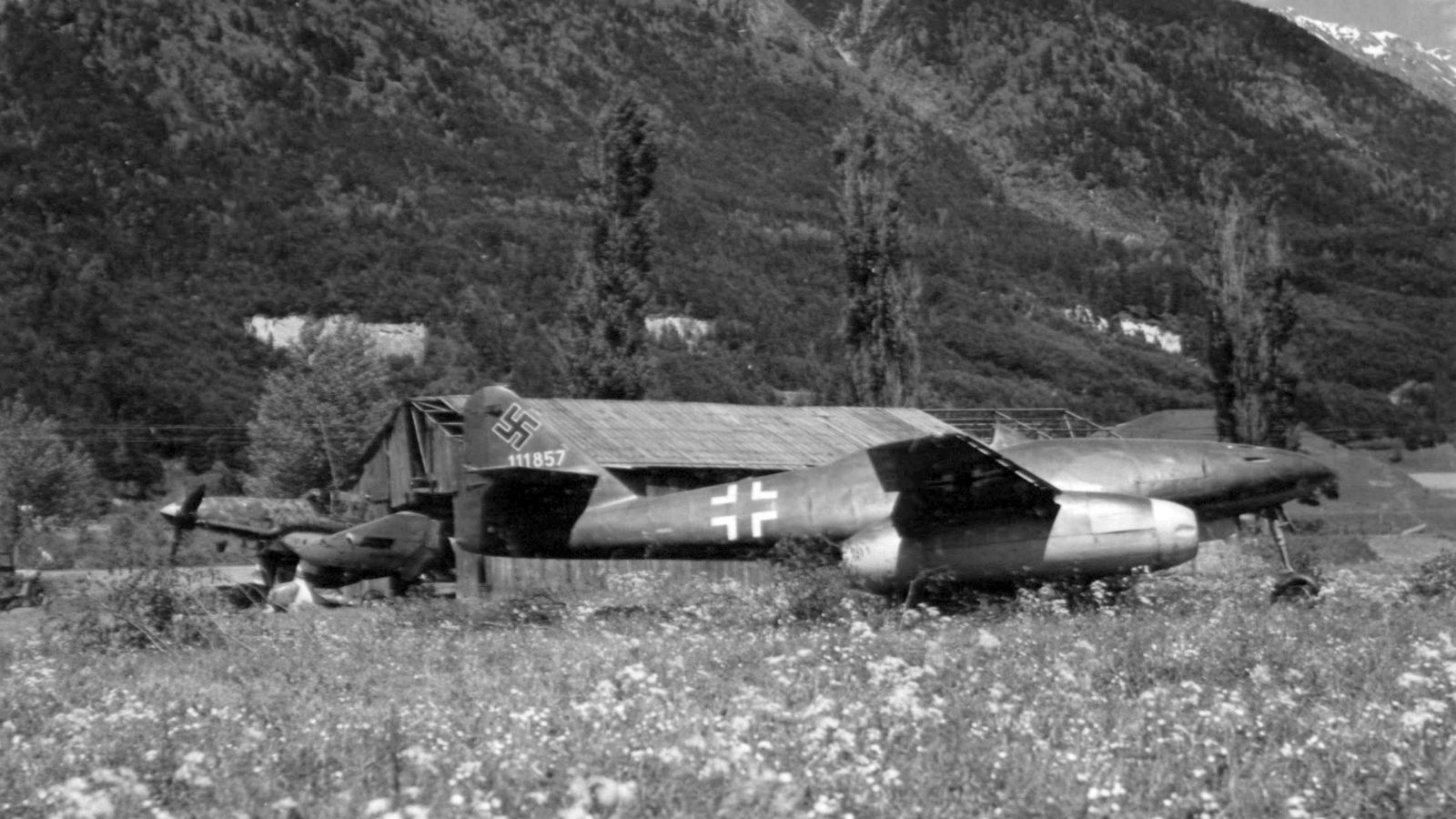
Today, we have for you the plane that pioneered the transition from propellor engines to jet engines, the second revolution in aviation: the Messerschmitt ME 262, the world’s first operational jet fighter.
Key Takeaways
- The Messerschmitt ME 262 was the first operational jet fighter, marking a significant shift in aviation technology.
- Jet engine development was pioneered by Frank Whittle and Hans von Ohain in the 1930s.
- The ME 262 faced numerous challenges, including heat management and landing gear issues.
- Despite its advantages, the ME 262 was expensive and fuel-intensive, limiting its impact during World War II.
- Post-war, the ME 262’s design influenced the development of jet aircraft in both Britain and the United States.
The Origin of Jet Power
Our story begins in Ancient Egypt. No, really. Some clever guy named Hero of Alexandria created the aeolipile, a rudimentary steam turbine, powered by jets of steam exiting the engine. This guy lived in the 1st century AD, by the way. So humans have known about jet power for a really long time, yet just like steam power, it wasn’t until the industrial age that the concept could be harnessed to its full potential.
Skipping ahead to the 1900s, we come to two individuals who basically single-handedly invented the jet engine: the Briton, Frank Whittle, and the German, Hans von Ohain. Frank Whittle, an RAF cadet, began formally working on his designs for a jet engine in the late 1920s, submitting a patent which was accepted in 1932. His work would eventually result in the Gloster Meteor, the only Allied jet aircraft to see combat operations in World War 2. Meanwhile, in Germany, von Ohain was working on his own version of the technology, likely helped along somewhat by Whittle’s work into the subject.
Side note here: these two met each other after the war and became very good friends. Life truly is strange, isn’t it?
Anyway, how did their engines work? And also… what is a jet engine exactly?
From Concept to Reality
A jet engine is powered by a jet. …what, you wanted more of an explanation? Alright, then.
Here are the primary principles behind jet power: cold air is taken into the engine from the front, or the intake. This air is then compressed within the engine through a series of compressors, essentially a combination of rotating and stationary fans, pressuring the air and heating it up. This is important for the next stage, where the air then mixes with fuel inside a combustion chamber, pushing the temperature of the air even higher and causing it to expand. This air then passes through a turbine, which cools the air down a little before it’s expelled through the back of the engine, creating a jet of hot air that propels the plane forward.
That’s the concept, at least. Actually getting it to work… that’s tougher.
The primary issue with these early engines was heat. Jet engines take air from around 10°C (50°F) and heat it up to around 450°C (842°F). Germany had significant material difficulties during the war, which limited their options for heat-resistant metals. What’s more, the engines had issues with vibration; essentially every time you turned it on, it would actively try to tear itself apart, which rather hinders the plane’s ability to fly.
For this and political reasons, even though a workable prototype was in use as early as 1939 with the Heinkel He 178, the research on jet engines was continually pushed back in Germany. At one point, the engineering team was reduced to just 35 people. But the research plodded on and on, and in 1941, the first test flight of the ME 262 was performed… using an emergency propellor engine because both of the jet engines failed mid-flight. Hey, at least they planned ahead.
Engine reliability was just one of several problems that the ME 262 had. Let’s go over a few more.
It’s Not Rocket Science, But It Might As Well Be
One problem with the ME 262 came from a very unexpected place – the landing gear. The ME 262 used a so-called “conventional” landing gear: two wheels forward on the wings, one wheel back on the tail, with the plane angled upwards. This was standard for prop-planes at the time. Yet for a jet-powered plane, this caused a major problem. If you mount the jet engine on the wings of your plane, and then angle those wings toward the ground… you can see where this is going.
In these early prototypes, the exhaust of the jet engines deflected off the runway, creating massive amounts of turbulence on the tail of the plane and negating the effects of the elevators – the parts of the plane, usually located on the tail, that help it move up or down. In plain English, the plane can’t get off the runway. The test pilot solved this problem by tapping the brakes at takeoff speed, lifting the tail out of the turbulence.
Some prototypes later, the engineers swapped the landing gear design from a conventional arrangement (two forward, one back) to a “tricycle” arrangement (one forward, two back). You’ll notice that pretty much every propellor plane from WWII photos or footage uses a conventional landing gear arrangement, while every modern jet fighter uses a tricycle arrangement. And now, you know why.
Watch the Video
Open Video
Video Briefing
ME-262: The World's First Jet Fighter
The aforementioned engine problems were eventually solved by using some very expensive materials to correct them. But given that they were very expensive materials, production of the engines didn’t ramp up until 1944, when it was becoming clear that Germany was more or less guaranteed to lose the war. What’s more, these jet engines weren’t perfect – they were a compromise based on wartime measures.
Originally, these engines were going to use even more strategic materials, but Germany just didn’t have enough to meet the demand for that. So, they did the best they could in designing the engine to work without them. Frank Whittle – remember him? – wrote in his final assessment of British jet engines versus German jet engines that, “it was in the quality of high temperature materials that the difference between German and British engines was most marked”.
Aside from the design problems, the ME 262 had some other drawbacks from a strategic perspective. First, it turns out jet planes are expensive. Currency conversion from World War 2 to today is basically impossible due to all the confounding factors, but for a rough answer, a unit cost for the ME 262 was 87,400 Reichsmark, which at the time was around 20,809 USD, or around $300,000 in today’s money.
It’s tough to find unit costs for other plane models of the time, but it’s safe to say that this plane was more expensive than conventional planes. Another problem was fuel. If you’re at all familiar with World War 2, you know that Germany suffered from fuel shortages throughout the war.
The ME 262 consumed double the fuel of a conventional prop-plane. All of this begs the question: if it’s more expensive to make, consumes more fuel, and needs its own special landing gear setup to not throw a tantrum on the runway, is this plane two, three, ten times better than a regular plane? Well, with the end of the war in sight, the Germans were about to find that out.
“The first time I ever saw a jet, I shot it down.” -Chuck Yeager, USAAF
The operational history of the ME 262 begins in April of 1944, when a test air wing was created with the intention to train Luftwaffe pilots to fly it. In July, an RAF reconnaissance aircraft was damaged by an ME 262, in what was probably the first aerial combat of a jet fighter in history. But adapting this new technology under wartime conditions proved difficult, and early combats saw only a slight edge in favor of the jets.
This improved over time, with one air unit making claims of 19 Allied aircraft downed with 6 losses. A major combat operation in March of 1945 by Jagdgeschwader 7 (JG 7), the first air unit in the world to include all jet fighters, saw 12 bombers and one fighter shot down for the loss of 3 MEs. That’s a good ratio, but in terms of scale, it was rather meaningless; the Allied air wing had consisted of 1,221 bombers and 632 escorting fighters.
So, the ME 262 wasn’t a miracle weapon that would’ve single-handedly changed the outcome of the war. But in isolation, it was certainly a powerful plane. It was easily faster than the propellor planes that the Allies were using, and it proved impossible to catch if the pilot decided to disengage.
It became something of a parallel to the Allies in the Pacific theatre, where the more maneuverable Japanese Zero had been countered by pilots simply gunning it and speeding away. ME 262 pilots, being faced with slower but comparably more nimble propellor planes, essentially did the same thing. Since fighting the planes in the air proved difficult, the Allies decided to base their countermeasures on destroying the planes when they were most vulnerable: when they were grounded, taking off, or landing.
Other than that, the Allies mostly felt comfortable ignoring the aircraft while they used sheer numbers to overwhelm the German defenses. With only 1400 aircraft produced in total during the war, it was never going to save Hitler.
In total, the ME 262 claims a count of anywhere from 200 to 562 Allied aircraft downed. Affirming the numbers is difficult due to the loss of German documents towards the end of the war, but we can make a safe guess that the plane was, at the very least, effective. And although the ME 262 didn’t make much of a mark on World War 2, it would define the era that came after it.
To Stand Still, We Must Move Very Fast
After the war ended, the Allies proceeded to seize a huge amount of German technology for their own research and development. One of those technologies were the still intact ME 262s. The allies shipped them back to Britain and America and studied the designs.
The British found that the ME 262 was faster and provided more visibility than the Gloster Meteor, although the engines were less reliable. America had a jet prototype of their own, the P-80 Shooting Star, and they used innovations from the ME 262 in future jet aircraft production. The F-86 Sabre was the eventual result, with several designs borrowed from the 262.
The Sabre was built to counter the Soviet MiG-15 – also partly built with reverse-engineered ME 262 technology. Both of these fighters would, famously, see dogfights with each other during the Korean War, overshadowing the propellor planes that also participated. It was clear from this point on that prop planes would no longer be the mainstay of air forces around the world; the age of the jet aircraft had come.
And, just like many, many innovations that were initially built for military purposes, this technology would soon find a civilian use in the form of the passenger aircraft.
Key Takeaways
- The Messerschmitt ME 262 was the first operational jet fighter, marking a significant shift in aviation technology.
- Jet engine development was pioneered by Frank Whittle and Hans von Ohain in the 1930s.
- The ME 262 faced numerous challenges, including heat management and landing gear issues.
- Despite its advantages, the ME 262 was expensive and fuel-intensive, limiting its impact during World War II.
- Post-war, the ME 262’s design influenced the development of jet aircraft in both Britain and the United States.
SideProjects Editors
The SideProjects editorial team researches, fact-checks, and structures explainers about the lesser-known tales, side narratives, and spin-offs behind major historical and contemporary subjects.
Frequently Asked Questions
What was the first operational jet fighter?
The Messerschmitt ME 262 was the world’s first operational jet fighter.
Who were the key inventors of the jet engine?
The key inventors of the jet engine were Frank Whittle from Britain and Hans von Ohain from Germany.
What were the primary issues with early jet engines?
The primary issues with early jet engines were heat and vibration. The engines had to handle extreme temperatures and often tried to tear themselves apart due to vibration.
What was the landing gear problem with the ME 262?
The ME 262 initially used a conventional landing gear arrangement, which caused turbulence from the jet exhaust to affect the tail, making it difficult to take off. This was later solved by switching to a tricycle landing gear arrangement.
How did the Allies counter the ME 262?
The Allies primarily countered the ME 262 by targeting it on the ground, during takeoff, or landing, as it was most vulnerable then. They also used sheer numbers to overwhelm German defenses.
What was the operational history of the ME 262?
The ME 262 began operational history in April 1944 with a test air wing. It saw its first aerial combat in July 1944 and continued to be used until the end of the war, claiming between 200 to 562 Allied aircraft downed.
How did the ME 262 influence post-war aviation?
After the war, the Allies studied the ME 262 and used its technology in their own jet aircraft designs, such as the British Gloster Meteor and the American F-86 Sabre. This marked the beginning of the jet age in aviation.
What was the cost of the ME 262?
The unit cost for the ME 262 was 87,400 Reichsmark, which was around 20,809 USD at the time, or approximately $300,000 in today’s money.
What was the fuel consumption of the ME 262 compared to conventional planes?
The ME 262 consumed double the fuel of a conventional prop-plane, which was a significant drawback given Germany’s fuel shortages during the war.
How many ME 262 aircraft were produced during the war?
A total of 1,400 ME 262 aircraft were produced during the war.