
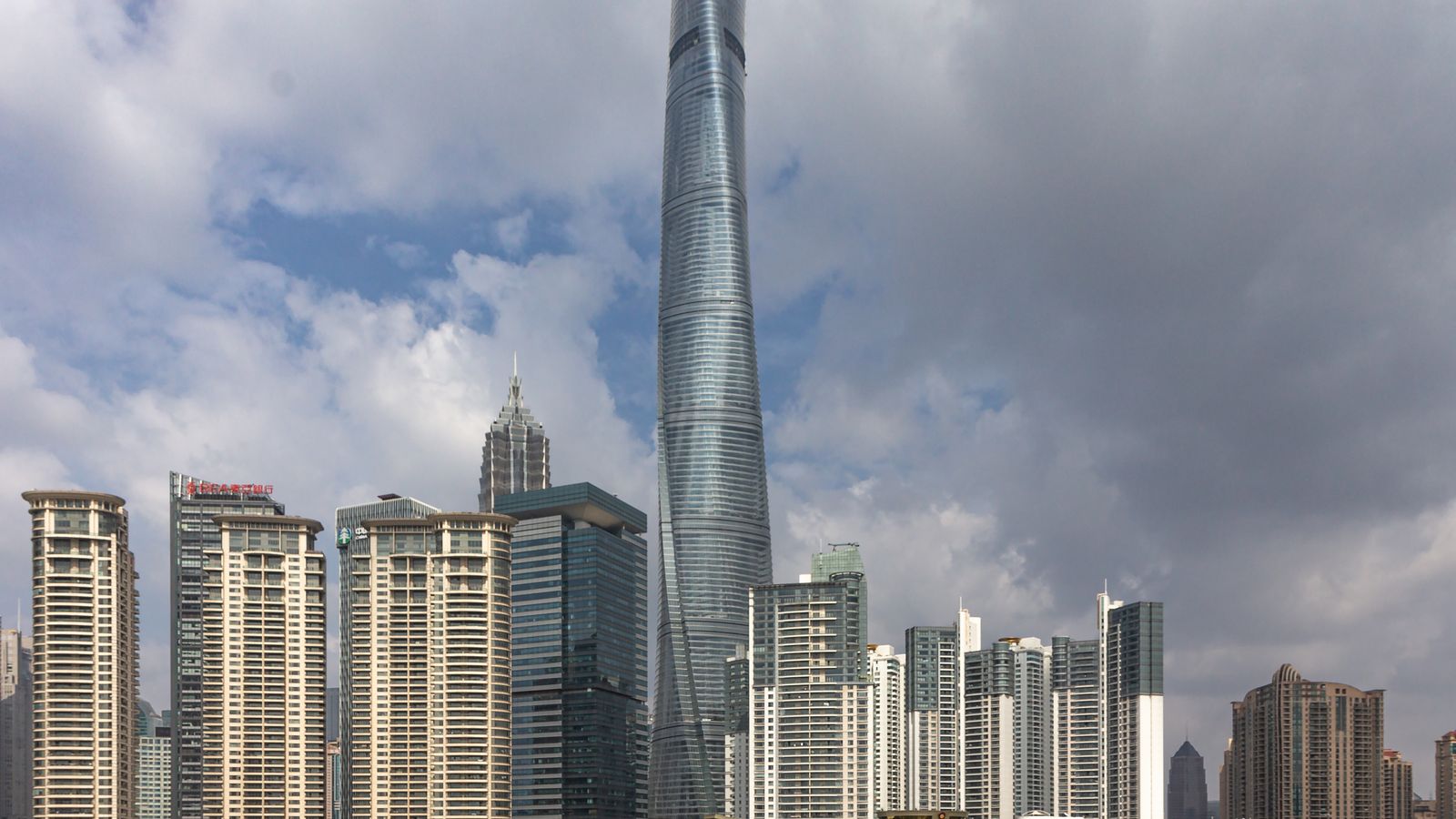
The Burj Khalifa, Dubai. The Merdeka 118, Kuala Lumpur. The Shanghai Tower, Shanghai, and the Abraj Al-Bait Clock Tower, Mecca. Across the world today, there are only four megatall skyscrapers in existence, and none in active construction. Built to a height of over 600 meters, over 1,969 feet, megatall skyscrapers are the next logical step for a builder species that has been obsessed for centuries with creating buildings that rise taller, and taller, and taller into the sky. A building of this size is a powerful driver of economics and tourism, and an indicator of a nation’s wealth, its progressivism. Several nations have well-formed design proposals for towers that could conceivably go up within the next few years, including China, Saudi Arabia, and the UAE. Yet as of right now, it seems unlikely that any new megatalls will be open to the public anytime soon.
But you can’t hold an architect back over silly things like resource availability, and the lack of ongoing construction on megatall skyscrapers has not done anything to prevent some truly remarkable concept pieces from coming out. Ranging from the feasible to the absurd to the mind-bogglingly gigantic, there are proposals out there for buildings that would, if ever built, constitute the greatest human architectural achievement of all time. In some cases, the design intention is to actually build a new architectural marvel or send a global message about a certain nation’s wealth and power, and in other cases, the goal is to develop and share concepts that can re-shape architectural design on a smaller scale. Today, we will look at ten of them, and their implications for a world that can’t help but think big.
Jeddah Tower
Announced in 2011 as the Kingdom Tower, the project now known as the Jeddah Tower is the only building on this list that is currently in the process of being built. Intended to be the crown jewel of Saudi Arabia’s Jeddah Economic City development, the Jeddah Tower is designed to crest a full kilometer into the sky. This would blow the Burj Khalifa way out of the water, and easily take the title of world’s tallest building. With at least 252 stories planned, over a total 243,000 square meters, the Jeddah Tower is expected to host apartments, offices, a hotel, and of course, the world’s highest observation deck. The price tag for the building is listed at $1.2 billion.
Key Takeaways
- There are only four megatall skyscrapers in existence, none currently under construction.
- Megatall skyscrapers drive economics, tourism, and indicate a nation’s wealth and progressivism.
- The Jeddah Tower is the only megatall skyscraper currently under construction, but it is stalled.
- Concepts for megatall skyscrapers range from feasible to absurd, with varying goals and designs.
- The X-Seed 4000 is the tallest building ever proposed, designed to be over 4 kilometers high.
The tower has a number of notable features that set it apart from other megatall skyscrapers, including a sleek, single-slope design that would have made it more resilient against air currents than the Burj Khalifa. Also unlike the Burj Khalifa, the Jeddah Tower was built to be profitable, and used as the centerpiece of a larger high-density development that eventually would have paid for itself. Unfortunately, construction appears to have stalled with no sign of resuming, due to the combined effects of labor disputes and the COVID-19 pandemic. However, the engineering group responsible for the design, Thornton Tomasetti, seems to believe that it will eventually be completed.
Azerbaijan Tower
Stretching high above the Caspian Sea, the Azerbaijan Tower was meant to put Azerbaijan on the map. The tower was announced in 2012, just shortly after the Jeddah Tower, with one sticky little selling point: the Azerbaijan Tower would be one thousand and FIFTY meters tall, a whole fifty meters taller than the measly little Jeddah Tower. The Azerbaijan Tower was planned as the center of the Khazar Islands development, a planned megalopolis that would unify 41 artificially made islands to host a million people—and for a price tag of 100 billion dollars. With a much wider, more broad-based design, the 189-floor Azerbaijan Tower was slated to occupy its own artificial island. The Avesta Group, the developers responsible for the Azerbaijan Tower design, said the building would be built to withstand up to a magnitude 9.0 earthquake, a design standard for the entire Khazar project. Avesta was scheduled to break ground in 2015, but unfortunately, the Azerbaijan Tower was cancelled before the first brick was laid, and fluctuations in the price of oil appear to have killed the whole development dead.
Sky City One
Moving to the city of Changsha, Hunan Province, in Southern China, we come to Sky City One, a tower that was expected to overtake the Burj Khalifa as the world’s tallest. But it wasn’t just the height that made Sky City One so ambitious; it was the timetable. Broad Sustainable Building, the company entrusted to build Sky City One, said that the entire project would take only 210 days: 120 to prefabricate sections of the building, and only ninety days to erect the entire building, from foundation to tip. Planned at a height of 838 meters, the project would have obviously been the most ambitious ever on such a tight deadline, but it would have been a very important proof-of-concept for Broad Sustainable Building, which had used the same techniques to assemble many other buildings quickly. Sky City One had several goals in mind: earthquake survivability, sustainability, cleanliness, and energy efficiency. Not only that, but at a cost of $1,500 per square meter, the 202-story building would have been three cheaper than the Burj Khalifa. Unfortunately, the project hit numerous delays before being cancelled in 2016, amid widespread skepticism about the feasibility of the project’s short timetable. Sky City One’s foundation pits are now used by local villagers, as fish ponds.
Oblisco Capitale
Egypt, too, has gotten in on the action around megatall skyscrapers, with the Oblisco Capitale (the Capitol Obelisk) planned for construction in the Egyptian New Administrative Capital, a large-scale urban development. Designed to be reminiscent of ancient Egyptian obelisk architecture fused with an art-deco style, the tower is targeted for a height of 1,000 meters, the same as the Jeddah Tower. Details on the project are sparse, but emphasize the use of louvres, angled window blinds, which rotate with the sun in order to reduce the impact of the crippling desert heat. The project is expected to commence in 2024, and complete in 2030.
Sky City 1000
Let’s take a break from sleek, fashionable 2010s architecture for a moment, and go retro. We’re headed back to 1989, in Japan, for the announcement of Sky City 1000. With no relation to Sky City One, Sky City 1000’s goal was in its name: a height of one thousand meters, with room to house approximately 35,000 full-time residents and a hundred thousand workers. Sky City was set up in a pattern of ‘space plateaus’—fourteen dish-shaped chunks of tower, stacked upon each other and connected through several support struts, with over eight kilometers of floor area inside. Sky City 1000 used a much squatter design to increase the space for interior development, and with over 200 floors to work with, the tower was an eye-catching concept when it was first announced. Each space plateau would have consisted of a ring of facilities, oriented around a broad swath of grass and vegetation in the middle. Sadly, the design never made it to a construction phase, but it did lead to the development of some triple-decker, high-speed elevators, so that’s something.
Bionic Tower
With China’s Bionic Tower concept, we cross from the realm of really, really big buildings, to really, really, really big buildings. Conceived by a team of Spanish architects, the Bionic Tower was designed for either Shanghai or Hong Kong with the express intent of using bionics, engineering using naturally occurring biological concepts. The tower was designed to way outsize anything we’ve discussed so far, stretching over 1,200 meters into the sky across 300 floors, exactly 400 meters higher than the Burj Khalifa. Bionic Tower was designed as a self-contained city, composed of twelve distinct vertical neighborhoods distributed throughout the structure. The eventual goal was to house a hundred thousand people, all living and working within the largest single-building community the world has ever known. The project was never started, but the design plans are still out there, ready and waiting for a developer since the late 1990s.
The Big Bend
Watch the Video
Open Video
Video Briefing
Megatall Skyscrapers: Ten Designs to Shape the World
The Big Bend was never designed to be the tallest building in the world, but it was designed to be the longest, and one look at the concept art is enough to explain how exactly that gets done. With a projected length of over 1,200 meters, the Big Bend would have risen to about 600 meters on one side, before horseshoeing around and going back down to the ground again. The reasoning for the design was purely logistical, and came down to the zoning rules in New York City, where the Big Bend was to be built. In the words of Oiio Studio, the architecture firm responsible, “If we manage to bend our structure instead of bending the zoning rules of New York, we would be able to create one of the most prestigious buildings in Manhattan”. And prestigious, it would be. The Big Bend was set to crest over 200 feet taller than the One World Trade Center, making it the tallest structure in the Western Hemisphere, and with a targeted location of Manhattan’s Billionaire Row, there isn’t much dispute as to who exactly this building is supposed to be for. There’s no word on if, or when, the building would ever actually be constructed, but the design speaks for itself.
Shimizu Mega-City Pyramid
So far, we’ve discussed tower concepts that resemble the world’s tallest buildings today, designs that wouldn’t look too out-of-place in their respective city skylines…but now, we cross into the absolutely gargantuan. The Shimizu Mega-City Pyramid takes its design from the pyramids of ancient Egypt, but with a peak of over two thousand meters, or well past a mile, the building would be a full fourteen times bigger than the Great Pyramid of Giza. The building is designed to occupy Tokyo Bay in Japan, with space for a full million people living inside dozens of 30-story skyscrapers suspended within the support structure. The Mega-City Pyramid is so big, the technology required to build it doesn’t yet exist, and until carbon-nanotube technology catches up to the designers’ vision, it will remain practically unfeasible. A big part of the pyramid’s design was its potential to help alleviate overcrowding in the Greater Tokyo area, but with a tentative completion date no earlier than the year 2100, the citizens of Tokyo are just going to have to wait.
Ultima Tower
If there’s anything that can make the Mega-City Pyramid look small, it’s Ultima Tower. Designed in 1991 by renowned architect Eugene Tsui, the Ultima Tower was intended for construction in San Francisco, with a projected height of over two miles—nearly three and a half kilometers—high. Ultima Tower would have matched the Mega-City Pyramid’s capacity for a million people, distributed across five hundred floors, with special technology to cope with the risk of earthquakes in the Bay Area. However, that million people isn’t any old million; it’s the entire population of San Francisco, plus some extra room for guests. Tsui modeled the concept after African termite mounds, the tallest structures in the world constructed by living creatures other than humans. This included not just specifications for the exterior and interior structure, but also a system of natural cooling that wouldn’t rely on air-conditioning. Inside, lakes, hills, and rivers would be interspersed with living space, with an outer skin of solar cells across the entire building to capture the energy needed to power it. With a price tag of $150 billion, Tsui’s tower was unfortunately a bit of a hard sell for San Francisco residents and will most likely never be attempted, but the design is incredibly impressive nonetheless.
X-Seed 4000
Finally, we come to it: the largest, tallest building ever to be feasibly designed and proposed to the public. The X-Seed 4000 was envisioned in 1995 by the Taisei Construction Corporation and designed mostly to generate public interest in the firm, but regardless of the architects’ intention, the thing is staggering. If you’re familiar with Mount Fuji, in Japan, then it’s probably the best analogue to explain exactly what X-Seed was meant to be, because the building would have capped off over seven hundred feet higher than the actual mountain. That’s a height of four kilometers, over two and a half miles, with eight hundred floors across the megastructure. That’s twice the size of the Shimizu Mega-City Pyramid, almost five times the size of the Burj Khalifa, or, if this is more your speed, over two thousand Dwaynes “The Rock” Johnson, standing on each other’s head. The internal capacity is somewhere around a million people, with an overall weight of three million tons of steel. Unfortunately, interior specifications for X-Seed and plans to deal with the earthquake- and tsunami-exposed region are hard to come by, if they ever existed at all, but when we’re talking about an estimated cost of up to 1.7 trillion dollars, that doesn’t much matter. Regardless of feasibility, regardless of detail, the X-Seed 4000 is a hypertall design unlike any other, and one that makes its intended impact on the world simply by the fact that once, it was imagined.
Other notable megatall concepts deserving mention include Tokyo’s Sky Mile Tower, the Dubai City Tower, New York’s Times Squared 3015, and the Dutch Mountain.
Key Takeaways
- There are only four megatall skyscrapers in existence, none currently under construction.
- Megatall skyscrapers drive economics, tourism, and indicate a nation’s wealth and progressivism.
- The Jeddah Tower is the only megatall skyscraper currently under construction, but it is stalled.
- Concepts for megatall skyscrapers range from feasible to absurd, with varying goals and designs.
- The X-Seed 4000 is the tallest building ever proposed, designed to be over 4 kilometers high.
SideProjects Editors
The SideProjects editorial team researches, fact-checks, and structures explainers about the lesser-known tales, side narratives, and spin-offs behind major historical and contemporary subjects.
Frequently Asked Questions
What are megatall skyscrapers?
Megatall skyscrapers are buildings that are over 600 meters (1,969 feet) tall. They are considered the next logical step in architectural development and are often seen as indicators of a nation’s wealth and progressivism.
How many megatall skyscrapers exist as of the article’s publication?
As of the article’s publication, there are only four megatall skyscrapers in existence: the Burj Khalifa in Dubai, the Merdeka 118 in Kuala Lumpur, the Shanghai Tower in Shanghai, and the Abraj Al-Bait Clock Tower in Mecca.
What is the Jeddah Tower and what are its planned features?
The Jeddah Tower, originally known as the Kingdom Tower, is planned to be the world’s tallest building at over 1 kilometer high. It is designed to have at least 252 stories, covering over 243,000 square meters, and will include apartments, offices, a hotel, and the world’s highest observation deck. The project is currently stalled due to labor disputes and the COVID-19 pandemic.
What is the Azerbaijan Tower and what happened to its construction?
The Azerbaijan Tower was planned to be 1,050 meters tall and was part of the Khazar Islands development. It was designed to withstand up to a magnitude 9.0 earthquake. However, the project was canceled before construction began, likely due to fluctuations in the price of oil.
What is Sky City One and what were its unique features?
Sky City One was planned to be 838 meters tall and was intended to be built in just 210 days. It was designed to be earthquake-resistant, sustainable, clean, and energy-efficient. The project was canceled in 2016 due to widespread skepticism about its short construction timeline.
What is the Oblisco Capitale and where is it planned to be built?
The Oblisco Capitale is planned for construction in the Egyptian New Administrative Capital. It is designed to be 1,000 meters tall and will use louvres to reduce the impact of desert heat. The project is expected to commence in 2024 and complete in 2030.
What is the Shimizu Mega-City Pyramid and what are its planned dimensions?
The Shimizu Mega-City Pyramid is designed to be over 2,000 meters tall, with a base that would occupy Tokyo Bay. It is planned to house a million people within dozens of 30-story skyscrapers suspended within the structure. The technology required to build it does not yet exist, making it practically unfeasible.
What is the X-Seed 4000 and what are its planned dimensions?
The X-Seed 4000 is planned to be 4 kilometers (over 2.5 miles) tall, with 800 floors. It is designed to house a million people and would weigh three million tons of steel. The project was envisioned to generate public interest but is considered infeasible due to its enormous cost and technological challenges.
What is the Bionic Tower and what are its unique design features?
The Bionic Tower is designed to be over 1,200 meters tall and 300 floors high. It is intended to be a self-contained city with twelve vertical neighborhoods, using bionics to incorporate naturally occurring biological concepts. The project was never started but the design plans are still available.
What is the Big Bend and what is its unique design feature?
The Big Bend is designed to be the longest building in the world, with a projected length of over 1,200 meters. It is intended to rise to about 600 meters on one side and then curve back down to the ground, designed to comply with New York City’s zoning rules.