
Call it fate, call it chance — call it a bizarre coincidence that leaves you scratching your head in bewilderment. We’ve all heard of those true stories that sound so utterly implausible they stretch the very fabric of believability.
Whether it’s a single person experiencing a repeated event again and again or a specific date that comes to define a culture or even a nation, the most extraordinarily bizarre coincidences have a habit of sending a slight shiver down the spine. They test the bedrock on which we base our assumptions of the world — questioning our own understanding and often blowing apart our safely packaged view of how things generally play out.
Bizarre coincidences occur every day, yet they usually pass us by with so much as a flicker of acknowledgement. However, some stories are so spectacular they’ve become lodged within our historical chronicles. Stories that make no sense and seem to bend the very rules of our world.
Key Takeaways
- Tsutomu Yamaguchi survived two atomic bombings in Hiroshima and Nagasaki during World War II, living to 93.
- Violet Jessops survived the sinking of the Titanic, the Britannic, and a collision on the Olympic.
- The 9th of November is known as Germany’s Day of Fate, marking significant historical events.
- Mexico experienced major earthquakes on September 19th in 1985, 2017, and 2022.
- The assassination of Archduke Franz Ferdinand, sparking World War I, was influenced by a sandwich break.
The Survival of Tsutomu Yamaguchi
Tsutomu Yamaguchi died on 4th January 2010 in the Japanese city of Nagasaki at the impressive age of 93. Of course, Japan is known for churning out age-defying people, with just over 15% of their population now above 80. Most put this down to a healthy diet, a much more social version of retirement than we have in the West and their ikigai, their sense of purpose — their reason for living.
However, even by Japanese standards, Tsutomu Yamaguchi reaching his 93rd birthday bordered on the miraculous. As World War II reached its hellish conclusion in its Pacific theatre, Yamaguchi, who lived in Nagasaki and worked for Mitsubishi Heavy Industries, travelled to Hiroshima for a three-month business trip.
On 6th August, he and his two colleagues were walking to the train station to return to Nagasaki when Yamaguchi realised he had forgotten his ID at the hotel. Leaving his partners, he returned, collected the ID, and was heading towards the city’s dock area at 8.15 am when he noticed two small parachutes drifting down to Earth.
Blinding light followed an intense boom that knocked Yamaguchi to the ground; his eardrums ruptured — his sight temporarily lost. Radiation burns were already creeping across the left-hand side of his body. He lay unmoving for a few minutes before hauling himself onto his feet.
Yamaguchi had been one of the estimated 350,000 people in Hiroshima when the world’s first atomic bomb had landed. Despite being just 3 km (1.8 miles) from the impact zone, Yamaguchi eventually crawled to a nearby shelter and somehow managed to meet up with his colleagues, who had also survived.
The following morning, Yamaguchi returned to Nagasaki and reported for work two days later, quite remarkably, considering his injuries. At 11 am on 9th August, he was relaying the story of Hiroshima to his boss when another ferocious eruption tore his world apart. The world’s second atomic bomb had just been dropped — and again, Yamaguchi was a mere 3km (1.8 miles) from where it fell.
This time he was uninjured, but the chaos meant he could not change his bandages, eventually leading to fever and severe infection. He battled through, and despite being at the epicentre of not one but two nuclear bombs, Yamaguchi lived another relatively healthy 65 years.
The exact number of deaths involved with the two bombings has always been vague but is thought to be between 129,000 and 226,000 — many of whom were further away from the epicentres than Yamaguchi. Call him lucky, call him horrendously unlucky, it just wasn’t his time.
The (Un)luckiest Seafarers
The same applies to our next example of bizarre coincidence in history. On 10th April 1912, just after midday, the vast bulk of the RMS Titanic slowly inched away from the dock in Southampton. Thousands had come to witness this historic moment, the maiden voyage of a ship of extraordinary size, which was unsinkable — if we were to believe the rumours.
Onboard the Titanic, as she steamed clear of British waters, was Violet Jessops, an Argentine woman with Irish heritage working as a stewardess and nurse. The fact that she was even going out to sea again took some courage as just the year before, she had been aboard the RMS Olympic, one of three sister ships that included the Olympic, Titanic, and Britannic, when HMS Hawke rammed it by accident.
The Olympic was able to limp back to Southampton with two gaping holes in her hulls, and Jessops had to find alternative employment. Seven months later, she took her place on the Titanic, no doubt soothing her fears that surely lightning doesn’t strike twice.
However, as we know, lightning definitely does strike twice — and sometimes more. Four days after leaving Southampton, the mighty ship struck an iceberg in the North Atlantic and sank within three hours. Jessops was initially deployed on deck after the incident to act as an example for non-English speaking passengers, but eventually took her place in lifeboat 16 before it was lowered into the freezing waters.
After watching the ship disappear beneath the dark waves, those in the lifeboat were picked up by the RMS Carpathia the following morning and taken on to New York.
Four and a half years later, war had broken out, and Jessops was now onboard the third of three ships, HMHS Britannic, which had been converted as a hospital ship. On 21st November 1916, the Britannic was ruptured by a mighty explosion — later found to be a mine — and sank within an hour, killing 32 of the 1,066 people on board.
One of those was very nearly Violet Jessops after her lifeboat was pulled towards the churning propeller. She managed to jump clear but suffered a traumatic head injury as a result. Jessops died at the ripe old age of 83 after spending the rest of her working life, would you believe it, working on cruise liners.
Now, impressive as that is, we’ve got it beat. Not much is known about Arthur John Priest. He was born in 1887 and died in 1937, aged 49, and worked for many years as a stoker in the bowels of ships, shovelling coal into the furnace and generally doing what you’d consider the worst job on the ship.
That may be the case, but Priest’s luck was beyond extraordinary. During his tenure at sea, he survived four sinkings and two major collisions, which included RMS Asturias (collision on her maiden voyage in 1908), RMS Olympic (collision with HMS Hawke in 1911), RMS Titanic (sunk by an iceberg in 1912), HMS Alcantara (sunk in combat with SMS Greif in 1916), HMHS Britannic (sunk by a mine in 1916) and SS Donegal (torpedoed by SM UC-27 in 1917).
After the sinking of the SS Donegal, Priest retired from the sea, claiming that “nobody wished to sail with him after that”. He is remembered today as the unsinkable stoker.
The 9th of November — Germany’s Day of Fate
Watch the Video
Open Video
Video Briefing
The Most Bizarre Coincidences in History - Fate or Chance?
Fate sometimes intertwines with a human story, but what about specific dates? In Germany, the 9th of November is called Schicksalstag — the Day of Fate — a date that has repeatedly popped up during German history over the last 150 years and has seen some of the nation’s most seismic events. Between 1848 and 1989, five events that significantly changed Germany in one way or another occurred on the 9th of November.
It began on 9th November 1848 with the execution of Robert Blum, a revolutionary politician who had taken part in the upheavals of 1848 — which sparked the German revolution. Blum was a liberal who believed in equality of the sexes and greater freedom and vehemently opposed antisemitism. When protests began sweeping German lands, with demands for liberal principles and improvements to working and living conditions at their core, Blum flung himself into the cause.
However, he, and the revolution he helped start, died before they could even get going. The conservative aristocracy won the day, and you can’t help but wonder how history might have been different had the outcome gone the other way.
The second event came as World War I was limping to its sad conclusion. With 1.7 million Germans dead due to the needless war that ultimately brought Germany zero gains, significant changes were inevitable. On 9th November 1918, Chancellor Max von Baden announced the abdication of Wilhelm II — even before the Kaiser did himself — and the German Republic was declared later that day.
The choppy waters took a dramatic turn over the next two decades, and on the 9th of November 1923, a man named Adolf Hitler attempted a poorly planned coup d’état involving 2,000 Nazi members marching through the streets of Munich.
They were stopped by police officers who eventually opened fire, killing 16 Nazis in the process. While Hitler fled the scene, he was eventually captured and sentenced to five years in prison — during which his infamous saga, Mein Kampf, was written. The event brought the Hitler persona into the national public eye for the first time. After just nine months in prison, he was released — presumably because authorities assumed he would play no further threat in the future.
But, of course, he was a threat. On 9th November 1938, Kristallnacht (the Night of Broken Glass) erupted, which saw Jewish properties and businesses attacked across Germany and more than 90 Jewish Germans killed. Two hundred sixty-seven synagogues were left in rubble, 7,000 businesses were damaged or destroyed, and 30,000 Jewish men were rounded up and eventually shipped to the first concentration camps. If there was the slightest doubt over Hitler’s plans for the Jewish people, this particular 9th November answered that question emphatically.
If most of these dates are looked upon with painful reflection, the final 9th of November was much better. In 1989, after heated political back and forth, along with a steadily increasing army of protestors, the first sections of the Berlin Wall came tumbling down. A momentous date that completely changed Germany and birthed the modern nation. The 9th was initially considered for the ‘Day of Unity’, but because of its association with the past, the 3rd of October was chosen instead.
Mexico’s Day of Earthquakes
If the 9th of November is the Day of Fate in Germany, the 19th of September is the Day of Horror in Mexico. On three separate occasions on this date, in 1985, 2017, and just last year in 2022, the ground in and around Mexico City began shaking. A twisted version of Groundhog Day, or just a terrible coincidence?
Of the three, the first was the most devastating, striking at 7.17 am, with many still in their homes. The event measured 8.0 on the Richter scale and killed at least 5,000 — with some estimates going up to 40,000 in the Greater Mexico area. The long duration of the shaking led to thousands of buildings coming down and the city as a whole losing 30% of its available living space.
Thirty-two years later, commemorations were held around Mexico to remember those lost in the 1985 earthquake. As part of the commemorations, a national earthquake drill was held on the same day at 11 am, and on 19th September 2017, these were all carried out without a hitch.
Then it began again. At 1.14 pm local time, a 7.1 earthquake with an epicentre about 55 km (34 mi) south of Puebla again brought buildings down — with 228 falling in Mexico City alone. While the death count was much lower at 370, the devastation was similarly severe, and over 6,000 were injured.
Five years later, once again, on 19th September, a national earthquake drill was held across the country around midday, but less than an hour later, the real thing arrived. The 7.7 earthquake hit at 1.05 pm between the Mexican states of Michoacán and Colima. Despite widespread damage once again, only two deaths were attributed to the earthquake, with a further two occurring during an aftershock.
Whether it’s the Day of Fate or the Day of Horror, they are bizarre coincidences that are enough to leave your mind humming as it draws near again.
The Sandwich that Led to War
The First World War delivered death on a scale previously unimagined. Around 20 million people died during this period, half service personnel and half civilians, with profound effects that stretched for decades after the war’s conclusion. But did you know it all began with a sandwich?
The story we’re often told in rather blaise terms is that Archduke Franz Ferdinand, the heir presumptive to the throne of Austria-Hungary, was assassinated in Sarajevo, sparking World War I. While this is all entirely accurate, it tells only a fraction of the astonishing coincidence that led up to it.
You see, the initial attempt on Ferdinand’s life was a complete and utter failure. Despite six separate assassins waiting along the planned route, the only meaningful effort resulted in one of the bombs landing beneath one of the cars travelling with the Archduke. The royal party were able to attend their planned event but then decided to leave and visit those in the hospital because of the earlier attack.
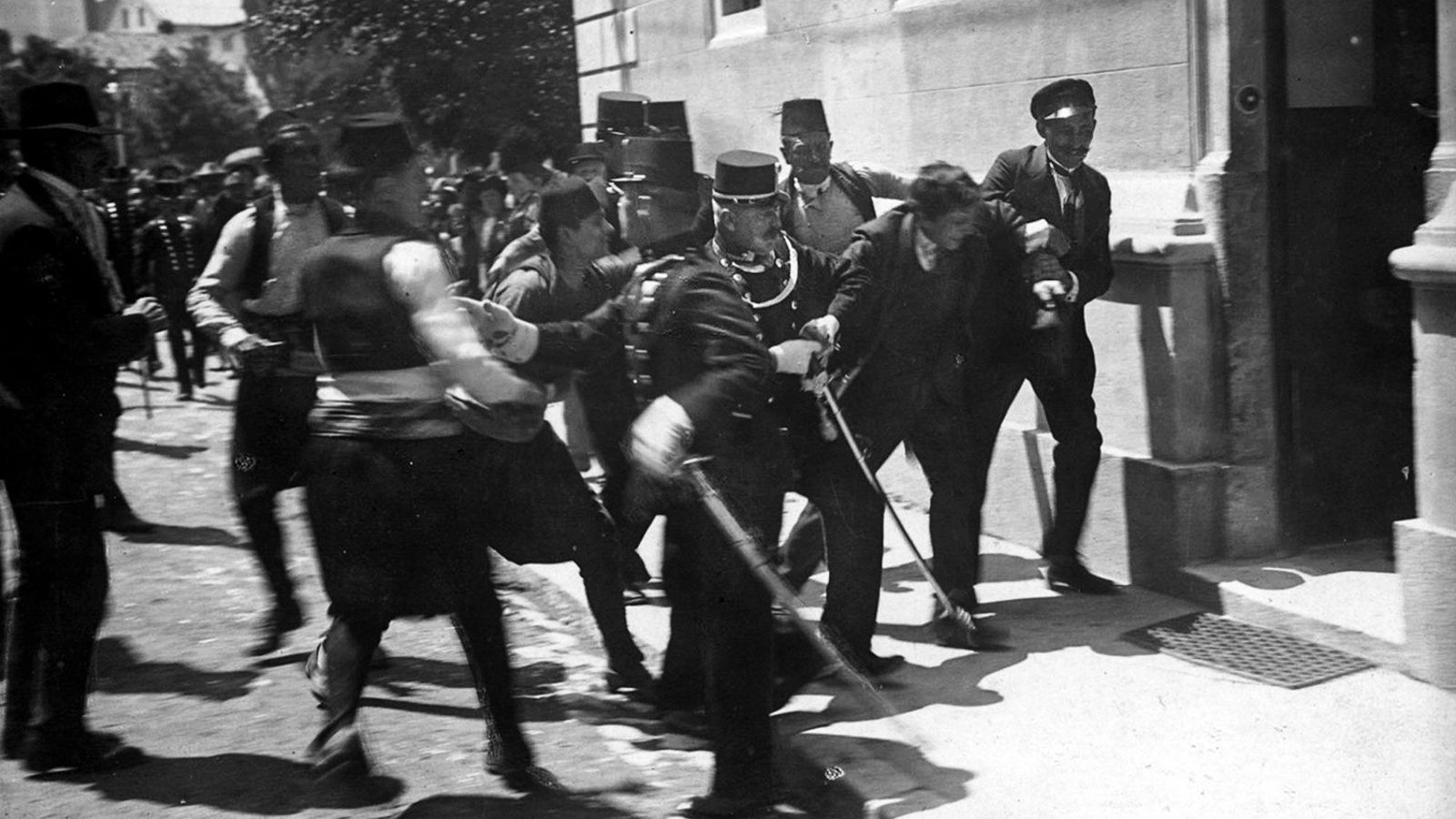
At the same time, Gavrilo Princip, one of the six assassins, considered his options and whether he could find a spot to lie in wait for the returning Archduke. As many do, Princip thought he’d think better with a bit of food in his stomach and so stopped at Schiller’s delicatessen near the Latin Bridge.
Three cars suddenly appeared on the road, the third carrying the Archduke. The first two turned down a sidestreet, but when the Archduke’s driver did the same, he was informed by Governor Potiorek, also in the car, that he was going the wrong way. There seems to have been a change in routing plans that hadn’t been relaid to everybody, and suddenly, a car carrying the heir to the Austria-Hungary throne was all alone on a quiet Sarajevo street.
The driver attempted to reverse but only succeeded in stalling the car. And would you believe it, he did it a stone’s throw from Schiller’s delicatessen, where Gavrilo Princip was sitting enjoying a sandwich. In one of the most astonishing twists of fate, Princip put down his food, retrieved his gun, and walked calmly towards the car before firing two shots inside. Both the Archduke and his wife, Sophie, Duchess of Hohenberg, died shortly after, and within a month, the bloodiest war the earth had ever seen erupted.
And it came down to a quick stop for a sandwich.
Fate or Chance?
So there you have it. Call them fate or call them chance, these five examples are enough to make you question the laws of our world. Do bizarre coincidences like these just happen, or is there something else going on? Was the Archduke destined to die that day, no matter what happened?
And was Tsutomu Yamaguchi just meant to live to old age even though his medical chances were negligible, to say the least? Humans have pondered whether it’s all glorious chaos or a predestined plan for as long as we’ve existed — and these stories certainly don’t make that question any easier to answer.
Key Takeaways
- Tsutomu Yamaguchi survived two atomic bombings in Hiroshima and Nagasaki during World War II, living to 93.
- Violet Jessops survived the sinking of the Titanic, the Britannic, and a collision on the Olympic.
- The 9th of November is known as Germany’s Day of Fate, marking significant historical events.
- Mexico experienced major earthquakes on September 19th in 1985, 2017, and 2022.
- The assassination of Archduke Franz Ferdinand, sparking World War I, was influenced by a sandwich break.
SideProjects Editors
The SideProjects editorial team researches, fact-checks, and structures explainers about the lesser-known tales, side narratives, and spin-offs behind major historical and contemporary subjects.
Frequently Asked Questions
Who was Tsutomu Yamaguchi?
Tsutomu Yamaguchi was a Japanese man who survived both the Hiroshima and Nagasaki atomic bombings during World War II and lived to the age of 93.
What happened to Violet Jessops on the RMS Titanic?
Violet Jessops was a stewardess and nurse on the RMS Titanic. She survived the sinking of the Titanic after being deployed on deck and then taking her place in lifeboat 16.
How many ships did Arthur John Priest survive?
Arthur John Priest survived four sinkings and two major collisions, including the RMS Titanic, HMHS Britannic, and SS Donegal.
What significant events occurred in Germany on the 9th of November?
Between 1848 and 1989, five significant events occurred in Germany on the 9th of November, including the execution of Robert Blum, the abdication of Kaiser Wilhelm II, Hitler’s failed coup, Kristallnacht, and the fall of the Berlin Wall.
What is the significance of the 19th of September in Mexico?
The 19th of September is known as the Day of Horror in Mexico because three major earthquakes occurred on this date in 1985, 2017, and 2022.
How did the assassination of Archduke Franz Ferdinand lead to World War I?
The assassination of Archduke Franz Ferdinand was a result of a series of coincidences, including a failed initial attempt and the Archduke’s car stalling near where the assassin, Gavrilo Princip, was eating a sandwich. This event sparked World War I.
What was the initial attempt on Archduke Franz Ferdinand’s life?
The initial attempt on Archduke Franz Ferdinand’s life involved six assassins waiting along his planned route, but the only meaningful effort resulted in a bomb landing beneath one of the cars traveling with the Archduke.
What happened to Violet Jessops after the Titanic?
After surviving the Titanic, Violet Jessops also survived the sinking of the HMHS Britannic in 1916, where she suffered a traumatic head injury but lived to the age of 83.
What was the outcome of Hitler’s attempted coup on the 9th of November 1923?
Hitler’s attempted coup on the 9th of November 1923 was stopped by police officers who opened fire, killing 16 Nazis. Hitler was eventually captured, sentenced to five years in prison, and released after nine months.
What was the impact of the 1985 earthquake in Mexico City?
The 1985 earthquake in Mexico City measured 8.0 on the Richter scale, killed at least 5,000 people, and led to the city losing 30% of its available living space.