

The periodic table of elements was first put forward by Russian chemist Dimitri Mendeleev, who, all the way back in the 1860s, had the pioneering idea of organizing the known elements by their atomic weight. It was such a spectacular success that unknown gaps left in Mendeleev’s chart would be filled in as the years went by and as more elements were discovered.
Today, the periodic table contains 118 unique elements, and among them are some pretty wild and wacky ones. We’ll cover a few of the strangest of these, and even explore the possibility of elements beyond the current periodic table.
Technetium
When Mendeleev was putting together the periodic table, one of the most intriguing places was element number 43, which was left blank, as it had not yet been found. With Molybdenum at number 42, and Ruthenium at number 44, it was expected that the elusive element 43 would be found soon enough. Mendeleev nicknamed the element “ekamanganese,” coming from the word eka, which means one in Sanskrit, and the element manganese, which was directly above the hole in the periodic table.
Key Takeaways
- The periodic table was first organized by atomic weight by Dimitri Mendeleev in the 1860s.
- Technetium, element 43, was difficult to discover due to its radioactivity and short half-life.
- Osmium is the rarest stable element on Earth and the densest, but it is not very useful.
- Bismuth has unique properties like expanding when frozen and being diamagnetic.
- Caesium is the softest metal and highly reactive, defining the official time measurement of one second.
Throughout the next 50 or so years, several researchers came forward claiming to have finally isolated and identified the element, but they were all wrong. Three of the researchers had actually found various different alloys, which are a combination of elements and not an element on their own, and another one had actually found the element Yttrium.
In 1925, a group of German chemists made headlines with their claim to have discovered element 43, which they reported to have found by blasting columbite with a beam of electrons. When analyzing the X-ray emissions produced by the interaction, they detected a faint signal at the wavelength predicted to be caused by element 43. They named it Masurium, and scientific articles of the time were already reporting on the success.
But there was just one problem. Nobody else could replicate the results. Obviously in science this is a big deal, and chemists around the world voiced their concerns that the results from the German team may have been nothing more than an error. There was also some resentment about the naming of Masurium, named after the Masuria region and apparently meant to signify the German victory over the Russians in the area during World War 1.
Finally, in 1937, element 43 was officially discovered. The previous year, at the Lawrence Berkeley National Laboratory in California, physicists had been messing around with a cyclotron, a type of early particle accelerator. An Italian physicist named Emilio Segrè was visiting the laboratory, and asked if he could take home some of the discarded parts from the cyclotron that had become radioactive throughout the experiments. He was given several pieces, including a molybdenum foil, which, if you remember, is element 42, one space before the missing spot.
Segrè returned home to the University of Palermo in Sicily, and began examining the cyclotron scraps, where he succeeded in detecting element 43, which would later be known as Technetium.
Technetium is a silver-gray metal, similar in appearance to platinum. Normally, it is acquired in its powder form, but be careful, because as a powder it will ignite when exposed to oxygen.
So what made Technetium so hard to find? Well, it’s all down to its radioactivity. Despite being surrounded on the periodic table by stable elements, all of its isotopes are radioactive.
The longest-lived isotope has a half-life of only 4 million years, a thousand times less than the age of the earth, so it’s no wonder that almost none of it is around today for us to find in nature. Only miniscule amounts have been found on earth, such as in pitchblende, a type of ore found in the Congo, which contains incredibly small quantities of natural technetium, mere fractions of a nanogram, which arise as a byproduct of the decay of local deposits of Uranium-238. The other discovery of it in nature came in 1952, when an American astronomer detected trace amounts of it in stars, specifically red giants that were nearing the end of their life.
This was further evidence that heavier elements are created in the cores of stars, because the technetium would be far too young to have been present during the stars’ formation.
Despite being so rare in nature and burning up if you accidentally expose it to oxygen, technetium has become a crucial part of modern medicine. The isotope Technetium-99 has a half-life of around 6 hours, making it a perfect radioactive tracer for nuclear imaging because it doesn’t stay in the body for very long. As of 2023, an estimated 30 million Tc-99m scans are performed every year, making it the most widely used medical radioisotope, and performing innumerable diagnoses for a wide variety of conditions.
Osmium
Unlike the previous element, Osmium, element number 76, does not have a history of eluding researchers, and it was officially identified all the way back in 1803. Several chemists at the time studying the recently discovered platinum noticed a strange, dark residue in some of their samples. This was originally thought to be graphite, but English chemist Smithson Tennant was later able to correctly identify part of the residue as a completely new metal, which he named Osmium, named after the Greek osme, or smell, because of the foul stench he’d concocted while isolating and analyzing the element in his laboratory.
There are a few things that make Osmium one of the more interesting elements out there. First up is its insane rarity: Osmium is the rarest stable element on Earth, with an average occurrence of just 50 parts per trillion in the planet’s crust. That makes it about 1500 times rarer than even Gold, and only a few tons of it are mined every year around the entire globe, usually found in small amounts while mining nickel or platinum.
Not only is it the rarest, but Osmium is also the densest stable element, coming in at 22.587 grams per cubic centimeter, about twice as dense as lead. It’s so heavy that if you filled a 1 liter bottle with osmium, it would weigh more than 22 kilograms, or almost 50 pounds.
But for as interesting as it is, Osmium isn’t all that useful. It’s extremely hard, has a very high melting point, and is brittle, meaning it’s pretty difficult to machine or work. Another problem is that osmium oxides are extremely toxic, which can form upon exposure to air in its purest form.
For this reason, the current uses of Osmium are almost always in the form of alloys with other metals, such as Osmiridium, a natural alloy of Osmium and Iridium, which is incredibly hard, and, crucially, not toxic. This alloy is used in the tips of fountain pens and some electrical applications, but as it stands, most applications of osmium can be somewhat substituted with a cheaper, more widely available alternative. For example, because of Osmium’s high ultraviolet reflectivity, several Space Shuttle missions were flown with osmium-coated mirrors, but it soon became clear that it wasn’t nearly durable enough to be worth the cost.
There are some companies selling osmium and flaunting it as the next big thing in jewelry and industry, such as a company based in Switzerland that is currently the only place to crystallize it, but for now, it seems that Osmium will remain a rare, and fascinating, but ultimately not very useful element.
Bismuth
Bismuth, atomic number 83 on the periodic table, is an element that many people are familiar with, whether they know it or not, and that’s because it is a common ingredient in medicines such as Pepto-Bismol that treat indigestion and other gut problems.
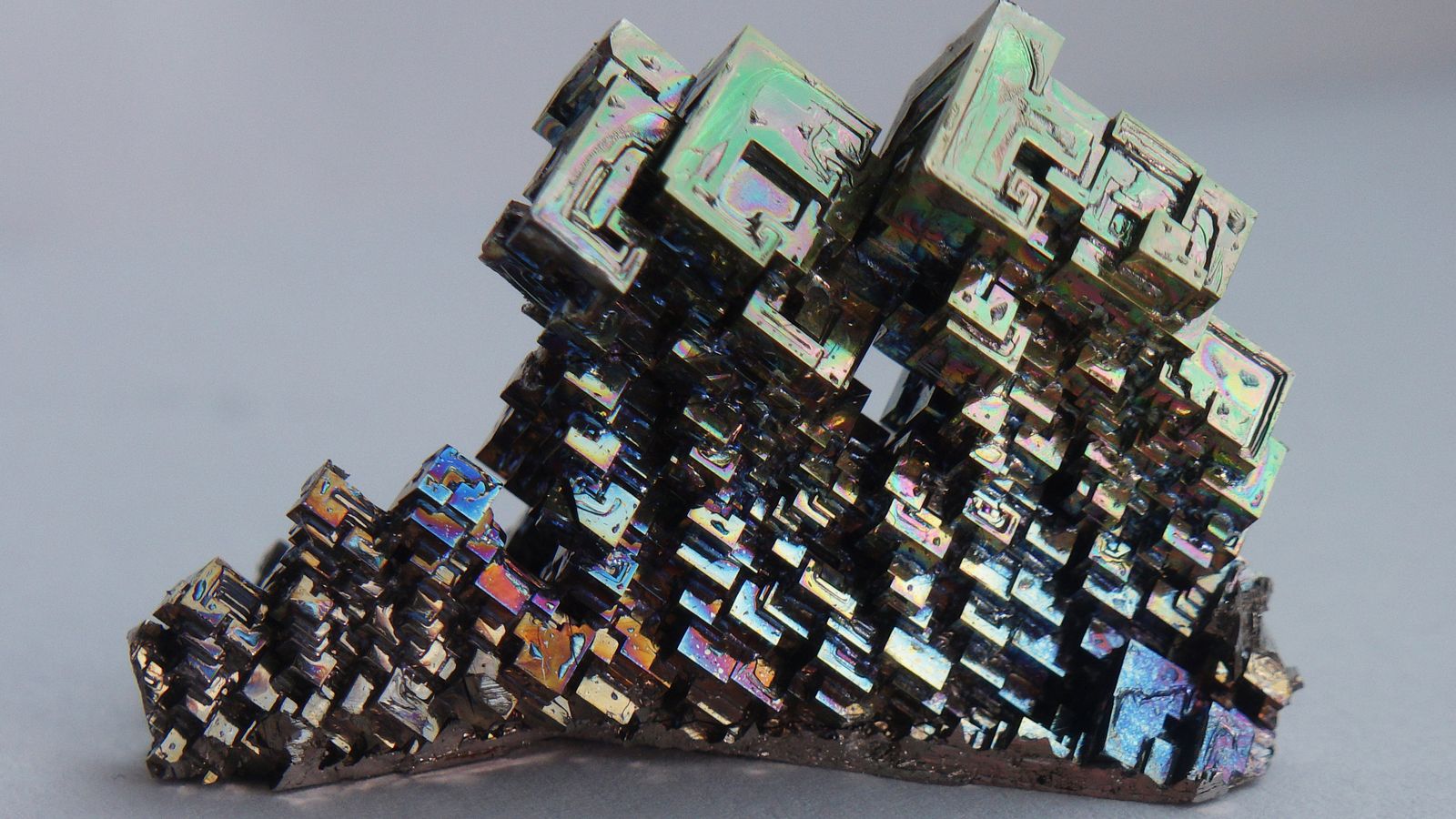
But it gets way more interesting than anti-diarrheal medicine. It is a fairly brittle metal, and is naturally silver in color, however, when tarnished due to oxygen exposure it can develop a multi-colored shell ranging from yellow to pink to blue. Combine this with the tendency for bismuth crystals to form hopper crystal structures, and you’re left with a fascinating, spiral staircase full of different colors and twisting shapes.
Watch the Video
Open Video
Video Briefing
The Most Bizarre Elements in the Universe
In stark contrast to many elements on the periodic table, bismuth has been known since antiquity, and is regarded as one of the first 10 metals to ever be discovered, even known to the Incas 700 years ago, who used it to make knives with a special alloy known as Bismuth bronze. Its popularity throughout history is due to its fairly common occurrence in the earth’s crust, its natural beauty, and the fact that it is nice and stable. Speaking of stability, it was long believed that the isotope bismuth-209 had the heaviest nucleus of any stable atom, but in 2003 it was found that this isotope does actually decay, it just has an astounding half life of 19 quintillion years, more than a billion times the current age of the universe. So while technically not stable, 19 quintillion is such an absurdly large number that it might as well be.
Strange properties of Bismuth include the fact that when burned, it creates a blue flame, while bismuth oxide creates a yellow flame. It also expands when frozen, something not commonly seen with solid metals, and has the distinct attribute of being diamagnetic. Diamagnetic means that when exposed to a magnetic field, it is repelled, rather than attracted. Not only is it diamagnetic, but it is the most diamagnetic metal out there, making it an ideal material for the construction of ultra-fast bullet trains utilizing magnetic levitation.
Caesium
Caesium, atomic number 55, is a soft metal with a silvery-golden shine. And it’s not just soft—out of all the elements that are solid at room temperature, Caesium is actually the softest of all, with a hardness of just .2 Mohs. For some reference, ice has hardness of 1.5 Mohs, and your average candle wax has a hardness of about .5, meaning Caesium is incredibly malleable, and you could easily squish it around and shape it with just your hands.
But it isn’t something you’d want to play with in your bare hands, as Caesium’s melting point is just 28.5 degrees Celsius, or 83.3 degrees Fahrenheit, which means you can literally melt it by holding it in your hand. Along with this, Caesium is highly, highly reactive, and exposure to the oxygen in the atmosphere is sufficient to spontaneously ignite it, which would release purple and blue tinted flames.
Even more spectacular is the element’s reaction to water. Upon contact with the surface of water, Caesium will almost immediately explode with a loud bang. Because of its volatile reactions with just about everything, Caesium is classified as a hazard by most health and safety institutions, and has to be transported in carefully constructed containers to ensure that it remains entirely airtight and completely dry.
But Caesium isn’t all purple fire and cool explosions for a high school chemistry class: it actually defines the official time measurement of one second.
Obviously the second as a unit of time has been around for quite a while, and is simply a fraction of the time the earth takes to rotate, 1/86,400th of a day to be exact. But scientists interested in making history’s most accurate timepieces use Caesium to narrow this down even more precisely.
You see, Caesium-133, the only stable isotope, emits photons of the microwave wavelength at a rapid, but predictable pace as the atom oscillates. By measuring these emissions scientists have redefined a single second to be the same amount of time it takes a cesium atom to oscillate 9,192,631,770 times. This is the official second of the metric system, and is so accurate that an atomic clock based on cesium oscillations will only be off by a single second after 1.4 million years.
While it might sound highly impractical to have such a clock, there are actually day-to-day applications of atom clocks. The most well-known of these are GPS satellites, where it is crucial to have a highly accurate clock to make precise measurements at such distances and to synchronize several satellites, with NASA stating in 2002 that each GPS satellite carries 4 atomic clocks on board. Crazier still is that these clocks are more than accurate enough to measure time dilation due to relativity, and show that due to the slight difference in gravity compared to clocks on the surface of the earth, GPS satellites end up with a difference of about 7 microseconds every day. It’s certainly not a very drastic change, but it’s pretty impressive that this time difference was predicted by Einstein in 1905 and is still being verified by some of the most accurate instruments in history.
Beyond the Periodic Table
As we stated at the beginning, the current periodic table contains 118 elements. However, there are hypothetical elements that could potentially push this number much, much higher.
But there’s a reason getting past 118, or discovering anything there, isn’t so easy. As we approach the higher numbers, beyond 83 to be precise, every element becomes unstable, but unlike Uranium, which has a half-life of 4.5 billion years, elements like Livermorium have a half-life of only 60 milliseconds, which is why there is absolutely none of it found floating around in the universe or on earth, and must be synthesized in a lab to be studied for its brief life. The other problem is that as we move higher and higher on the periodic table, the nucleus of the atom gets bigger and bigger.
The atomic number directly references the number of protons in the nucleus of the atom, so as we get up to the final entries on the table, you’re looking at well over 100 protons in the nucleus, and even more neutrons than this depending on the isotope. These massive nuclei are an issue for elements above 118, because while the strong nuclear force is sufficient to hold protons close to each other on a smaller scale, its strength quickly diminishes with distance, and at some point, the electromagnetic repulsion of the positively charged protons will overwhelm the strong nuclear force, preventing a nucleus from forming in the first place. This is one of the reasons why neutrons are so crucial in the nucleus, as they have no electromagnetic charge, they help separate protons and keep the strong nuclear force, well, strong.
Another issue is electron speed. As the nucleus gets heavier and heavier, the electrons get faster and faster in their orbit. In Gold, for instance, the electron orbiting closest to the nucleus cruises at around 58% the speed of light. Legendary American physicist Richard Feynman used this concept to calculate that element 137 would be the last stable element, because beyond this point electrons would have to move faster than the speed of light. However, while he was on the right track, Feynman’s calculations treated the nucleus as a single point in space. Accounting for the actual size of the nucleus, more recent estimations place the final possible element at 173, which has been given the systematic name of unsepttrium.
It is worth noting that while above atomic number 83 all elements become unstable, it has been hypothesized that awaiting researchers is a so-called island of stability, a region in the much higher, yet undiscovered, atomic numbers where superheavy elements are possible. This is due to the hypothesis that 184 neutrons will provide maximum nuclear stability, but so far the most neutron-rich nuclei we’ve found have only 177, falling quite short of this coveted treasure island supposedly awaiting chemists.
But as our technology in the field improves, as it has been rapidly in recent years, we may be in for some surprises in the near future. After all, it was only in 2010 that a joint Russian-American collaboration succeeded in synthesizing Tennessine, element 117, the most recent element to be discovered as of 2023. So there’s a lot still up in the air, and the coming decades may reveal much more about the periodic table than we ever thought possible.
Key Takeaways
- The periodic table was first organized by atomic weight by Dimitri Mendeleev in the 1860s.
- Technetium, element 43, was difficult to discover due to its radioactivity and short half-life.
- Osmium is the rarest stable element on Earth and the densest, but it is not very useful.
- Bismuth has unique properties like expanding when frozen and being diamagnetic.
- Caesium is the softest metal and highly reactive, defining the official time measurement of one second.
SideProjects Editors
The SideProjects editorial team researches, fact-checks, and structures explainers about the lesser-known tales, side narratives, and spin-offs behind major historical and contemporary subjects.
Frequently Asked Questions
What is the atomic number of Technetium?
The atomic number of Technetium is 43.
How was Technetium discovered?
Technetium was discovered in 1937 by Emilio Segrè, who detected it in discarded parts from a cyclotron that had become radioactive.
What makes Technetium hard to find in nature?
All isotopes of Technetium are radioactive, and the longest-lived isotope has a half-life of only 4 million years, which is much shorter than the age of the Earth.
What is the primary medical use of Technetium?
The isotope Technetium-99 is used as a radioactive tracer for nuclear imaging in medical diagnostics.
What is the atomic number of Osmium?
The atomic number of Osmium is 76.
How rare is Osmium on Earth?
Osmium is the rarest stable element on Earth, with an average occurrence of just 50 parts per trillion in the planet’s crust.
What is the density of Osmium?
Osmium is the densest stable element, with a density of 22.587 grams per cubic centimeter.
What is the atomic number of Bismuth?
The atomic number of Bismuth is 83.
What are some unique properties of Bismuth?
Bismuth is diamagnetic, expands when frozen, and has a half-life of 19 quintillion years for its isotope bismuth-209.
What is the atomic number of Caesium?
The atomic number of Caesium is 55.