

The field of psychology is a relatively recent development in history, as only in the last hundred years or so have we really begun a deep dive into the study of the human mind and behavior. This research largely started in the 19th century, and really took off with the infamously bizarre theories of Sigmund Freud, but quickly evolved into a reputable field employing the scientific method and rigorous testing to uncover the secrets of the mind. Along the way though, there were more than a few experiments that pushed the limits of ethics.
Experiments that, despite providing useful knowledge, would have a hard time getting approved in the 21st century. Today we’ll explore the most controversial of these, and the impact they’ve had on our understanding of human behavior.
The Milgram Experiment
After Germany was defeated in the Second World War, generals and high ranking officers were hunted down and tried for their crimes. Arguably the most high-profile of these was the trial of Adolf Eichmann, the architect of the holocaust, who was sentenced to death by the Supreme Court of Israel in 1961. Some justice had been served, but there were still questions without answers, specifically, how and why did so many thousands participate in the various atrocities?
Key Takeaways
- The Milgram Experiment revealed that many people will obey authority figures, even when asked to perform harmful acts.
- The Stanford Prison Experiment was criticized for its ethical breaches and questionable results, but it highlighted potential abuses of power.
- The Little Albert Experiment demonstrated classical conditioning in humans, but raised concerns about manipulating children’s fears.
- The Monster Study induced speech issues in children through criticism, leading to long-term psychological damage and legal repercussions.
- These controversial experiments pushed ethical boundaries and led to stricter guidelines in psychological research.
Was every single one of them a willing accomplice to the genocide, or were they simply soldiers following orders, able to momentarily toss aside their morality in the face of authority? These questions were of particular interest to psychologist Stanley Milgram, who had been born to Jewish parents in New York, and whose many relatives had endured brutal treatment in concentration camps during the war.
Determined to figure out the psychology behind obedience and genocide, Milgram put together an experiment in his lab at Yale in 1961. Advertisements were posted and featured in newspapers in the city of New Haven, Connecticut searching for 500 participants between the ages of 20 and 50 for participation in a memory study, for which they would be paid $4.00, which is the equivalent of about 40 bucks today. In total, 40 subjects signed up for the experiment.
When a subject arrived, the experimenter told them that they were going to be participating in a study that would test the effects of punishment on one’s ability to memorize information. In total, there were three people present for each session: The experimenter and two subjects. Each subject would draw a random slip of paper that read either teacher or learner, signifying the role that they would go on to play in the experiment.
Unbeknownst to the subject, however, was that the other participant was actually an actor, someone entirely aware of the experiment and only pretending to be a volunteer. The subject was also unaware that both slips of paper actually had teacher written on them, and the actor would simply pretend that he had drawn learner each time, ensuring that the subject who had answered the advertisement was the teacher every single time.
After this deception had been carried out successfully, the trio then moved into a separate room, where the learner was strapped into a device that resembled an electric chair. The teacher was then given a mild, sample shock to be convinced that the device was real before moving into a separate room.
Now that the teacher could only hear, but not see, the learner, the experiment commenced. The teacher would read pairs of words out loud to the learner, who was supposed to do his best to memorize the pairs. After this, the teacher would then quiz the learner, by giving one word from the pair and four possible answers. To indicate his answer, the learner would press a button, and if he got the answer wrong, the teacher would punish him by administering a shock through the electric chair.
These shocks started at 15 volts, but with each wrong answer it would be increased by a further 15 volts, all the way up to 450. Alongside the two highest voltages were markings such as Danger: Severe Shock, and, upon reaching the maximum 450, an ominous triple X.
Now, as you may have guessed, the actor in the other room wasn’t actually being electrocuted for his failure, in fact, there was a tape recorder which played recorded sounds of electric zapping, all while the actor would repeat rehearsed lines of protest, cries, and even bang on the wall. This would escalate into begging to be set free, and finally, once the shocks had reached 300 volts, the learner would fall completely silent.
If at any time during this torturous process the teacher decided that they’d had enough and wanted to leave the experiment, they had to deal with the experimenter, ominously standing over them in a lab coat, who would first respond with:
“Please continue.”
If the subject still desired to leave, the experimenter would move to the second prod:
“The experiment requires that you continue.”
If this too failed, a third push:
“It is absolutely essential that you continue.”
And finally, a fourth and final command:
“You have no other choice, you must go on.”
If the teacher still wanted to stop after all four of these, they were permitted to leave and the experiment was over. If not, the experiment would continue until the teacher had administered the highest dosage of 450 volts three consecutive times.
So, what do you think happened? Before his experiment began, Milgram polled fourteen senior Psychology students at Yale and asked them to predict the behavior of the teachers. Every one of them strongly predicted that the teachers would stand up for themselves before reaching the maximum voltage, a prediction shared by Milgram’s colleagues and forty psychiatrists.
So imagine their shock, pun intended, when not just one of the 40 subjects made it all the way to the maximum voltage, but 26 of them. And of the 14 that ended early, every one of them made it to at least 300 volts. In their defense though, they all did stop at least once before agreeing to continue. At the end of the experiment, each participant was debriefed and the true nature of the session was revealed.
The scientific world reacted to Milgram’s experiment with mixed emotions. Many called the experiment unethical, as people had been coerced into doing what they believed was harming someone else, causing serious emotional distress. According to many of his contemporaries, the moment that subjects experienced stress, sweating, and visible discomfort, he should have ended the experiment.
There was also some backlash on the four-step refusal to let subjects end the experiment, and today one of the most important guidelines in the American Psychological Association is that participants be made aware that they can withdraw from an experiment at any time. In his defense though, the guidelines weren’t nearly as extensive back then, so it’s not like he violated clearly established standards. There was also some criticism of how this could possibly be connected to the Holocaust at all, as the subjects were assured that the shocks wouldn’t cause permanent damage, while perpetrators of war crimes knew the exact opposite.
Milgram pushed back on all of this, however, arguing that critics were just uncomfortable that he had uncovered disturbing patterns of human behavior, a dark side of the mind that some people would rather leave buried. He also continually asserted that 84% of former subjects selected ‘glad’ or ‘very glad’ when surveyed about how they felt having participated, but with the majority of them, this was the end of contact, and it’s unclear how many of them may have faced long-term guilt or emotional damage from their participation and cooperation.
To really nail down his findings, Milgram conducted nearly 20 variations of the experiment, and came to some very interesting conclusions. For example, if there are other ‘teachers’ alongside the subject, who are, of course, just actors, that stand up for themselves and defy the experimenter, participant’s compliance dropped significantly, as they now felt more comfortable defying authority. On the other hand, when the fellow teachers obeyed the experimenter without question, 37 out of 40 subjects completed the entire range of voltage.
What he also found was that distance was a big factor. Making the teacher closer to the learner decreased compliance, especially when the teacher had to personally administer the shock by pressing the learner’s arm against a shock plate. And when the experimenter wasn’t asserting his authority in person, only giving orders by telephone, compliance dropped to just 1/5th of participants.
Similar results were found in all-women groups, as well as international versions of the study replicated around the world. If these findings truly can be applied to behavior in the greater world, they serve as a warning, that a figure of authority can have a stronger effect on our actions than we might think, especially when everyone else seems to go along with it.
Being aware of this can help someone stick to what they believe is right, even when faced with reprimand or consequences from authority, such as one former participant, who wrote to Milgram at the height of the Vietnam War:
“While I was a subject in 1964, though I believed that I was hurting someone, I was totally unaware of why I was doing so. Few people ever realize when they are acting according to their own beliefs and when they are meekly submitting to authority… to permit myself to be drafted with the understanding that I am submitting to authority’s demand to do something very wrong would make me frightened of myself … I am fully prepared to go to jail if I am not granted Conscientious Objector status. Indeed, it is the only course I could take to be faithful to what I believe.”
The Stanford Prison Experiment
Our next experiment also deals with authority, born in the wake of Milgram’s shock experiments as there were now even more questions about obedience and power.
Watch the Video
Open Video
Video Briefing
Most Controversial Psychological Experiments in History
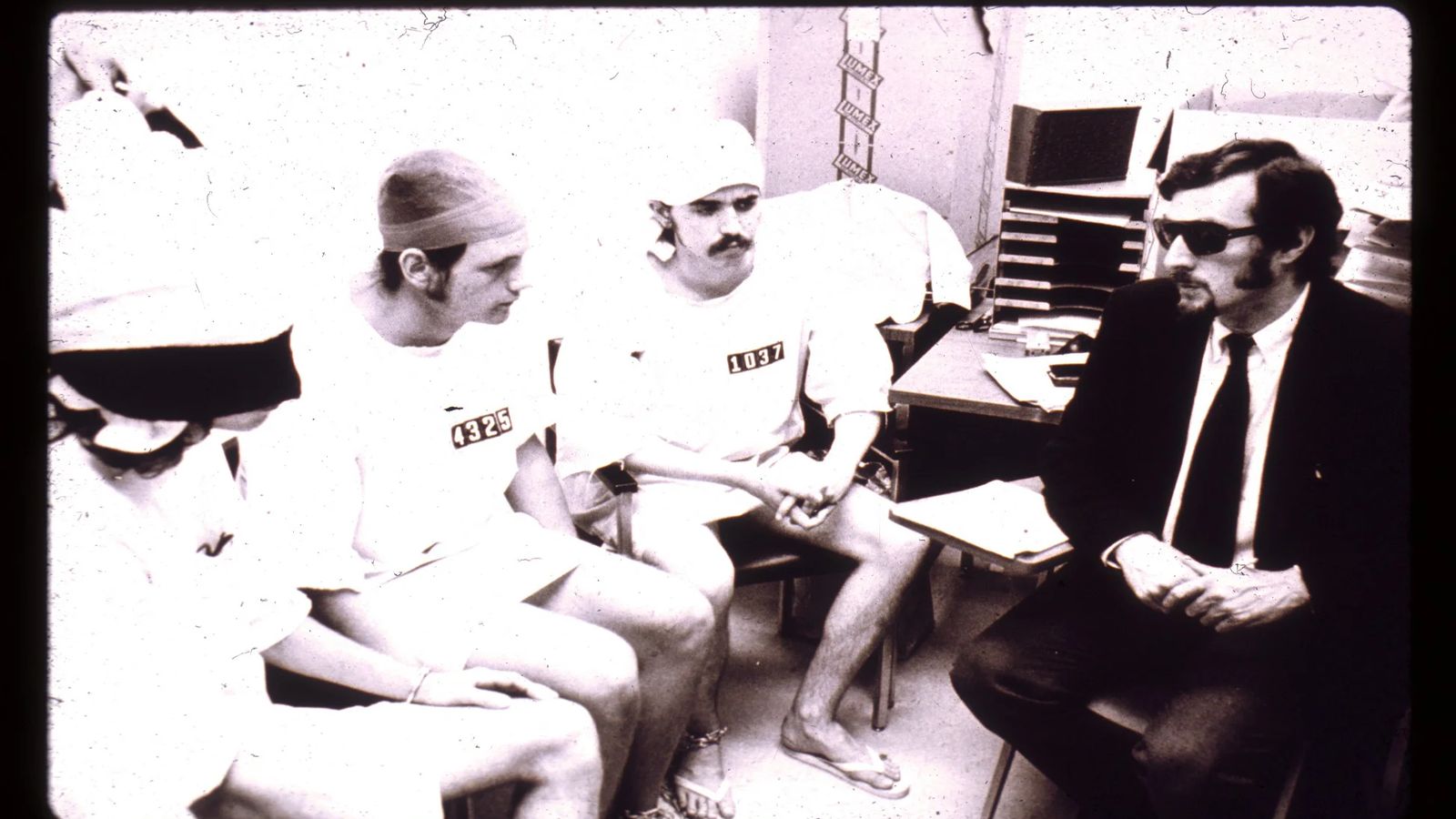
Organized by professor Philip Zimbardo, the Stanford Prison Experiment was a two-week simulation of a prison-like environment, designed to examine the behavior of both the guards and the prisoners as they adapted to their respective roles, and to observe the power dynamics that emerged between the two.
Of 75 young men that responded to his newspaper ad asking for volunteers to study prison life, only 26 were chosen, selected for their survey scores showing mental stability, clean criminal records, and no serious medical history.
When the subjects arrived at Zimbardo’s laboratory in a Stanford basement, they were randomly assigned to two groups: prisoners and guards. Prisoners were then sent to their cells, which were only 7 feet x 10 feet, or about 2 meters x 3 meters. Three prisoners shared each cell, and each prisoner was given a small folding bed and blanket to sleep on. Aside from the cell, there was a small shared yard, and these two areas were where the prisoners were to spend the entirety of experiment, both day and night.
Those assigned to be guards were treated quite differently, given areas to rest and relax, and were even allowed to leave the site when it wasn’t their shift to watch the prisoners. Guards wore khaki-style shorts, mirrored sunglasses, and wielded wooden batons. They were instructed to treat the prisoners in such a way that would make them submissive, and assert their authority whenever possible. Part of this included only referring to the prisoners by assigned numbers, and never by name.
Professor Zimbardo took on the role of superintendent, and his research assistant was the warden.
The experiment began on August 15th, 1971, and it began in such a way that you’re already going to be questioning this study’s ethics. The subjects assigned to be prisoners were arrested by the local Palo Alto police at their homes, something that the subjects had not agreed to in their contracts and were not expecting whatsoever. Zimbardo later claimed that this was because he wanted the arrest to be a surprise to make the experience more authentic, but it was a clear breach of ethics.
Prisoners were given mock charges, such as armed robbery, and were taken to the Stanford County jail, where they were fingerprinted and their mugshots were taken. After this, they were strip-searched, sprayed with a substance to eliminate the potential of lice, and were given an ill-fitting gown to wear for the remainder of the study, with no underwear. They were then transported to the mock prison cells, where they were greeted by the warden, and the experiment had begun.
Guards had been specifically instructed to not withhold food or water, and to not physically harm the prisoners, but this did not stop them from inflicting mental anguish. At 2:30 am on the first night in prison, the guards woke up all the inmates with whistles and ordered them out into the yard. Many of the prisoners refused, and began rioting by throwing things around, ripping off their inmate number patches, and insulting the guards.
To quell the rebellion, the guards sprayed fire extinguishers at the prisoners, took away their beds, and removed all their clothes. They then took the supposed instigators of the riot and put them in solitary confinement, a tiny cell known ominously as ‘The Hole’, while those who were seen as having a lesser role in the rebellion were granted a larger cell with better food.
On day 3, the guards began arbitrarily ordering the prisoners around to assert their authority, forcing them to do random attendance count-offs, various amounts of pushups, and other tasks. They also denied access to the bathroom, forcing the prisoners to relieve themselves in a bucket. Day 3 also saw the first prisoner leave the experiment entirely, a young man named Douglas Korpi who had a mental breakdown, screaming that he couldn’t take it anymore. After personally seeing his condition, the research assistant allowed him to leave the experiment.
The next person to leave was on day 4, when the prisoner assigned the number 819 was found lying in his cell crying, asking for a doctor. When Zimbardo allowed him to leave, the guards forced the rest of the prisoners to repeatedly chant ‘819 is a bad prisoner’.
Day 5 was scheduled to be visitation day, when friends and family could come see the prisoners. This was immediately restricted though, as they experienced long wait times and only 10 minutes to talk with the prisoner, all while a guard stood close by. Understandably, several parents were concerned about their sons’ conditions in the prison, and some began collaborating to hire a lawyer and end the experiment early.
But there would be no need, as the experiment wasn’t going to last much longer. Two of Zimbardo’s colleagues came to check on the prison, and upon seeing how everything was going, began to question him about what was actually being measured. One colleague, Christina Maslach, chastised him for mistreating the young men and for the various breaches of ethics in the study.
She even said that his acting as the prison’s superintendent had transformed him into a new person. Hearing her very valid points, Zimbardo shut the whole thing down a week early. Everyone was paid the modern equivalent of about $1500, and there were several hours of debriefing for both the prisoners and guards, including a group session where everyone talked about their experiences.
So what did we learn from the Stanford Prison Experiment? Well, to be honest, not very much, and that’s another one of the controversies of it. Zimbardo claimed that his results showed that no matter a person’s traits before becoming a guard, once they had the authority they became more cruel and sadistic. However, the validity of these findings is heavily disputed. Many critics argue that the guards were affected by something called demand characteristics, which is when participants in a study act in a certain way to benefit the experiment, in other words, intentionally trying to make it turn out like the experimenter wants. This is a common issue in psychological experiments, and is one of the primary reasons for the use of deception in the experimental design.
This was made worse when it was discovered that one of the guards was told by the research assistant to act harsher because he wasn’t doing enough, and this type of interference is potentially enough to discredit the results entirely. Additionally, and perhaps most importantly, the results cannot be verified in a second study. To ensure that results were not a fluke or a statistical outlier, psychological experiments can only be verified by replicating the results with different subjects.
But, because the nature of this experiment obviously prevents it from being repeated identically, we simply can’t verify them. The amount of ethical breaches in the Stanford Prison Experiment are almost too many to count, and it’s one of the studies that paved the way for psychological review boards which now approve human studies before they can begin.
However, the experiment did potentially shed light on what people are capable of in positions of authority, especially when there are no perceived consequences for their actions. Zimbardo himself gave a TED talk on this, likening his experiment to the horrific treatment of detainees in the Abu Ghraib prison, where the CIA and US Army committed numerous human rights violations.
Experiments on Children
Our last two experiments have made this list for one specific reason, and that’s the fact that the subjects were all children.
The Little Albert Experiment
The first one we’ll cover is the Little Albert Experiment, designed by psychologist John Watson and his graduate student Rosalie Rayner, who wanted to test the effects of classical conditioning in humans in the early 20th century. If you’re not familiar, classical conditioning is a learning process in which a previously neutral stimulus is paired with a new one to bring out a learned response in a subject. The most famous example of this is Pavlov’s dogs, who quickly began to associate the sound of a metronome with the arrival of food, and, soon enough, began to salivate upon hearing only the metronome, even if food wasn’t present. This metronome, which before held no meaning, now caused a response all on its own.
So Watson and Rayner wanted to see how well this would work in humans too, and wondered if they could condition a child to fear an object that it normally wouldn’t, such as a small furry animal. For their only subject, they selected a nine-month-old infant from a hospital at John Hopkins University, who they referred to as Albert.
Before beginning the tests, Albert was exposed to various white, furry objects, and his responses were recorded. As most children would, he showed no fear when introduced to a white rabbit, cotton, wool, etcetera. When the experiment began, Albert was placed on a mattress in the middle of the laboratory, and was given a white lab rat to play with. Just like the other objects, he didn’t fear the rat, seemed curious, and began to play with it.
But, as soon as he touched it, one of the experimenters smacked a steel bar with a hammer, causing a painfully sharp noise that echoed through the room. Eventually, Albert began to associate the rat with the scary noise, and as soon as the rat was even placed near him, he would begin to cry and crawl away. Just as they’d suspected, the previously neutral stimulus was now causing fear purely through association.
But what they didn’t expect was that his fear would begin to generalize. Instead of just fearing the white rat, he began to show signs of distress when he saw anything white or fluffy, for instance, a rabbit and a Santa Claus mask with a full beard.
By the time the experiment had concluded, Albert was about a year old and had left the hospital with his mother. By some accounts his mother was a worker at the hospital and wasn’t even aware that the experiment was taking place or, by other accounts had possibly been coerced into permitting it, tying back into the studies on authority. And because they didn’t keep tabs with Albert or his mother afterward, there is no way to know which of these is true, who Albert really was, or if his fears remained long-term.
The Monster Study
But the experience Albert went through is almost nothing compared to what happened in the Monster Study, an experiment performed on 22 orphans in 1939. University of Iowa Psychologist Wendell Johnson and his graduate student Mary Tudor wanted to investigate the effects of praise and criticism on children’s behaviors, specifically on stuttering.
The children recruited from the orphanage were deceived about the experiment’s intent from the beginning, being told that they were receiving speech therapy. In reality, Johnson and Tudor were going to attempt to induce a stutter in some of them.
Among the 22 children, 4 groups were created, but the most notable of these was group IIA, comprised of 6 children that had been identified as speaking fluently with no issue, but who were now going to be falsely reprimanded for supposed poor speech. They were told things like “You have many of the symptoms of a child who is beginning to stutter,” “Don’t ever speak unless you can do it right,” and “You must try to stop yourself immediately… Do anything to keep from stuttering.”
The results were almost immediate. After just 2 sessions of this “speech therapy”, 5-year-old Norma Pugh refused to speak, even though she had been talkative just weeks earlier. Hazel Potter, the oldest in the group at age 15, had become more socially withdrawn, and also spoke less.
Of the 6 children in IIA, 5 of them developed speech issues as a result, such as 11-year-old Clarence Fifer, who began obsessively correcting himself mid-sentence, saying that he knew the words wouldn’t come out right, and they felt like they were stuck in his mouth. One of them began anxiously snapping their fingers every time they spoke, and another young girl even ran away from the orphanage during the experiment.
The results were honestly terrifying, the treatment of these children had been sufficient to convince them of imaginary problems, to the point that it disrupted their friendships, schoolwork, and self-confidence to a significant degree. This reinforced Johnson’s hypothesis that stuttering “begins not in the child’s mouth, but in the parent’s ear.”
But the results were never published, perhaps because Johnson feared his experiment would be viewed as a bit too similar to other experiments being carried out around the same time by German researchers on the other side of the globe. And Tudor, the assistant that had done most of the interaction, felt so bad that she returned to the orphanage off the clock three separate times, and wrote to Johnson in 1940:
“I believe that in time they… will recover, but we certainly made a definite impression on them.”
Tudor would later describe deep regret for her role in the Monster Study, and criticized Johnson for not caring to reverse the effects of his experiment.
Many decades later, in the 21st century, several of the subjects got back together and sued the state of Iowa for emotional and psychological damage. In return, they were awarded a combined 1.2 million dollars and a formal apology, but many see this as too little, too late, as it does little to reverse decades of psychological scarring from when they were taken advantage of and experimented on as vulnerable children.
Key Takeaways
- The Milgram Experiment revealed that many people will obey authority figures, even when asked to perform harmful acts.
- The Stanford Prison Experiment was criticized for its ethical breaches and questionable results, but it highlighted potential abuses of power.
- The Little Albert Experiment demonstrated classical conditioning in humans, but raised concerns about manipulating children’s fears.
- The Monster Study induced speech issues in children through criticism, leading to long-term psychological damage and legal repercussions.
- These controversial experiments pushed ethical boundaries and led to stricter guidelines in psychological research.
SideProjects Editors
The SideProjects editorial team researches, fact-checks, and structures explainers about the lesser-known tales, side narratives, and spin-offs behind major historical and contemporary subjects.
Frequently Asked Questions
What was the purpose of the Milgram Experiment?
The Milgram Experiment aimed to understand the psychology behind obedience and genocide, specifically how individuals respond to authority figures when instructed to perform acts that conflict with their personal conscience.
How did participants react in the Milgram Experiment?
In the Milgram Experiment, 26 out of 40 participants administered the maximum voltage of 450 volts, and all participants went up to at least 300 volts before stopping.
What were the ethical concerns raised by the Milgram Experiment?
Ethical concerns included the emotional distress caused to participants, the coercion to continue the experiment despite their discomfort, and the lack of clear guidelines allowing participants to withdraw at any time.
What was the Stanford Prison Experiment designed to study?
The Stanford Prison Experiment was designed to examine the behavior of both guards and prisoners in a simulated prison environment to observe the power dynamics and adaptations to their respective roles.
What were some of the ethical breaches in the Stanford Prison Experiment?
Ethical breaches included the surprise arrest of participants, the mistreatment of prisoners, the interference by researchers, and the lack of verification of results through replication.
What was the Little Albert Experiment about?
The Little Albert Experiment tested the effects of classical conditioning in humans by conditioning a nine-month-old infant to fear a white rat through association with a loud, frightening noise.
What were the long-term effects on the child in the Little Albert Experiment?
The long-term effects on Albert are unknown because the researchers did not follow up with him or his mother after the experiment.
What was the Monster Study and what were its findings?
The Monster Study involved inducing speech issues in children through false criticism. The findings showed that five out of six children in the experimental group developed speech problems and experienced significant psychological distress.
What was the outcome for the participants of the Monster Study?
Decades later, several participants sued the state of Iowa and were awarded a combined $1.2 million and a formal apology for the emotional and psychological damage they suffered.