

By Kevin Jennings
Roads have existed for about 6,000 years, or arguably even longer depending on how you define a road. The earliest roads were little more than dirt trails with trees and large rocks cleared out of the way to better allow the transport of pack animals. As for paved roads, those date back to 4,000 BC in Ur, now modern day Iraq. With the invention of wheeled transport, paved roads became important to support the heavier vehicles.
While the technology used to pave roads and the vehicles traveling upon them have both advanced a long way over the millennia, the necessity of building roads to travel from point A to point B has become no less important. Unfortunately, not all points people want to travel between are connected by long stretches of flat, open land. As a result, people have built some truly dangerous roads to facilitate travel between these locations. Today we’ll be looking at four of the most dangerous roads in the world.
Key Takeaways
- The 99 Bends to Heaven in China is extremely dangerous due to its steepness, sharp turns, and frequent heavy rains.
- The R504 Kolyma Highway in Russia is known as the Road of Bones, built by prisoners and dangerous due to extreme cold and unpaved roads.
- BR-116 in Brazil, known as the Highway of Death, is perilous due to overworked truckers, poor maintenance, and criminal activity.
- North Yungas Road in Bolivia, dubbed the Road of Death, features narrow paths, no guardrails, and frequent fog and rain.
- Despite safer alternatives, dangerous roads like North Yungas in Bolivia still attract tourists, leading to ongoing accidents.
99 Bends to Heaven
Sitting atop Tianmen Mountain in China is a naturally formed stone arch known as Tianmen cave. It is the highest such arch in the world, which has earned it the nickname the Gateway to Heaven. And there are a few different ways to scale the mountain to visit the arch in person.
First, there are cable cars that can take people up the mountain, giving them a birds’ eye view of the beautiful scenery. For those who prefer more of a challenge, there is also the Stairway to Heaven. This stone staircase features 999 steps, and that number is no accident. The number 9 is a lucky number in China. Because it is the largest single digit number, it is believed to symbolize longevity, happiness, and luck.
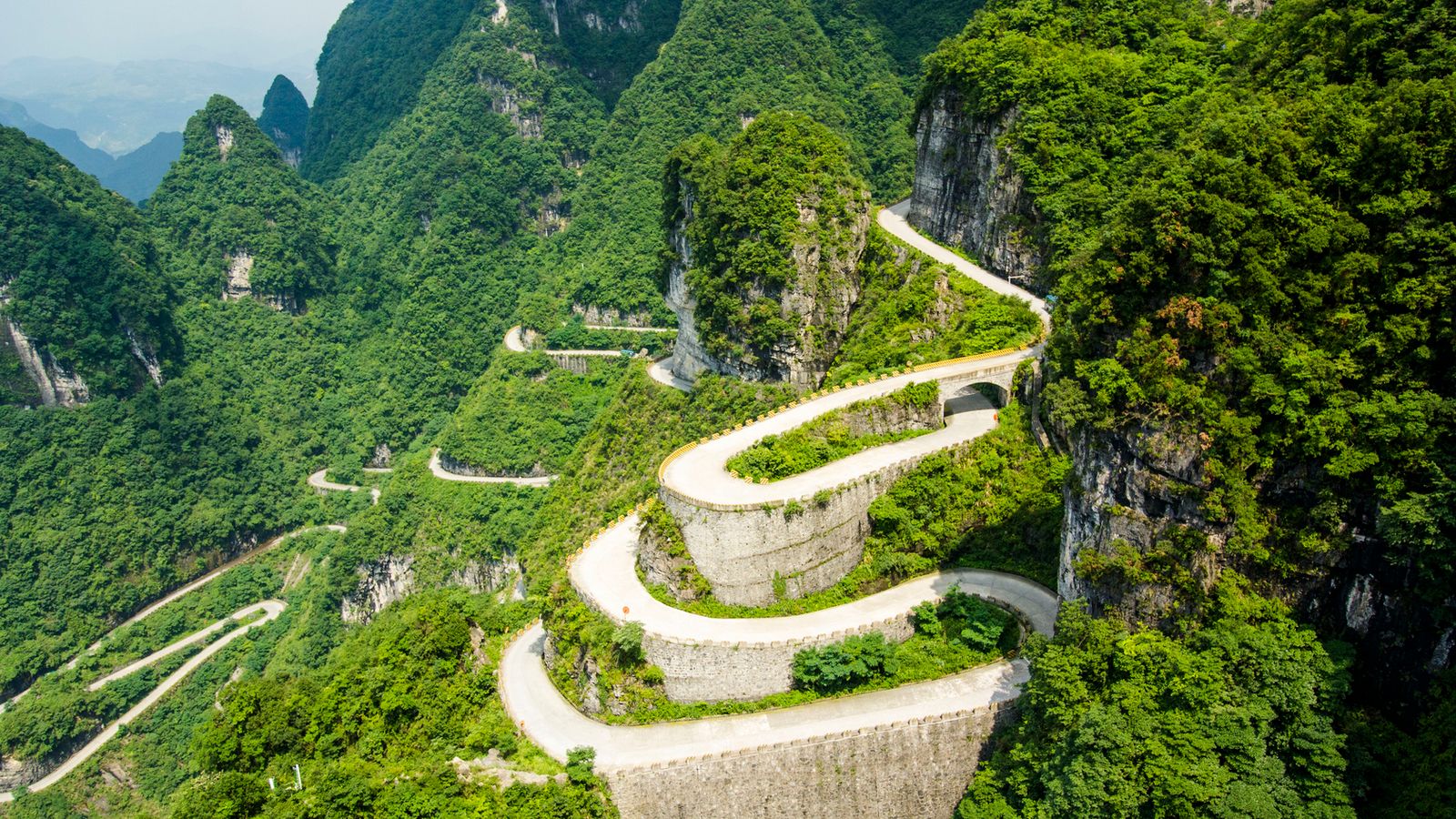
But the third way that tourists could seek to reach the peak of the mountain is Tongtian Avenue, a road also known as 99 Bends to Heaven. This name derives from the 99 hairpin turns the road makes, just one of many features that makes the road considered one of the most dangerous in the world.
Not only is the narrow road full of sharp turns, it is also very steep. This probably seems obvious since the road literally scales a mountain, but it is a major contributing factor to just how dangerous the road is. Though there are Jersey barriers lining the road to prevent cars from careening off the edge, there are reasonably large gaps between the barriers as well.
It’s not just the design of the road itself that makes this so dangerous either. The area is known for frequent heavy rains, resulting in slippery pavement that makes navigating the road even more dangerous. There is often thick fog covering the road as well, resulting in reduced visibility. And with an altitude of over 5,000 feet above sea level, the thinner air can cause dizziness and fatigue for drivers who aren’t used to the elevation.
However, while the 99 Bends to Heaven is known as an extremely dangerous road, driving fatalities are very rare. This is because the vast majority of traffic on the road is in the form of tourist buses with experienced drivers. That said, there is one noticeable instance of a civilian driving on the road in the least safe way possible.
The mountainside road is 11 km (6.8 miles) in length, and in 2016, Italian driver Fabio Barone set the record for completing the drive in his Ferrari 458 in just 10 minutes and 31 seconds. Of course, it was easy to set the record as no previous speed record existed, and 1 km per minute, or about 37 miles per hour, doesn’t seem terribly fast. It certainly doesn’t seem like a speed that would require a Ferrari to achieve. But since Barone is an incredibly experienced driver with a number of daring speed records to his name, this seemingly leisurely speed record should demonstrate just how dangerous China’s 99 Bends to Heaven is to navigate.
R504 Kolyma Highway, Russia
The R504 Kolyma Highway extends just over 2,000 km (1,260 miles) from Magadan in the Russian Far East to Yakutsk in Siberia. To many locals it is known simply as “Trassa”, or “the route”, as it is the only road in the area so there is no need to differentiate it from others. However, Kolyma Highway has a much darker nickname as well: the Road of Bones.
Construction of the highway began in 1932 and ran through 1953. The entire time, the construction was being performed by prisoners of the gulags. These prisoners were deliberately worked to death, and it is believed that over 250,000 prisoners died making the highway, with some estimates putting the number as high as one million.
Though not confirmed, it is widely believed that the bodies of prisoners who died during construction were buried beneath the road. The entire length of the Kolyma Highway is built atop permafrost, so it has been argued that it would simply have been easier to bury the dead as part of the road rather than trying to dig separate holes for them.
But the road wasn’t just dangerous for the people building it. The highway is unpaved, and sharp rocks littering the road are a major hazard that can cause punctured tires. There are no service stations along the highway, so unless the driver is able to repair the tires themselves, they will be stranded. And seeing as the highway extends into Siberia, you can guess how dangerous being stranded on this road is in the winter.
That’s a very real risk, as winter in the region lasts for 10 months, with average winter temperatures of about -50 degrees Celsius (-60 degrees Fahrenheit). In fact, the coldest temperatures ever recorded outside of Antarctica are along the Kolyma Highway. Some sections of the road require driving across frozen rivers, though many motorists have lost their lives when it turned out that the rivers they were driving on weren’t quite as frozen yet as they had believed them to be.
However, while driving thousands of km across icy roads in such extreme cold seems incredibly dangerous, and it is, it turns out that winter is actually the safer time to travel along the highway. In July and August when the road isn’t iced over, things actually get much worse. If the weather is dry, vehicles traveling along the unpaved roads kick up massive clouds of dust and sand, creating white out conditions for anyone traveling behind them. The lack of visibility can result in cars driving off the road or into oncoming traffic.
The summer months are rarely dry though, and the roads are usually soaked either by rain or runoff from melting ice flows and rivers. This turns the road into a muddy quagmire from which cars often can’t escape. When the road is muddy, it’s common to see traffic jams extending for 100 km or more thanks to those who got trapped in the mud. During the brief period of summer, those stranded on the road have to contend with wildlife hazards that are not present in the winter month.
The more obvious threat is the abundance of hungry bears roaming the wilderness, though bear attacks on humans aren’t particularly common. Less noticeable, but far more dangerous to humans, are ticks carrying encephalitis. This is particularly dangerous given how remote the highway is and the lack of medical facilities.
Fortunately, travelers are now able to skip the most dangerous section of the Kolyma Highway. In 2008, the highway officially became a Federal Road and received some upgrades, including a new path that bypassed a 420 km section from Kyubeme to Kadykchan. The previous section has been renamed Old Summer Road. Old Summer Road receives very little maintenance, and half of it has been entirely abandoned. The road now features collapsing bridges and areas of road that are reclaimed by rivers in the summer.
For fans of needlessly dangerous adventures, the Kolyma Highway and especially Old Summer Road are seen as a bucket list item, somewhere that absolutely must be visited. Just remember that you can’t drive a standard car down the highway, as only off-road motorcycles and 4x4s are capable of traversing the dangerous road. You’ll want to be sure you know how to repair your vehicle and tires in case anything goes wrong, lest you become yet another traveler to freeze to death in a broken down vehicle. And if you plan on going in the summer months, of course be sure to get vaccinated for tick-borne encephalitis.
Watch the Video
Open Video
Video Briefing
These are the Most Dangerous Roads in the World
BR-116, Brazil
BR-116 is the longest and most important highway in Brazil, extending over 4,500 km (2,800 miles). With a highway that long, it’s safe to say that not all of it can be inherently dangerous because of the terrain. Much of the terrain itself is fine, and in recent decades large sections of the highway were duplicated. That’s just a fancy way of saying they made the highway wider and added a median to prevent head on collisions from traffic traveling in opposite directions.
That said, there are stretches of the road that are dangerous for the traditional reasons one might expect. The section of BR-116 connecting Taboão da Serra and Curitiba, Paraná is official named Rodovia Régis Bittencourt, but it is better known as Rodovia da Morte, or the Highway of Death. This area of the highway runs dangerously close to steep cliffs, and terrible weather conditions often result in accidents.
But there are several reasons that this road is so dangerous that may not be so obvious from a glance. While the danger on many roads is related to how the road was designed, for BR-116 much of the danger comes from the people on the road. Most notably, the highway is packed with long haul truckers. On the Highway of Death, these trucks make up 60% of the total traffic on the road.
This causes immense wear on the roads themselves, and despite the recent duplication the roads are notorious for being poorly maintained.
Not only are the trucks damaging the road itself and making it more dangerous, but the truckers work long, grueling hours resulting in a bunch of massive big rigs being driven by tired, overworked drivers. Numerous studies have shown that driving while exhausted is just as dangerous as driving while intoxicated, and many of these truckers are doing both, as drug use is one of the most common ways long haul truckers around the world attempt to stay alert.
According to a study from 2017, the vast majority of Brazilian truckers drive over 9 hours each day, two thirds use amphetamines while driving to stay alert, and an astonishing 91% drink alcohol on the job.
However, it’s not just overworked and intoxicated truckers whose heavy big rigs destroy the pavement that make the road dangerous. Even if the physical road itself was perfect and the weather was beautiful and clear every day, there’s one other danger lurking on BR-116: gangs. It’s well known that police virtually never patrol the highway, so drivers may fall prey to roaming gangs and ambushes set up by armed bandits.
And if all of that wasn’t enough, the highway is also the most active road in the world for child sex trafficking. Along the full length of BR-116 there are over 260 locations where children are known to be sold, which is almost one every 10 miles. Some of these children are victims of kidnapping while others are sent there by their own parents to earn money so the family can afford food.
It all goes to show that it isn’t just climate and topography that can make a road dangerous. Those are factors on BR-116 as well, but there’s a whole lot more going on. It’s reported that, in total, there are thousands of deaths on the highway every year.
North Yungas Road, Bolivia
While there are a lot of dangerous roads, there can only be one most dangerous road in the world. And in 1995, the Inter-American Development Bank gave that distinction to North Yungas Road in Bolivia. What makes a bank’s opinion on the matter hold so much weight is a little bit nebulous, but there are few who would disagree that this truly is the most dangerous road in the world.
The road was built in the 1930s, mostly by Paraguayan prisoners during the Chaco Wars. It was built to connect the capital city of La Paz, located high in the Andes Mountains, with the Yungas region of Bolivia. The Yungas region is a subtropical region connecting the mountains to the Amazon, and a road connecting La Paz and Yungas was important because of the natural resources located within the region. Specifically those resources were gold and white gold, also known as cocaine (or in this case raw coca plants).
Stretching 64 km (40 miles) and descending 3,500 meters (11,500 feet) across that path, the journey across the North Yungas Road is as long as it is treacherous. The road is narrow, with some sections only being about 3 meters wide. That’s the minimum width of a single lane of highway traffic, and cars would have to pull over and wait at wider sections of the road if there was traffic coming in the other direction. Although Bolivia (like all sensible countries) uses right-hand traffic, Yungas Road uses left-hand traffic so that drivers can more accurately gauge how close they are to the edge of the mountain.
This is incredibly important, because if a car heads too far in that direction it will fall straight off the mountain; there are virtually no guardrails at all along the entire length of road. Instead, the roadside is littered with makeshift tombstones and memorials to all of the people who perished by falling off the mountain. And that was an all too common experience.
From the time it was built until the mid 1990s, an average of 200-300 people each year died in vehicles that fell off the road. Locals referred to Yungas Road as “camino de la muerte”, or “the road of death”.
While a steep, narrow, winding road with no guardrails would already be dangerous, there’s so much more to make this road as unsafe as possible. The road is frequently covered in fog making it difficult to see, and constant rain leaves this unpaved gravel road muddy and slippery. Even if it hasn’t rained, there are a number of waterfalls leaving sections of the road permanently slick.
But even if a driver is being as careful as they can possibly be it may not matter, as unpredictable landslides can sweep a vehicle over the edge of the cliff. And if all of that wasn’t enough, the road is also uneven and full of potholes.
Fortunately, an alternate route was finally constructed in 2009 so that travelers would no longer need to rely on the Road of Death to travel from La Paz to the Yungas region. The new road is paved, two lanes wide, and features guardrails and a drainage system to keep the road from flooding. But despite the existence of this safer route, tens of thousands of tourists still visit Bolivia to travel on Yungas Road each year.
In 2011, two years after the alternate route was built, there were still 114 accidents resulting in 42 deaths. Not all accidents involve large vehicles either, as dozens of cyclists are known to have fallen off the cliff as well.
Although some would argue that North Yungas Road no longer deserves the title of most dangerous road in the world since it is no longer a mandatory route, the ever-growing pile of corpses on the side of the mountain seems to suggest that the road is no safer today than it was in the 1930s.
Key Takeaways
- The 99 Bends to Heaven in China is extremely dangerous due to its steepness, sharp turns, and frequent heavy rains.
- The R504 Kolyma Highway in Russia is known as the Road of Bones, built by prisoners and dangerous due to extreme cold and unpaved roads.
- BR-116 in Brazil, known as the Highway of Death, is perilous due to overworked truckers, poor maintenance, and criminal activity.
- North Yungas Road in Bolivia, dubbed the Road of Death, features narrow paths, no guardrails, and frequent fog and rain.
- Despite safer alternatives, dangerous roads like North Yungas in Bolivia still attract tourists, leading to ongoing accidents.
SideProjects Editors
The SideProjects editorial team researches, fact-checks, and structures explainers about the lesser-known tales, side narratives, and spin-offs behind major historical and contemporary subjects.
Frequently Asked Questions
What is the 99 Bends to Heaven?
The 99 Bends to Heaven is a road in China that scales Tianmen Mountain, featuring 99 hairpin turns. It is known for its steepness, narrowness, and dangerous conditions due to frequent heavy rains, thick fog, and high altitude.
Why is the Kolyma Highway in Russia called the Road of Bones?
The Kolyma Highway is called the Road of Bones because it was constructed by prisoners of the gulags, many of whom died during its construction. It is believed that the bodies of these prisoners were buried beneath the road.
What makes the BR-116 highway in Brazil dangerous?
The BR-116 highway is dangerous due to its proximity to steep cliffs, poor maintenance, overworked and intoxicated truck drivers, gang activity, and being a hotspot for child sex trafficking.
What is the North Yungas Road in Bolivia known for?
The North Yungas Road in Bolivia is known for being extremely dangerous, with narrow paths, no guardrails, frequent fog, muddy and slippery conditions, and a high number of fatalities due to vehicles falling off the mountain.
How long is the Kolyma Highway in Russia?
The Kolyma Highway in Russia extends just over 2,000 km (1,260 miles) from Magadan in the Russian Far East to Yakutsk in Siberia.
What are the dangers of driving on the North Yungas Road in the summer?
In the summer, the North Yungas Road is frequently covered in fog and constant rain leaves the unpaved gravel road muddy and slippery. Additionally, waterfalls leave sections of the road permanently slick, and landslides can sweep vehicles over the edge of the cliff.
What is the significance of the number 99 in the 99 Bends to Heaven?
The number 99 in the 99 Bends to Heaven is significant because the number 9 is considered lucky in China, symbolizing longevity, happiness, and luck.
What is the alternate route to the North Yungas Road?
The alternate route to the North Yungas Road was constructed in 2009. It is paved, two lanes wide, and features guardrails and a drainage system to keep the road from flooding.
What are the dangers of driving on the Kolyma Highway in the summer?
In the summer, the Kolyma Highway can have whiteout conditions due to dust and sand, or it can turn into a muddy quagmire from rain or melting ice, leading to traffic jams and stranded vehicles. Additionally, there are wildlife hazards such as bears and ticks carrying encephalitis.
What is the Highway of Death on BR-116?
The Highway of Death is a section of BR-116 connecting Taboão da Serra and Curitiba, Paraná. It is known for its proximity to steep cliffs, poor maintenance, and high traffic of long-haul truckers, which contributes to its danger.