
By Kevin Jennings
If there’s one thing people love, it’s to run their mouths. And while different nations allow for varying degrees of freedom of speech, people will happily remind you that freedom from speech does not mean freedom from consequences.
Of course, the extent of those consequences may vary. Some people may only experience a blow to their reputation, while others could be financially ruined. And in at least one instance, saying the wrong thing at the wrong time resulted in the loss of the United States presidency.
Key Takeaways
- Gerald Ratner’s speech about his company’s products led to a £500 million drop in value.
- Neville Chamberlain’s ‘peace for our time’ speech was ironic, as war began shortly after.
- Theresa May’s speech was disrupted by a comedian and a persistent coughing fit.
- Elon Musk’s tweet about taking Tesla private resulted in legal consequences and fines.
- Herbert Hoover’s optimistic statements about the economy were proven wrong by the Great Depression.
Gerald Ratner’s Crap Speech
Viewers in the US may not recognize the name Gerald Ratner, but the Ratner Group was once one of the most successful jewelry chains, particularly discount jewelry. The group owned over 1,000 stores in the United States, such as the Kay Jewelers chain, but few if any stores in the US actually used the Ratner name.
Gerald was born in London in 1949, and jewelry stores were the family business. However, once he became CEO in the 1980s, he was able to build up the company to new heights. This was all thanks to observations he made as a child at the Petticoat Lane Market. Gerald noticed that “the people who shouted the loudest and appeared to give the best offers sold the most”.
That lesson stuck with him throughout his life, and it became the foundational principle for the chain of discount jewelry stores. Rather than focusing on the rarity, prestige, and extravagance of their jewelry, the stores hung neon posters offering deep discounts on their products.
While many people believed that the advertisements were as tacky as the products that Ratner’s was selling, the gimmick still worked. And it has continued to work across multiple industries, most notably the mattress industry where every retail store has been running “going out of business” sales nonstop since the 1990s.
By 1990, the Ratner Group reached a peak value of £840 million. Gerald had worked hard as CEO and Chairman for over a decade, and his efforts had really paid off. You might think it would be hard to undo that level of success, but Gerald managed to bring it all crashing down in a matter of minutes.
On April 23, 1991, Gerald gave a speech at the Royal Albert Hall during a conference of the Institute of Directors, a professional organization for company owners big and small. In what can only be described as an attempt to be funny, Gerald decided that he was going to ridicule the quality of his company’s own products.
He talked about a fake coffee table book that he described as being in poor taste, even though the company sold over 250,000 copies of it. He went on to say, “We also do cut-glass sherry decanters complete with six glasses on a silver-plated tray that your butler can serve you drinks on, all for £4.95. People say, ‘How can you sell this for such a low price?’, I say, ‘because it’s total crap.’”
After that he mentioned gold earrings that Ratner’s sold for less than a pound. He described the price as being “cheaper than a prawn sandwich from Marks and Spencer’s, but I have to say the sandwich will probably last longer than the earrings.” In Gerald’s defense, the audience did seem to find his comments entertaining. But the rest of the general public did not.
Almost overnight, the company’s value fell by £500 million. Gerald stepped down as chairman of the company and hired a new chairman to try to rehabilitate the company’s image. The new chairman did so by firing Gerald a year later and changing the company’s name to Signet Group, removing the Ratner name entirely. By the time Gerald was fired, the company’s value had fallen to just £33.7 million, less than 5% of its peak value just two years earlier.
Neville Chamberlain’s “Peace for Our Time”
You may often hear references to the appeasement of Nazi Germany, and how attempts to appease a totalitarian state will always be unsuccessful. Such was the case with the Munich Agreement of 1938.
On September 17, Hitler began a low-intensity, undeclared war on Czechoslovakia. When the First Czechoslovak Republic was created in 1918 following the fall of the Austro-Hungarian Empire, there were millions of ethnic Germans living on the nation’s border near Germany and Austria. This area was named the Sudetenland, and the ethnic German residents had not been given a choice on whether or not they wanted to be part of Czechoslovakia.
Legally they were supposed to be equal, but Germans in Czechoslovakia faced severe discrimination. When the Great Depression hit, it was the German residents that were hit hardest. It was based on these factors that Hitler wanted to take control of the Sudetenland, which he wanted people to believe was his last territorial claim in Europe.
Just days after Germany’s war began, England and France were both requesting that the Czechoslovakian government cede the Sudetenland to Germany. Fighting continued for over a week, until an emergency meeting was held between Germany, England, France, and Italy on September 29th and 30th. Czechoslovakian representatives were notably absent from the meeting, even though they were in the city at the time.
All parties involved quickly agreed to Hitler’s terms and signed the Munich Agreement, a treaty that would require Czechoslovakia to cede the Sudetenland to Germany. Czechoslovakia obviously didn’t want to do this, but between the military assaults and diplomatic pressure, there didn’t seem to be another option.
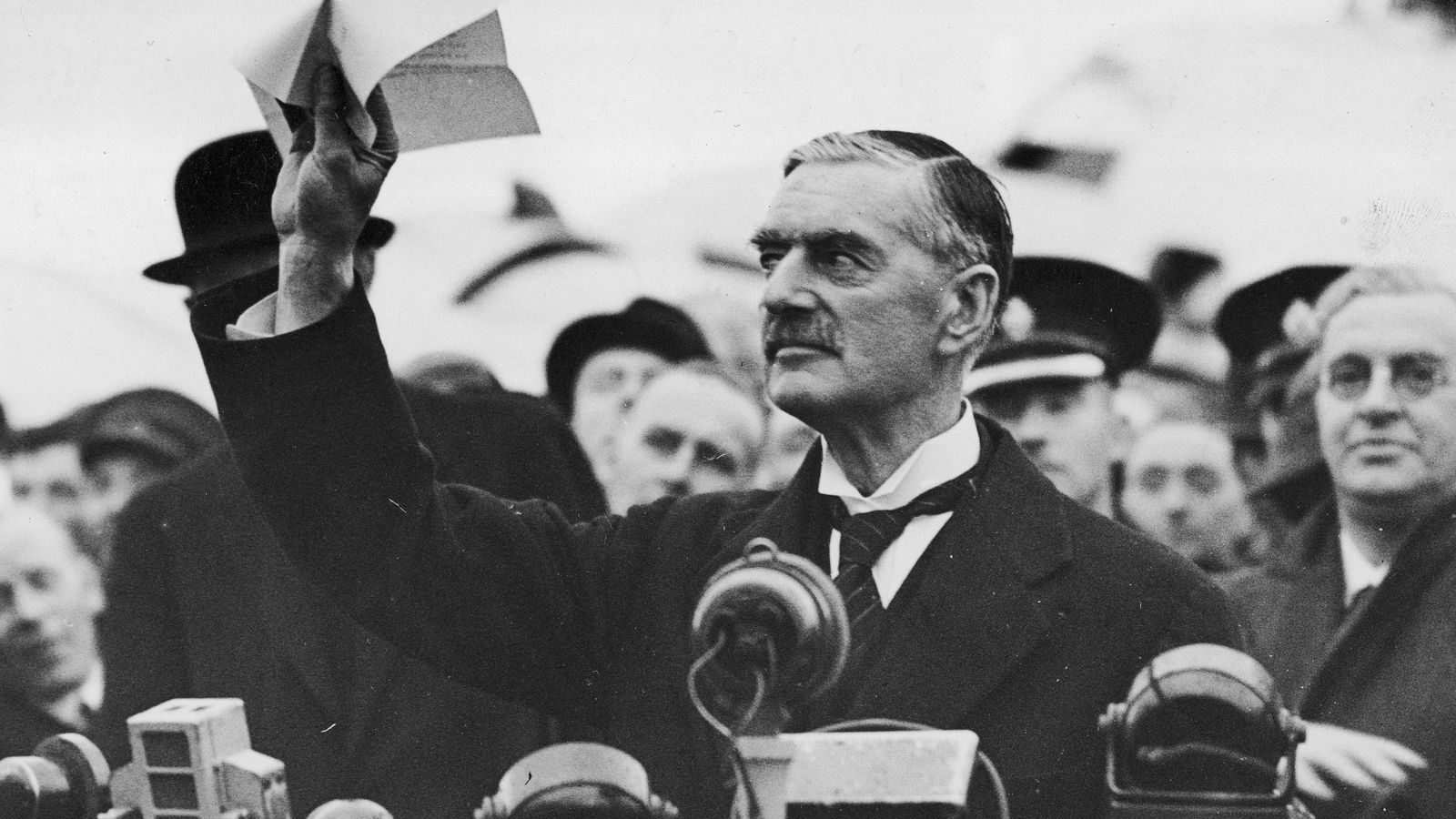
After the treaty was signed on September 30th, Prime Minister Neville Chamberlain returned to England where he gave a speech about the treaty they had signed, reading the agreement out for spectators. Later that day he stood outside 10 Downing Street and again read the treaty, adding, “My good friends, this is the second time in our history that there has come back from Germany to Downing Street peace with honour. I believe it is peace for our time. We thank you from the bottom of our hearts.
Now I recommend you go home and sleep quietly in your beds.”
Hopefully you already know what happened next, but less than a year after Chamberlain declared “peace for our time”, Hitler invaded Poland and began the Second World War. The phrase “peace for our time” became famous for how disappointingly ironic it turned out to be, and as a reminder of the futility of appeasement. It has since been referenced by everyone from JFK to Monty Python to Iron Man.
Two months after Chamberlain’s speech, Isaac Asimov wrote a short story in which World War II broke out in 1940, partly inspired by Chamberlain’s prediction of “peace for our time”. Asimov had found Chamberlain’s analysis of the situation to be detached from reality, though he later admitted he was too conservative in thinking Germany would wait until 1940 to launch a full scale war.
Theresa May’s Conservative Party Conference Speech
Every once in a while, a speech will be labeled a disaster unrelated to the actual contents of that speech. This was the case for Theresa May’s speech at a conservative party conference in October of 2017 where, while the words themselves were largely unremarkable, it was everything else surrounding the event that made it an entertaining disaster.
May had been appointed Prime Minister in July of 2016, two days after becoming the Leader of the Conservative Party. Her appointment came after the resignation of her predecessor, David Cameron. Although he had wanted to remain in the EU, Cameron had decided to call the Brexit referendum as an attempt to quash infighting within the Conservative Party and to weaken his opposition.
Watch the Video
Open Video
Video Briefing
Most Disastrous Speeches of All time.
But as you all know, the plan backfired. Voters opted to leave the EU, after which Cameron resigned. This left May with the unenviable position of having to negotiate a Brexit deal, even though she had also been opposed to leaving the EU. There was also the (accurate) public perception that Boris Johnson, who had been in favour of Brexit, wanted to become Leader of the Conservative Party.
None of that was what May’s speech was actually about that night, but it does provide the background for the first and largest interruption to the speech. About halfway through May’s speech, comedian Simon Brodkin (dressed up as his character Lee Nelson), emerged from the crowd and approached the podium.
He told Theresa, “Boris wanted me to give you this”, and handed her a P45, the document a person is given when they are fired for being redundant. Simon then turned to Johnson, gave him a thumbs up, and said, “Job done, Boris!” He was understandably escorted out of the venue following this, but it was a dramatic interruption to the speech that also raised a lot of questions about the security of the Prime Minister.
To her credit, and after the initial shock of a random person walking right up to her while she was on stage, May was able to laugh this off and make a joke about the situation. But that was one of the last clear statements she was able to make, as the second half of her speech was repeatedly interrupted by a nonstop coughing fit. Chancellor Philip Hammond came to the stage and gave her a cough drop, though this didn’t help; the coughing continued for the rest of May’s speech.
It wasn’t until the final minutes of the speech that the audience witnessed the most ironic mishap. On the wall behind May’s podium was the conference’s slogan, “Building a country that works for everyone.” As the speech neared its end, letters from that slogan began falling off the wall, onto the floor.
None of these issues through May’s speech were her fault, and she handled them all quite well, given the circumstances. But the speech remains a disaster not just because of all the things that went wrong, but because that’s all anybody can remember about that night. That, and that Boris Johnson needing to by told be those around him to stand up while everyone else was giving May a standing ovation. While lots of people remember the sight of a comedian handing the Prime Minister a P45 on stage, very few could actually tell you what her speech that night was even about.
Elon Musk’s “Funding Secured”
This statement wasn’t a speech in the traditional sense, but it was still a very public statement. On August 7, 2018, Elon Musk tweeted, “Am considering taking Tesla private at $420. Funding secured.” He followed up by saying, “Investor support is confirmed. Only reason why this is not certain is that it’s contingent on a shareholder vote.”
That would have been an exciting announcement for anyone who owned Tesla stock, which was valued at about $344 before Elon’s tweet. The only problem was that the statement wasn’t true at all. Elon later claimed to have been in talks with a Saudi sovereign wealth fund about securing funding to take the company private, but no specific purchase price had been worked out. In short, the funding was in fact not secured.
To the average person, that might seem like a minor distinction and just a man exercising his free speech. But even in America free speech has limits, and according to the Securities Exchange Act of 1934, the statements were a crime. In fact, they were potentially two crimes: fraud and market manipulation. Because the alleged sale price was going to be over 20% higher than the share price, Tesla stock saw a predictable bump in value following Elon’s announcement. However, that lasted about all of a day.
Because it’s very illegal for the Chairman and CEO of a company to make the sort of public statements Elon did if they aren’t true, the Securities and Exchange Commission immediately began investigating, demanding to see proof that the company was about to commence such a sale. Tesla’s stock price began falling once news of the SEC investigation broke, and a month after the initial tweets the price had fallen 25% from where it was before the tweets.
Tesla and Elon were facing civil and possibly even criminal prosecution, and a costly legal battle against the SEC threatened to bankrupt Tesla, which had lost $2 billion the previous year. As such, they opted to come to a settlement agreement instead. Tesla and Elon were each required to pay $20 million in fines, Elon was forced to step down as Tesla’s chairman, and a team of Tesla executives were required to approve any of Elon’s future tweets that contained substantive information about Tesla. However, Elon was still allowed to remain CEO of the company.
There was also a class action lawsuit filed against Elon by a number of Tesla’s investors. This lawsuit dragged on until 2023, when a jury acquitted Elon. That may not be the end of the story though, as the plaintiffs indicated that they were interested in appealing that decision.
While Elon had enough money not to be personally bankrupt by the $20 million fine, that’s still a whole lot of money to lose over a single tweet. And that’s before taking into account all of the court costs from the class action lawsuit. Of course, since $20 million is such a meaningless amount of money compared to both the US federal budget and Elon’s personal wealth, it does call into question why the SEC would have even agreed to such a lenient settlement in the first place.
Herbert Hoover’s “The Worst Is Behind Us”
In a way, Herbert Hoover was a victim of his own success. Hoover was born into poverty in 1874, and orphaned at the age of 10. Afterwards he lived with his uncle, and dropped out of school at the age of 13 to become an office assistant for his uncle’s real estate company. Hoover studied bookkeeping, typing, and math at night school, and in 1891 he was somehow accepted to Stanford University, despite failing his entrance exams.
Initially Hoover planned to study engineering, but he switched his major to geology. This turned out to be a wise decision, as an internship with the United States Geological Survey convinced him to pursue a career as a mining geologist. Keep in mind this was 1800s California, where gold mining was all the rage.
He graduated in 1885, and after a year working as a mining scout, he was hired by a London based mining company with mines in Australia. Hoover was paid $5,000 per year (about $166,000 today) to work as a manager in the Australian goldfields.
Just a couple years into this job, he was made a junior partner after impressing the owners by bringing in cheap immigrant labour and fighting against workers’ rights, such as minimum wage. His career just kind of spiraled from there, and by 1914, at the age of 40, Hoover owned his own consulting company, had mining investments on every continent (except Antarctica), and was worth over $4 million (about $130 million today).
Thanks to the trajectory of his own life story, Hoover believed in the ideas of American individualism and exceptionalism. As an American, all you had to do was work hard and pull yourself up by your bootstraps, and anything would be possible. Assuming you were white that is, particularly the late 1800’s America’s version of white, so no filthy Italians or Irish. Anyway, that would be a useful attitude to have as someone selling self-help books or something, but not a particularly good attitude for the President of the United States to have during a global Great Depression.
In 1929, Hoover said that “Any lack of confidence in the economic future or the strength of business in the United States is foolish.” Note that this statement would have come mere weeks after the devastating collapse of the stock market. That was a really bad take, but to be fair the collapse had just happened. Reality hadn’t yet had enough time to set in and disillusion Hoover from his dogmatic belief in some mythical, American ideal.
This became even more evident a year later when Hoover made his most famously horrible statement regarding the Great Depression, a statement he made in 1930: “The worst is behind us.” For anyone unaware, there were still nine more years of the Great Depression left, and it was definitely going to get worse. Despite Hoover’s insistence that the worst had already past and that there was no need for the government to provide aid to starving Americans who could succeed if only they worked harder, reality continued to prove otherwise.
The public began referring to shanty towns as Hoovervilles, to newspapers used as cover by the homeless as Hoover blankets, and to pant pockets that were turned inside out and completely empty as Hoover flags. His repeated doubling down on that 1930 statement and his refusal to accept the reality that gumption alone would not protect Americans from the state of the global economy resulted in a landslide defeat in 1932, with FDR unseating Hoover as president with an overwhelming 90% of electoral votes. Note that Hoover’s 1928 presidential win had also been a landslide victory, so the voting public turned against him in record numbers.
To be fair to Hoover, though, it’s not like he wasn’t trying to help. He may have been vehemently opposed to direct federal aid for children and elderly Americans who were starving to death, but he did offer up $2 billion of taxpayer money to help rescue banks and insurance companies.
Key Takeaways
- Gerald Ratner’s speech about his company’s products led to a £500 million drop in value.
- Neville Chamberlain’s ‘peace for our time’ speech was ironic, as war began shortly after.
- Theresa May’s speech was disrupted by a comedian and a persistent coughing fit.
- Elon Musk’s tweet about taking Tesla private resulted in legal consequences and fines.
- Herbert Hoover’s optimistic statements about the economy were proven wrong by the Great Depression.
SideProjects Editors
The SideProjects editorial team researches, fact-checks, and structures explainers about the lesser-known tales, side narratives, and spin-offs behind major historical and contemporary subjects.
Frequently Asked Questions
Who is Gerald Ratner?
Gerald Ratner was the CEO of the Ratner Group, a successful jewelry chain, particularly known for discount jewelry. He was born in London in 1949 and built up the company to new heights in the 1980s.
What was the impact of Gerald Ratner’s speech at the Royal Albert Hall?
Gerald Ratner’s speech at the Royal Albert Hall in 1991 led to a significant drop in the company’s value, from £840 million to £33.7 million within two years. He was eventually fired, and the company changed its name to Signet Group.
What was the Munich Agreement of 1938?
The Munich Agreement of 1938 was a treaty that required Czechoslovakia to cede the Sudetenland to Germany. It was signed by Germany, England, France, and Italy, with Czechoslovakia notably absent from the meeting.
What was the outcome of Neville Chamberlain’s ‘Peace for Our Time’ speech?
Less than a year after Chamberlain’s speech, Hitler invaded Poland, starting World War II. The phrase ‘peace for our time’ became famous for its ironic and disappointing outcome.
What happened during Theresa May’s Conservative Party Conference speech in 2017?
Theresa May’s speech was interrupted by a comedian who handed her a P45 document, and she suffered a persistent coughing fit. Additionally, letters from the conference’s slogan fell off the wall behind her.
What was the consequence of Elon Musk’s ‘Funding Secured’ tweet?
Elon Musk’s tweet led to an SEC investigation and a settlement where Tesla and Musk each paid $20 million in fines. Musk was forced to step down as Tesla’s chairman, and a team of executives had to approve his future tweets containing substantive information about Tesla.
What was Herbert Hoover’s famous statement during the Great Depression?
Herbert Hoover famously stated in 1930 that ‘The worst is behind us,’ which turned out to be incorrect as the Great Depression continued for another nine years.
What was the public’s reaction to Herbert Hoover’s handling of the Great Depression?
The public referred to shanty towns as ‘Hoovervilles,’ newspapers used as cover by the homeless as ‘Hoover blankets,’ and empty pockets as ‘Hoover flags.’ Hoover’s insistence that the worst was over led to his landslide defeat in the 1932 election.
Sources
- Original Side Projects video: Most Disastrous Speeches of All time.
- Hero image source by Photographer/studio not provided. Public domain photo according to Narodowe Archiwum Cyfrowe, the national archive of Poland. / openverse, by-sa.