Handguns have been with us for several centuries now, and throughout that time they’ve been a stalwart friend to Mankind, glued reliably to our hips whenever we happen to find ourselves with the need for something small and handy; just in case – be we soldier, police officer, hunter, or just a civilian.
But because of this niche that they fill oh so well, most handguns tend to be a bit… well, small, and we have a word to describe handguns like that: BORING. Instead, what we are interested in today is the ones that are the popular opposite of that: the BIG ones, the BRASH ones, and dare we say, the ridiculous ones – the handguns that are either so physically large, or go down range with so much power, that the only word to describe them is ‘OP,’ and we shall be taking a look at five of them.
Oh, and don’t worry, if you happen to be gritting your teeth in anticipation of yet ANOTHER video about powerful handguns on this illustrious platform that mentions nothing but Desert Eagles and .44 revolvers, that won’t be happening here – we’ve intentionally tried to think outside the box a bit to keep this video fresh.
Key Takeaways
- The article explores five unique and powerful handguns, avoiding common examples like the Desert Eagle.
- The Se-Chongtong Pistol, created in 1432, is noted as the first handgun, designed for widespread use.
- The Pfeifer-Zeliska .600 Nitro Express Revolver is a custom-made, extremely powerful revolver designed for big game hunting.
- The Gyrojet pistol, developed in the 1960s, fired rocket ammunition but had significant reliability and cost issues.
- The Arsenal Firearms AF2011 is a double-barreled version of the M1911, created as a publicity stunt to enter the U.S. market.
So, with that said, let’s begin!
Chapter 1: Two Bore Pistols
Dear audience, may we begin our first chapter by introducing you to this bad boy, the MIGHTY four bore, an olden day’s black powder era cartridge that was used for killing very big things very quickly; imagine being a mutton chopped Victorian chap on Safari, when suddenly, a giant elephant decides to charge at you – a four bore rifle was what you would reach for to drop it one shot. Given time, the cartridge would also find its way into pistols, for much the same reasons, just in a handier package.
As you can see on the screen now, four bore is just A BIT big, and if you happen to be wondering about specifics, a four bore projectile would typically have a diameter of exactly one whole inch, and also weigh a quarter of a pound. Being a black powder round, it was a tad slow however, with a typical muzzle velocity in the region of 1,200 to 1,400 feet per second, as compared to the three or so thousand feet per second you would expect out of a modern smokeless powder rifle round. This, incidentally, was exactly why it was so big; black powder has a rather slow maximum potential muzzle velocity, so when you need to make it pack more punch, what do you do? You make the projectile bigger – simple!
Oh, and if you happen to be wondering what the hell an ‘X bore’ even is, don’t worry, as it is rather out of date bullet lingo at this point. To put it simply, it is an old British system of measuring the barrel diameter according to the number of round lead balls of that size that would make up one pound of lead – so a perfectly circular lead ball of four bore size would equate to a quarter pound of lead, as we just mentioned.
But as ridiculous as four bore pistols were, they at least had SOME practical use to them, even if it was rather niche. The same cannot be said of its bigger brother, the frankly ridiculous two bore. As you might have already guessed, it’s twice as heavy as four bore, with a typical spherical projectile weighing an entire half pound. As for its physical size, a normal two bore round is 1.3 inches in diameter. Muzzle velocity is in the same ballpark four bore, but typically strays a tad higher, in the region of 1,500 feet per second or so. As a result of all this, a two bore cartridge ends up with a typical muzzle energy in the region of 17,500 foot-pounds.
To put this into perspective, because what the hell is a foot-pound, right? A .50BMG, the round most people are referring too when they say ‘50 cal,’ typically produces muzzle energy in the region of 12 or 15 thousand foot-pounds… LESS than two bore. Further to that, a .50BMG projectile also typically weighs somewhere around 0.1 pounds – so a two bore is give or take five times heavier than the .50BMG. Naturally however, thanks to smokeless powder, the .50BMG is rather faster, having a typical velocity in the 2,800 to 3,000 feet per second kind of area.
And in case that wasn’t mad enough, don’t forget this is a video about PISTOLS, whereas the .50BMG is a RIFLE round – so yes, this ridiculous round, which is actually broader than the modern ‘cannon diameter’ benchmark of 20mm has actually been put into pistols.
Unlike the four bore however, which did have a legitimate use back in the black powder days, there is no such legitimate usage for two bore that we were able to find in our research. Instead, it appears as though it was, and still is, little but a windmilling tool for aspiring gunsmiths – an easy way of getting attention by saying “look at this ridiculous thing I made, aren’t I clever, please buy my guns!”
We also know basically nothing about the history of two bore, as seemingly no historian has ever taken the time to delve into the matter, they just kind of turn up every now and then, with a great example being this ‘Stolzer & Sons Lil Deuce 2 Bore Back Action Percussion Pistol’ which was made back in 2011 through to 2012, ‘Stolzer & Sons’ being a small craft gunsmith that specialises in making BIG bore firearms.
Chapter 2: Pfeifer-Zeliska .600 Nitro Express Revolver
Dirty Harry once famously claimed that a .44 magnum revolver was “the most powerful handgun in the world.” Certainly, this made for quite the exhilarating cinematic experience when the luck of the punk to whom he proclaimed it was put the test, but alas, though exciting, the claim was in fact a big old load of bollocks, as at that time, this, the mighty .454 Casull existed, and had done since 1958 – and it packed a whopping typical muzzle velocity of 1,900 foot-pounds as compared to the 1,000 to 1,400ish typical muzzle velocity of the .44 Magnum, or .44 ‘Remington’ Magnum, to give it its proper name.
But even the .454 Casull is but a peashooter compared to the .600 Nitro Express, which has been knocking around since all the way back in 1899 and posts a typical muzzle velocity in the region of seven to eight thousand foot-pounds. But, as the gun nuts amongst you have no doubt already shouted at your screens, this is to be expected, right, as .600 Nitro Express is a rifle round, and so, is far bigger than any handgun round, and thus OF COURSE it is more powerful… so why do we bring it up on a video all about OP handguns?
Well, that would be because in 2001 an Austrian craft gun manufacturer by the name of Pfeifer Waffen put it into a revolver, and here it is, BEHOLD.
Dubbed the ‘Pfeifer-Zeliska .600 Nitro Express Revolver,’ it came about because somewhere in the rolling peaks of the Austrian Alps, a shooting enthusiastic by the name of Adolf Zeliska, who had far too much disposable income and an enormous love of the ‘Golden Age of Big Game Hunting’ that was the late Victorian period wanted his favourite cartridge, .600 Nitro Express, crammed into a handy dandy revolver package – because why not? And a few months later, after many, MANY Austrian Schilling had changed hands, this ridiculous revolver was born – with it essentially just being an enlarged version of Pfeifer Waffen’s earlier, already very large, .458 Win Mag revolver.
It weighs about 13 pounds, which, its safe to say, is quite heavy for a handgun, given that a typical Glock 17, as very likely carried by your local police officer, weighs roughly 1.5 pounds. Partly, this weight was the result of mere fate – a revolver firing a big round is naturally going to be quite big anyway, but also, this weight was very intentional, as a heavier gun has less recoil than a lighter gun, thanks to its mass absorbing some of the energy, and so, quite intentionally, NO effort towards weight saving was made during its design process, so that, touch wood, you wouldn’t need to book a rhinoplasty appointment after every range day.
Despite purportedly costing him the equivalent of $17,000 USD, and $40 US per round, although the sources don’t specify whether or not those figures are adjusted for inflation or not, Zeliska couldn’t have been more chuffed with his new toy, and started showing it off to anyone and anyone who would take an interest, firearms magazines included. Naturally, quite a few others then started taking an interest in the ridiculous revolver which fired a round that could stop and elephant dead in its tracks too, and wanted one for themselves, which led to Pfeifer continuing to pump a few more out in the following years.
It appears as though it was discontinued at some point however, because as of the time of writing there is no reference at all to it in Pfeifer’s sales catalogue.
All in all, it’s ridiculous, it’s impractical, its ungodly expensive, and its almost impossible to find one for sale today, but be honest… you want one, don’t you?
Chapter 3: Gyrojet
Now bear with us folks, because no doubt, having just read this chapter’s title card, many of you are now ready to launch your device out of the window while screaming words to the extent of “Sideprojects you bunch of tools, everyone knows the Gyrojet was a load of crap!” Well, hold that thought folks, because today we aren’t looking for reliable, cost effective, or even practical handguns are we? We are looking for POWERFUL ones, ones that you REALLY don’t want to be shot by, and that is all, and there is no doubt that the Gyrojet, for all of its many flaws, DEFINITELY fits into that category.
Watch the Video
Open Video
Video Briefing
Most Ridiculously OP Handguns of All Time
For those of you not in the know however, allow us to give you a quick overview of the Gyrojet.
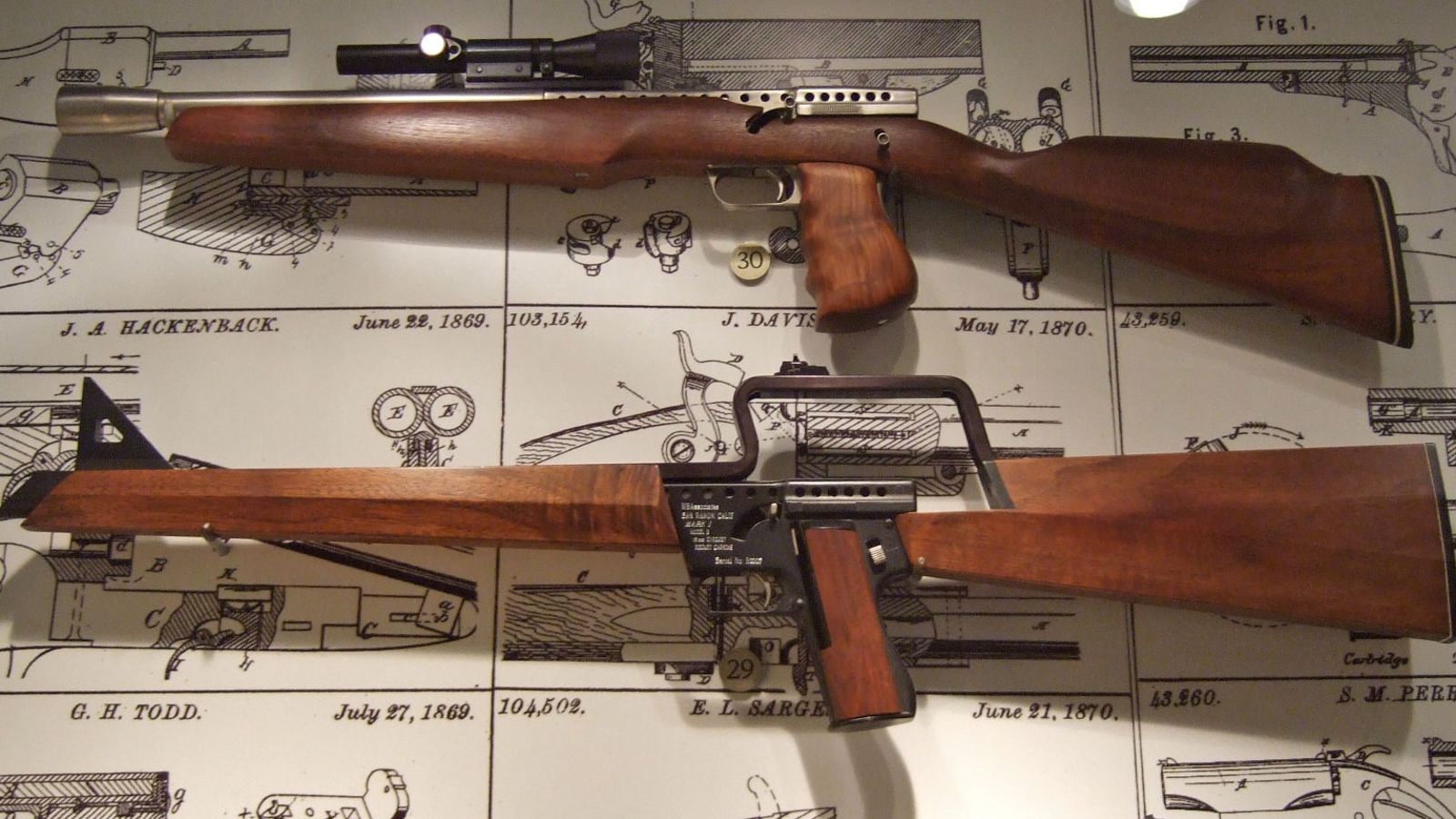
Developed in the 1960s by Robert Mainhardt and Art Biehl of MBA Associates, it was a pistol whose function was every bit as sci-fi as its looks, because it fired rocket ammunition. You didn’t mishear us there, we did say ROCKET ammunition – as in, tiny little rockets that fly out the barrel straight into the face of whatever villain the Gyrojet happens to be pointed at.
These rockets, or “Microjets,” as they were referred to in official lingo, were caseless rounds that had their rocket motors built into the projectile itself. As a result of this, unlike a normal firearm, whose bullets stop accelerating after they leave the barrel because there is no more ‘explosion’ behind them, the microjet would carry on accelerating once it was free of the barrel, and this, theoretically anyway, would result in lower recoil, as acceleration was no longer happening internally of the firearm, and greater accuracy, as the rocket motors would be actively ‘twisting’ the round for far longer than a normal bullet would be while within the length of a barrel. It also packed a fair punch too, with some estimates claiming that once a Microjet had travelled 60 feet and was up to full speed, about 1200 feet per second or so, it had twice as much energy as a .45ACP round.
Unfortunately, however, the Microjet was a big old load of junk in the real world. Theoretically the idea was a good one make no mistake, but it was an idea that required beyond precise manufacturing of the projectiles to work correctly, and that simply couldn’t be figured out by MBA Associates, so SOME Microjets would work an absolute treat, but then the next one out of the barrel would be about as accurate as a Sunday league striker after 15 pints of lager.
Worst of all however, remember how we said the Microjet continued accelerating out of the barrel? Well, with that in mind, how fast do you suppose a Microjet travelled immediately after leaving the barrel? To use the technical term: slow as f*ck, as in, couldn’t even reliably penetrate a man’s chest at point blank range slow.
And on top of all of that, the Microjets were also unfathomably expensive, and if you know anything about Uncle Sam, he can be a tad allergic to revolutionary new technologies that promise the world… for a price. So, naturally, after playing with it a bit here and there in Vietnam to suss it out, the US Army was not interested in adopting it at all. Incidentally, this is something that has only gotten worse with time, as Gyrojets have gotten more and more interest over the years, and, let’s be frank, become a meme gun, the value of the few that MBA made have gone through the roof, and will now set you back $6,000ish USD for a nice one, and the ammo, HA!, if you can find someone still making it, expect to pay a couple of hundred bucks a round.
So, with all of that in mind, where do we find the gall, the barefaced cheek, to put the Gyrojet on this list of OP handguns? Well, remember what we said about it having twice the energy of a .45ACP round when the stars aligned right? Yeah, that. When it worked right, the Gyrojet was a downright terrifying tool, and seeing as how we’re specifically thinking outside of the box today to keep this list different to all of those other copy and pasted list of powerful handguns on the internet, let’s all come together, absolve the Gyrojet of its many sins, and judge it at its absolute best.
Chapter 4: Se-Chongtong
Now we must travel back in time several centuries to have a look at THIS, the Se-Chongtong Pistol, which was created all the way back in Korea in 1432 during the reign of King Sejong. Now, we’ll be the first to admit, this doesn’t exactly look like the most terrifying tool ever places into Man’s palm, so what historiography manipulation have we done to justify it as an interesting inclusion on our list? Well, that’s simple, it was THE first handgun – and what could be more OP than having no competition at all?
In many ways, it was a FP-45 Liberator 500 years before its time, as it was designed to be a cheap and cheerful bit of kit, that was lightweight and easy enough to handle that ANY able-bodied person could use it.
It is made primarily from bronze, and measures 13.8 centimetres in length by 1.4 centimetres across, with a barrel diameter of 1.4 centimetres. As for ammo, it shot small arrows rather than any sort of metal ‘bullet’ as we might imagine it today, and was operated by shoving some gunpowder down the barrel, stuffing the arrow in front of it to both compact said gunpowder and sealing it in tight, and then lighting a fuse that pocket out the back, which would burn down, ignite the gunpowder, and shoot out the arrow; a bit clunky compared to a Glock to be sure, but for the 15th century, it was a damned clever bit of kit.
Opinions on it were mixed at the time. King Sejong apparently founds its range, about 200 yards or so on a good day, disappointing, as he apparently pictured his handgun as having the exact same range as a big boy towed cannon – it was the same technology after all, why shouldn’t it shoot as far! The soldiers on the ground however, who were forced to take a more pragmatic view of things what with the whole enemy trying to kill them thing, soon grew to love it, particularly the cavalry, who would often keep a bag load of them to hand to quickly fire off simply devastating barrages without having to reload.
Further to that, it also came to be appreciated by those engaged in clandestine operations, who valued its ability to discretely stowed away in one’s clothes. Civilians took a shine to it too – the state could pump them out by the thousand since they were so simple and give them to basically everyone who wanted one, and because it didn’t require immense upper body strength to effectively operate, like a bow did, ANYONE could pick one up and get a few shots off if the barbarians ever poured through the gate.
As for its lethality, that is something we know A LOT about, as modern Korean historians have extensively put recreations of the Se-Chongtong through its paces to see what it was capable of, and after letting them off against ballistic dummies, it was found that it could quite happily penetrate and shatter the jaw, get through the skull and lodge itself in the oh so sensitive grey matter that it protected, or even, if the stars aligned correctly, pass in through the front of the skull, and keep on going right out through the back – not bad for a cheap and cheerful little thing that could be used by any old civilian, right?
Chapter 5: Arsenal Firearms AF2011
And so we arrive at our final chapter, and once again, we have bent the definitions of ‘OP’ a bit here to bring you something legitimately interesting, rather than just the five millionth dissection of the Desert Eagle on the internet.
As for exactly what, that would be the Arsenal Firearms AF2011. But pray tell Sideprojects, we hear you all cry out, what even is one of those?
Well, you know the M1911, the pistol that the US first adopted as its service pistol over 100 years ago, and since then has gone on to be adopted by over DOZENS of countries, made by the 10s of million, and is beloved the world over for the heavy punch of its .45ACP, the cartridge we specifically used as a point of reference two chapters back to give you a soft foundation for this chapter? Well, what if that absolute unit of a handgun had two barrels… BEHOLD.
As for how this works, it really is, to simplify it a bit, two 1911s smashed together. It has two magazines, although Arsenal Firearms supply special ‘combo’ mags that share a common base for easier insertion, it has a single large slide that covers both barrels, and it has two triggers, which are mechanically connected so that one trigger pull will actuate both hammers and discharge both sides – something that is absolutely necessary, because even if you wanted too, for some reason, discharging just one side of the pistol would not produce enough kinetic energy to cycle the heavy ‘double’ slide.
As for its history, it was, in a nutshell, a publicity stunt. Arsenal Firearms, an Italian company, was looking at expanding into the VERY lucrative American market as the 2010s loomed, and they needed something to REALLY make themselves stand out in that unbelievably saturated arena, and at some point, one of their executives spitballed the idea of making a double-barrelled pistol to show off the fine manufacturing quality of which they were capable, that being a smart idea because to make something like that which ACTUALLY works is a surprisingly hard thing to do – because both halves of the gun MUST cycle at the exact same rate as one another, or else the fresh rounds won’t be in the correct position to be picked up by the shared slide as it is pushed back into battery.
And really, there isn’t much more to say than that. It hit the market in 2011, and seemingly is still sold to this very day, as it is still listed on Arsenal’s Italian website, but curiously, not on their US one – so there is a chance it is no longer being imported, although we personally find that hard to believe given how huge of a market the US is.
But whatever the current state of it may or may not be, one thing is certain: if a double 1911 doesn’t count as OP, then we don’t know what does!
Key Takeaways
- The article explores five unique and powerful handguns, avoiding common examples like the Desert Eagle.
- The Se-Chongtong Pistol, created in 1432, is noted as the first handgun, designed for widespread use.
- The Pfeifer-Zeliska .600 Nitro Express Revolver is a custom-made, extremely powerful revolver designed for big game hunting.
- The Gyrojet pistol, developed in the 1960s, fired rocket ammunition but had significant reliability and cost issues.
- The Arsenal Firearms AF2011 is a double-barreled version of the M1911, created as a publicity stunt to enter the U.S. market.
SideProjects Editors
The SideProjects editorial team researches, fact-checks, and structures explainers about the lesser-known tales, side narratives, and spin-offs behind major historical and contemporary subjects.
Frequently Asked Questions
What is a four bore pistol?
A four bore pistol is a large, old-fashioned black powder handgun that uses a four bore cartridge. This cartridge has a projectile diameter of one inch and weighs a quarter of a pound. It was used historically for hunting large game like elephants.
What is the muzzle velocity of a four bore pistol?
The muzzle velocity of a four bore pistol is typically between 1,200 to 1,400 feet per second.
What is a two bore pistol?
A two bore pistol is an extremely large and impractical handgun that uses a two bore cartridge. This cartridge has a projectile diameter of 1.3 inches and weighs half a pound. It is known for its high muzzle energy but has no practical use.
What is the Pfeifer-Zeliska .600 Nitro Express Revolver?
The Pfeifer-Zeliska .600 Nitro Express Revolver is a custom-made revolver that fires the .600 Nitro Express cartridge, originally a rifle round. It was created for an Austrian enthusiast and is known for its immense power and weight, around 13 pounds.
What is the Gyrojet pistol?
The Gyrojet pistol is a unique handgun developed in the 1960s that fires rocket-powered ammunition. Despite its innovative design, it was impractical due to manufacturing issues and high costs, but it was theoretically very powerful.
What is the Se-Chongtong Pistol?
The Se-Chongtong Pistol is the first known handgun, created in Korea in 1432. It fired small arrows using gunpowder and was designed to be lightweight and easy to use. It was appreciated for its simplicity and effectiveness in combat.
What is the Arsenal Firearms AF2011?
The Arsenal Firearms AF2011 is a double-barreled pistol based on the M1911 design. It has two magazines, a single large slide, and two triggers that fire both barrels simultaneously. It was created as a publicity stunt to showcase the manufacturer’s capabilities.
What is the muzzle energy of a two bore pistol?
The muzzle energy of a two bore pistol is typically around 17,500 foot-pounds, which is more than that of a .50BMG rifle round.
What is the historical significance of the Se-Chongtong Pistol?
The Se-Chongtong Pistol is historically significant because it was the first handgun ever created, dating back to 1432 in Korea. It was designed to be simple, lightweight, and effective, making it accessible to a wide range of users.
What makes the Gyrojet pistol unique?
The Gyrojet pistol is unique because it fires rocket-powered ammunition, which continues to accelerate after leaving the barrel. This design was intended to reduce recoil and increase accuracy, but it was impractical due to manufacturing issues and high costs.