
We typically like to think of World War II as a morally black and white war, one where one side were clearly the good guys, and the other, the bad guys. For the most part, this is an agreeable enough lens through which to understand the conflict — after all, the Axis Powers were headed by Fascist Italy, Nazi Germany, and Imperial Japan, and the Allied Powers by the United States, the United Kingdom, the Soviet Union, and China… one of these teams is blatantly much worse than the other.
Yet, despite this general paradigm upon which we all agree, there exist certain quandaries regarding the conflict that force us to accept the fact that while it is generally true, it is certainly not absolutely true.
Chief among these dilemmas are the war crimes committed by the Allies — uncomfortable moments when militaries which no doubt stood as an overall force for good in the conflict, lowered themselves to acts of savagery much more typical of their Axis opponents.
Key Takeaways
- World War II, while generally seen as a conflict between good and evil, had instances where Allied forces committed war crimes.
- The internment of Japanese-Americans in concentration camps during WWII is debated as a war crime, with arguments on both sides.
- The British attack on the French fleet at Mers-el-Kébir is considered a war crime by some historians due to its targeting of surrendered allies.
- Allied forces, including the British and Americans, committed war crimes at sea by killing shipwreck survivors and sinking hospital ships.
- The bombing of Dresden by Allied forces is controversial, with some historians classifying it as a war crime due to the high civilian casualties.
Although they can make for uncomfortable learning, understanding these events is critical to having a well-rounded view of the conflict, so, with that in mind, join us today as we delve into the history of five of the worst war crimes committed by the allies in WWII.
Chapter 1: American Concentration Camps
In the aftermath of the calamitous attack on Pearl Harbor on the 7th of December 1941, the American psyche was fraught with fear and paranoia. Spurred by speculations of fifth-column activity, and under the yoke of wartime hysteria, President Franklin D. Roosevelt signed Executive Order 9066 on the 19th of February 1942. This controversial mandate led to the forceful relocation and internment of more than 120,000 individuals of Japanese descent, the majority of whom were American citizens.
The order was framed under the guise of military necessity. Yet, the military threat posed by these people was largely imagined, fuelled by a hateful concoction of racial prejudice and fear. Stripped of their civil liberties, Japanese-Americans were torn from their homes and thrust into desolate “War Relocation Centres,” or more accurately, concentration camps. Their world was reduced to ramshackle barracks with scant privacy and appalling sanitary conditions.
These camps were a stark world away from the supposed Land of the Free, of which many of them had been citizens from birth.
The toll of such mass incarceration was substantial. Life inside the camps was a continuous struggle, marked by stifling heat, numbing cold, dust storms, and substandard rations. Education for children was far from adequate, with make-do classrooms and limited resources. Yet, the real wounds ran deeper than these physical hardships.
The internees suffered a devastating blow to their dignity and self-worth. They were American citizens, yet treated as dangerous aliens, their loyalty and integrity questioned solely on account of their race.
Although the death toll in the internment camps was not as high as in many of the infamous concentration camps in Europe, there were still numerous fatalities, with estimates hovering around 1,862 deaths. Every death was a tragedy, with inadequate medical facilities and emotional distress contributing to the toll.
Historians have long debated the nature of these internment camps, and whether they indeed constitute a war crime. Scholars like Richard Reeves, author of Infamy: The Shocking Story of the Japanese American Internment in World War II, argue that the mass incarceration was a gross violation of civil rights, and hence, by extension, a war crime. He points out that the Fifth Amendment to the American Constitution, designed to guard against the deprivation of life, liberty, and property without due process of law, was blatantly ignored.
Some however, defend the action, with a notable example being Michelle Malkin, author of In Defense of Internment: The Case for ‘Racial Profiling’ in World War II and the War on Terror, have contended that the internment was a military necessity borne out of legitimate fear of espionage. Malkin argues that in the fog of war, it might not have been as clear-cut a violation of civil liberties as we see it in hindsight. This… is certainly a bold perspective if nothing else.
But however you choose to interpret it, there is no questioning the fact that the internment of Japanese-Americans remains a controversial episode in American history, and as such, the United States has attempted to atone for its actions. In 1988, President Ronald Reagan signed the Civil Liberties Act, which acknowledged the grave injustice inflicted upon Japanese-Americans and offered a formal apology and reparations to the surviving internees.
Chapter 2: Sinking the French Fleet
For our next war crime let us cast our gaze upon Operation Catapult; an attack launched by the British Royal Navy on the 3rd of July 1940, with the aim of destroying the French Fleet moored at the Algerian port of Mers-el-Kébir in a surprise attack. An attack which, due to being launched upon recently surrendered allies not actively engaged in hostilities, is considered by many to be a war crime.
The attack itself was carried out by a squadron of 23 Royal Navy aircraft, who without warning or a formal declaration of hostilities, turned the tranquil port into a hellish landscape of fire and smoke. When the dust settled, the harrowing sight of 1,297 French sailors’ lifeless bodies and eight crippled or sunken vessels painted a chilling picture. From a strictly military perspective, the British had achieved their aim.
The attack was a response to a crisis borne out of desperation. France had just signed an armistice with Nazi Germany, leaving Britain standing alone against the Axis powers. The fear of the formidable French fleet falling into German hands spurred the British leadership into drastic action.
Previous attempts to diplomatically resolve the situation—proposing that the French either join Britain, send their fleet to British ports, or scuttle their own ships—had been rebuffed by the French, citing the armistice restrictions. But the French, understandably wishing to preserve their fleet but deny the enemy assets, had reassured the British that they would scuttle the fleet themselves should the Germans make any attempt to seize it. This wasn’t good enough for the British however, who wanted absolute certainty, and so the attack against their former allies was greenlit.
In the aftermath of Operation Catapult, anti-British sentiment surged in France, prompting the Vichy government to sever diplomatic ties with Britain. This action further isolated the embattled island nation, already reeling from its lone stand against the Axis. The French response also included a retaliatory order to engage Royal Navy vessels, although this was quickly rescinded. However, the assault also backfired on the British, as following it the Germans amended their treaty with Vichy France, allowing it to keep its remaining ships armed, directly causing the defeat of British and Free-French forces at the hands of Vichy France in the Battle of Dakar in September 1940.
The question of whether Operation Catapult constitutes a war crime has generated intense debate among historians. Some, like A. J. P. Taylor, have contended that the British actions were a necessary, if regrettable, strategic move to prevent the French fleet from falling into German hands. They view the incident as a justifiable, albeit grim, exercise of military necessity.
On the other hand, historians such as Claude Quétel argue that the attack was a flagrant violation of international law. They believe that the sailors at Mers-el-Kébir, not actively engaged in hostilities, should have been protected by the spirit of the Geneva Conventions. The lack of an immediate threat to the British further complicates the legality of the action, strengthening the case for viewing it as a war crime. The tragic end of these sailors, marked by what Quétel describes as an act of “treachery and betrayal,” remains a contentious issue in the narrative of World War II.
Chapter 3: Killing Shipwreck Survivors
Let us stay with the Royal Navy for a chapter longer, this time focusing on its conduct at sea, specifically its occasional habit of killing the survivors of enemy shipwrecks – an act which even by the grey and often vague legal standards of the day, was a clear-cut war crime.
This contemporary legal standard originates from the Second Hague Convention of 1907, which made the rules of naval warfare very clear, banning the killing of shipwreck survivors under any circumstances, as, and we quote:
“It is especially forbidden … to kill or wound an enemy who, having laid down his arms, or having no longer means of defence, has surrendered at discretion … to declare that no quarter will be given (and) In the absence of a special agreement between the belligerents, prisoners of war shall be treated as regards board, lodging, and clothing on the same footing as the troops of the Government who captured them.”
While these articles may not explicitly say “don’t kill shipwreck survivors”, when interpreted in the context of naval warfare, they quite clearly stipulate it. And yet, despite this, and despite Britain being a signatory to this treaty, on numerous occasions throughout the war they disregarded it, and killed the survivors of shipwrecks.
To explain further let us zoom in on the story of HMS Torbay. Commanded by Lieutenant Anthony Miers, this British submarine prowled the Mediterranean waters between 1941 and 1942, and during this period Miers openly killed survivors of shipwrecks. One such incident occurred on the 4th of March 1942, when having sunk the Italian tank Iridio Mantovani, Miers ordered his crew to machine-gun the shipwreck survivors. The helpless men were left with no chance, their fate sealed by the unforgiving barrage of bullets fired from the Torbay’s guns.
Then he did it again! Once again machine gunning the survivors of an Italian shipwreck on the 28th of the same month.
Watch the Video
Open Video
Video Briefing
The Most Shocking ALLIED War Crimes
Miers, for his part, was completely unrepentant, proudly boasting of his massacres in the ships log, stating:
“Submarine cast off, and with the Lewis gun, accounted for the soldiers in the rubber raft to prevent them from regaining their ship.”
Shockingly, instead of inciting outrage, Miers’ actions were met with indifference by his superiors. The closest he ever came to a formal reprimand was (literally) a strongly worded letter asking him if he wouldn’t mind not killing unarmed and helpless combatants, not that this condemnation was rooted in any humanity, or appreciation of the grim, but unfortunately necessary situation Britain found herself in, oh no, they simply didn’t want Germany and Italy to start returning the favour.
Moving beyond Meirs and HMS Torbay, we can see that this unsettling trend was not just limited to the waters of the Mediterranean either, with the Battle of the Bismarck Sea in March 1943 bearing witness to a similarly grim directive. There General George Kenney ordered the sinking of Japanese rescue vessels attempting to pick up survivors adrift at sea. This directive, justified under the pretence that the rescued would return to combat, mirrored Miers’ ruthlessness and also constituted a gross violation of the laws of war.
If we cast our lens wider still, we see that British war crimes at sea were not limited simply to killing shipwreck survivors. There is also a litany of incidents involving the sinking of hospital ships, which were ordinarily shielded by international law due to their humanitarian role.
Take, for instance, the tragic fate of the Italian hospital ship Arno. On the 10th of September 1942, RAF bombers sent this sanctuary of the wounded to the bottom of the sea near Tobruk. Supposedly, British commanders had believed that the vessel had been carrying arms, making it a legitimate target, but quite how they knew this has never been explained. Two other Italian hospital ships shared this same fate during the war: the Po which was sunk in March 1941, and the California, which was sunk in August of that same year.
German hospital ships also shared this fate, with an example being the Tübingen, which met its grim fate at the hands of Beaufighter bombers in November 1944. Such gross violations of wartime conduct did not pass unnoticed; prominent American author Alfred M. de Zayas was among those who, in unequivocal terms, branded the sinking of the Tübingen as a war crime.
As for how we view these crimes today, historians are exceptionally torn on the matter. At one end of the spectrum, we have Richard Overy and Max Hastings. Overy, in his book Why the Allies Won, acknowledges the darker aspects of the Allies’ maritime strategies but presents them as an unfortunate necessity in the harsh context of global conflict against Nazism. Similarly, Hastings, in Inferno: The World at War, 1939-1945, while refraining from outright endorsement of such actions, contextualizes them within the broader exigencies of the war effort and the overarching goal of victory.
On the other end, Alfred M. de Zayas, a dedicated researcher into the laws of war, resolutely condemns several actions of the Allies as war crimes. His perspective, highlighted in his book A Terrible Revenge: The Ethnic Cleansing of the East European Germans, labels the sinking of the German hospital ship Tübingen as a blatant infringement of international law.
Chapter 4: Rape
Tragically, all allied militaries were guilty of this war crime. But to begin with, let us focus in on those committed by the soldiers of the Soviet Union, by far and away the worst offender amongst all of the allied nations.
So shocking was the Soviet Union’s incursion into wholesale sexual violence that historian Antony Beevor called it the “greatest phenomenon of mass rape in history,” with at least 1.4 million women violated in East Prussia, Pomerania, and Silesia alone. No one was spared from this brutal onslaught, not even Soviet women and girls in the liberated territories, nor Jewish women saved from Hitler’s concentration camps.
But while the Soviet’s were by far the worst, they were far from the only allied nation to partake in this crime. In Italy and Germany, the French Moroccan troops, known as Goumiers, unleashed a reign of sexual terror, committing mass crimes during and after many battles, with their crimes following the Battle of Monte Casino being particularly numerous. Reliable numbers of women raped by these troops are hard to come by, but Italian sources document the abduction, rape, and killing of over 12,000 women in Italy alone. Concurrently, in the French-occupied zone in Germany, estimates suggest that the Goumiers committed hundreds of rapes in multiple locations across the sector.
British forces also committed many instances of rape as their forces advanced across Europe, with the problem reaching near epidemic levels following the Invasion of Sicily in 1943, after which time, rape, sexual harassment, and even sometimes murder became an appalling reality for many women. The one thing the British can be credited with however, was their senior command found the crimes so reprehensible, that unlike many other nations, they did at least attempt to stamp the problem out, with it seemingly having been largely eliminated by the time of the Advance Towards the Rhine in late 1944.
The American military too had a rape problem. Secret wartime files released in 2006 indicate that American GIs committed over 400 sexual offenses in Europe, including 126 rapes in England. Historian Robert J. Lilly, in his book Taken by Force, estimates the number of rapes committed by U.S. servicemen in Germany to be 11,040. Disturbingly, many of these assaults were gang rapes committed by armed soldiers at gunpoint. Unlike the British however, the attitude of American commanders greatly exacerbated these crimes, with some even tacitly encouraging such behaviour to keep their men ‘focused’.
No incident typifies American sexual crimes better than the Lippach Massacre on the 22nd of April 1945. Here American soldiers from the 12th Armoured Division, freshly liquored up having stolen copious amounts of alcohol from a warehouse, killed and brutalised 24 German POWs, and then proceeded to rape 20 women in the town.
What makes this particular war crime perhaps the most tragic of all is that there is no way to even begin to explain it away; no lens that can be applied that that makes it ‘pragmatically’ justifiable, and no patriotic veneer that nurses the wound because ‘it was done to beat Hitler’. At its core it was men in position of power using that power to force themselves upon women, and that, regardless of what despotic regime they may or may not have supported, is simply vile.
Chapter 5: The Bombing of Dresden
Dresden, a city celebrated for its architectural and cultural grandeur, lay nestled near the eastern front. Its location and relatively untouched state drew the attention of the Allied forces, who suspected the city had become a vital logistical base for the German military. Eager to stop this, on the nights of the 13th and 14th February 1945, a formidable force of 1,300 heavy bombers of the British Royal Air Force and the United States Army Air Forces took to the sky, their deadly payloads poised to transform the cityscape into a fiery hellscape.
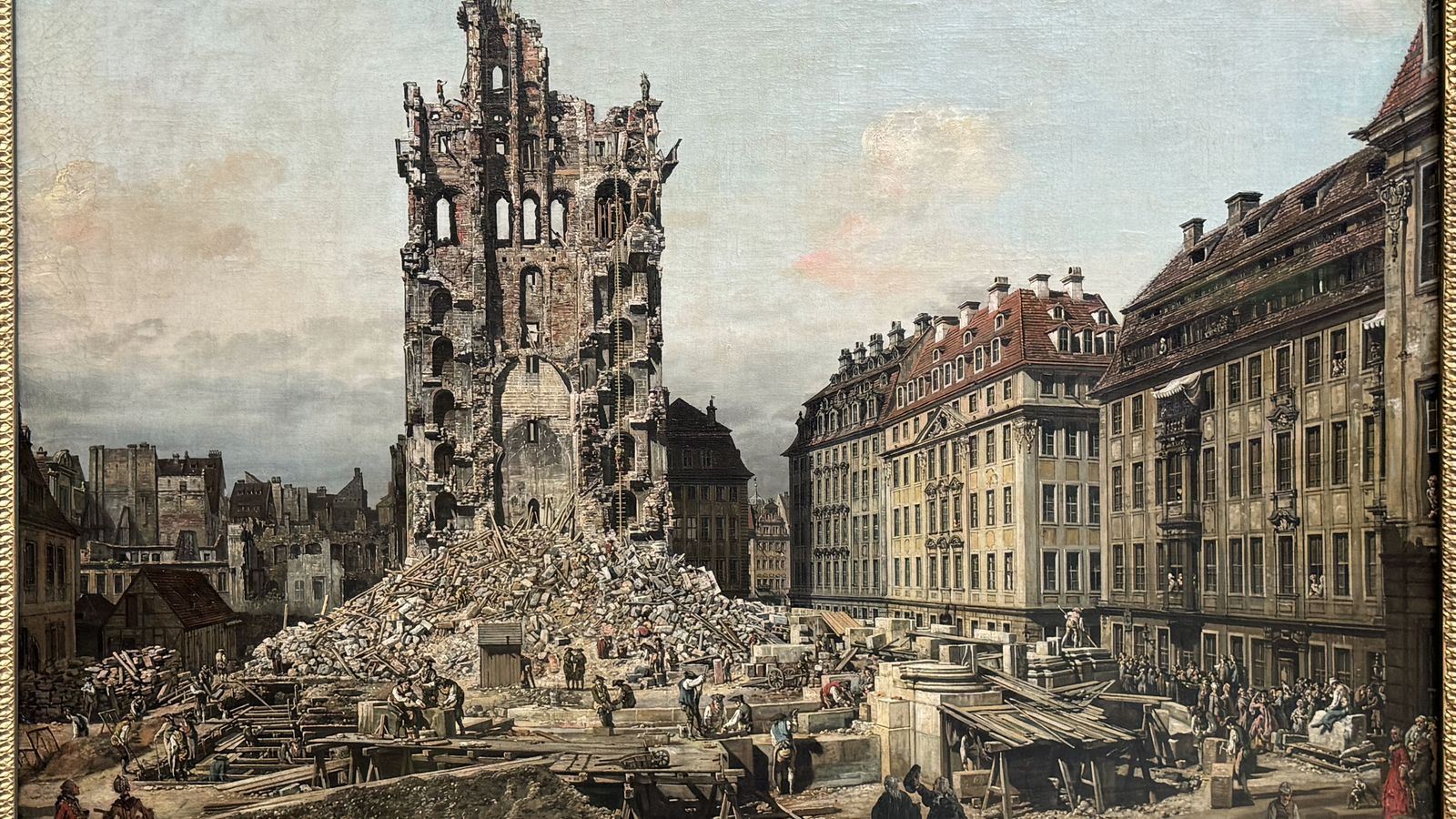
The destruction that swept across Dresden on those nights is difficult to comprehend. Eyewitnesses recounted horrific scenes of chaos and despair as incendiary bombs set the city ablaze; streets, metalwork, and people alike were melted by the heat in mere instants when the inferno reached its peak. Buildings crumbled under the onslaught, and even the city’s iconic Frauenkirche wasn’t spared, collapsing two days after the attack, its stone structure weakened beyond endurance by the relentless heat that came with two nights of relentless firebombing.
The human cost of this brutal assault was staggering. Official estimates suggest that between 22,000 and 35,000 people perished, but the total count may be significantly higher. Many of the victims were civilians, including women, children, and the elderly, who stood little chance against the inferno that consumed the city.
In the decades following the war, the bombing of Dresden has been the subject of much debate among historians, legal scholars, and military strategists. Dr Gregory Stanton, a scholar renowned for his studies on genocide, has classified the Dresden bombing as a war crime. He is not alone in this assessment. Several experts have endorsed this view, some going as far as suggesting that Winston Churchill, then British Prime Minister, could have been put on trial.
German historian Jörg Friedrich, an acclaimed author known for his work on the Allied bombings of German cities, has been particularly outspoken on this issue. He has drawn parallels between the devastation wrought in Dresden and genocidal acts, branding Churchill as ‘the greatest child-slaughterer of all time’. Though this remark is perhaps hyperbolic, it underscores the profound anger and heartache that the event has stirred among observers.
Some however, are more forgiving of the bombing, the incident being clouded by the cold hard pragmatism that dictates actions during war time. For example historian Frederick Taylor, author of Dresden: Tuesday, 13 February 1945, argues that the attack on Dresden fits into the broader context of the war, a time when both Axis and Allied powers were engaging in extensive bombing campaigns targeting enemy cities. He suggests that Dresden was a legitimate military target because of its transportation and communication networks, and its industries supporting the German war effort.
In addition, it is important to note that the term “war crime” as we understand it today didn’t fully take shape until the Nuremberg Trials after the war. The Geneva and Hague Conventions that were in place at the time of World War II were much vaguer about what constituted unlawful aerial bombardment. As such, some historians argue that while the bombing of Dresden was certainly devastating and tragic, it was not technically a “war crime” based on the conventions of the time.
Key Takeaways
- World War II, while generally seen as a conflict between good and evil, had instances where Allied forces committed war crimes.
- The internment of Japanese-Americans in concentration camps during WWII is debated as a war crime, with arguments on both sides.
- The British attack on the French fleet at Mers-el-Kébir is considered a war crime by some historians due to its targeting of surrendered allies.
- Allied forces, including the British and Americans, committed war crimes at sea by killing shipwreck survivors and sinking hospital ships.
- The bombing of Dresden by Allied forces is controversial, with some historians classifying it as a war crime due to the high civilian casualties.
SideProjects Editors
The SideProjects editorial team researches, fact-checks, and structures explainers about the lesser-known tales, side narratives, and spin-offs behind major historical and contemporary subjects.
Frequently Asked Questions
What was Executive Order 9066?
Executive Order 9066 was signed by President Franklin D. Roosevelt on February 19, 1942, leading to the forceful relocation and internment of more than 120,000 individuals of Japanese descent, the majority of whom were American citizens.
What were the conditions like in the Japanese-American internment camps?
The internment camps were characterized by ramshackle barracks with scant privacy and appalling sanitary conditions. Life inside the camps was marked by stifling heat, numbing cold, dust storms, and substandard rations. Education for children was inadequate, and the internees suffered a devastating blow to their dignity and self-worth.
How many deaths occurred in the Japanese-American internment camps?
Estimates hover around 1,862 deaths, with inadequate medical facilities and emotional distress contributing to the toll.
What was Operation Catapult?
Operation Catapult was an attack launched by the British Royal Navy on July 3, 1940, aimed at destroying the French Fleet moored at the Algerian port of Mers-el-Kébir. The attack resulted in 1,297 French sailors’ deaths and eight crippled or sunken vessels.
What was the British justification for Operation Catapult?
The British feared that the French fleet might fall into German hands after France signed an armistice with Nazi Germany. Previous diplomatic attempts to resolve the situation had been rebuffed by the French, leading the British to launch the surprise attack.
What was the international legal context for killing shipwreck survivors?
The Second Hague Convention of 1907 banned the killing of shipwreck survivors under any circumstances. Britain, as a signatory, disregarded this treaty on numerous occasions during WWII.
What actions did Lieutenant Anthony Miers of HMS Torbay take against shipwreck survivors?
Lieutenant Anthony Miers ordered his crew to machine-gun survivors of shipwrecks on March 4 and March 28, 1942, after sinking Italian vessels. He boasted of these actions in the ship’s log.
What was the Soviet Union’s involvement in mass rape during WWII?
The Soviet Union was the worst offender among the Allied nations in terms of sexual violence, with at least 1.4 million women violated in East Prussia, Pomerania, and Silesia alone. No one was spared from this brutal onslaught.
What was the Lippach Massacre?
The Lippach Massacre occurred on April 22, 1945, when American soldiers from the 12th Armoured Division killed and brutalized 24 German POWs and then raped 20 women in the town after stealing alcohol from a warehouse.
What was the human cost of the bombing of Dresden?
Official estimates suggest that between 22,000 and 35,000 people perished, but the total count may be significantly higher. Many of the victims were civilians, including women, children, and the elderly.