
For thousands of years humans have been fascinated by the possible existence of strange, mythical creatures. These creatures appear in stories, artwork, and sometimes even in what were meant to be genuine historical accounts. That just begs the question of where all of these creatures came from.
Some were undoubtedly pure works of fiction originating from the imagination of the author, but many of these fabled monsters are believed to have been based on real world observations. Today we’ll be looking at five mythical creatures and the surprisingly simple theories behind their creation.
The Questing Beast
Whether it’s magical characters like the Lady of the Lake, the Green Knight, or Merlin, or mythical creatures like dragons, Arthurian legends are full of stories that let the imagination run wild. While dragons are the most common and are rather plentiful in these tales, there is perhaps no singular creature more iconic in Arthurian legend than The Questing Beast.
Key Takeaways
- The Questing Beast from Arthurian legend was likely based on European’s first encounters with giraffes.
- The Basilisk myth originated from European’s misunderstandings of African cobras and their venomous spitting behavior.
- Cyclopes in Greek mythology were probably inspired by fossilized skulls of dwarf elephants, misinterpreted as giant humans.
- Griffins may have been inspired by dinosaur fossils, particularly protoceratops, found near gold deposits in Asia.
- Mermaids were likely misidentifications of aquatic mammals like manatees, especially by sailors at sea for extended periods.
The Questing Beast is described as a sort of ravenous chimera, a vicious beast comprised of parts of different animals. It is said to have the head of a snake, the body of a leopard, the haunches of a lion, and the feet of a hart. The monster’s name is derived from the sound it makes, a barking or yelling described as being like “thirty couple hounds questing”.
The beast first appeared in the French prose cycles written in the early 13th century, and it was portrayed as an almost otherworldly creature that knights would futility hunt. It is particularly associated with King Pellinore, whose bloodline had been destined to hunt the beast, seemingly for all eternity as none were ever successful in slaying the monster. The Questing Beast is often seen as representing an elusive and perhaps impossible goal, though it was eventually slain by Sir Palamedes.
Of course, even if a medieval knight really had killed The Questing Beast, there would have been plenty more of them running around, just not in Europe. Going back to description of the beast itself, you may have found that it sounded somewhat familiar. It is believed that the supposed monster, with its snakelike head, leopard body, and hooves, was just the European’s description of seeing a giraffe for the first time.
Although Julius Caesar famously brought a giraffe to Rome to show off as an exotic, African animal, that was over 1,000 years before these legends were written. By medieval times, most Europeans would have been completely unaware of the animal’s existence. And while we normally associate giraffes with eating leaves high up in trees, if you’ve ever seen a giraffe eating from the ground, especially when leaning over a fence or other barrier to reach food while in captivity, their necks really can move in a rather serpentine fashion.
The Basilisk
The basilisk has gone through many iterations over the past 2,000 years. The earliest reference to a basilisk came from Pliny the Elder’s Natural History written in about 79 AD. In his book, Pliny described the basilisk as a small snake, “not more than 12 fingers in length”. The snake was said to be native to Cyrene, a Greek and later Roman settlement in what is modern day Libya.
Pliny essentially described the basilisk as being the most dangerous snake in the world, so deadly that its mere presence left a wake of destruction in its path. So venomous was this monster that it didn’t even need to make contact with something to kill it. All the basilisk had to do was breathe to kill its prey, and the basilisk could even break stones by breathing on them. Rather than slithering along the ground like other snakes, the basilisk was described as moving upright and erect.
Over time, the basilisk myth evolved quite a bit. It somewhat merged with the legend of the cockatrice, making it a sort of half snake, half rooster creature. Some accounts stated that it could breathe fire, and it was referred to as the king of serpents because it appeared to be wearing a crown or miter. The basilisk also became known for its petrifying gaze, with the ability to either kill or turn to stone anything that it looked at.
But as Pliny wrote, “it has pleased Nature that there should be nothing without its antidote”, and so of course there was a way to kill the terrifying basilisk. The scent of a weasel was reportedly deadly to the basilisk, and weasels would be thrown into the holes where basilisks lived to kill them.
Once again, a lot of that probably sounds pretty familiar, as this was almost certainly another case of a European encountering African wildlife for the first time and just misunderstanding and/or exaggerating what they saw.
It is believed that the basilisk was just a cobra. Cobras are known for taking an upright position, and many species, such as the king cobra and Indian cobra, are known for their hoods, which often appear miter shaped. Many African cobras can spit their venom as well, rather than needing to bite and inject their prey, and if the airborne venom wasn’t spotted this would look like the snake was killing its victim purely with its breath.
As for their allergy to the scent of weasels, this would likely have been Pliny mistaking a mongoose for a weasel. The two animals look similar and both hunt snakes, so upon seeing a mongoose for the first time it would be easy to assume it was just another breed of weasel. Because a mongoose released into a cobra’s hole would be fighting it underground and out of sight, the belief that its odour was fatal may have stemmed from the assumption that the “basilisk” was far too deadly to have any natural predators, so surely a weasel could not kill such a deadly monster on its own.
This is all a pretty simple explanation for the original basilisk myth, and later iterations of the basilisk just exaggerated the original myth or melded it with other existing myths. However, there is one part of the later basilisk lore that we’d like to quickly address: turning people into stone. Because the basilisk’s gaze was supposedly deadly, this got conflated with the mythical gorgons whose gaze turned people to stone. The fact that the basilisk was a snake and the gorgons were very much snake themed certainly would have helped that association as well.
However, this idea of turning people to stone also has a simple explanation as well. Many venomous snakes contain powerful neurotoxins that result in paralysis, sometimes including facial paralysis as well. The body of a person bitten by such a snake would eventually become frozen from the venom, as if they had been turned to stone, and their face may even be stuck in a horrified expression of terror as well. So basically, the idea that basilisks or gorgons could turn people to stone was likely just a metaphorical description of paralysis that started to be taken literally.
The Cyclopes
The idea of Cyclopes, the plural of cyclops, dates back to ancient Greek mythology. Or at the very least, that is where we can find the earliest stories written about them. At a fundamental level, a cyclops was a giant, man-like creature with a single, large eye. However, the manner in which they are depicted varied wildly.
Cyclopes were first described by Hesiod in his poem Theogony. There were only three Cyclopes, Brontes, Steropes, and Arges, who were the sons of Uranus and Gaia. These brothers were skilled craftsmen and weaponsmiths, and they famously made Zeus’s trademark weapon, the thunderbolt.
For those unfamiliar with Greek mythology, all lightning was believed to be hurled down to Earth by Zeus himself from atop Mount Olympus as a display of power and/or anger, and the lightning was apparently made by Cyclopes the same way a blacksmith would make a sword. It’s probably best not to think about the logistics of all this too hard.
Anyway, in Homer’s Odyssey, the description of the Cyclopes was much different. Rather than three skilled artisans who worked directly for Zeus, Homer described the Cyclopes as large groups of primitive, uncivilized shepherds who didn’t care about Zeus at all. A few centuries later, the historian Hellanicus write of a third type of cyclops, the builders responsible for the Cyclopean Walls of Mycenae and Tiryns.
Cyclopean masonry is characterized by the use of massive, unworked limestone boulders placed together with little to no mortar. Because the Cyclopes were viewed as being giants, and sometimes primitive ones, it made sense that they would have had the strength to move the boulders by hand, and that they would also rely on tightly packing them together as is, rather than relying on more advanced and civilized masonry like mortar and sculpting the stones to properly fit together.
Watch the Video
Open Video
Video Briefing
Mythical Creatures with Simple, Real World, Origins
There are a couple proposed explanations for the creation of cyclops myths, one more likely than the other. The first is a condition known as Cyclopia. This is a rare birth defect in which a person (or other animal) only has one eye in the center of their face. However, this is unlikely to have been the true origin of the cyclops.
To start, for those with Cyclopia, the singular eye is actually formed below the nose, while the mythical Greek Cyclopes are depicted as having their eye above the nose. More importantly, however, Cyclopia is a serious and fatal condition. Most fetuses that develop with Cyclopia result in either a miscarriage or stillbirth, and those that survive birth usually die very shortly thereafter. The odds that Ancient Greeks would have seen even an average size adult with Cyclopia, let alone a giant one, are vanishingly small.
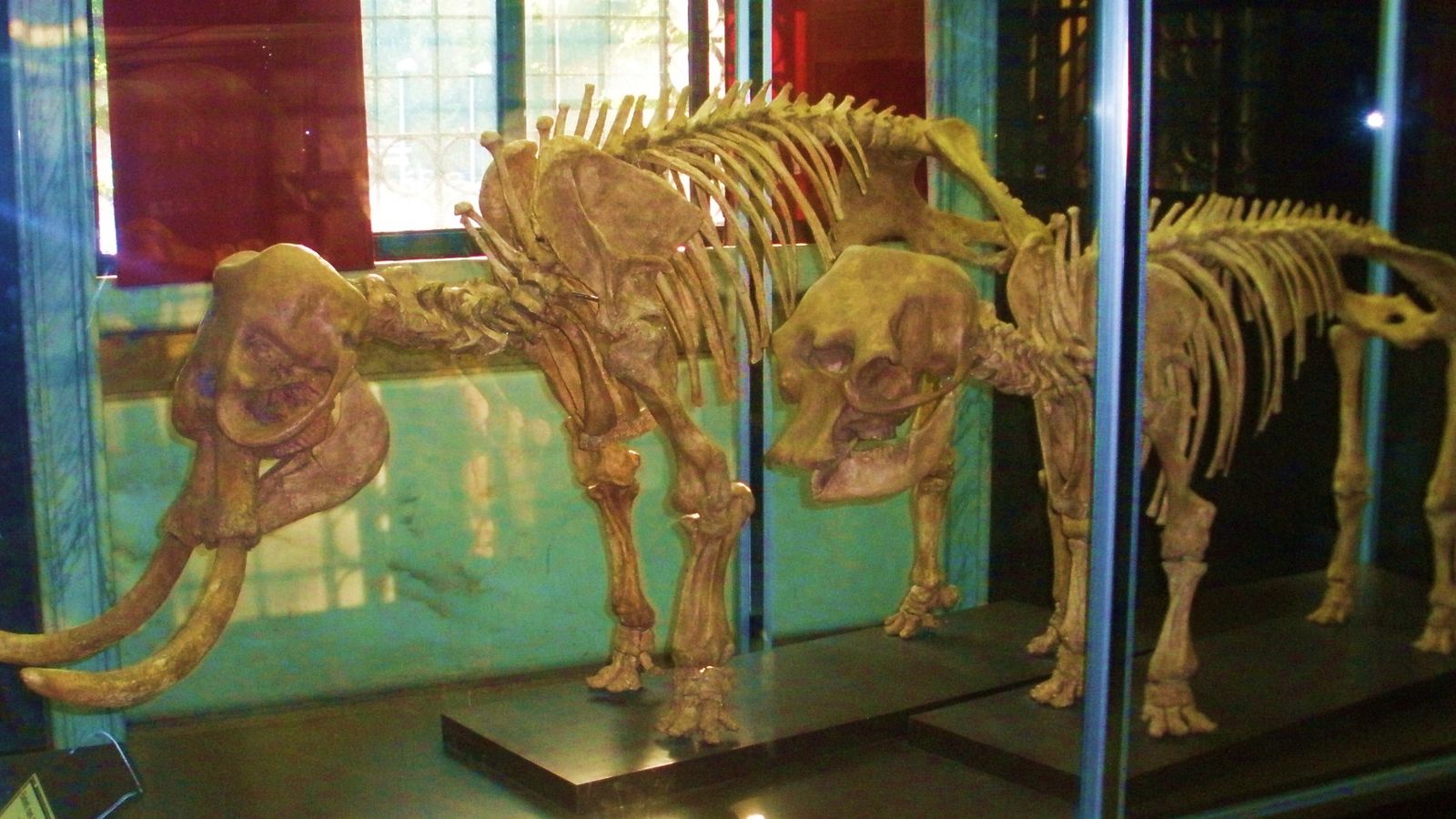
The much more likely explanation is that the idea of Cyclopes arose from the discovery of the fossilized skulls of Palaeoloxodon falconeri, an extinct species of dwarf elephant. These elephants lived in the Middle Pleistocene era, predominantly on the islands of Sicily and Malta. It’s worth noting that Cyclopes were heavily associated with Sicily and the Aeolian Islands, so that part seems to line up.
And while these creatures were dwarves by elephant standards, they still would have been giants by human standards. As for how the Greeks would have made the leap from an elephant to a giant human, however, all you would have to do is remove the tusks. It is believed that Ancient Greeks found these dwarf elephant skulls without the tusks still attached, and that they mistook the large, central nasal cavity as being a single eye-socket.
This also makes sense within the context of how these creatures were described. The Questing Beast and basilisks were described as creatures that existed in the contemporary world in which they were being written about, but the stories of Cyclopes were always set multiple centuries before they were written. The idea that the walls of Mycenae were built by Cyclopes wasn’t written about until roughly 800 years after the walls’ construction.
Essentially, the Greeks could have found the elephant skulls, mistaken them for skulls of a race of extinct giant humans, and then figured out how those creatures might have fit into their mythology. This would also explain why the descriptions of the Cyclopes by Hesiod and Homer were so wildly different, despite being written at relatively close to the same time.
The Griffin
The lion has traditionally been seen as king of the beasts, and even today people still refer to lions as king of the jungle. Similarly, the eagle was traditionally seen as the king of the birds. Logically, then, if you could somehow breed an eagle and lion together, the result would be one of the most powerful and majestic creatures to ever live. And thus we get the griffin.
Of course, nobody is actually suggesting that griffins were created by crossbreeding eagles and lions, or that they even ever existed at all. There have been other mythical creatures similar to griffins, but the earliest written description of griffins in particular comes from Greek poet Aristeas in the 7th century BC. Or at least it would, had the poem in question not been lost to time forever. However, the basic description set forth by Aristeas was preserved by Greek historian Herodotus a couple centuries later.
The griffins were described as having sharp beaks, and they were described as “unbarking hounds of Zeus”. Some have speculated this meant that the earliest incarnations of griffins were flightless, but because the physical description given by Herodotus is so vague it’s difficult to know one way or the other. By the time Pliny the Elder got around to writing about them, however, griffins were explicitly winged.
At least according to Pliny they were. One of his contemporaries instead claimed that, rather than wings, griffins had webbed feet that allowed them to glide like a flying squirrel. They achieved this gliding flight not by jumping out of trees, but by leaping high in the air from the ground.
In all of the various accounts, though, there was no dispute where the griffins lived or what they were doing. They were stated to live in Central Asia, predominantly in modern day India, and they were there to hoard gold and other treasures.
It has been argued that the literature surrounding griffins may have been the result of nomadic gold prospectors discovering the fossilized remains of dinosaurs, like the protoceratops. The protoceratops was a dinosaur from the Late Cretaceous period. As the name might suggest, the protoceratops was initially believed to be an ancestor of the much more famous triceratops, though the two are more like cousins rather than one being descendant from the other.
But if you know what a triceratops skeleton looks like, you can easily imagine a protoceratops. The two look very similar, but the protoceratops is much smaller and its skull has no horns. The Ancient Greeks could have seen these skeletons of mammalian looking bodies with large, beaked heads and believed that they belonged to some sort of lion/eagle chimera. And since they were found near gold deposits in Asia, the lore about the griffins guarding treasure naturally followed suit.
However, this proposed origin is more contested than the others in today’s episode. The Cyclopes were also allegedly based on fossils, and as such the stories of them were set in the past. Griffins, however, were discussed by authors as though they were still an extant species. Also, chimeras were popular in general in Ancient mythology.
Whether it was the Egyptian sphinx, the Persian manticore, or the Jewish Ziz, these creatures were everywhere. It is argued that because of this, as well as based on various details in the accounts of griffins and other chimeras, that these creatures were purely imaginary rather than being based on anything in the real world.
Well, they would still have been based on eagles and lions, but not on some combination of the two that had genuinely been observed in the wild.
Mermaids
Stories and depictions of merfolk have existed for over 4,000 years, with the emphasis being placed heavily on mermaids. They are always described as being beautiful and usually as seductive singers, though this later part seems to be because people in medieval times conflated mermaids with sirens. Sirens were originally described as being half-bird, but they were seductive creatures found at sea so why not just combine them with mermaids.
However, there is a pretty well agreed upon explanation for most of the sightings of mermaids; this likely explains their origin as well. We’ve already established that people in the past would often misinterpret or exaggerate things that they saw. Imagine how much that would be amplified if you were a medieval sailor who had been at sea for months, starved of food, water, and female companionship. And also you may have been drunk, as water could easily spoil on a long voyage whereas rum remained potable much longer.
Now imagine that, in this delirious and drunken state, you see a creature roughly the size of a human, but with a long, mammalian tail rather than feet. Oh yeah, and you also have no idea that manatees, seals, or dugongs exist. Especially if the creature was far away, it would be easy to mistake such a sighting for that of a mermaid.
There’s actually a lot of evidence that the existence of mermaids is based entirely on people observing these animals in the wild, especially because mermaids, despite being described as being half fish, are always depicted with the same sideways spanning tails that are only found on aquatic mammals rather than on fish.
But perhaps the most famous account of mistaken mermaid identity came from none other than Christopher Columbus. Manatees are notoriously gentle and curious creatures, and they will often approach vessels at sea just to check out what’s going on. Columbus observed these animals, and they even got close enough for him to see their faces.
While sailing off the coast of Haiti, Columbus encountered a group of manatees that he believed to be mermaids. He said of the creatures that they were, “not half as beautiful as they are painted, though to some extent they have the form of a human face.” He also stated that although they had a woman’s face, many of the facial features were more masculine. Being close enough to manatees to see their faces and still thinking that they’re mermaids seems pretty dumb, but it’s not like that’s the worst thing Columbus ever did.
Key Takeaways
- The Questing Beast from Arthurian legend was likely based on European’s first encounters with giraffes.
- The Basilisk myth originated from European’s misunderstandings of African cobras and their venomous spitting behavior.
- Cyclopes in Greek mythology were probably inspired by fossilized skulls of dwarf elephants, misinterpreted as giant humans.
- Griffins may have been inspired by dinosaur fossils, particularly protoceratops, found near gold deposits in Asia.
- Mermaids were likely misidentifications of aquatic mammals like manatees, especially by sailors at sea for extended periods.
SideProjects Editors
The SideProjects editorial team researches, fact-checks, and structures explainers about the lesser-known tales, side narratives, and spin-offs behind major historical and contemporary subjects.
Frequently Asked Questions
What is the Questing Beast?
The Questing Beast is a mythical creature from Arthurian legend described as a ravenous chimera with the head of a snake, the body of a leopard, the haunches of a lion, and the feet of a hart. It is named for the sound it makes, described as like ‘thirty couple hounds questing’.
What is the origin of the Questing Beast?
The Questing Beast is believed to have been based on the European’s description of seeing a giraffe for the first time. The beast’s description matches the appearance of a giraffe, especially when it leans over to eat from the ground.
What is the basilisk?
The basilisk is a mythical creature that has gone through many iterations over the past 2,000 years. It was originally described as a small, deadly snake by Pliny the Elder, but later versions merged it with the cockatrice, giving it a half snake, half rooster appearance.
What is the real-world origin of the basilisk?
The basilisk is believed to be based on the cobra. Cobras are known for taking an upright position and have hoods that appear miter-shaped. Many African cobras can spit their venom, which would look like the snake is killing its prey with its breath.
What are Cyclopes?
Cyclopes are mythical giants from Greek mythology with a single, large eye. They were described differently by various authors, including Hesiod, Homer, and Hellanicus, who portrayed them as skilled craftsmen, primitive shepherds, and builders, respectively.
What is the likely real-world origin of the Cyclopes?
The Cyclopes are believed to have originated from the discovery of fossilized skulls of Palaeoloxodon falconeri, an extinct species of dwarf elephant. Ancient Greeks may have mistaken the large, central nasal cavity of these skulls for a single eye-socket.
What is a griffin?
A griffin is a mythical creature with the body of a lion and the head and wings of an eagle. It was described by Greek poet Aristeas and later by Greek historian Herodotus, who stated that griffins lived in Central Asia and hoarded gold and other treasures.
What is the proposed origin of the griffin?
The griffin is proposed to have originated from nomadic gold prospectors discovering the fossilized remains of dinosaurs like the protoceratops. The protoceratops had a mammalian-like body with a large, beaked head, which could have been mistaken for a lion/eagle chimera.
What is the likely origin of mermaid sightings?
Mermaid sightings are likely based on people observing aquatic mammals like manatees, seals, or dugongs in the wild. Sailors, often delirious and drunk, would mistake these creatures for mermaids, especially if they were far away.
What did Christopher Columbus encounter that he mistook for mermaids?
Christopher Columbus encountered a group of manatees off the coast of Haiti and mistook them for mermaids. He described them as having a woman’s face but with more masculine features.