
Modern archaeology and the discovery of ancient cities around the world has made one thing clear: war has been a part of human society since the very beginning. In some cases, it seems like that warfare has even taken precedence to the preservation of these places and their value to humanity. From Medieval torches to modern bombs, warfare has meant the destruction of many priceless ancient sites.
The Old Summer Palace
By the late 18th Century, European powers were desperate for trade access to China. Since 1757, the ruling Qing Dynasty had restricted European traders to the southern port of Canton, now known as Guangzhou, on the mainland near Hong Kong and Macau. They also restricted trade to the summer and required that the “foreign barbarians” live in a group of supervised warehouses known as the “Thirteen Factories.” They were not allowed to enter any other part of China.
The fact was that Europe didn’t really have anything that China wanted, and the Qing had seen how the British, French and Dutch had colonized nearby nations like India and Indonesia for commercial purposes. The result was a large trade deficit. European silver flowed into Canton and Chinese goods like tea, silk and porcelain flowed out. The British found the solution: opium grown in their Indian colonies.
Key Takeaways
- British and French troops burned the Old Summer Palace in 1860 during the Second Opium War, looting roughly one million relics now scattered across 47 museums worldwide.
- Ghurid invaders led by Muhammad Bakhtiyar Khalji destroyed Nalanda Mahavihara in 1203, massacring monks and razing the 800-year-old university that once hosted 10,000 students.
- German artillery destroyed the medieval city of Ypres during five World War I battles, including first uses of chlorine and mustard gas, killing over 700,000 soldiers.
- A Venetian mortar shell ignited Ottoman gunpowder stored inside the Parthenon in 1687, blowing out three walls and collapsing the roof after 2,000 years of preservation.
- ISIS destroyed Palmyra’s Temple of Bel, Temple of Baalshamin, and other ancient structures in 2015, though archaeologists believe 98 percent of the site may be restorable.
The British began selling Bengalese opium into China through Canton in 1781, and it didn’t take long for it to wreak social havoc. By 1796, millions of Chinese were addicted. This led to mass deaths and antisocial behavior by those seeking the drug at any cost. The Qing government banned the import of opium, but British merchants found ways to smuggle it in, soon joined by Americans.
Things came to a head in 1839 when the Qing government seized over 1,000 tons of opium in the Thirteen Factories and on nearby British ships. The Chinese officials destroyed the opium and banned the British merchants from China forever. The British immediately began preparing for war and launched the first offensive of what would become known as the First Opium War in June 1840.
The British Navy easily outclassed the antique Chinese junkers, and British victory resulted in the Treaty of Nanking, the first of what the Chinese referred to as “Unequal Treaties.” As well as granting the British the islands of Hong Kong, the treaty opened up four more ports for free trade, legalized opium and required the Qing government to reimburse British merchants for the product they’d destroyed.
The Treaty of Nanking also set the stage for the Second Opium War, starting in 1856, in which allied British, French and American troops invaded Qing China to further improve their trade positions. The Western powers had easy military superiority to the Qing, and in 1860, their expeditionary forces reached Beijing. They sent a delegation of diplomats to negotiate with the Xianfeng Emperor Wenzong, but the Qing took them captive and tortured them, killing 19 of the delegation’s 35 members.
The Europeans retaliated in a fury and went straight for the Old Summer Palace, the imperial residence of the royal Qing. Called Yuánmíng Yuán in Mandarin, meaning “Gardens of Perfect Brightness,” the palace involved various architectural projects dating back to the 13th Century and the Yuan Dynasty. The main construction and expansion was started in 1707 by the Qing who incorporated a notable amount of European style and extensive gardens.
The Old Summer Palace covered 860 acres, or 3.5 square kilometers, five times the size of the Forbidden City and eight times that of the Vatican. In fact, it was so large it took 4,000 British and French troops three days to fully burn it down, during which time they looted the site’s 5,000 years’ worth of ancient treasures and artifacts dating back to the earliest Chinese dynasties. There was no resistance from the outgunned Qing military, but 300 eunuchs and palace maids, who had hidden from the invaders, died in the blaze.
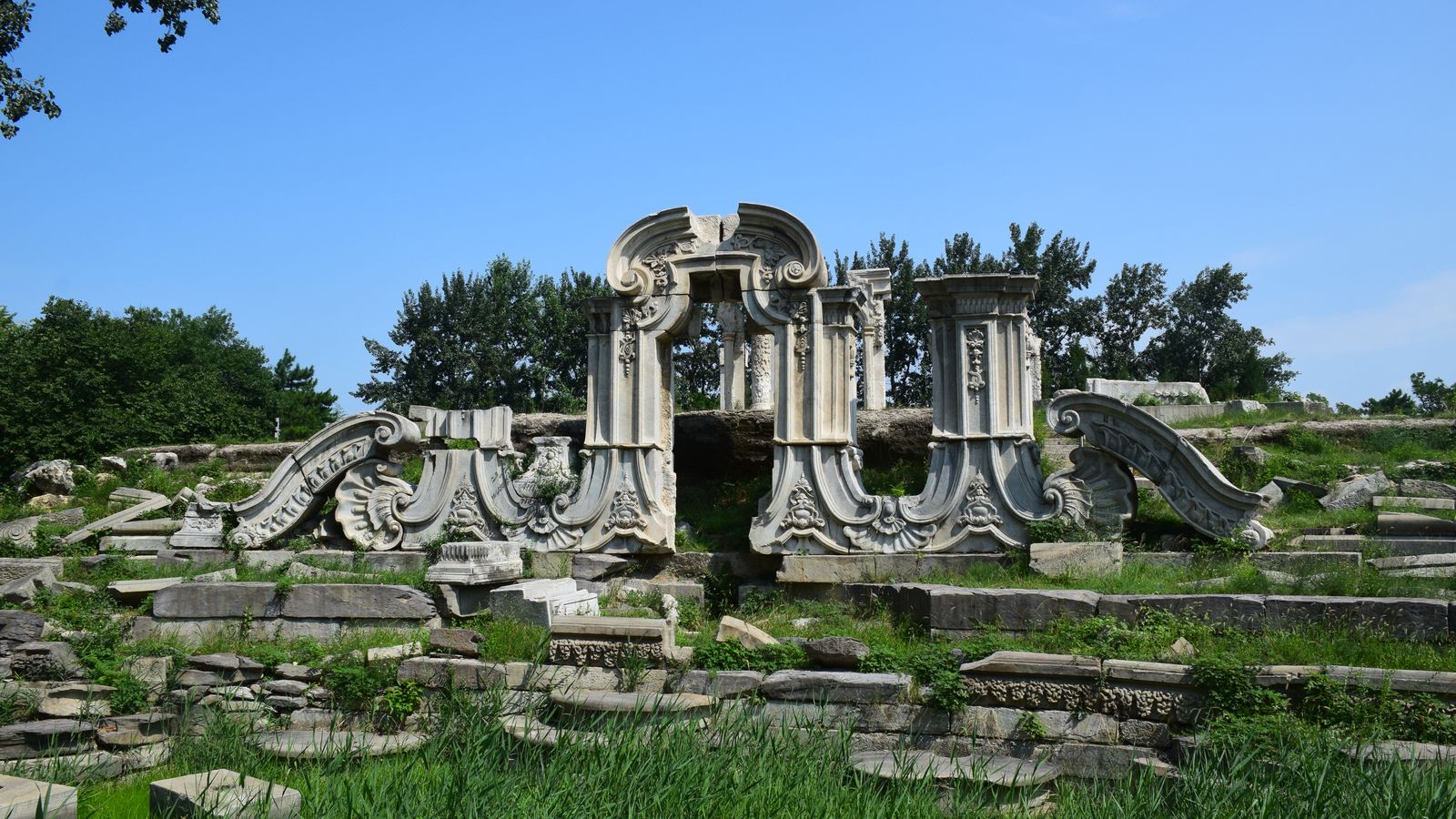
Today, nothing is left but the ruins, which are open to the public as a monument to Chinese history. While little remains of the grand buildings but a few pillars, the natural beauty of the gardens and lakes has survived. A few structures, like the Zhengjue Temple, are being refurbished.
However, getting a look at the palace’s ancient treasures is a more difficult task. Roughly a million relics from the site, including sculptures, porcelain, jade, silk robes and gold, were taken by the looters. They are now scattered among 47 museums around the world.
Nalanda Mahavihara
Centuries before Oxford and Cambridge, the Gupta Empire in ancient northern India built the world’s first residential university: Nalanda. Though the university itself was built around 427 AD, the site was important academically and religiously as early as the first millennium BC. Texts say that Buddha himself visited Nalanda where he gave lectures in a mango grove. After the Buddha’s visit, the site, which is located in modern-day Bihar in northeast India, became an important retreat for monks from around the Indian subcontinent, China and even Korea.
Then in the 5th Century AD, the Gupta Empire expanded into the area. The Emperor, Kumaragupta I, inherited a large territory from his father Chandragupta II, and improved and stabilized its economy and finances. Part of this involved funding the foundation of a sangharama, or monastery at Nalanda. His son, Budhagupta, and other successors, despite not being Buddhists themselves, continued to fund the monastery, which grew into a mahavihara, a large monastery complex devoted to academic learning and scholarship.
Eventually the ancient university grew to cover over 30 acres, or 12 hectares, and consisted of at least 11 monasteries and six temples, though many believe the campus was much larger than the ruins suggest. Faculty included some of the age’s most revered scholars who taught Buddhist philosophy as well as secular studies like medicine, logic and mathematics. The Buddhist thought that developed at the university spread throughout the Gupta Empire and beyond, and many Chinese monks carried back texts that influenced the development of East Asian Buddhism.
In fact, the university became so important that it gained many patrons, not all of them Buddhist. It largely contributed to what historians call the “Golden Age of India” and lasted even after the Gupta Empire declined. During the Seventh Century, the Hindu King Harsha endowed 100 villages to the university to provide it with food and other supplies. This was enough to support 1,500 faculty and 10,000 students coming from lands as far away as Japan and Turkey. That’s larger than modern-day Princeton.
Altogether, the university thrived for nearly 800 years, through numerous empires, rulers and religions, until the invasion of the Ghurids in the 13th Century. A tribe from the Ghor region in central Afghanistan, the Ghurids had converted to Sunni Islam and driven out other local powers until they’d expanded to control 770,000 square miles or two million square kilometers of central Asia in modern day Iran and Afghanistan by 1200 AD.
In 1175, Ghurid General Muhammad Bakhtiyar Khalji led a campaign into the Indian subcontinent. Rapidly subjugating the local rulers, Khalji reached Nalanda in 1203. His work there can be seen in the layer of ash that now forms the uppermost stratum of the Nalanda archaeological site. The invaders massacred thousands of monks, razed the buildings and threw the ruins into the Ganges River.
Khalji then went rogue and established his own kingdom in Bihar, replacing Buddhist traditions and institutions with Muslim ones. This was short lived. Unsatisfied with his little empire, Khalji pushed north into Tibet in 1206 where he was decidedly turned back by guerrillas. Returning sick and weary with only a hundred surviving soldiers, Khalji was promptly assassinated by his own governor, after which various power struggles ensued.
With the collapse of the Khalji regime, monks who had fled north to Tibet returned in 1235 to find their beloved university deserted. Some tried to rebuild it, but it never reached its former grandeur. It was abandoned and forgotten to local memory by the time the archaeological site was discovered by the British in the early 19th Century.
Nalanda is now a UNESCO World Heritage Site open to the public with multiple museums exhibiting discovered artifacts, but it also has a more practical legacy. In 2010, the Indian Government established the public Nalanda University nearby. With a current faculty of 45 and student body of 406, it may not reach the prestige of its namesake just yet, but its growing catalog of courses in numerous languages do hark back to the scholarship and diversity of the ancient mahavihara.
Ypres, Belgium
By September 1914, just a few months into World War I, Allied forces had stalled the German advance into France at the Marne River, leading to a stalemate of trench warfare. In what came to be called the “Race to the Sea,” both sides attempted to break the stalemate by outflanking the other to the north, but neither was successful. Instead, heavy fighting pushed north until both sides reached the Belgian coast.
On 19 October, the Allies attempted to break the German lines and managed to capture the city of Ypres in Flanders, but the Germans successfully pushed back to the north and south of the town. This created a salient, or a bulge into the German lines, the Allies surrounded on three sides. The Germans then laid siege to the city.
Watch the Video
Open Video
Video Briefing
Priceless Ancient Sites Destroyed by War
Ypres was founded almost 2,500 years ago by Celtic tribes who’d built a fort in the nearby Kemmelberg hills. Later, Germanic peoples took over the area, and a settlement had grown along either side of the Ieper River by the time Romans invaded in the First Century BC.
Despite changing hands among many European powers over the course of history, Ypres evolved into a wealthy and important town by the Middle Ages due its location on several trade routes. Growing to a population of 40,000 by the 13th Century, the city was famous from England to Russia for its high-quality linen and textiles, even earning it a mention in the Canterbury Tales.
Ypres only grew in fame and fortune over the centuries, filling the city with important cultural sites. The most impressive was the Lakenhal, or Cloth Hall, one of the largest commercial buildings of the Middle Ages. Completed in 1304, the building was a textile market and warehouse with an imposing belfry consisting of four turrets and a spire reaching 230 feet or 70 meters into the sky and topped with a golden dragon.
The Cloth Hall, other important buildings like Martin’s Church, a Gothic cathedral built over 140 years from 1230 to 1370, and indeed the entirety of Ypres were destroyed by German artillery over the course of five battles lasting through November 1918. Fighting over the town also destroyed a devastating amount of human life. Germans used chlorine gas for the first time against Allied forces in the Second Battle of Ypres. Then they used mustard gas for the first time in the Third Battle of Ypres, also known as the “Battle of Passchendaele,” in which the Allies only gained a few hundred yards of ground at the cost of the city’s buildings and 700,000 lives on both sides.
After World War I, the town’s citizens rebuilt Ypres thanks to money from German reparations. This included completely reconstructing the Cloth Hall and Cathedral just as they had been prior to the war. However, the more-than-a-million men who perished in and around the ancient city could never be brought back. All that’s left of them is the Menin Gate Memorial to the Missing, erected at Ypres’s eastern entrance, and the acres and acres of mass graves surrounding the resurrected town.
The Parthenon
For many, the Parthenon is the image that comes to mind when they think of ancient ruins. Still an inspiring image on the Acropolis of Athens, the now-crumbling columns draw 7.2 million visitors each year. While many of them are aware that the Ancient Greeks built the Parthenon as a temple to Athena in the Fifth Century BC, what’s less well-known is that the architectural marvel far outlived the Greeks… and Romans… and Byzantines, Catholic crusades, and even into the Ottoman Empire. It survived over 2,000 years before its destruction due to warfare in the late 17th Century, fully within the Modern Period.
The Ancient Athenians, led by architects Callicrates and Ictinus, built the temple in celebration over Persian invaders during the Greco-Persian Wars. A massive project for the time, they recruited tradesmen specialized in marble work, metallurgy and carpentry from distant lands. Completed in 432 BC, the building had a floor area of nearly 23,000 square feet, or 2,100 square meters, and a cella tall enough to accommodate the 38-foot or 11.5-meter gold-plated statue of Athena sculpted by Phidias.
In 404 BC, Athens came under the control of Sparta and then later Philip II of Macedon, but the Parthenon remained a temple to Athena. The Roman Republic annexed Greece in 146 BC but, great admirers of Greek history and culture that they were, they left it a shrine to Athena, though not without a few added Roman touches. In fact, the Romans even repaired the Parthenon after Germanic pirates damaged it in the Third Century.
After a millennium in service of Athena, the Byzantine Empire converted the temple to a Christian church dedicated to the Virgin Mary at the end of the Fifth Century. Consequently, they removed the statue of Athena and took it to Constantinople where it was lost during the Middle Ages, never to be found again. The Parthenon remained a Christian place of worship when Athens passed into the hands of the Catholic Church after the Fourth Crusade.
Finally, in the 15th Century, the Ottoman Empire conquered Athens and converted the Parthenon to a mosque. Although they removed Christian icons and religious paraphernalia, they left the structure intact.
It was not until 1687 and the Morean War that the Parthenon finally met its end. The prosperous Republic of Venice, who had lost many of their Greek possessions to the Ottomans, had decided to fight back. They managed to gain a foothold on the Peloponnese peninsula in southern Greece from where they pushed east to besiege Athens.
Ottoman forces retreated to the fortified Acropolis. They were able to hold the position, but they made the fateful mistake of storing all their gunpowder in the Parthenon. A single mortar shell fired from the Venetian battery struck the temple and ignited the gunpowder. The resulting explosion blew out three of the four walls. Many of the columns fell, and the roof collapsed. 300 people died, but the Parthenon ultimately remained under Ottoman control.
Nevertheless, in 1832, the ancient ruins passed into the hands of one more power: an independent Greece. In fact, images of the Parthenon circulating around Western Europe played a crucial role in gaining international sympathy for the Greek Revolution. The Greek government quickly turned it into a historical archaeological site that drew European and American artists, writers and travelers who viewed it as an unparalleled architectural achievement and sacred bastion of Western civilization and culture.
The Greek government also began initiatives to preserve the ruins, which have since evolved into initiatives to restore it. Using ever-improving computer models and the same Pentelic marble as the Ancient Athenians, the Committee for the Conservation of the Acropolis Monuments aims to make the new Parthenon as true to the original as possible and give it life into a third millennium.
Palmyra
Located in central Syria about 215 kilometers, or 134 miles, northeast of Damascus, Palmyra, also known as Tadmur in Arabic, is one of the richest archaeological sites in the world with artifacts dating to the Neolithic Period nearly 10,000 years ago and birth of human civilization. The city has been continuously inhabited through the modern day and currently has a population of over 50,000.
Most of the historical and cultural wealth of Palmyra comes from the Bronze Age, and the city was first mentioned in the Mari tablets. Written in Akkadian around 1800 BC, these texts include administrative, economic and judicial documents, as well as letters, and describe Palmyra as a common waypoint for trade caravans.
After the dissolution of Alexander the Great’s empire in 321 BC, Palmyra became a part of the Greek Seleucid Empire, under which it grew into a prosperous city. It was then conquered by the Romans in 64 BC, who placed it within their Province of Syria. Magnificent ancient structures date to the Roman period, from government buildings to religious temples and military fortifications.
Unfortunately, 21st-Century warfare has destroyed much of Palmyra’s priceless ancient buildings and artifacts. In May 2015, during the height of the Syrian Civil War, the Islamic State, also known as the Islamic State of Iraq and Syria or ISIS, carried out the Palmyra offensive and took control of the city and surrounding region, increasing their control of Syria to 50 percent. Despite pleas from the townsfolk, ISIS made it clear they intended to remove any religious monuments or statues they considered “polytheistic,” but they stated they would not destroy the site itself, which had been a UNESCO World Heritage Site since 1980. They then immediately demolished the Lion of Al-lāt statue, a limestone depiction of the goddess al-Lat’s feline companion.
However, the insurgents went back on their word in August when they used explosives to destroy the Temple of Baalshamin. Dated to the Second Century BC, it was dedicated to the Canaanite sky god.
A few days later they blew up the Temple of Bel, arguably Palmyra’s most impressive ancient structure. Built in the First Century to worship the god Bel, it formed the center of religious life in the city during the Roman period and featured a unique combination of Greco-Roman and Middle Eastern architecture. Later satellite surveys of the terrain revealed that nothing was left after the ISIS demolition.
The destruction didn’t end there. ISIS also destroyed many of Palmyra’s tower tombs such as the Tower of Elahbel. They tore down the Arch of Triumph built by the Romans in the Third Century too. Finally, in their retreat from Syrian forces recapturing the city in 2016, they blew up the Palmyra Castle, which was built in the 13th Century and overlooked the region from a nearby hill.
Today the site is once again fully under the control of the Syrian Arab Republic and protected by its Ministry of Culture. Restoring the destroyed buildings and sculptures has become one of the archaeological community’s highest priorities, and the New Palmyra project started by the Creative Commons is devoted to gathering 3D models of the structures for future reconstruction. In fact, Italian archaeologist Paolo Matthiae has stated that he believes 98 percent of the site can be restored. Like many of the priceless ancient sites unfortunately destroyed by war, modern technology may resurrect this one to inspire generations to come.
Key Takeaways
- British and French troops burned the Old Summer Palace in 1860 during the Second Opium War, looting roughly one million relics now scattered across 47 museums worldwide.
- Ghurid invaders led by Muhammad Bakhtiyar Khalji destroyed Nalanda Mahavihara in 1203, massacring monks and razing the 800-year-old university that once hosted 10,000 students.
- German artillery destroyed the medieval city of Ypres during five World War I battles, including first uses of chlorine and mustard gas, killing over 700,000 soldiers.
- A Venetian mortar shell ignited Ottoman gunpowder stored inside the Parthenon in 1687, blowing out three walls and collapsing the roof after 2,000 years of preservation.
- ISIS destroyed Palmyra’s Temple of Bel, Temple of Baalshamin, and other ancient structures in 2015, though archaeologists believe 98 percent of the site may be restorable.
SideProjects Editors
The SideProjects editorial team researches, fact-checks, and structures explainers about the lesser-known tales, side narratives, and spin-offs behind major historical and contemporary subjects.
Frequently Asked Questions
What was the Old Summer Palace and why was it destroyed?
The Old Summer Palace, called Yuánmíng Yuán in Mandarin meaning ‘Gardens of Perfect Brightness,’ was the imperial residence of the royal Qing Dynasty covering 860 acres. It was destroyed in 1860 by British and French troops during the Second Opium War as retaliation after Qing forces captured, tortured, and killed 19 of 35 members of a European diplomatic delegation. The 4,000 troops took three days to burn it down while looting 5,000 years’ worth of ancient treasures.
How large was Nalanda Mahavihara and what subjects were taught there?
Nalanda Mahavihara grew to cover over 30 acres (12 hectares) and consisted of at least 11 monasteries and six temples. Faculty taught Buddhist philosophy as well as secular studies like medicine, logic, and mathematics. At its peak during the Seventh Century under King Harsha, it supported 1,500 faculty and 10,000 students from lands as far away as Japan and Turkey.
What happened to Ypres during World War I?
Ypres was destroyed by German artillery over the course of five battles lasting through November 1918. The city, including the famous Cloth Hall with its 230-foot belfry and Martin’s Gothic Cathedral, was completely destroyed. The battles also saw the first use of chlorine gas by Germany in the Second Battle of Ypres and first use of mustard gas in the Third Battle of Ypres (Battle of Passchendaele), which cost 700,000 lives on both sides for only a few hundred yards of ground.
How did the Parthenon survive for over 2,000 years before its destruction?
The Parthenon survived from 432 BC through multiple empires and religious changes. It remained a temple to Athena under Spartan and Macedonian control, then Roman rule. The Byzantine Empire converted it to a Christian church to the Virgin Mary in the Fifth Century. It became a Catholic church after the Fourth Crusade, then a mosque under the Ottoman Empire in the 15th Century.
It was finally destroyed in 1687 during the Morean War when a Venetian mortar shell ignited gunpowder the Ottomans had stored inside, blowing out three of four walls and collapsing the roof.
What ancient structures did ISIS destroy in Palmyra?
ISIS destroyed multiple ancient structures in Palmyra in 2015: the Lion of Al-lāt statue in May; the Temple of Baalshamin (dated to Second Century BC) in August; the Temple of Bel (built in the First Century, Palmyra’s most impressive structure) days later; many tower tombs including the Tower of Elahbel; the Arch of Triumph (built by Romans in the Third Century); and finally the 13th Century Palmyra Castle during their retreat in 2016.
What is the current status of restoration efforts for these destroyed sites?
The Old Summer Palace ruins are open to the public with some structures like the Zhengjue Temple being refurbished, though roughly a million relics remain scattered in 47 museums worldwide. Nalanda is a UNESCO World Heritage Site with museums, and a new Nalanda University was established nearby in 2010. Ypres was completely reconstructed after WWI using German reparations.
The Parthenon is undergoing restoration using computer models and original Pentelic marble. Palmyra is under Syrian government protection with the New Palmyra project gathering 3D models; Italian archaeologist Paolo Matthiae believes 98 percent of the site can be restored.
What role did opium play in the destruction of the Old Summer Palace?
British merchants began selling Bengalese opium in China in 1781, causing widespread addiction. When the Qing government seized and destroyed over 1,000 tons of opium in 1839 and banned British merchants, Britain launched the First Opium War. The resulting Treaty of Nanking set the stage for the Second Opium War (1856-1860), during which the British and French reached Beijing in 1860 and destroyed the Old Summer Palace after the Qing tortured and killed members of a European diplomatic delegation.
Who destroyed Nalanda Mahavihara and when?
Ghurid General Muhammad Bakhtiyar Khalji destroyed Nalanda Mahavihara in 1203 during his campaign into the Indian subcontinent. The invaders massacred thousands of monks, razed the buildings, and threw the ruins into the Ganges River, leaving a layer of ash that now forms the uppermost stratum of the archaeological site. Khalji then established his own kingdom in Bihar, replacing Buddhist traditions with Muslim ones.
How did the Parthenon’s destruction influence Greek independence?
Images of the damaged Parthenon circulating around Western Europe played a crucial role in gaining international sympathy for the Greek Revolution. When Greece became independent in 1832, the Greek government turned the Parthenon into a historical archaeological site that drew European and American artists, writers, and travelers who viewed it as an unparalleled architectural achievement and sacred bastion of Western civilization and culture.
What was the historical significance of Palmyra before its destruction by ISIS?
Palmyra, located in central Syria, was one of the richest archaeological sites in the world with artifacts dating to the Neolithic Period nearly 10,000 years ago. First mentioned in Akkadian Mari tablets around 1800 BC as a trade caravan waypoint, it became prosperous under the Greek Seleucid Empire after 321 BC and then under Roman rule from 64 BC. Magnificent structures from the Roman period included government buildings, religious temples, and military fortifications, featuring unique combinations of Greco-Roman and Middle Eastern architecture. It was a UNESCO World Heritage Site since 1980.
Sources
- Original Side Projects video: Priceless Ancient Sites Destroyed by War
- https://en.wikipedia.org/wiki/Canton_System
- https://en.wikipedia.org/wiki/Destruction_of_opium_at_Humen
- https://en.wikipedia.org/wiki/First_Opium_War
- https://en.wikipedia.org/wiki/Old_Summer_Palace
- http://www.chinadaily.com.cn/culture/2017-10/19/content_33436716_2.htm
- https://en.wikipedia.org/wiki/Qing_dynasty
- https://en.wikipedia.org/wiki/Second_Opium_War
- https://en.wikipedia.org/wiki/Treaty_of_Nanking
- https://www.unodc.org/documents/wdr/WDR_2008/WDR2008_100years_drug_control_origins.pdf
- https://en.wikipedia.org/wiki/Bihar
- https://en.wikipedia.org/wiki/Chero_dynasty
- https://en.wikipedia.org/wiki/Ghurid_dynasty
- https://en.wikipedia.org/wiki/Gupta_Empire
- https://en.wikipedia.org/wiki/Indian_campaigns_of_Muhammad_of_Ghor
- https://en.wikipedia.org/wiki/Kumaragupta_I
- https://en.wikipedia.org/wiki/Mahavihara
- https://en.wikipedia.org/wiki/Muhammad_Bakhtiyar_Khalji
- https://en.wikipedia.org/wiki/Nalanda_mahavihara
- https://en.wikipedia.org/wiki/Nalanda_University
- https://en.wikipedia.org/wiki/Princeton_University
- http://www.greatwar.co.uk/ypres-salient/town-ieper-history.htm
- https://www.britannica.com/event/Battle-of-Passchendaele
- https://en.wikipedia.org/wiki/Battle_of_Passchendaele
- [https://en.wikipedia.org/wiki/Battle_of_the_Lys_(1918](https://en.wikipedia.org/wiki/Battle_of_the_Lys_(1918)
- https://en.wikipedia.org/wiki/Chlorine#World_War_I
- https://en.wikipedia.org/wiki/First_Battle_of_the_Marne
- https://en.wikipedia.org/wiki/First_Battle_of_Ypres
- https://en.wikipedia.org/wiki/Kemmelberg
- https://en.wikipedia.org/wiki/Langemark_German_war_cemetery
- https://en.wikipedia.org/wiki/Menin_Gate
- https://en.wikipedia.org/wiki/Mustard_gas
- https://en.wikipedia.org/wiki/Race_to_the_Sea
- http://www.greatwar.co.uk/ypres-salient/town-ieper-history-1919.htm
- https://en.wikipedia.org/wiki/Second_Battle_of_Ypres
- https://en.wikipedia.org/wiki/St_Martin%27s_Cathedral,_Ypres
- https://www.riflemantours.co.uk/the-rebuilding-of-ypres/
- https://en.wikipedia.org/wiki/Tyne_Cot
- [https://en.wikipedia.org/wiki/Western_Front_(World_War_I](https://en.wikipedia.org/wiki/Western_Front_(World_War_I)
- https://www.britannica.com/place/Ypres
- https://en.wikipedia.org/wiki/Ypres
- https://en.wikipedia.org/wiki/Ypres_Cloth_Hall
- https://en.wikipedia.org/wiki/Ypres_Salient
- https://en.wikipedia.org/wiki/Acropolis_of_Athens
- https://en.wikipedia.org/wiki/Athena_Parthenos
- https://en.wikipedia.org/wiki/Athens
- https://en.wikipedia.org/wiki/Cella
- https://en.wikipedia.org/wiki/Fourth_Crusade
- https://en.wikipedia.org/wiki/Greece
- https://en.wikipedia.org/wiki/Greek_War_of_Independence
- https://justfunfacts.com/interesting-facts-about-the-parthenon/
- https://en.wikipedia.org/wiki/Morean_War
- https://en.wikipedia.org/wiki/Parthenon
- https://en.wikipedia.org/wiki/Philip_II_of_Macedon
- https://www.cs.mcgill.ca/~rwest/wikispeedia/wpcd/wp/r/Roman_Greece.htm
- [https://en.wikipedia.org/wiki/Siege_of_the_Acropolis_(1687](https://en.wikipedia.org/wiki/Siege_of_the_Acropolis_(1687)
- https://romangreece.wordpress.com/2014/10/25/the-parthenon-and-its-sculptures-in-roman-times-part-one/
- https://en.wikipedia.org/wiki/Al-Lat
- [https://en.wikipedia.org/wiki/Bel_(mythology](https://en.wikipedia.org/wiki/Bel_(mythology)
- https://en.wikipedia.org/wiki/Destruction_of_cultural_heritage_by_the_Islamic_State
- https://en.wikipedia.org/wiki/Lion_of_Al-l%C4%81t
- https://en.wikipedia.org/wiki/Mari,_Syria
- https://en.wikipedia.org/wiki/Palmyra
- [https://en.wikipedia.org/wiki/Palmyra_(modern](https://en.wikipedia.org/wiki/Palmyra_(modern)
- https://en.wikipedia.org/wiki/Palmyra_Castle
- [https://en.wikipedia.org/wiki/Palmyra_offensive_(May_2015](https://en.wikipedia.org/wiki/Palmyra_offensive_(May_2015)
- https://en.wikipedia.org/wiki/Seleucid_Empire
- https://en.wikipedia.org/wiki/Temple_of_Baalshamin
- https://en.wikipedia.org/wiki/Temple_of_Bel
- https://en.wikipedia.org/wiki/Temple_of_Bel
- https://en.wikipedia.org/wiki/Tower_of_Elahbel