
If you stop and think about it for a moment, living organisms are pretty amazing. From animals such as the polar bear, a mammal capable of surviving some of the coldest temperatures anywhere on the globe, through to bacteria which eke out an existence on the control rods inside nuclear reactors, there are very few places on our planet where some sort of life can’t survive. When compared to these epic survivors, humans may, at first glance, appear to be comparatively weak.
However, although the majority of our species has elected to populate those areas of the world with more temperate climates, there are more than a few humans who have gone above and beyond when it comes to battling against adversity in order to survive. In this article, we shall take a look at some of these people together with the places that they have chosen to settle.
5. Floating Villages of Tonlé Sap, Cambodia
For some people, mainly those who get seasick at the mere thought of setting foot on a boat, the idea of living their entire life on a floating island is the stuff that nightmares are made of. If you are one of these people, then you would do well to avoid the floating villages of Tonlé Sap (pronounced ton-lay sap). Although you might think that never leaving the water would place serious limitations on your activities, the people who have built and expanded these communities over the years have done so in such a way that they really do have everything they need.
Key Takeaways
- Floating villages in Tonlé Sap, Cambodia, adapt to seasonal flooding with structures built on bamboo poles or barrels.
- Oymyakon, Russia, is the coldest inhabited place, with average winter temperatures dropping to -46.4°C.
- Coober Pedy, Australia, residents live underground to escape extreme heat, with homes often yielding opals during construction.
- Joyxee Island, off Cancun, Mexico, is a floating paradise built from plastic bottles, featuring solar and wave-generated electricity.
- The Principality of Sealand, off the UK coast, exists in a legal grey area, offering citizenship and titles for sale.
So, just how do they work? First of all, you need to know that during the wet season, water levels can rise by as much as 10 meters. While some buildings sit on top of long bamboo poles, many others are built on empty barrels or, in some cases, on top of lashed-together barges. Different structures contain everything that the community needs, from schools and temples to dwellings and storage facilities.
During the dry season, it is often possible to walk from place to place, but as soon as the floodwater comes, residents of these villages either swim from place to place or, for greater distances, travel by boat. So comfortable are they with living in and around water that most children are exceptionally proficient swimmers long before they can even walk.
When the floodwaters come, they bring huge stocks of freshwater fish with them, and these fish not only provide the villages with an excellent source of protein but also provide them with a source of income. It is estimated that these floating villages supply more than half of the fish consumed across Cambodia.
4. Oymyakon, Russia
Whilst human settlements in particularly cold places are not unheard of, the citizens of Oymyakon seem to take genuine pride in the fact that their little slice of the globe is one of the most inhospitable places in the world. Located closer to the Arctic Circle than it is to the nearest city, this small town in eastern Siberia has the dubious honor of being, on average, the coldest inhabited place in the world.
During the coldest month of the year, the average temperature drops to -46.4 degrees Celsius (-51.52 degrees Fahrenheit). However, these temperatures are almost balmy when you consider that the coldest temperature ever recorded was -96°F or -71°C.
Strangely, due to the fact that the town grew up around a hot water spring where travelers would water their reindeer, the name Oymyakon comes from the Russian meaning “water that does not freeze.” Take a few steps away from that hot water spring, however, and everything freezes. Water pipes freeze, meaning that the majority of toilet facilities in the town are nothing more than a hole in the ground.
Fuel freezes, meaning that those residents who own a car or truck often find it easier to keep engines running 24 hours a day during the colder months. Even that most famous of Russian staples, vodka, will freeze if left outside.
So, does this little town on the edge of the Arctic Circle actually have anything going for it? Well, there is one thing that might be mildly interesting. If you’re prepared to travel to Oymyakon, bearing in mind it is a two-day drive from the nearest airport, then you can participate in the “Cold Pole Festival.” At the end of every winter, in order to celebrate the end of nights that last for nearly 23 hours, the whole town gathers together for reindeer and dog sled races, ice fishing competitions, and of course, lots and lots of vodka!
3. Coober Pedy, Australia
From the coldest place on Earth to one of the hottest, the residents of Coober Pedy have developed a novel way of escaping the heat.
So, what’s the deal?
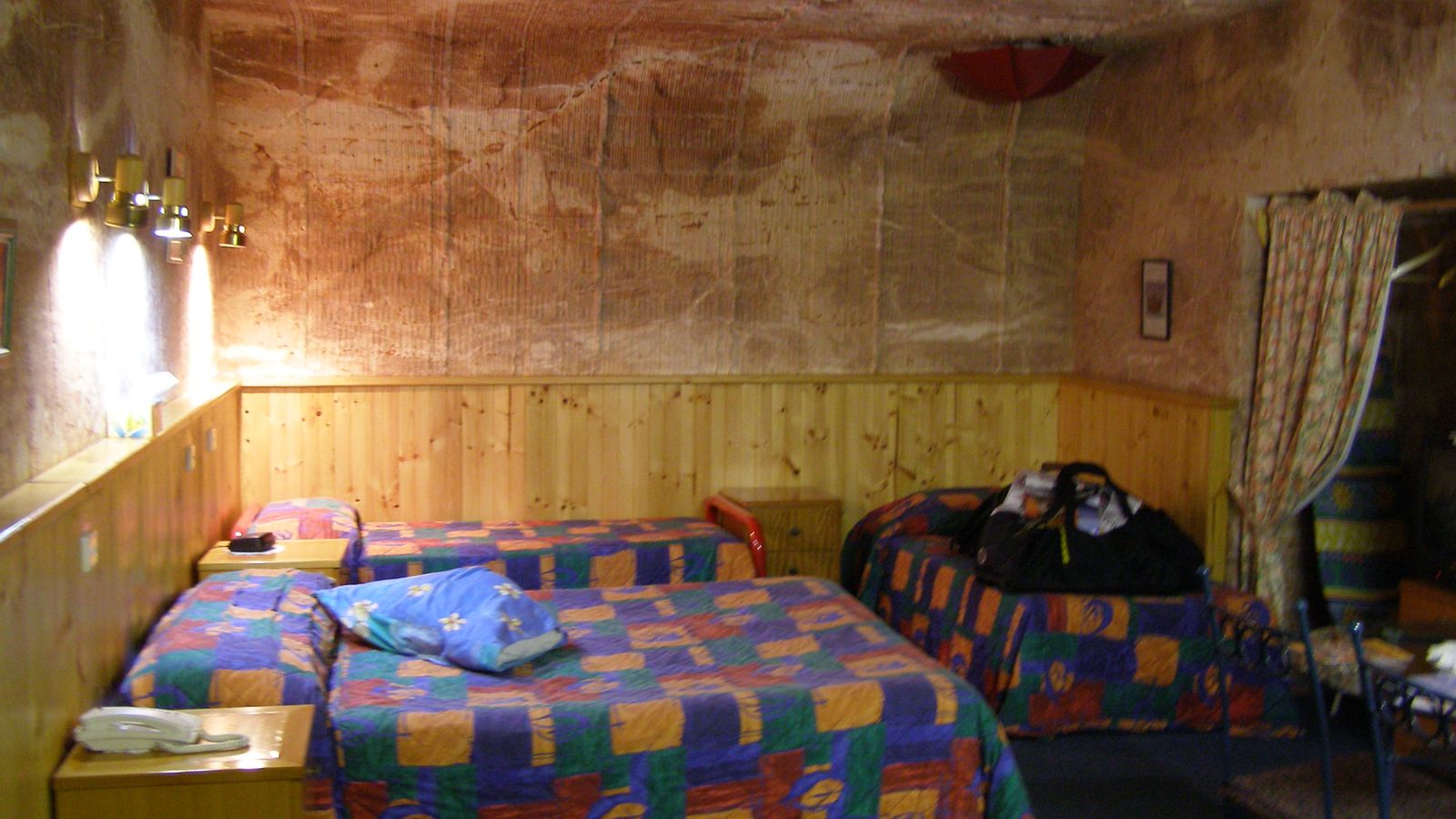
During the hottest months of the year, temperatures can reach as much as 53°C or about 127°F. While these temperatures would be hellish to endure, about 60% of the residents live at least 4 meters underground where the temperature remains stable, and above all, cool.
But, why live here at all? Coober Pedy is extremely rich in opals. In fact, this small town provides a sizable chunk of all opals sold around the world. Given that the rock is very soft, so soft that you can easily mark it with a fingernail or a pocket knife, miners took to excavating their own underground shelters and the whole thing spread from there.
Bizarre as the whole concept might seem, there are actually many benefits to living here. For starters, energy costs. The town generates all of its own power and about 70% of this comes from solar or wind generators. If all of the buildings were above ground, there is no way that enough energy could be generated. The extra electricity required to drive that many air-conditioning units would require energy to be piped in from outside.
Furthermore, who wouldn’t want to live in a place where, if you had a baby or wanted somebody to move in with you, you could just take a pickaxe to the wall and carve yourself out a new room? In the past, this sort of home renovation could prove to be exceptionally lucrative. One man who was installing a shower room found a huge opal as he tunneled into his wall and, when a local hotel started to build an extension, they excavated $1.5 million worth of the precious stones.
If you add into the mix the extreme levels of privacy that can be attained, the complete lack of sound and light pollution underground, and the fact that the comparatively cold temperatures cause insects to literally leap off you as you enter your dwelling, not to mention the fact that you can pick up a modest three-bedroom underground dugout for about £35,000, it really doesn’t seem to be a bad place to live at all.
2. Joyxee Island
Plastic pollution is perhaps one of the biggest environmental issues we as a species face today. Plastic waste, be it drinking bottles, disposable nappies, single-use carrier bags, or even drinking straws, take hundreds of years to decompose and, even as they do break down, they release tiny particles which inevitably find their way into the ocean or the water table. Although some steps are finally being taken to lessen the environmental damage caused by single-use plastics, one British artist has taken reusing waste plastics to a whole new level.
Joyxee Island is located just off Cancun, Mexico, and is the brainchild of Richard Sowa. So, what’s so special about it? Well, this 8,000 square-foot slice of floating paradise was constructed almost entirely from plastic bottles that Sowa collected by hand. After collecting more than 100,000 of these bottles, he bound them together with nets, covered the whole thing in driftwood and soil, planted trees and other vegetation on top, and now the whole thing is bound together by roots.
Watch the Video
Open Video
Video Briefing
Unbelievable Places that People Really Live
Now you might think that, as a proof of concept, this little floating island is fairly impressive. However, Sowa didn’t stop there. Not only does he live on his island, he has built himself a sizable house complete with a swimming pond, solar and wave-generated electricity, a hot tub, and, most importantly, an Internet connection.
Perhaps the most impressive thing about this island is that, theoretically, Sowa could take it wherever he wanted. During an interview for a documentary, he told a reporter that, assuming he could get the island towed out of the lagoon where he built it, he could, through the use of sails, sail the entire contraption in much the same way that you would sail any large ship. Obviously, the shape of the island means that doing so would be considerably more difficult than maneuvering your average yacht but, given that Sowa grows his own fruit, vegetables, and herbs, the idea of traveling the world on his own self-propelled island is not really that far-fetched.
1. The Principality of Sealand
Have you ever become so bored and depressed with the various actions of your government that you just felt like finding some uninhabited piece of land and starting your own country? Well, in 1967, one family from the UK did exactly that. Sort of.
During World War II, the British armed forces built several forts along the East Coast of England to defend against incoming German aircraft. Several of these forts, such as Roughs Tower, were technically illegal as they were outside the 3-mile boundary and therefore in international waters. However, due to the fact that there was a war on, nobody really bothered about this too much.
After the war, these structures were abandoned by the military and became objects of interest to many citizens, mostly those who were interested in operating so-called pirate radio stations. One such individual was Roy Bates, a former major in the British army. After setting up one of these radio stations on an abandoned fort and being quickly shut down because the fort was less than 3 miles from the coast, Bates set his sights on Roughs Tower. This fort, being roughly 7 miles from shore, was technically outside of UK jurisdiction, and Bates moved there with his family to continue broadcasting.
That was, until he had a better idea. Why not start his own principality? So, he did. In 1967, Bates declared this former military installation the Principality of Sealand.
Perhaps understandably, the United Kingdom government was less than pleased with this idea, and the military were swiftly dispatched to destroy any other such structures that still remained in international waters. According to Sealand’s official website: “Shortly after the declaration of independence, Roy’s son, Prince Michael, repelled no less than seven armed invasion attempts, employing an arsenal of guns, Molotov Cocktails, and homemade projectiles. By late 1968, Sealand would find itself battling for survival on several fronts as the British government had become aware of Sealand, and the potential problems associated with a new country seven miles off their coast.”
Over time, the government would fail in various attempts to reclaim the fort and, even when they extended the boundary for international waters to 12 miles from the coast, it still remained annoyingly out of their control, due to the fact that such extensions do not change land ownership. While the government has never formally acknowledged Sealand as its own country, it has admitted on several occasions that it does not have legal jurisdiction. For example, when a group of German masonries briefly captured the principality and one of the group ended up in Sealand prison, the UK did nothing to assist the German effort to free their citizen and diplomats had to be dispatched to the fort to negotiate his release.
Even now, the principality seems to exist in some sort of legal grey area. The website offers the sale of various titles such as lordships, and the money raised goes towards maintaining the fort. Even better, if you want to become a citizen, you absolutely can.
Again, according to the official website:
“This is an open invitation to all persons of the world who share our beliefs to join our community and formally show their support in a meaningful and enjoyable way.”
Hong Kong Shoebox Apartments
Whilst you’d be hard-pressed to find a city where space was not at a premium, the landlords of Hong Kong have stretched the definition of close-quarters living to such a degree that it would have the average Westerner going utterly insane from claustrophobia in just a few hours.
Among the working class in Hong Kong, there is a popular proverb which, when translated, means “If you work long and hard at it, you’ll get to own your own house.” Whilst this may be true for a small group of select individuals, the reality for most people could not be further from this pretty little lie. The reality is that, for a large amount of the ordinary working class, not only will they never be able to afford their own house, they will live out their days in so-called shoebox or coffin apartments.
So, how small are we talking here? Obviously, this depends on a number of factors, not least among these being the money-grabbing tendencies of the landlord. Some of these apartments are literally only big enough to fit a single mattress. But wait, there’s more.
It is certainly not uncommon for 20 or 30 of these apartments to have only one toilet between them and, although some of them are separated by opaque wooden boards, this is by no means a guarantee. In the worst cases, residents have to make do with wire mesh divides which, according to one former tenant, gives the feeling that you and your neighbors are living in stacked dog crates.
At this point, you may well be wondering, are these places at least comparatively cheap? Well, that depends on your financial perspective. At first glance, the average price of around $200 a month doesn’t sound entirely unfair for what you are getting. However, if you take into consideration that the average wage of the people who are forced to decide between living in what is essentially a coffin or living on the streets is just slightly less than $800 a month, it suddenly becomes a lot less reasonable.
According to one source, not only is the city’s overcrowding problem such that even these dwellings are at a premium, there are actually visiting tourists who will pay good money to stay in a shoebox apartment just for the experience. Obviously, this does very little to improve availability.
Although the government has claimed that improving living conditions is a high priority, as it stands at the moment, there are low working-class families living in considerably less space than they would have if they were in prison. Not only that, but they are being charged exorbitant fees for the privilege.
Key Takeaways
- Floating villages in Tonlé Sap, Cambodia, adapt to seasonal flooding with structures built on bamboo poles or barrels.
- Oymyakon, Russia, is the coldest inhabited place, with average winter temperatures dropping to -46.4°C.
- Coober Pedy, Australia, residents live underground to escape extreme heat, with homes often yielding opals during construction.
- Joyxee Island, off Cancun, Mexico, is a floating paradise built from plastic bottles, featuring solar and wave-generated electricity.
- The Principality of Sealand, off the UK coast, exists in a legal grey area, offering citizenship and titles for sale.
SideProjects Editors
The SideProjects editorial team researches, fact-checks, and structures explainers about the lesser-known tales, side narratives, and spin-offs behind major historical and contemporary subjects.
Frequently Asked Questions
What are the floating villages of Tonle Sap?
The floating villages of Tonle Sap in Cambodia are communities built on water, with structures sitting on bamboo poles, barrels, or barges. They have everything needed, including schools, temples, and dwellings, and residents swim or use boats to travel during the flood season.
Why is Oymyakon, Russia considered one of the coldest places?
Oymyakon is considered one of the coldest inhabited places in the world, with average temperatures dropping to -46.4°C (-51.52°F) in the coldest month. The coldest temperature ever recorded there was -96°F or -71°C.
How do residents of Coober Pedy, Australia escape the heat?
About 60% of the residents of Coober Pedy live underground where the temperature remains stable and cool. This is due to the town’s richness in opals, which led miners to excavate underground shelters.
What is Joyxee Island and who built it?
Joyxee Island is a floating island located off Cancun, Mexico, built by British artist Richard Sowa. It is constructed almost entirely from plastic bottles and includes a house, swimming pond, solar and wave-generated electricity, and an Internet connection.
What is the principality of Sealand?
Sealand is a principality declared by Roy Bates in 1967 on an abandoned military fort off the East Coast of England. It is technically outside UK jurisdiction and has existed in a legal grey area, with the UK government acknowledging it does not have legal jurisdiction over it.
What are Hong Kong shoebox apartments?
Hong Kong shoebox apartments are extremely small living spaces, often just big enough for a single mattress. They are shared among many tenants, sometimes with only one toilet between 20 or 30 apartments, and are a result of the high demand for housing in the city.
How do the floating villages of Tonle Sap adapt to the changing water levels?
During the wet season, water levels can rise by as much as 10 meters. Buildings are constructed on bamboo poles, barrels, or barges to accommodate these changes. Residents swim or use boats to travel during the flood season.
What challenges do residents of Oymyakon face due to the extreme cold?
Residents of Oymyakon face challenges such as frozen water pipes, requiring outdoor toilets, and frozen fuel, which often means keeping car engines running 24 hours a day. Even vodka can freeze if left outside.
What benefits do residents of Coober Pedy enjoy from living underground?
Residents of Coober Pedy benefit from stable, cool temperatures underground, lower energy costs due to solar and wind generators, and the ability to easily expand their living spaces by excavating new rooms. Additionally, there is minimal sound and light pollution.
How does Richard Sowa’s Joyxee Island generate electricity?
Joyxee Island generates electricity through solar and wave power. This allows Richard Sowa to live sustainably on his floating island, which is constructed from plastic bottles and other recycled materials.