Though the world is covered in ancient ruins, very few ancient buildings have remained in use since their construction. Today we look at a few that are, including the Tower of Hercules, the Colosseum, Luxor Temple, Hōryū-ji Temple, and 9,000 year old Sassi di Matera.
World’s Oldest Buildings that Are Still in Use
By Kevin Jennings
All across the world, examples of ancient architecture can be found. Most of these lay in ruin, with what remains being little more than a tourist destination. However, on rare occasions these buildings have truly withstood the test of time, so much so that they are still in use today.
Key Takeaways
- The Tower of Hercules, built by Romans, is the world’s oldest lighthouse, in use for nearly 2,000 years.
- The Colosseum, originally for gladiatorial combat, now hosts limited events and religious observances annually.
- Luxor Temple, dedicated to kingship, has been a continuous site of religious worship for over 3,400 years.
- Hōryū-ji Temple, the world’s oldest wooden building, has been a Buddhist temple and tourist attraction since 607 AD.
- Sassi di Matera, prehistoric caves, have housed communities for nearly 9,000 years, with a brief interruption in the mid-20th century.
Today we’ll be looking at a few incredible structures that have been in use for roughly 2,000 years or longer, and one that has been in use for over 9,000.
The Tower of Hercules
Located in A Coruña, Galicia, Spain, the Tower of Hercules is the world’s oldest lighthouse. It was built by the Romans in the first or second century AD, and it has been in continuous use for nearly 2,000 years.
Until the 20th century, the lighthouse was known as Farum Brigantium, the name given to it by the Romans. Brigantium was the Romans’ name for this area of Spain, and it was built specifically on the shores of Cape Finisterra. Finisterra is Latin for “end of the Earth”, so named because the Romans believed it to be the end of the world, figuratively speaking; it had already been understood for hundreds of years that the world was round.
The word “farum” in the tower’s originally name comes from the Greek “Pharos”, the name given to the Lighthouse of Alexandria. This wasn’t just some boasting on the part of Roman architects who saw fit to compare their work to one of the Seven Wonders of the World either. It was named this because the Tower of Hercules was built using the original plans for the Lighthouse of Alexandria, just on a smaller scale.
The lighthouse currently stands 55 meters (180 feet) tall, though the original design was only 34 meters (112 feet) tall. The additional fourth story was added in the late 1700s when the tower underwent renovations. Despite these renovations, the original Ancient Roman core of the structure has been fully preserved and tourists can see the nearly 2,000 year old masonry contained within the lighthouse’s newer outer shell.
Even though the structure has been in use for so long, it actually has a pretty quiet history; the Romans built a really good lighthouse, and it’s been in continuous use since its construction. That’s pretty much the whole story. This actually isn’t too surprising since it was built using the plans for the Lighthouse of Alexandria, a tower that stood for over 1,000 years and took five major earthquakes to destroy.
If you’re wondering where Hercules fits into any of this, the new name of the lighthouse comes from one of the several creation myths surrounding the structure. According to one myth, Hercules engaged in continuous combat for three days and three nights with the giant tyrant Geryon. After slaying the giant, his head was buried and Hercules ordered a town, including the lighthouse, to be built on top of the buried skull.
Renaming the lighthouse could be seen as a slight to Gaius Sevius Lupus, the man we know served as chief architect on the project thanks to an inscription on the original cornerstone, but Spain’s ministry of tourism may have just felt that the Tower of Hercules was a catchier name.
The Colosseum
In the center of Rome stand the ruins of the most famous amphitheatre ever built, the Colosseum. If you’ve ever seen a portrayal of Ancient Rome, you’ve undoubtedly seen depictions of gladiatorial combat taking place in the Colosseum. This was just one of the theatre’s many uses by the Romans.
In addition to battles between gladiators, the Colosseum was also used to showcase hunting exhibitions and public executions. On occasion, the building would even be flooded and used to reenact naval battles.
Built in the first century AD, the six acre Colosseum was similar in size to a modern day football stadium. The arena floor was 87 meter by 55 meters (287 by 180 feet), very close to the size of a football field. The entire structure was 189 meters long, 156 meters wide, and 48 meters tall (615 by 510 by 157 feet), and it had a maximum capacity of about 85,000 spectators.
While the Colosseum has remained in use, the days of hunting and gladiatorial combat came to a close by the end of the 6th century, and it has served several different purposes since then. For several centuries, the arena was used as a cemetery while the arcades were converted into homes and workshops. Then it was taken over by the powerful Frangipani family who used it as a castle.
By the mid 14th century, Rome was in decline and the Colosseum mainly served as a popular squatting location for groups of bandits. This was the same time that a massive earthquake caused much of the structure to fall to ruin. Starting in the 16th century, the Catholic Church tried to revitalize the location. Early proposals included turning it into a wool factory or a bullfighting arena, but none of these projects ever came to fruition.
In 1749, Pope Benedict XIV installed the Stations of the Cross in the Colosseum, a series of 14 carvings depicting the events on the day of Jesus’ execution. This is one of its modern day uses, and every year on Good Friday over 10,000 people will visit the Colosseum as the pope leads them in the Stations of the Cross. Though the stations were first installed in 1749, this didn’t become an annual tradition until 1964.
Of course, the Colosseum was built as a venue for live performances, and it still serves this role today albeit in an extremely limited capacity. Though the likes of Elton John, Ray Charles, and Billy Joel have performed at the Colosseum, the building itself is used as a backdrop for these larger concerts with the event actually taking place outside.
Live performances do still take place within the Colosseum walls, but the days of an 85,000 person capacity crowd are long since over thanks to the extensive damage the building has suffered. So much of the Colosseum has been damaged that the venue itself can now only hold a few hundred people using temporary seating.
Luxor Temple
Watch the Video
Open Video
Video Briefing
The Worlds Oldest Buildings That Are Still in Use
Ancient Egypt is known for its incredible amount of immense structures that have stood tall for thousands of years. But other than being tourist destinations or sites of archeological research, they aren’t really doing much. Each temple was generally dedicated to a specific god or pharaoh, so as belief in the ancient gods waned so too did any utility of those temples. We can’t even say that the pyramids are technically still in use as tombs seeing as most of them were entirely cleared out long before modern archeologists had a chance to ship their mummies off to the British Museum.
The exception to this is the Luxor Temple built on the east bank of the Nile River in ancient Thebes, what is now modern day Luxor. The temple was originally constructed in approximately 1400 BC by Amenhotep III. Additions to the temple complex were commissioned by Tutankhamen and Ramses II, though that construction would have completed during the 1200s BC.
Unlike most other Egyptian temples, Luxor Temple was dedicated to the rejuvenation of kingship rather than to any particular deity. Some historians believe this may be the official location where many pharaohs were crowned, at least figuratively. At least some of this speculation comes from the fact that Alexander the Great claimed to have been crowned at Luxor despite evidence that he may have never personally traveled that far south.
The temple was built with a type of sandstone known as Nubian sandstone, quarried in South-Western Egypt. They would have needed a lot of it, because the complex is absolutely massive. When it came to ancient construction projects, the Egyptians weren’t going to let anyone outdo them in terms of sheer size. The Luxor Temple is over 72 square kilometers, or 28 square miles.
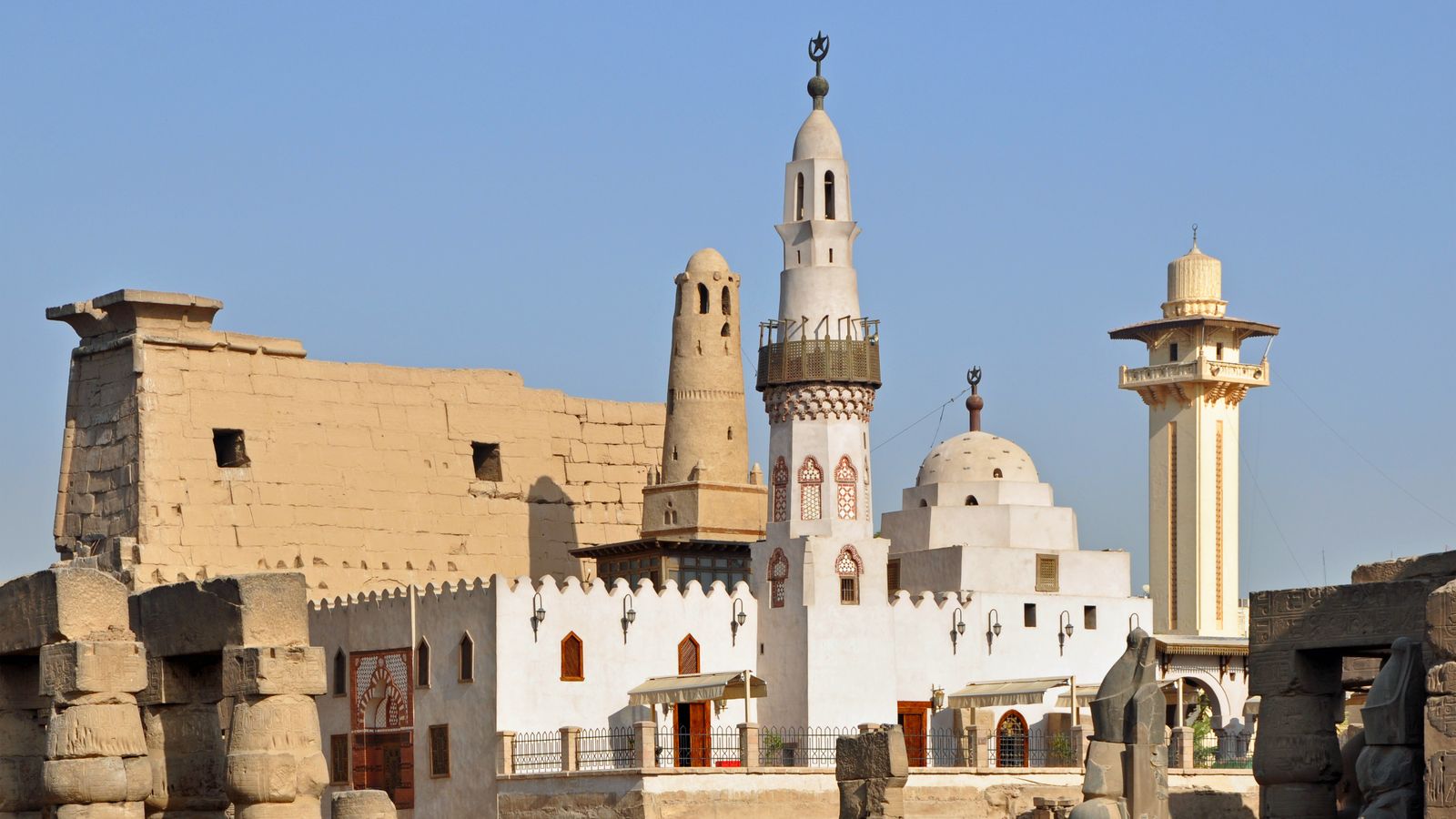
When the Romans conquered Egypt, the complex was first turned into a fortress and government building before the temple itself was converted into a Catholic Church in 395 AD. It was then converted to the Mosque of Abu Haggag in 640, and that mosque is still in use today. Though the religion may have changed a couple times, the Luxor Temple has been home to religious worship continuously for over 3,400 years.
The temple is regarded as the oldest building in the world that is at least partially active for anything other than tourism or archaeological research. As we’ll get to shortly, that impressive distinction is entirely dependent on how we choose to define the word “building”.
Hōryū-ji Temple
Hōryū-ji Temple is the youngest building on this list, but it has one special characteristic that separates it from the others. Everything else we’ve mentioned, as well as the final entry in today’s episode, share a single common characteristic that is largely expected of millennia old manmade structures: they were all made of stone. Wood was used in different parts of the Colosseum, such as the arena floor, but by and large the main structure was built out of stone.
Hōryū-ji Temple, on the other hand, is made of wood. First constructed in 607, it is widely acknowledged as the world’s oldest wooden building. Of course, things have to be slightly more complicated than that. In total, the entire temple complex contains nearly 30 buildings. The two main buildings are the five story pagoda and the Kondo, or main hall.
In 670 all of the buildings were burned down after a lightning strike. The Kondo was the first rebuilt, and that specific building has the distinction of being the oldest wooden building in the world. The original construction was commissioned by Prince Shōtoku. The complex was built as a Buddhist temple, though it became the key location in the rise of the Cult of Shōtoku, a sect of Buddhism focused on venerating the late prince.
Aside from that early fire in 670 and despite being made of wood, the actual buildings themselves seem to have suffered very little hardship. The next major repairs didn’t take place until the 14th and 17th centuries. When Japan made Shinto the official state religion in 1868, Hōryū-ji Temple began suffering from a lack of funding. In order to ensure the preservation of the temple, the monks had to sell some of the ancient treasures housed in the temple to museums.
They used this money to fund conservation efforts, and in 1934 a massive restoration project began. This was halted during World War II when some parts of the temple were disassembled and hidden to protect them. Fortunately, the United States had a policy not to bomb important cultural sites like this.
Today, Hōryū-ji is still in use as a Buddhist temple and as the headquarters of the Shotoku sect of Buddhism. It is also a major tourist attraction, and in 1993 it was named as Japan’s first UNESCO World Heritage Site. But it is not just the historic temple itself that draws tourists to this location. In addition to being a place of worship, Hōryū-ji Temple is home to over 180 of Japan’s designated National Treasures.
Sassi di Matera
We’ve talked about some pretty old buildings, but nothing can compare to the homes of Sassi di Matera, two districts in what is now the Italian city of Matera, Basilicata. These prehistoric homes have been in near continuous use since they were first constructed in 7,000 BC.
If you’re wondering how Stone Age people from the Paleolithic period could have built something that would still be standing and housing people over 9,000 years later, the answer is simple: they technically didn’t build them, because they’re caves. The homes were dug into calcarenitic rock, a form of limestone, on the slope of a ravine created by the Gravina River. This is where the name “Sassi” comes from, literally translating to “stones”.
The proximity to water, combined with both the durability of limestone and the ease with which it can be carved, made this a perfect location for the troglodyte settlement. In addition to the houses that were carved into the stone, the early inhabitants also created primitive roads. Many of these roads ran on top of the houses.
The Sassi looked a bit like a Stone Age high-rise apartment complex, with caves stacked on top of one another up to ten levels high. Unfortunately, despite being an impressive feat of prehistoric engineering, these dwellings did leave quite a bit to be desired. There was no natural light, ventilation, or running water. The residents did have access to clean water thanks to a remarkable water system they built, but they would have to leave their caves to access it.
This was less than ideal given that a single room cave would normally be home to both an entire family and their livestock.
While the Sassi may not have been luxury condominiums, they were enough to service a community of as many as 30,000 residents continuously for nearly 9,000 years. Then, in 1950, the Italian government got involved. Even in 1950, there was not yet any running water or electricity. The residents were extremely poor and diseases, particularly malaria, ran rampant and resulted in levels of infant mortality that were comparable to ancient times.
The government decided that the living conditions were inhumane and forcibly removed the residents.
Over the ensuing decades, renovations went underway to try to make the Sassi habitable again while also preserving the historic significance of these ancient dwellings. Beginning in the 1980s, people began moving back and there are roughly 3,000 permanent residents again. That 30-40 year period in the mid 1900s is the only time in a period spanning over 9,000 years that these prehistoric caves were not inhabited.
Now, Sassi di Matera is a popular tourist destination. There are shops, restaurants, hotels, and even electricity. Even if you had never heard of this city before, there’s a good chance you’ve seen it. Because the ancient homes are reminiscent of sites around Jerusalem, the Sassi has been featured in several movies set in biblical times such as The Passion of the Christ and The Nativity Story.
Or if you prefer summer blockbusters to religious-themed movies, it was also used as the location of the Amazonian city Themyscira in the 2017 Wonder Woman film.
While we could debate whether or not the Sassi technically qualify as buildings, these caves were absolutely manmade. Were it not for that brief interruption beginning in 1950, Sassi di Matera would comfortably hold the title of “Oldest Continuously Inhabited City” by at least 2,000 years.
Key Takeaways
- The Tower of Hercules, built by Romans, is the world’s oldest lighthouse, in use for nearly 2,000 years.
- The Colosseum, originally for gladiatorial combat, now hosts limited events and religious observances annually.
- Luxor Temple, dedicated to kingship, has been a continuous site of religious worship for over 3,400 years.
- Hōryū-ji Temple, the world’s oldest wooden building, has been a Buddhist temple and tourist attraction since 607 AD.
- Sassi di Matera, prehistoric caves, have housed communities for nearly 9,000 years, with a brief interruption in the mid-20th century.
SideProjects Editors
The SideProjects editorial team researches, fact-checks, and structures explainers about the lesser-known tales, side narratives, and spin-offs behind major historical and contemporary subjects.
Frequently Asked Questions
What is the oldest lighthouse still in use?
The Tower of Hercules in A Coruña, Galicia, Spain, is the world’s oldest lighthouse, built by the Romans in the first or second century AD and has been in continuous use for nearly 2,000 years.
What is the oldest building still in use?
The Sassi di Matera, two districts in the Italian city of Matera, Basilicata, have been in near continuous use since they were first constructed in 7,000 BC.
What is the oldest wooden building still in use?
Hōryū-ji Temple in Japan, first constructed in 607, is the world’s oldest wooden building still in use.
What was the original purpose of the Colosseum?
The Colosseum was originally used for gladiatorial combat, hunting exhibitions, public executions, and even reenacted naval battles by flooding the arena.
What is the Luxor Temple dedicated to?
The Luxor Temple is dedicated to the rejuvenation of kingship rather than to any particular deity.
What is the current use of the Colosseum?
The Colosseum is used as a backdrop for large concerts and for religious events, such as the Stations of the Cross led by the pope on Good Friday.
What is the significance of the Tower of Hercules’ name?
The name ‘Tower of Hercules’ comes from a myth where Hercules engaged in combat with the giant tyrant Geryon and ordered a town, including the lighthouse, to be built on top of the buried skull of Geryon.
What is the current religious use of the Luxor Temple?
The Luxor Temple is currently used as the Mosque of Abu Haggag, which has been in use since 640 AD.
What is the significance of the Hōryū-ji Temple?
The Hōryū-ji Temple is significant because it is the world’s oldest wooden building and is still in use as a Buddhist temple and the headquarters of the Shotoku sect of Buddhism.
What happened to the residents of the Sassi di Matera in 1950?
In 1950, the Italian government forcibly removed the residents of the Sassi di Matera due to inhumane living conditions, including lack of running water, electricity, and rampant diseases.