
We all know that the Nazis loved themselves a bit of posh aerospace tech; hence the Messerschmitt 262, the world’s first jet fighter, the Messerschmitt 163, the world’s first rocket interceptor, and the Arado 234, the world’s first jet bomber.
But what is less well known is that those famous examples that actually made it to service are just the tip of the iceberg, and that for every one like them that roared their way into the historical zeitgeist, there is another 10 that for one reason or another, failed, and as a result remain but enigmas that languish in obscurity; and today, we shall be shining a light onto five of them – so let’s begin!
Messerschmitt P.1101
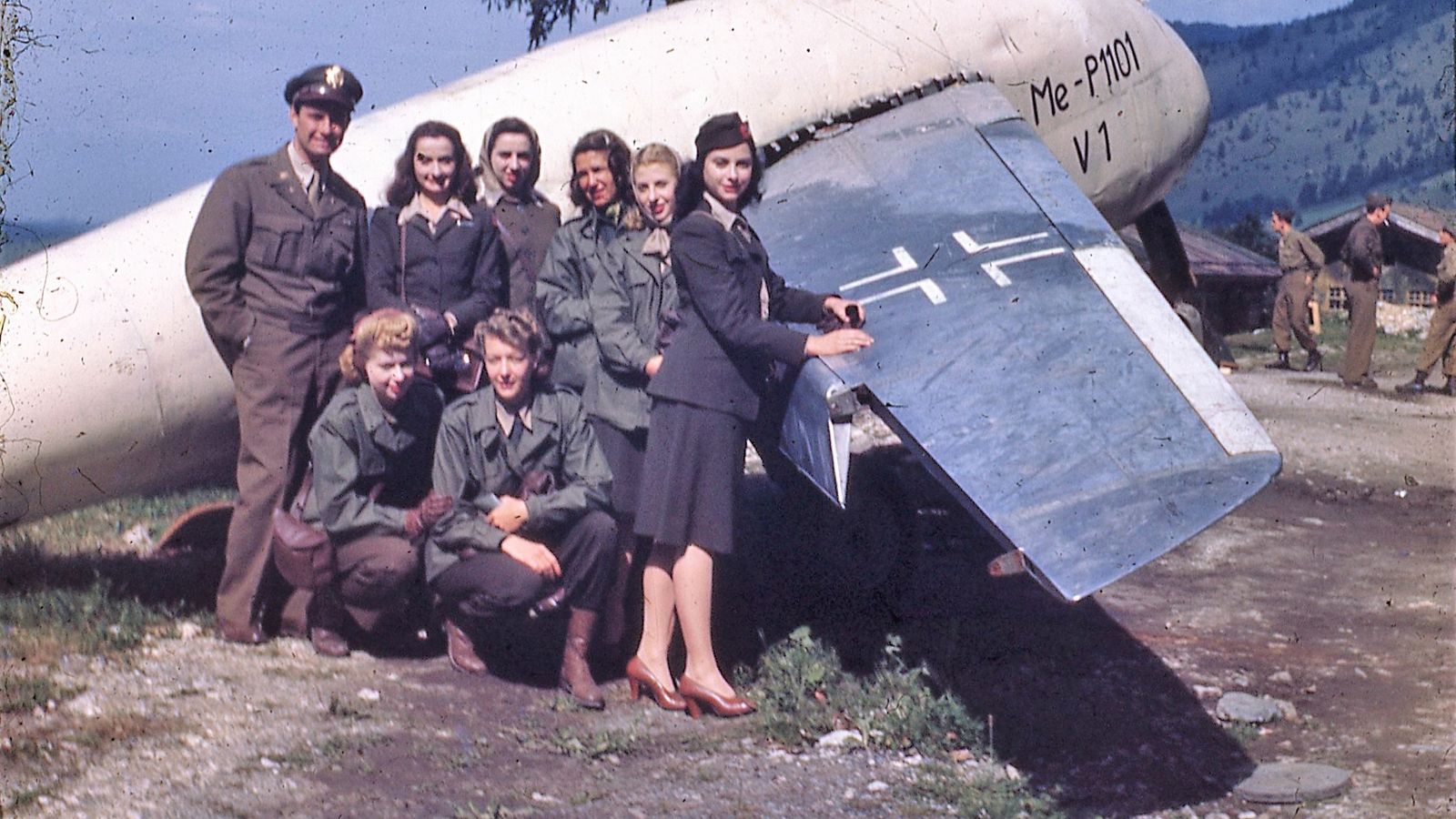
Let us begin with the Messerschmitt P.1101 – a jet fighter. It has its genesis in the ‘1-TL-Jäger’ competition of July 1944, which was announced by the Ministry of Aviation, RLM, and was all about trying to find a simpler, more reliable, and above all else, cheaper alternative to the Messerschmitt 262, which, despite being the world’s first operational fighter jet, and a truly innovative bit of kit… was none of those things.
Key Takeaways
- The Messerschmitt P.1101 was a jet fighter with variable-sweep wings, a first for aircraft design.
- The DFS 346 was a rocket-powered plane designed to break the sound barrier, but never flew.
- The Junkers Ju 322 Mammut was a large glider intended to carry tanks, but failed weight tests.
- The Junkers EF 61 was a high-altitude bomber prototype that crashed due to poor visibility.
- The Focke-Achgelis Fa 225 combined a glider and helicopter, but was abandoned due to slow descent.
The RLM had a vague idea of what they wanted too, as they stipulated that the new aircraft should be a single seater, top out at 1,000kph, have an aerial endurance of at least an hour, a bit of armour to protect the pilot, at least two 30mm MK108 cannons, and a Heinkel HeS 011 engine.
Knowing a thing or two about jets by that point, Messerschmitt rose to the challenge and produced an initial design for what would become the P.1101. Sketched by Waldemar Voigt, who had been the project lead for the Me-264 bomber and Me-163 that we mentioned earlier, it featured an all-metal fuselage, a single Heinkel HeS 011 buried within the fuselage, twin air intakes at its wing roots, much like a Cold War era British V-Bomber or Hawker Hunter, and a ‘v-tail’ configuration.
This did not spark much joy among the RLM big wigs however when it was presented to them in September 1944, and so, Voigt returned to his drawing board and created an updated preliminary design, one that saw the twin air intakes replaced by a single big one up in the nose, and the moving back of the cockpit, which had to be shifted to accommodate said new intake. The ‘v-tail’ was also replaced with a more conventional design. The most interesting addition of all however was variable-sweep wings, i.e. wings that can be moved into different positions. It was quite a crude system, with them only able to be adjusted when it was stationary on the ground, rather than when in the sky as you may initially imagine; but still, this was the first aircraft to ever incorporate such a system – so it was certainly a bit of a big deal.
Ultimately, however, despite now having a fully RLM approved design, very little came of the project, as labour shortages, constant bombing, and technical development hiccups meant that come early 1945, not even the first prototype had been completed.
The worst problem by far was the fact that Messerschmitt couldn’t even get their hands on the engine they wanted; the component that had to be figured out first and foremost, as so many other systems of the aircraft couldn’t even begin to be engineered before it was in place to build around. Chiefly, this was because Heinkel, themselves being beset by labour shortages, constant bombing, and technical hiccups, simply couldn’t get it out of the factory fast enough; with a mere 19 units being produced come the war’s end – all of which were hotly fought over by the many, many experimental aircraft programs Germany was running.
Voigt, rather prudently, eventually gave up ever getting his hands on one at all, and instead opted to use the much more readily available Junkers Jumo 004 instead. This engine, which also powered the 262 and 234 was, to all intents and purposes, little but posh scrap: it’d last 15 operational hours, if you were lucky, before it completely wore out, its turbine blades would often sheer off and get sucked into the engine, completely destroying it, and it was horribly inefficient; but hey – a crap engine is better than no engine!
The powerplant change was not enough to see the P.1101 through to completion, however. By the time all of the faffing about with the engine had been resolved, the Reich was at the point of near total collapse, with the Armies of both the Western Allies and the Soviets closing in to deliver the coup-de-grâce.
Voigt and his team kept working till the last minute however, for what it was worth by that point, with their progress only being interrupted by the arrival of American tanks at the Messerschmitt Oberammergau Research Centre, at which point, they surrendered, and happily showed the Americans what they had been working on to try win some brownie points with their captors – this worked, and the team ended up being relocated to the US via Operation Paperclip, and all found gainful employment within the American Aerospace sector, with Voigt himself ending up with Vought, where he would lend his expertise to the development of the F7U Cutlass.
As for the unfinished P.1101 however, it ended up being transported to the US, where it was pulled apart and examined by Bell Aircraft. Their Chief Designer, Robert Woods, was very impressed by the variable wings, and went on to refine the idea further for the Bell X-5, the first aircraft ever to be able to adjust its wings while in the sky.
DFS 346
Next, we have the DFS 346, which was developed in the final stages of the war. DFS, if you are wondering, because it isn’t exactly the most familiar name, refers to the ‘German Institute for Glider Research,’ a state-owned enterprise that brought all of Germany’s previously privately owned glider companies together under one roof.
As for the 346 specifically, it, bizarrely, was the exact opposite of a glider: a rocket powered research plane that had the aim of smashing the sound barrier. As for why a glider company of all things found itself attempting to break the sound barrier, that would because of one of their employees by the name of Felix Kracht. He had made quite a name for himself, both in the world of glider-ing and in Germany more generally, thanks to his equal skill both in building gliders and then flying them in various exciting ways, an example of which comes from 1937, when he designed the high performance FVA-10B ‘Rhineland’ and then flew it over the Alps.
Because of his quasi-celebrity status, when Kracht, for reasons that have been lost to history, barged in to see DFS’ management, and announced that he wanted to build a plane that’d break the sound barrier, rather than being told to get lost, as basically any other employee would be, he instead had cash hurled at him, and was told to get to it.
As for its design, a notable feature was its backward-swept wings and a highly streamlined fuselage, which were designed to reduce drag and enable higher speeds. But while notable, they’re both ultimately pretty normal design quirks compared to the pilot’s positions, because that was prone… as in lying down on one’s front. This seemingly bizarre choice actually had some reasonable thinking behind it: firstly, not having a cockpit poking out helped to avoid compromising the highly streamlined fuselage, and also, the Germans had discovered that laying prone actually allowed a pilot to tolerate much higher g-forces than if they were sat upright – because it lessens the amount of blood that is pulled away from the brain during high-g manoeuvres.
But wait, there’s more weirdness, because the 346’s design also included an escape capsule. Basically, if the flight ended up going a bit wrong, the pilot could separate the cockpit from the fuselage, which had a built-in parachute for descent, and then, when closer to the ground, he would then jump out and use his own personal parachute in the normal manner.
As for this prospective supersonic plane’s power, it was to come from two Walter HWK 109 rocket motors. For the day, these were rather decent units, and were intended to propel the 346 not just through the sound barrier, but all the way up to Mach 2.0+, and even take it up to altitudes as high as 30,000 metres. They were arranged in quite an interesting manner too, because only one motor would actually be used for ‘speed,’ with the other one intended to provide sporadic bursts of power to help maintain velocity and altitude.
Unfortunately for Kracht however, he had proposed his design in 1944, so naturally, it never got anywhere near completion before the war’s end; he managed to knock out some blueprints and do some scale model wind tunnel testing – but that was about it.
But that’s not the end of the story however, because the facility in which Kracht was working ended up falling into the Soviet’s hands – and they were very interested in his work indeed.
So, is this the part of the story where we tell you that they brought Kracht’s vision to life, and managed a cheeky breaking of the sound barrier themselves mere moments after the Americans did it with the Bell X-1?
Actually, no, not at all, because it turns out, would you believe it, a glider designer wasn’t actually that qualified to be making record breaking rocket planes, and so, Kracht’s design was actually just a bit crap, and never really worked.
Not for a want of trying on the part of the Soviets however, because they piled serious resources into the 346 to try to get it to work. They gave it a go as an unpowered glider in 1947, just to test its aerodynamics… and it crashed, and they also tried it again in 1951 with a proper big boy rocket motor fitted… and it crashed, again, so the project was then abandoned.
Junkers Ju 322 Mammut
Watch the Video
Open Video
Video Briefing
5 Prototype Nazi Planes You've Probably Never Heard of
For our third aircraft, let us take a look at the Junkers Ju 322 Mammut, or Mammoth. Its development began in late 1940, a time when Germany was starting to see some real success with its glider deployed airborne units, having used them extensively during its Invasions of the Lowlands and Scandinavia.
But as successful as they were, there was a problem: their go-to gliders, things like the DFS 230, were just a tad small, and thus Germany’s airborne forces couldn’t really take any serious hardware into battle with them; the 322 was intended to be a solution to this problem – a seriously big glider that would be happily able to carry tanks and larger artillery pieces.
Its development was also made a top priority, because at that time, the Germans were sketching out their plans for Operation Sealion, the Invasion of the United Kingdom, where, on account of the English Channel, the ability to transport serious amounts of heavy hardware by air was naturally deemed essential.
As for why Junkers were chosen to develop such a machine, that was because they were one of Germany’s top aircraft manufacturers, with a proven track record of developing incredible aircraft such as the Ju-87 ‘Stuka’ dive-bomber, and the Ju-88 medium bomber, both of which were serving Germany very well indeed.
One small problem soon presented itself however, because all of those aircraft were all made of metal, and the 322 was to be made out of wood… a material that Junkers hadn’t seriously worked with for many years. The basic idea itself was a smart one to be sure, because wood was an abundant non-strategic resource that Germany was never going to run out of… but it turned out that wood is a very different beast to metal, and so Junkers engineers majorly struggled to get their heads around it.
Nevertheless, they persisted, and come October 1940, they had the basic design worked out. It was to be an almost flying wing kind of design, a genius move that created a simply enormous space for cargo in the centre, with a rear pointing boom to accommodate a traditional rear tail. To further maximise space, the flight crew were positioned in a gondola mounted above and to the left of the centre section – nice and out of the way to leave plenty of space for anything big that had to be squeezed in its belly. To further maximise cargo space, it was to take off using a large sixteen-wheeled trolley, and land on four sprung skids – skids being nice and flat, and thus neither overly eating into cargo space, nor creating excess drag, as a wheeled landing gear would. Some thought was even given to defence, with three MG15 machine guns being mounted around it in strategically located mounts.
All of this looked great on paper, and Junkers were confident that their creation would happily be able to carry 20,000kg worth of stuff – happily enough for a tank or up to 100 fully equipped troops… and then they began to test it out.
They began by driving a Panzer III into it… and the fuselage was immediately crushed underneath its weight – turns out, despite all their efforts to figure it out, wood had stumped them. They then returned to the drawing board and after a redesign of the floor, and reducing the prospective payload capacity to 16,000kg… it failed weight testing yet again. The third time proved to be the charm however, as with yet more strengthening work, and further reducing the payload estimate to 11,000kg, the fuselage no longer fell apart.
One small problem with that however, the 20,000kg target was set for a very specific reason – because it was basically the exact weight of an early war Panzer III. The whole point of this project was to develop a glider that could transport serious hardware, and now, it couldn’t even transport their lightest medium tank.
Needless to say, the Luftwaffe wasn’t exactly chuffed with this development, but they pushed it through to testing anyway in April 1941 – because after all, 11,000kg was still about the weight of 100 fully tooled up fellas, so maybe some use for it could be found.
Unfortunately for Junkers, its first test was an absolute disaster, the take-off trolley almost bounced up and destroyed the glider, and it took so long to take off that the Ju-90 towing it almost crashed. But wait, it gets worse, because then, after all of that, when in the air, the 322 proved about as stable as a newborn deer that’s just downed 15 pints of lager.
At this point, its fate was sealed, and the project was cancelled in May 1941, with the two finished prototypes, and 98 production models that were in various stages of completion all being chopped up for firewood.
Junkers EF 61
Let’s stay with Junkers for now and move on to have a look at the EF-61, a prototype high-altitude bomber. Its development began in December 1935, when Junkers, having gained a wealth of high-altitude aircraft experience from their earlier Ju-49 research aircraft, were commissioned to make a veritable Rolls Royce of a bomber, one that would make use of a pressurised cabin to allow it fly higher than any bomber before it had – so high in fact, that it would be completely out of reach of both ground based AA systems and interceptor aircraft.
Two prototypes ended up being built, which were designated the EF-61 ‘V1’ and ‘V2’ as per the usual German experimental nomenclature. They were both powered by two 900 horsepower Daimler-Benz DB 600s, a stopgap measure intended to tide them over until the then still in development 1,200 horsepower Junkers Jumo 211s could be fitted. Knowing that these beastly engines were (hopefully) on their way, Junkers engineers took special care with the cooling system, making sure to integrate nozzle coolers on the front of the engines that would provide more than enough airflow to really keep the new engines cool when pilots opened the throttle and gave it the beans.
Unfortunately, however, while the team at Junkers certainly put lots of effort into trying to make the EF-61 a quality high altitude bomber, they had been so hyper fixated on trying to squeeze every foot of altitude out of it that they could, that they totally neglected to think about how the measures they implemented to achieve this would affect other aspects of its performance. The worst offender by far was the cockpit, which, to achieve pressurisation with the crude technology of the day had really, really tiny windows. So small in fact, that it was a struggle to see much out of them at all – picture a tank’s vision slit bolted to a plane, and you’re about right. This ended exactly how you would expect, with EF-61 V1 crashing in September 1937.
Determined not to be defeated however, the Junkers engineers then revisited EF-61 V2 and made a few changes to solve the visibility problem, which included raising and repositioning the pilot’s seat, and fitting a metal dome, which could take larger windows without compromising pressurisation. A noble effort to be sure, but not a successful one, as EF-61 V2 also crashed in December 1937.
Following this, the whole program was written off as an abject disaster and was cancelled shortly after.
Focke-Achgelis Fa 225
A question for you dear readers. What happens when a DFS 230 glider and a Fa 223 helicopter decide they love each other very much? That’s right, they have a special hug and make a Focke-Achgelis Fa 225 – behold.
This bizarre looking thing was the result of Germany’s go-to glider, the aforementioned DFS 230 having a particular problem – that being that it needed really quite a large area to land, something which was less than ideal, as on a good day, it severely limited where the pilot could put it down, and on a bad day, the pilot would say “sod it, it’ll be fine,” and then proceed to kill everyone on board as his glider belly slid its way right into something solid.
By fusing the rotor assembly from a Fa 223 to the top of the venerable glider, Focke-Achgelis hoped that it would be able to land in much the same way as a helicopter: either vertically straight down, or in a very short distance, no more than 18 metres or so.
Naturally, a change this radical required quite a bit of tinkering with the base 230 design, and so a vast framework of struts was created above the fuselage so that they had somewhere nice and high to mount the rotor. This added a fair bit of weight, and so a highly strengthened undercarriage was also fitted in order to support the weight of it all. The rotor was also completely unpowered, depending entirely on autorotation, the natural movement of rotors from airflow as an aircraft moves through the sky, to generate lift. The original wings were also chopped off, as after all, they were a tad surplus to requirements now.
Development proved most quick too, with the whole process, from initial idea, through to working prototype, only taking seven weeks.
It was a reasonable idea all in all, and their thinking for creating such a machine is easy to follow, but alas, a reasonable idea isn’t always a good one – and sure enough, after a single working prototype was built, the 225 turned out to be complete dud, and so it was quickly abandoned and saw no further development.
The issues mostly revolved around speed, or rather a lack of it. We were unable to find an exact figure for exactly how slowly it approached the ground when released, but what we do know, is that whatever speed it was, it was so slow that the extra risk created by being longer exposed to enemy fire during the descent was deemed a far greater problem than any had by a normal glider.
Beyond just that, the 225 was also a victim of changing German doctrines. You see, early in the war, Germany was all about airborne troops. They had invested in them big time before the war broke out and had some cracking early war successes with them during their invasions in the Lowlands and Scandinavia. Inspired by that, they went all out during their Invasion of Crete in 1941, conducting it using mostly airborne troops… and it turned into something of a disaster. They won the battle don’t get us mistaken, but the victory was a pyrrhic one, with airborne casualties being large. This caused a total rethink in German airborne operations, that saw the near total abandonment of mass parachute assaults, in favour of occasional drops of only a handful or two of soldiers for really important occasions – with their paratroopers otherwise basically just becoming elite ground infantry after that point.
As a result of both of those factors, there was just no enthusiasm for the project by the Luftwaffe’s moneymen, and so the project was ultimately abandoned, with just a single prototype having been made.
Key Takeaways
- The Messerschmitt P.1101 was a jet fighter with variable-sweep wings, a first for aircraft design.
- The DFS 346 was a rocket-powered plane designed to break the sound barrier, but never flew.
- The Junkers Ju 322 Mammut was a large glider intended to carry tanks, but failed weight tests.
- The Junkers EF 61 was a high-altitude bomber prototype that crashed due to poor visibility.
- The Focke-Achgelis Fa 225 combined a glider and helicopter, but was abandoned due to slow descent.
SideProjects Editors
The SideProjects editorial team researches, fact-checks, and structures explainers about the lesser-known tales, side narratives, and spin-offs behind major historical and contemporary subjects.
Frequently Asked Questions
What was the Messerschmitt P.1101 designed for?
The Messerschmitt P.1101 was a jet fighter designed as part of the ‘1-TL-Jäger’ competition to find a simpler, more reliable, and cheaper alternative to the Messerschmitt 262.
What unique feature did the Messerschmitt P.1101 introduce?
The Messerschmitt P.1101 introduced variable-sweep wings, which could be adjusted when the aircraft was stationary on the ground.
Why was the DFS 346 project abandoned by the Soviets?
The DFS 346 project was abandoned by the Soviets because the design, created by a glider designer, was flawed and did not work as intended, despite significant resources being invested in it.
What was the purpose of the Junkers Ju 322 Mammut?
The Junkers Ju 322 Mammut was designed to be a large glider capable of carrying tanks and heavy artillery for Germany’s airborne units, particularly for Operation Sealion.
What material was the Junkers Ju 322 Mammut made of, and why?
The Junkers Ju 322 Mammut was made of wood because it was an abundant non-strategic resource, but Junkers struggled with the material, leading to structural failures during testing.
What was the Junkers EF 61 designed to achieve?
The Junkers EF 61 was designed to be a high-altitude bomber with a pressurized cabin, allowing it to fly above the reach of ground-based AA systems and interceptor aircraft.
What was the primary issue with the Junkers EF 61’s design?
The primary issue with the Junkers EF 61’s design was the extremely small windows in the cockpit, which severely limited visibility and led to crashes.
What was the Focke-Achgelis Fa 225 intended to solve?
The Focke-Achgelis Fa 225 was intended to solve the landing issues of the DFS 230 glider by adding a rotor assembly from a Fa 223 helicopter, allowing for vertical or short-distance landings.
Why was the Focke-Achgelis Fa 225 project abandoned?
The Focke-Achgelis Fa 225 project was abandoned because the aircraft was too slow, making it vulnerable to enemy fire during descent, and due to changing German doctrines on airborne operations.
What happened to the Messerschmitt P.1101 after the war?
After the war, the unfinished Messerschmitt P.1101 was transported to the US, where it was examined by Bell Aircraft. The variable-wing design impressed Robert Woods, who refined the idea for the Bell X-5.