
Britain is a nation known for its eccentricity and unique approach to life, from cheese rolling to constant apologising, eccentricity proves to be a key foundation of Britain’s international image, easily on par with the royal family or Big Ben. But what you may not know however is that this penchant for the unconventional is not limited to daily life and cultural practices; it also permeates the realm of engineering and design, particularly in the field of military technology.
So, with that in mind, today we shall embark on a journey through the annals of British armoured history and look at some of the most peculiar and innovative tanks that showcase the nation’s inherent eccentricity. From multi-turreted monstrosities to insect-like urban fighters, we will delve into the captivating stories behind five weird British tanks that embody the quirky spirit that has come to define this island nation. As we unravel the tales of these unique military marvels, we will discover the challenges they faced, the reasons why they all failed, and the valuable lessons learned from these daring experiments in tank design.
TOG II
The TOG II was big… really, really big. With an incredible length of 10 metres and weighing a staggering 80 tons, it was one of the biggest tanks ever made when it left the factory in 1941. Developed during the early years of World War II, it was intended to serve as a heavily armoured breakthrough tank capable of traversing the most difficult terrain and widest trenches. Its immense size was paired up with a similarly ridiculous amount of armour, with thicknesses ranging from 114mm at the front to 76mm on the sides and rear.
Key Takeaways
- Britain’s eccentricity extends to military engineering, with unique tank designs reflecting the nation’s innovative spirit.
- The TOG II and Tortoise tanks were massive, heavily armored, but ultimately impractical due to slow speed and logistical challenges.
- The FV4005 tank’s large cannon was obsolete by the time it was ready, as anti-tank missiles became the preferred technology.
- The Independent tank’s multi-turret design was innovative but failed due to high costs, maintenance issues, and changing military strategies.
- The Praying Mantis tank’s unique design to shoot over obstacles was promising but flawed due to instability and light armor.
It was armed with a 76.2mm gun and two machine guns, providing it with considerable firepower – remember this was an early WWII tank, firepower such as this was very rare indeed during that period.
Power for this mighty machine came from a Paxman-Ricardo V12 diesel engine, which delivered 600 horsepower. However, due to the tank’s enormous mass, its top speed was a mere 13.8 km/h, making it rather slow and difficult to manoeuvre.
Only one TOG II was ever produced, and it never saw active service… this will become a recurring theme with these weird and ridiculous tanks. It underwent a series of trials before being relegated to a training role.
The reasons for its failure were closely tied to its most unique feature: its massive size and weight. This had been intended to make it excel in the type of drawn-out trench warfare that characterised World War I, but in World War II this situation simply never developed, making the TOG II unnecessary. Instead, the focus shifted towards more mobile and versatile tanks that could easily adapt to the diverse terrains and conditions of modern warfare.
Beyond this, the TOG II’s slow speed and limited mobility made it an easy target for enemy forces, particularly aircraft and artillery. Its enormous size and weight also presented significant logistical challenges, as transporting it by rail or ship was a difficult and time-consuming process.
But the TOG II would be far from the only stupidly large tank to leave the British drawing boards in World War II, because as the war’s conclusion loomed, British planners began looking at Germany’s final line of fortifications and wondered if whether a super heavy breakthrough tank might be needed after all… which moves us nicely onto our next tank.
The Tortoise
The A39 Tortoise, like the TOG II before it was BIG. Measuring approximately 10 metres in length, 3.8 metres in width, and 3 metres in height. It was equally heavy too, weighing in at an incredible 78 tons. To put that into perspective, the Tortoise was nearly twice as heavy as a more ‘typical’ World War II tank, such as the American M4 Sherman or the German Panzer IV.
Developed during late World War II, its primary goal was to serve as a heavily-armoured assault gun that could shake off hits, and systematically level German bunkers. Naturally then it had lots of armour. Its front armour was an astounding 225 mm thick, while its sides and rear were 102 mm and 51 mm thick respectively. Naturally it was thicker on the front, as its primary role as a bunker buster meant that it (theoretically at least) should have never been pointing its rear towards the enemy.
Its firepower was exceptional, being equipped with a powerful 94 mm cannon and two machine guns. This would have served it well against enemy tanks, as its impressive armour penetration of up to 230 mm was easily enough to handle all enemy tanks of its day, for example, the mighty and much venerated German Tiger II only had a maximum armour thickness of 150 mm, and the Panther, a mere 80 mm.
Powering this great beast was a Rolls-Royce Meteor petrol engine, which delivered 650 horsepower, but like the TOG II before it, the great weight of the machine significantly limited its top speed, which at best was a mere 6.4 km/h.
Like all of today’s tanks it never saw active service. For the Tortoise this was because by the time its six prototypes were built and tested, World War II had already come to an end. But it did at least undergo extensive trials, and one prototype was even sent to Germany for evaluation by the British Army of the Rhine, where it did its job of demolishing bunkers and armour very well.
Full production of the Tortoise was considered in the early days of the Cold War, but it was not meant to be. It was deemed that its slow speed and limited mobility made it far too easy a target to be useful on a real battlefield. Further to this, it was also deemed that there was little need for a heavily armed and armoured bunker buster by the time of the Cold War, in which mobility, and therefore survivability was increasingly deemed of far greater importance. Also, like the TOG II before it, the sheer size of the Tortoise made it a logistical nightmare – it was far too wide to easily ship by rail, and many bridges couldn’t support its weight.
Further to this, its slow speed and limited mobility made it an easy target for enemy forces and rendered it ineffective on the rapidly changing battlefields of World War II. Furthermore, the Tortoise’s enormous weight posed significant logistical challenges, as it was difficult to transport by rail or ship, and many bridges could not support its weight.
The FV4005
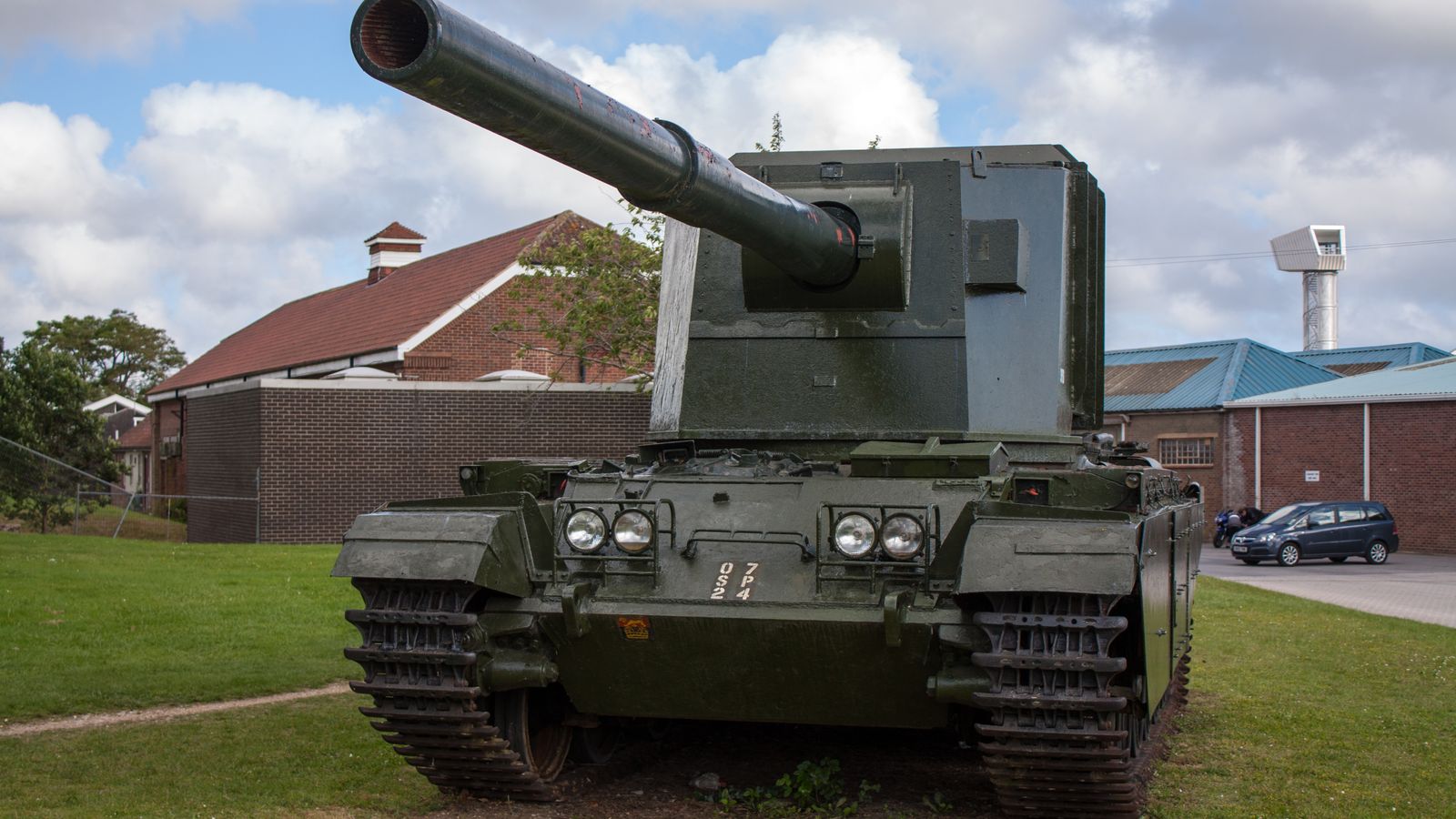
Our next weird tank is the FV4005. This was weird for one reason: its absolutely enormous 183mm cannon. Designed in the early 1950s, it was a machine with a single purpose: to destroy the latest Soviet heavy tanks, such as the IS-3 and T-10.
The FV4005 was an interim tank. The British were absolutely terrified of having to face those new Soviet heavy tanks if the Cold War went hot, and so, they needed a tank with a big cannon, and they needed it now.
With this in mind, it was built on the chassis of the readily available Centurion tank, one of the most successful British post-war tank designs. This chassis remained unchanged, but the turret on top of it received a total redesign to accommodate the new cannon. This turret was enormous – big enough to have a full-sized door in the rear.
But don’t let its size fool you into thinking it was well protected, because in reality it had very thin armour of just 14mm. This thickness was just enough to defeat rifle fire and shrapnel, but it would have been useless against any serious cannon. This thin armour was very intentional however, as the extreme firepower and range of the FV4005 meant that it would rarely have come under fire - it was intended to simply sit at great (and safe) distances, knocking out tanks at its leisure.
In testing the FV4005 performed like a dream: its cannon destroyed everything put before it with ease, and the venerable Centurion chassis upon which it was based proved reliable. Yet, despite this success, the FV4005 never entered service… why?
Primarily, this was because big guns were becoming obsolete. Sure, the FV4005 was a very effective tank killer, but a new technology had emerged that could do its job at a significantly cheaper cost and in a much more compact package… the anti-tank guided missile. These have a longer range and are more accurate than cannons, and can be mounted on a greater variety of vehicles – making them seem like a much more sensible choice for heavy tank hunting.
Considering this realisation, there was simply no need for the FV4005, regardless of how well it might have completed its assigned task, and so, it was unceremoniously cancelled in 1957.
The Independent
Watch the Video
Open Video
Video Briefing
5 Weird British Tanks
For our next weird tank, we must wind the clock back to the 1920s - back to that magical time when the standard form of a tank had yet to be finalised, and as a result all sorts of weird and wacky designs emerged… where we find this, the Independent.
Like the TOG II, the independent was a breakthrough tank intended to spearhead assaults on heavily fortified enemy positions. So far this sounds quite normal doesn’t it? Its aim was indeed pretty orthodox, what made it weird was how it went about achieving this task – a little design feature that the eagle eyed amongst you might already have spotted… its five turrets.
These turrets varied in size, and each served a specific purpose. Central to the tank sat a large main turret housing a 47mm gun, and surrounding it on each corner were four more modestly sized secondary turrets each housing a 7.7mm machine gun. This configuration allowed the Independent to take on a heavy target (such as a tank or bunker) with its main cannon and fend off attacking infantry with its machine guns all at the same time.
All this firepower naturally made the Independent rather heavy, weighing in at 32 tons. This is nothing compared to some of the tanks we’ve already covered of course, but for the time this was simply enormous. But surprisingly, the Independent was no slouch, and was able to reach a top speed of 32 km/h. Every rose has its thorn however, and for the Independent, its impressive speed and firepower came at the cost of its armour, which was only 28mm thick at its greatest point.
Ultimately, despite its innovative design the Independent never saw active service. Its multi-turreted configuration, while ground-breaking, presented several challenges that contributed to its ultimate failure. The tank was expensive to produce and maintain, and its numerous moving parts and turrets created a multitude of potential points of failure. Additionally, the complex communication system required for the tank’s crew to coordinate the multiple turrets proved unreliable.
The Independent also failed because of changing tank philosophies in the interwar period, particularly among the British there was a shift towards lighter, more mobile tanks. This change in thinking rendered the Independent obsolete, as its sheer size and weight became significant drawbacks. Furthermore, the tank’s armour was simply not thick enough to be of use on the battlefield.
But while the Independent was a failure in and of itself, it did at least live on vicariously by inspiring other tank designs, chief among which was the Soviet T-28, which was a key component of the Red Army’s armoured forces in the 1930s. Soviet engineers found its multi turret design particularly intriguing, and liked the idea of being able to engage multiple targets at the same time, and so, the T-28 incorporated this concept into its design, featuring a main turret armed with a 76.2 mm gun, along with two smaller turrets equipped with machine guns. The T-28 also went on to actually be mass produced, making the Independent the one tank of the video that actually went on to have a direct impact in the real world.
The Praying Mantis
Now the tanks we have discussed so far have certainly been weird, but they have been weird primarily due to their absurdly ambitious scale – having much more armour, significantly greater firepower, and many more turrets than their contemporaries. For our final example let’s up the ante, and look at a machine which took the entire concept of what a tank should be, and threw it in the bin in favour of a radical new approach: The Praying Mantis.
But just what was the Praying Mantis we hear you cry! Let us answer that question with a question: have you ever found yourself in a tank, keen and eager to blow up your enemies, but gosh darn it, wouldn’t you know, someone has gone and put a giant wall between you and them? What are you meant to do, drive around the thing? Imagine such a scene, what a labour, what a chore, to throw your tank in reverse and move it - absolutely unacceptable. What you yearn for is some kind of contraption to raise your turret above the wall. But surely such a thing doesn’t exist? That’d be the preserve of science fiction! Well dream no more our hypothetical tank crew member, because the guys and gals at the County Commercial Cars Company had you covered with the Praying Mantis – a tank with a turret that could be raised over three metres to shoot over that pesky wall!
It was built on the chassis of a Bren Gun Carrier, a venerable lightly armoured utility vehicle from World War II. Very little of the donor vehicle remained however, as the entire mid-section of the vehicle was replaced with a long rectangular elevating section topped with a turret touting two Bren Machine Guns. This gave it modest, but acceptable firepower that could happily deal with infantry and soft targets. It being based on a Bren Gun Carrier also made it lightweight and mobile, with a top speed of approximately 48 km/h.
But despite its innovative design, it never saw active service. Only a single prototype was built, and it underwent a limited series of trials. These tests showed the basic premise to have promise, as it fulfilled its aim of firing over walls perfectly, but they also exposed a glaring issue… it was so top heavy that it fell over… a lot. Compounding this issue was the fact that it was simply too lightly armoured – a quick buzz of a German machine gun would have been enough to kill the crew.
As a result of these rather glaring flaws, it was deemed unsuitable for deployment, and was cancelled in 1944.
So, what can we take away from this? For sure the Praying Mantis’ unique, insect-like appearance leaves us with an interesting tank for us to ogle over in the present day. But what more insightful conclusion can we draw from its failure? If nothing else, it serves as a reminder of the importance of experimentation and adaptation in the ever-evolving landscape of military technology.
It also highlights the challenges of balancing innovation with practicality, showing that even the most unusual and imaginative creations can be held back if its radical features are poorly implemented.
Reflections
As peculiar as these tanks may appear at first glance, it is crucial not to dismiss them simply as oddities or failed experiments. To fully appreciate the ingenuity behind these unconventional designs, one must delve deeper into the historical context and the technological landscape that surrounded their development. Understanding the rationale behind these tanks provides us with a greater insight not only into the tanks themselves but also into the broader history of tank design and the evolution of military technology.
Just as biological evolution produces dead ends and failed concepts, technological evolution similarly experiences its share of missteps and detours. These instances, although never adopted, are nonetheless essential elements of the story. They demonstrate the iterative process of innovation, in which engineers and designers test the boundaries of what is possible and explore unconventional solutions to the challenges they face. In the case of these unusual tanks, their unique characteristics arose from attempts to address specific tactical or strategic needs, and thereby reflected the shifting priorities and concerns of military planners at the time.
For example, the Independent, with its multiple turrets, was a product of the interwar period when the concept of a “land battleship” seemed to be a plausible solution to breaking through heavily fortified enemy lines. The design may have ultimately proved impractical, but it serves as a valuable reminder of the mindset of military thinkers at the time and the uncertainties they faced in a rapidly changing world.
As for the Tortoise and the TOG II, they emerged from the chaos and destruction of World War II, a period in which the potential for heavy armour and powerful armament to turn the tide of battle was well recognized. The Tortoise, with its hulking frame and formidable gun, was a response to the need for a heavily armoured infantry support vehicle capable of withstanding anti-tank fire and demolishing enemy fortifications. The TOG2, on the other hand, was an ambitious attempt to create a truly massive tank that could dominate the battlefield with its sheer size and firepower.
The FV4005 was developed during the Cold War, a period characterized by rapid technological development, its enormous gun by no means being a failure, just simply being obsolete by the time it was ready for production.
These tanks also serve as important lessons for the modern era, as we continue to push the boundaries of technology and explore new solutions to the challenges we face. Just as the engineers and designers of the past were willing to take risks and pursue unconventional ideas, we must also be open to experimentation and the potential for failure in our quest for innovation.
For the Praying Mantis, it should be remembered as a testimony to the fact that there will always be designers who look at the established orthodox of the day and find it lacking, so as a result decide to forge their own path, challenge conventional wisdom, and dare to explore bold, uncharted territories. Sometimes this approach will produce something revolutionary… and other times it will produce a Praying Mantis.
Failures they might be, but that is no reason to overlook them!
Conclusion
In conclusion, the captivating stories of these five weird British tanks not only serve as intriguing spectacles for our curiosity but also offer valuable insights into the innovative spirit and unwavering determination of their creators. While it is easy to dismiss these tanks as mere oddities, we must not overlook the fact that there was solid logic and reasoning behind each of their designs. The designers sought to address specific needs and challenges on the battlefield, and their solutions, although unconventional, were grounded in a genuine desire to revolutionize the field of military technology.
As we reflect on the tales of the Independent, the Tortoise, the TOG II, the FV4005, and the Praying Mantis, we are reminded that innovation is often born from necessity and that even the most peculiar designs can be rooted in practical considerations. Though the battlefield ultimately proved these tanks to be less relevant than their creators had hoped, their existence remains an important testament to the power of human ingenuity and the courage to think outside the box. By examining the history of these weird British tanks, we not only satisfy our curiosity but also gain a deeper appreciation for the bold, eccentric spirit that has long defined this fascinating nation.
One more point to note before we close, if after today’s video you find yourself with the urge to go and see these weird tanks for yourself (and let’s face it why wouldn’t you!) you are in luck, because all but one of them survive to this day. The TOG II, Tortoise, Independent, and FV4005 can all be found in the Bovington Tank Museum in Dorset, England for your viewing pleasure!
Key Takeaways
- Britain’s eccentricity extends to military engineering, with unique tank designs reflecting the nation’s innovative spirit.
- The TOG II and Tortoise tanks were massive, heavily armored, but ultimately impractical due to slow speed and logistical challenges.
- The FV4005 tank’s large cannon was obsolete by the time it was ready, as anti-tank missiles became the preferred technology.
- The Independent tank’s multi-turret design was innovative but failed due to high costs, maintenance issues, and changing military strategies.
- The Praying Mantis tank’s unique design to shoot over obstacles was promising but flawed due to instability and light armor.
SideProjects Editors
The SideProjects editorial team researches, fact-checks, and structures explainers about the lesser-known tales, side narratives, and spin-offs behind major historical and contemporary subjects.
Frequently Asked Questions
What was the TOG II designed for?
The TOG II was designed to serve as a heavily armoured breakthrough tank capable of traversing the most difficult terrain and widest trenches during World War II.
What were the main issues with the TOG II?
The TOG II’s massive size and weight made it slow, difficult to manoeuvre, and an easy target for enemy forces. Its logistical challenges and the shift towards more mobile tanks in World War II also contributed to its failure.
What was the primary goal of the A39 Tortoise?
The A39 Tortoise was designed to serve as a heavily-armoured assault gun that could withstand hits and systematically demolish German bunkers.
Why was the FV4005 never put into service?
The FV4005 was never put into service because the emergence of anti-tank guided missiles made it obsolete. These missiles offered a cheaper, more accurate, and versatile alternative for heavy tank hunting.
What made the Independent tank unique?
The Independent tank was unique due to its five turrets, with a central main turret housing a 47mm gun and four smaller turrets each with a 7.7mm machine gun. This design allowed it to engage multiple targets simultaneously.
What was the main problem with the Praying Mantis tank?
The Praying Mantis tank was too top-heavy and prone to falling over. Additionally, it was too lightly armoured, making it vulnerable to enemy fire.
Where can these weird British tanks be viewed today?
All but one of these weird British tanks survive to this day and can be found in the Bovington Tank Museum in Dorset, England.
What was the primary reason for the failure of the Independent tank?
The Independent tank failed due to its complex and expensive design, unreliable communication system, and the shift towards lighter, more mobile tanks in the interwar period.
What was the significance of the Tortoise tank’s armour?
The Tortoise tank had exceptionally thick armour, with 225 mm at the front, 102 mm on the sides, and 51 mm at the rear. This was intended to make it highly resistant to enemy fire, especially when used as a bunker buster.
What was the purpose of the FV4005’s enormous cannon?
The FV4005’s 183mm cannon was designed to destroy the latest Soviet heavy tanks, such as the IS-3 and T-10, during the early Cold War period.