In highly pressurized situations such as global warfare, victory can turn on the smallest advantage so the ability to learn from past mistakes and adapt quickly is crucial. In World War 2, Operation Overlord heralded the beginning of the end of the war when the Allies landed on the beaches of Normandy on the 6th of June 1944 and started their invasion of Europe. Hitler had anticipated a coastal invasion and had constructed his Atlantic Wall, fortifying the coastline from Norway to France.
Thanks to some colorful and stubborn characters thinking outside of the box, the Normandy landings were a success. This was due in no small part to a collection of unusual, modded-out tanks produced under the command of Major General Percy Hobart. This is the story of those tanks, also known as Hobart’s Funnies.
Lessons from Dieppe
In order for the Normandy beach assaults to be successful, the Allies had to learn lessons from the disastrous attack on the port of Dieppe in 1942. This was intended to be a pre-cursor to a full-on invasion, testing the waters and gathering intelligence. Unfortunately the amphibious attack was a total failure with tanks stuck on the beaches, unable to help the infantry and the Luftwaffe taking out many more of the RAF’s planes than anticipated. Within hours, every tank was disabled and nearly 60% of the Allied troops were dead, wounded or captured with the rest forced to withdraw.
Key Takeaways
- The Normandy landings success was partly due to specialized tanks called Hobart’s Funnies.
- The Allies learned from the Dieppe failure to improve artillery and tank mobility.
- Major General Percy Hobart led the 79th Armoured Division, creating over 7000 modified tanks.
- Hobart’s Funnies included tanks like the DD tank, which could float and support infantry.
- The Churchill AVREs and other specialized tanks played crucial roles in breaching Hitler’s Atlantic Wall.
It was decided that for future attacks, artillery would have to be improved to get through the reinforced German defenses and tanks would need some sort of help travelling over the inconsistent terrain. How to get the tanks to the beaches was also an issue. This was solved by the Mulberry Harbours, prefabricated artificial harbours towed out in pieces and assembled off the Normandy coast.
These would be able to provide shelter for supply ships and meant the Allies wouldn’t have to try capturing a port again. Realizing the advantages a specialized armoured division could bring, the UK’s 79th Armoured Division was created in August 1942 with Major General Percy Hobart in charge.
Percy Hobart
Percy Cleghorn Stanley Hobart was an expert in tanks and armored warfare, having started working in the Royal Tank Corps in 1923. His ideas about tank warfare were so good that his fans included German general Heinz Guderian, an early proponent of Germany’s “blitzkreig” style, who studied translated versions of his reports. Hobart became a Major General in 1937 but due to personality clashes and seemingly unusual ideas about armored warfare, by 1940 he had been pushed out altogether into early retirement.
Never one to keep still, he busied himself keeping the village of Chipping Campden safe as Lance Corporal of the Local Defence Volunteers, the O.G. Home Guard. In the run up to a new plan to land troops in France, Winston Churchill was made aware of Hobart’s situation and emphatically backed him to return and lead a new armored division.
He wrote a note that ended “This is a time to try men of force and vision, and not be confined exclusively to those who are judged thoroughly safe by conventional standards.” This was Percy Hobart to a T and in 1942 at the age of 57 he was reinstated and given command of the 79th Armored Division.
Hobart’s Funnies
It was clear to Hobart that normal tanks just wouldn’t cut it. They had got bogged down on the Dieppe beaches and overall had been pretty ineffective. His tanks would be different.
While some of the ideas for his collection of “funnies” were already in use, Hobart innovated, modified and mass-produced tanks to provide them with additional functions above and beyond those of just armored artillery. Using readily available Sherman and Churchill tanks as the base units, the 79th division ended up creating over 7000 funnies during the course of the second world war. They didn’t operate together as one unit but were attached to lots of other units during battles, spreading their engineering expertise and tactical advantages across a much wider area.
One of the most ingenious tanks was the Duplex Drive or DD tank. This was a tank that could float. Yes, really.
Watertight canvas screens were fitted to Sherman tanks and provided enough buoyancy that the vehicles could float and, on calm waters, could be launched from a couple of miles from shore. The duplex drive meant that the engine powered a propeller in the water and then the tracks once the tank made land. Once the canvas housing was dropped, the tank could function as normal.
These tanks provided invaluable support to the landing infantry and was the only one of Hobart’s designs that was used by the Americans on D-Day, the other designs not coming across as useful enough. Unfortunately for the American forces though, the weather on the 6th of June was bad causing larger waves than the tanks could really handle. While the Canadians and British changed tack and launched theirs closer to the shore to give them the best chance, the Americans launched theirs more than two miles out, causing them to be swamped by the waves and resulting in one battalion losing 27 of their 29 tanks almost immediately.
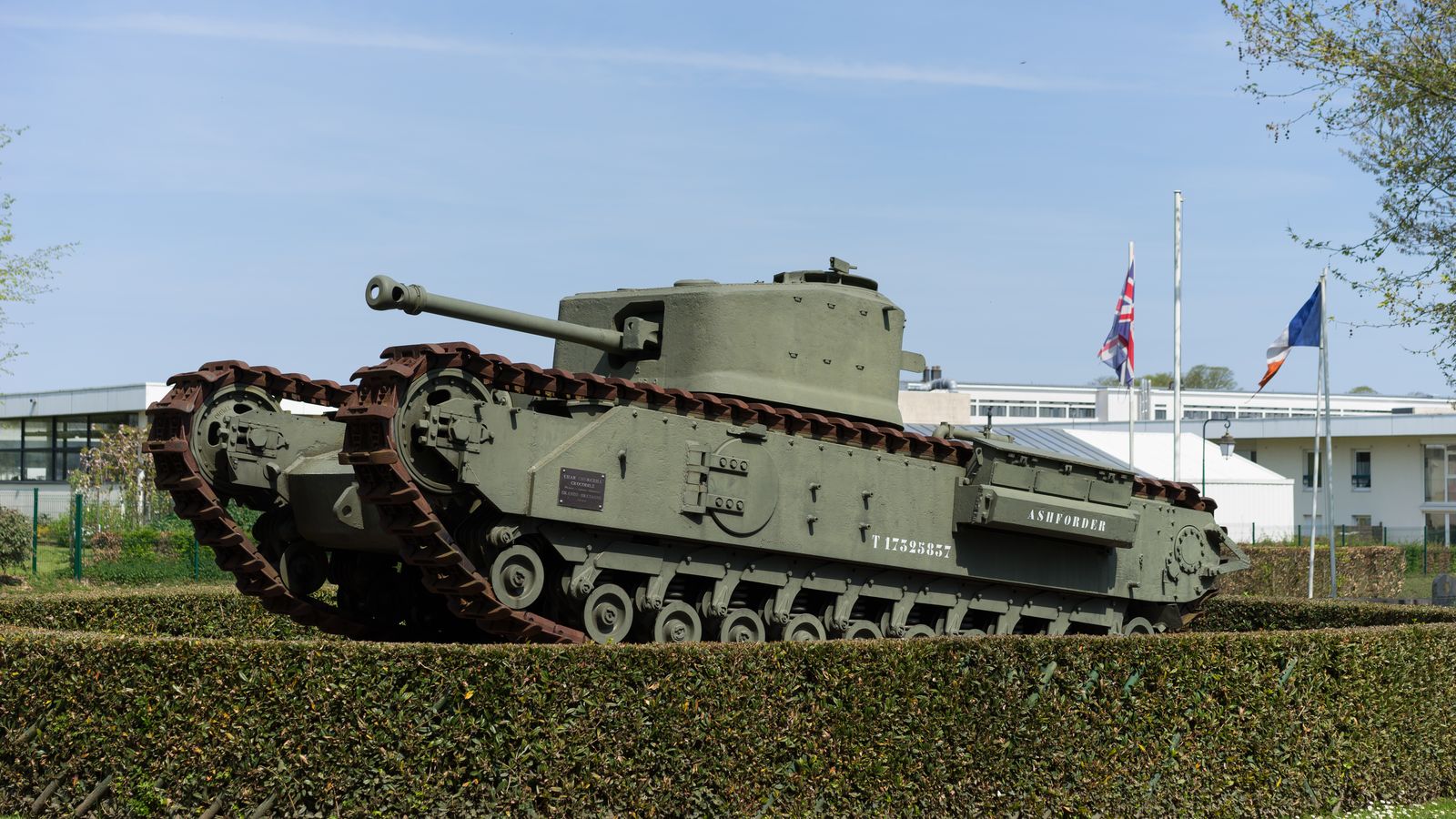
Once the attack was underway, it was time for more of Hobart’s funnies to shine. But how to overcome the previous issue in Dieppe of tanks sinking into the ground? Enter the Churchill AVRE Bobbin, a benign-sounding name for a tank that’s literally laying the groundwork for the enemy’s demise. The Churchill AVREs which stands for Assault Vehicle Royal Engineers played multiple roles in the Normandy landings.
The aforementioned Bobbin was a tank with a 10ft (3m) wide canvas roll on the front which it could lay down like a white carpet of doom allowing itself and any following vehicles safer passage across loose ground.
If there was a trench coming up, the Churchill AVRE Fascine Carrier was the tank for the job. Using a bridging trick that’s been around for millenia, it carried and dumped a large bundle of sticks bound with wire into the gap, creating a way over. Another bridging tank was the Small Box Girder or SBG Bridge Layer. A bridge was carried on the front of the tank which it could lay down to span gaps of up to 30ft (9m) within half a minute.
There was also the Armoured Ramp Carrier or ARK. This was a Churchill tank without a turret that had extendable platforms on either end. The two ramps could be raised and lowered and the whole thing could be parked up next to a wall and driven over as a makeshift ramp for other vehicles.
In addition to these extra functions, the AVREs could also be fitted with a petard mortar which could lob huge 18kg (40lb) projectiles, affectionately known as “flying dustbins” which were capable of destroying concrete bunkers and blockades from 150 yards (137m) away.
If all this wasn’t enough, two of the most formidable members of Hobart’s menagerie were the Crab and Crocodile tanks. The Crab was a modified Sherman tank with chain flails on a cylinder at the front which could rotate at up to 140 rpm. These flying chains would strike the ground and blow up any mines in the tanks path, leaving a safe trail for soldiers and vehicles to follow. It could also use the flail to beat down other obstacles such as barbed wire and when not using it, the tank could still function as a normal tank and fire its gun.
The Crocodile was a Churchill tank but instead of a normal gun, it had possibly the coolest weapon of all time, a freaking flamethrower. It could blast fire across a range of 120 yards (110m) and used a special fuel, carried behind in an armored trailer, that allowed the fire to stick closer to the ground so it would actually burn down into trenches instead of just blasting over the top of them. It was so terrifying, in fact, that even a few practice blasts could sometimes be enough to clear the enemy from an area.
Watch the Video
Open Video
Video Briefing
Hobart's Funnies: D-Day's Weird and Wonderful Tanks
Hobart and the 79th Armored Division also developed a few extra funnies that were used in later stages of the war, the most top-secret of which was the Canal Defence Light or CDL. Even the name was a bit of a bluff to keep it on the down-low. The CDL was a carbon-arc searchlight housed in a modified turret that could be fitted onto a variety of tanks.
The CDL was capable of producing a dazzling beam of light to pick out enemies during night missions while also temporarily blinding them. The large beam of light was engineered to come out of only a small slit in the tank’s turret, thus making it a difficult target to hit.
The Buffalo LVT (Landing Vehicle Tracked) also played a role in the campaigns following D-Day. Another amphibious vehicle, it was not heavily armoured but light and fast enough to be hugely useful in transporting supplies, personnel and small vehicles across bodies of water.
Thanks to Percy Hobart’s ingenuity and unflagging championing of armoured warfare, his unconventional tanks were one of the main reasons the Normandy beach landings were successful, especially on the Canadian and British beaches. Hitler’s Atlantic wall was breached in a matter of hours, allowing the Allied troops to start their advance into France. The funnies were used to great effect in many other campaigns throughout the remainder of the war and some Churchill AVREs were still seeing combat action into the 1960s. Hobart retired again in 1946 and died in 1957 with his “funnies” having made a contribution to the second world war that was certainly no laughing matter.
Key Takeaways
- The Normandy landings success was partly due to specialized tanks called Hobart’s Funnies.
- The Allies learned from the Dieppe failure to improve artillery and tank mobility.
- Major General Percy Hobart led the 79th Armoured Division, creating over 7000 modified tanks.
- Hobart’s Funnies included tanks like the DD tank, which could float and support infantry.
- The Churchill AVREs and other specialized tanks played crucial roles in breaching Hitler’s Atlantic Wall.
SideProjects Editors
The SideProjects editorial team researches, fact-checks, and structures explainers about the lesser-known tales, side narratives, and spin-offs behind major historical and contemporary subjects.
Frequently Asked Questions
What were Hobart’s Funnies?
Hobart’s Funnies were a collection of unusual, modified tanks produced under the command of Major General Percy Hobart. They were designed to overcome specific challenges faced during amphibious landings and other battlefield scenarios.
What was the significance of the Dieppe raid?
The Dieppe raid in 1942 was a disastrous amphibious attack that highlighted the need for improved artillery, better tank mobility, and specialized armored vehicles. It served as a crucial learning experience for the Allies before the Normandy landings.
Who was Percy Hobart?
Percy Cleghorn Stanley Hobart was an expert in tanks and armored warfare. He commanded the 79th Armoured Division, which developed the Hobart’s Funnies. Despite being pushed into early retirement due to personality clashes, he was reinstated by Winston Churchill to lead the division.
What was the Duplex Drive (DD) tank?
The Duplex Drive tank was a Sherman tank modified to float using watertight canvas screens. It could be launched from a couple of miles from shore and use its engine to power a propeller in the water and then tracks once on land.
What was the Churchill AVRE Bobbin?
The Churchill AVRE Bobbin was a tank that carried a 10ft wide canvas roll on the front, which it could lay down to create a safer passage across loose ground for itself and following vehicles.
What was the Crab tank?
The Crab tank was a modified Sherman tank with chain flails on a cylinder at the front. These flails could rotate at up to 140 rpm to detonate mines and clear obstacles, leaving a safe trail for soldiers and vehicles.
What was the Crocodile tank?
The Crocodile tank was a Churchill tank equipped with a flamethrower that could blast fire across a range of 120 yards. It used a special fuel carried in an armored trailer to burn down into trenches.
What was the Canal Defence Light (CDL)?
The Canal Defence Light was a carbon-arc searchlight housed in a modified turret that could be fitted onto various tanks. It produced a dazzling beam of light to pick out enemies during night missions and temporarily blind them.
What role did the Buffalo LVT play?
The Buffalo LVT (Landing Vehicle Tracked) was an amphibious vehicle used to transport supplies, personnel, and small vehicles across bodies of water. It was light and fast, though not heavily armored.
How did Hobart’s Funnies contribute to the success of the Normandy landings?
Hobart’s Funnies provided specialized functions that addressed specific challenges faced during the landings, such as floating tanks for amphibious assaults, mine-clearing tanks, and flamethrower-equipped tanks for clearing trenches. These innovations were crucial in breaching Hitler’s Atlantic Wall and advancing into France.